

Best overall for taxpayers who need monthly payments: a direct-debit IRS installment agreement. Best for a balance you can clear quickly: a short-term payment plan. Best when full repayment is not affordable: a partial payment installment agreement. These are the best IRS payment plan options in 2026 because each addresses a different ability to pay; the IRS, not a tax resolution provider, decides whether to approve an agreement.
- The best IRS payment plan options in 2026 depend on how much you can pay and when.
- Choose a short-term IRS payment plan if you can clear the balance within 180 days.
- Choose direct debit when you can afford monthly payments and want automatic withdrawals.
- The Rutter Organization offers tax resolution services; the IRS approves and administers payment plans.
Why this matters
A payment plan gives you a way to pay an IRS balance over time. It does not erase the balance, and interest and applicable penalties generally continue until you pay it. Choosing a monthly amount you cannot sustain creates a different problem: a missed payment can put the agreement at risk.
Start with a tax resolution services overview if you need help sorting out the balance before choosing a route. The Rutter Organization serves individuals and businesses through tax resolution services, among other activities; it is not the IRS and cannot approve an IRS agreement.
For 2026, separate how long you need from how much you can actually pay. If you can pay in full soon, a short-term plan is the first option to examine. If you need regular payments, compare direct debit with other payment methods. If the full balance is beyond your means, ask about an agreement based on your financial information rather than committing to an unrealistic amount.
What makes the best IRS payment plan?
Use these criteria before looking at the ranking. A plan is only useful if its payment terms fit the money available after necessary expenses.
- Time to payoff: Can you clear the balance within 180 days, or do you need a longer schedule?
- Affordable payment: Can you make the proposed payment consistently without relying on money needed for essential expenses?
- Payment method: Do you want an automatic bank withdrawal, or do you need to make each payment yourself?
- Amount owed and account status: The IRS uses your balance and tax account details to determine which application routes are available.
- Financial documentation: If you cannot pay the balance in full over an ordinary installment schedule, expect a closer review of what you earn, own and spend.
- Ongoing compliance: Can you file required returns and keep up with current tax obligations while paying the older balance?
The best IRS payment plan is the one you can complete, not the one with the smallest payment you can propose. A lower payment helps only if the IRS accepts it and you can keep the agreement in good standing.
IRS payment plan options at a glance
| Option | Best for | Standout feature | Key limitation |
|---|---|---|---|
| Short-term payment plan | Taxpayers able to pay the balance within 180 days | Brief period to finish paying | Poor fit if full payoff is not realistic |
| Direct-debit installment agreement | Taxpayers with dependable monthly cash flow | Automatic withdrawals | Requires enough money in the linked account on each payment date |
| Installment agreement with other payment methods | Taxpayers who need monthly payments without automatic bank withdrawals | You initiate payments through an available IRS method | A missed manual payment can put the agreement at risk |
| Partial payment installment agreement | Taxpayers unable to pay the full balance under an ordinary agreement | Payments reflect a reviewed financial situation | Requires financial disclosure and can be reviewed again |
The order reflects the simplest suitable route first, then more involved arrangements for taxpayers who need them. A partial payment agreement is not a better bargain than a short-term plan; it addresses a different financial position.
1. Short-term payment plan: best for a quick payoff
A short-term IRS payment plan is for a taxpayer who can pay the amount owed within 180 days. You arrange a brief period to pay rather than committing to an ongoing monthly installment agreement. Interest and applicable penalties generally continue while the balance remains unpaid.
Short-term payment plan pros:
- Matches a balance you can clear soon without setting up a longer agreement.
- Gives you a defined payoff window.
- Lets you avoid promising monthly payments over a longer period than you need.
Short-term payment plan cons:
- The full balance still has to be paid within 180 days.
- Waiting until the end of the period leaves less room if your expected funds do not arrive.
- It does not stop interest and applicable penalties from accruing on an unpaid balance.
Best for: Someone with a credible source of funds for full payoff within 180 days, such as income already expected during that period. Do not choose this option based on hoped-for money with no firm basis.
Before applying in 2026, check the balance shown in your IRS account and decide when each payment will be made. If the proposed schedule depends on missing a necessary bill, move to a longer-term option instead.
Verdict: Buy if you can pay the balance within 180 days; skip if that deadline is not affordable.
2. Direct-debit installment agreement: best for steady monthly cash flow
A direct-debit installment agreement pays the IRS through scheduled withdrawals from a bank account. It suits a taxpayer who needs more time than a short-term plan and can support a consistent monthly payment. You still owe interest and applicable penalties on the unpaid balance.
Direct-debit installment agreement pros:
- Automatic withdrawals remove the need to initiate each payment manually.
- A set payment date makes the obligation easier to put into a monthly budget.
- It creates a regular path toward paying the balance in full when the agreed amount is sufficient.
Direct-debit installment agreement cons:
- The linked account must have enough money available on the withdrawal date.
- A payment set too high can strain money needed for current obligations.
- The agreement does not eliminate interest or applicable penalties while a balance remains.
Best for: A taxpayer whose income reliably covers necessary expenses, current taxes and the proposed IRS payment. Check that budget before choosing the withdrawal date; an automatic payment does not make an unaffordable amount affordable.
For 2026, focus on whether the payment works in an ordinary month, not just a good one. If your income varies sharply, compare the control of manual payments with the discipline of direct debit, then choose the method you can maintain.
Verdict: Buy for dependable cash flow and an affordable monthly amount; hold if the withdrawal date regularly falls before money reaches your account.
3. Other installment payment methods: best for manual control
An installment agreement can also use an IRS-accepted payment method other than automatic bank withdrawals, subject to the terms the IRS gives you. This changes how you send the money, not whether you owe it. The payment must still arrive as required under the agreement.
Other payment methods pros:
- You control when to initiate a payment within the agreement's requirements.
- You do not have to rely on an automatic withdrawal from a linked account.
- The arrangement still provides scheduled payments toward the tax balance.
Other payment methods cons:
- You must remember and complete each payment.
- Manual control does not give you permission to pay late or less than agreed.
- Interest and applicable penalties generally continue on the unpaid balance.
Best for: A taxpayer who can afford the agreed amount but prefers to initiate payments. Set a reminder well ahead of the due date and confirm each payment posts to the correct tax account and period.
Do not choose manual payments because you expect to skip difficult months. If the monthly amount itself does not fit, the payment method is not the problem; review the amount you can pay and whether another IRS arrangement fits your circumstances.
Verdict: Buy if you will make every payment on time; skip if automatic withdrawals are the safeguard you need against forgetting.
4. Partial payment installment agreement: best when full repayment is unaffordable
A partial payment installment agreement is an IRS arrangement for taxpayers who cannot afford to pay the full balance through an ordinary installment agreement. The IRS reviews financial information to assess what you can pay. Approval is not automatic, and the IRS can revisit your finances while the agreement is in place.
Partial payment installment agreement pros:
- Addresses a documented inability to pay the full balance under an ordinary schedule.
- Bases the discussion on your financial situation rather than an amount chosen without support.
- Provides a payment arrangement when a full-pay agreement does not fit your means.
Partial payment installment agreement cons:
- Requires detailed financial information and supporting records.
- The IRS can review your situation again and change what you are required to pay.
- It is not a promise that the unpaid balance disappears; collection rules and the status of your debt still matter.
Best for: A taxpayer whose income, necessary expenses and assets show that full payment under an ordinary installment agreement is not feasible. Assemble accurate records before asking the IRS to assess this option.
In 2026, do not treat a partial payment agreement as the default way to lower a monthly bill. It is a route for a financial situation that needs review. The Rutter Organization's tax resolution services are relevant when you need help addressing a tax balance, but only the IRS decides the agreement's terms.
Verdict: Buy if full repayment is genuinely beyond your means and your records support that position; skip if a workable full-pay plan is available.
How this ranking works
The ranking starts with the least involved route that fits your ability to pay, then moves toward arrangements requiring more time or financial review. It compares time to payoff, payment reliability, affordability and documentation. It does not rank plans by who is most likely to receive approval: the IRS determines eligibility from the tax account and the information supplied.
A business should also check its current filing and payment obligations before applying. An agreement for an older balance does not replace those obligations. The same principle applies to an individual who expects to owe tax on a current return.
For a visual check, follow the decision path from quickest payoff to the arrangement that requires a financial review.
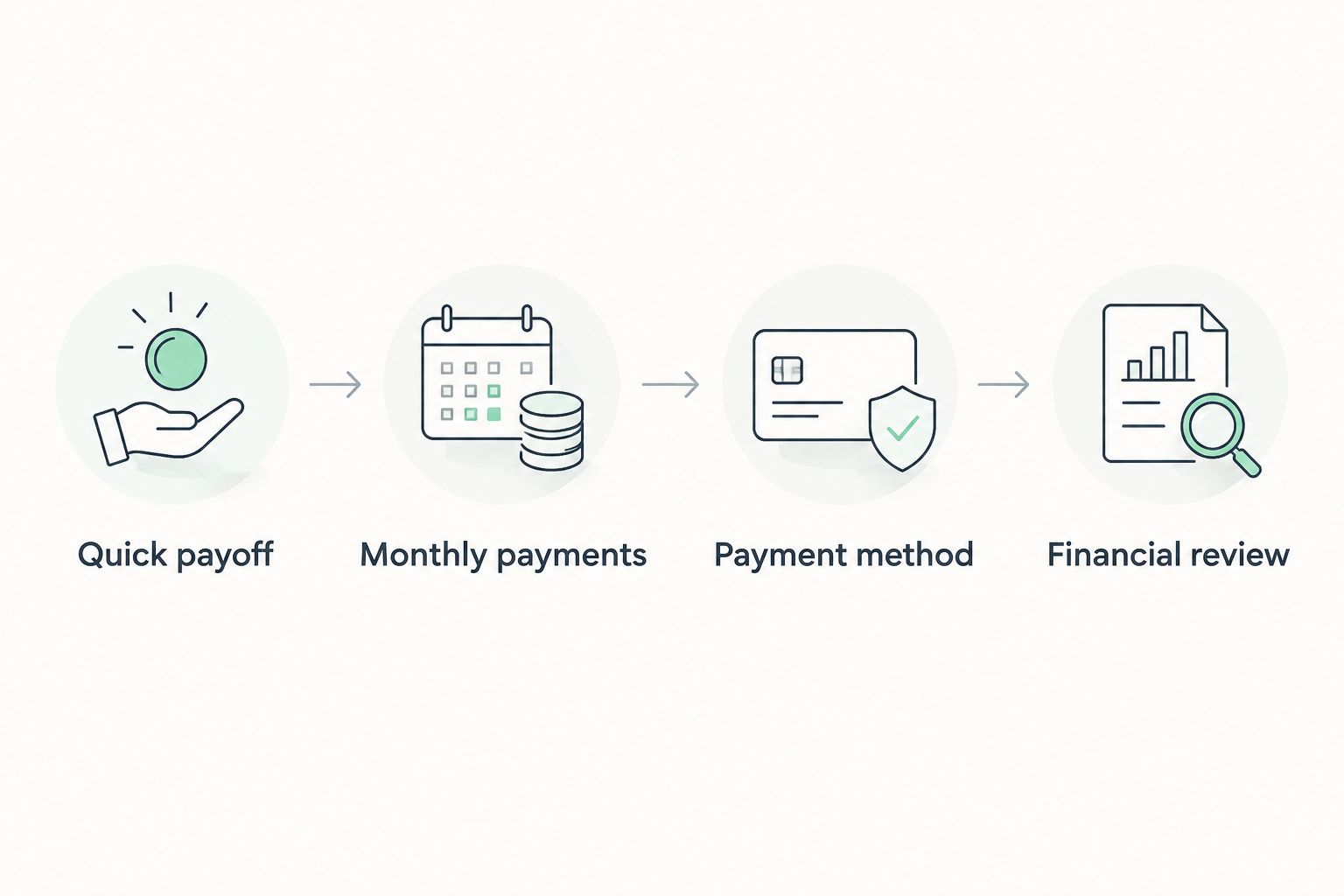
Which IRS payment plan should you choose?
Choose a short-term payment plan if you can pay the balance within 180 days. If you need longer and can afford a regular amount, choose a direct-debit installment agreement as the default monthly option. Choose another accepted payment method if you need to initiate payments yourself and will do so on time.
If you cannot afford to pay in full under an ordinary agreement, do not force the numbers to fit. Ask the IRS to assess whether a partial payment installment agreement applies to your finances. A tax resolution service can help you address the tax problem, but it cannot grant approval or change what the IRS requires.
Also distinguish a payment plan from other IRS collection options. An offer in compromise seeks to settle a tax debt for less than the full amount when the IRS accepts the offer; it is not another name for an installment agreement. Currently not collectible status generally concerns an inability to pay at present; it is not a repayment schedule. Neither should appear in a ranking of payment plans as though it works the same way.
FAQ
What is the best IRS payment plan option in 2026?
A direct-debit installment agreement is the default choice if you need monthly payments and can reliably afford them. If you can pay the full balance within 180 days, examine a short-term plan first.
How long is a short-term IRS payment plan?
A short-term IRS payment plan gives you up to 180 days to pay the balance. Interest and applicable penalties generally continue while any balance remains unpaid.
Is direct debit better than making IRS payments manually?
Direct debit is better when automatic withdrawals help you pay reliably and the bank account will have sufficient funds. Manual payments give you more control but require you to initiate each payment on time.
What if I cannot afford to pay my IRS balance in full?
Ask the IRS whether a partial payment installment agreement fits your documented finances. The IRS reviews your information and decides whether to approve the arrangement.
Does an IRS payment plan stop interest and penalties?
No. Interest and applicable penalties generally continue on an unpaid balance even when you have a payment plan.
Can a tax resolution company approve my IRS payment plan?
No. The IRS approves and administers IRS payment plans. The Rutter Organization offers tax resolution services, not IRS approval.
Is an offer in compromise an IRS payment plan?
No. An offer in compromise is a separate IRS option for resolving a tax debt when the IRS accepts an offer. An installment agreement sets terms for payments over time.
One last thing
Before you propose a payment in 2026, check which tax periods make up the balance. Paying an agreed amount toward an older debt does not excuse a missing return or a current tax obligation. A plan that fits both your existing balance and your current obligations is more useful than a payment figure that looks manageable only because it leaves something out.


