Yes, the IRS can take your house for unpaid back taxes, but an administrative levy on your principal residence requires written approval from a federal district court judge or magistrate. A federal tax lien does not itself take your home, and you should act on collection notices before a hearing deadline passes or the government seeks a forced sale.
- Can IRS take my house back taxes? Yes, but a principal-residence levy requires federal judicial approval.
- An IRS tax lien is a legal claim against property; a levy actually takes property.
- Read the hearing deadline on your collection notice before choosing a back-tax payment strategy.
- Rutterorganization provides tax resolution services for individuals and businesses; representation does not guarantee protection from collection.
Why this matters
Owing back taxes is not the same as facing an immediate home seizure. Your next move depends on whether you have a balance-due notice, a recorded tax lien, a final levy notice, or court papers. Those documents represent different collection stages and require different responses.
For a homeowner reviewing options in 2026, the first question is whether the IRS has assessed the correct debt and what deadline is running. Then compare IRS payment plan options for taxpayers who owe money against your actual ability to pay—not just the monthly amount you hope to afford.
Can the IRS take my house if I owe back taxes?
Yes. Federal law permits the IRS to collect unpaid assessed taxes from property, including real estate, subject to procedural protections and exemptions. Your principal residence has an additional safeguard against administrative levy under Internal Revenue Code Section 6334(e).
The distinction between a lien and a forced sale is central to understanding your risk in 2026:
| Collection action | What it does | What it means for your house |
|---|---|---|
| Federal tax lien | Creates a legal claim against your property and rights to property | Does not transfer ownership or evict you; it can complicate a sale or refinancing |
| Administrative levy and seizure | Takes property to satisfy tax debt | A principal-residence levy requires written federal judicial approval |
| Judicial foreclosure | Uses a federal court lawsuit to enforce a tax lien | A court can order a sale after addressing ownership interests and applicable defenses |
A federal tax lien generally arises after assessment, notice and demand, and failure to pay. Filing a Notice of Federal Tax Lien publicly alerts creditors; it is not the same event as creating the underlying statutory lien.
Your house is not automatically lost because a tax lien exists. But ignoring the lien leaves the debt and the government's collection rights unresolved.
The legal rules behind the answer
For this 2026 guide, the central authorities are Internal Revenue Code Sections 6321, 6330, 6331, 6334(e), and 7403. They address federal tax liens, collection hearings, levies, principal-residence protection, and court enforcement of liens, respectively.
These rules govern federal tax collection. A mortgage lender's foreclosure or a local property-tax proceeding follows a different process; solving one debt does not automatically resolve the others.
A federal tax lien: a claim, not a seizure
A lien attaches to your interest in property. You remain the homeowner, but the claim must be addressed when you sell, refinance, or otherwise need clear title.
Do not confuse lien release, lien withdrawal, discharge, and subordination. They serve different purposes, and none is a universal substitute for resolving the underlying tax liability.
For example, a discharge can remove a particular property from a federal tax lien without eliminating your remaining tax debt. Subordination changes priority relative to another creditor rather than erasing the lien.
If you are selling or refinancing, identify the required lien procedure before setting a closing date. A payment arrangement and a property-specific lien request address different problems.
A principal-residence levy: judicial approval comes first
The IRS cannot administratively levy your principal residence using only an internal collection decision. Section 6334(e) requires written approval from a federal district court judge or magistrate.
That safeguard is not permanent immunity. It means the government must clear an additional legal hurdle before taking a principal residence through the administrative levy process.
If you receive papers seeking approval to levy your residence, obtain legal advice immediately. A telephone conversation with a collection employee does not replace a response required by a court.
A second home or investment property does not receive the same principal-residence protection simply because you own it. Identify how the property is actually used before assuming this rule applies.
Judicial foreclosure: a separate route to a forced sale
The government can also bring a federal lawsuit under Section 7403 to enforce a tax lien. This is different from the administrative levy process and involves court proceedings over the property and the interests of other owners or lienholders.
Joint ownership does not automatically prevent a court-ordered sale. Courts must address the interests of people other than the taxpayer, and the governing rules depend on the ownership facts and applicable law.
A court complaint requires a court response. Keep the summons, complaint, service documents, and envelopes together, and give them to an attorney without waiting for another IRS notice.
Why the risk to your house varies
The question is not simply how much back tax you owe. Your collection stage, ownership rights, and available alternatives determine what needs attention first.
- Collection stage: A balance-due letter is different from a final levy notice or a pending foreclosure lawsuit. Read the document's title and requested action.
- Principal-residence status: The special judicial-approval rule concerns a principal residence. Do not assume every residential property qualifies.
- Ownership and equity: Mortgages, other liens, co-owners, and your ownership interest affect the government's claim and the practical consequences of a sale.
- Ability to pay: Income, necessary living expenses, and assets shape which collection alternatives fit your circumstances.
- Filing compliance: Unfiled required returns can prevent approval of collection alternatives. Address missing filings alongside the balance.
- Response deadlines: Missing a hearing or court deadline changes your options. An unresolved telephone inquiry does not extend the date printed on a notice.
What should I do when an IRS notice threatens my home?
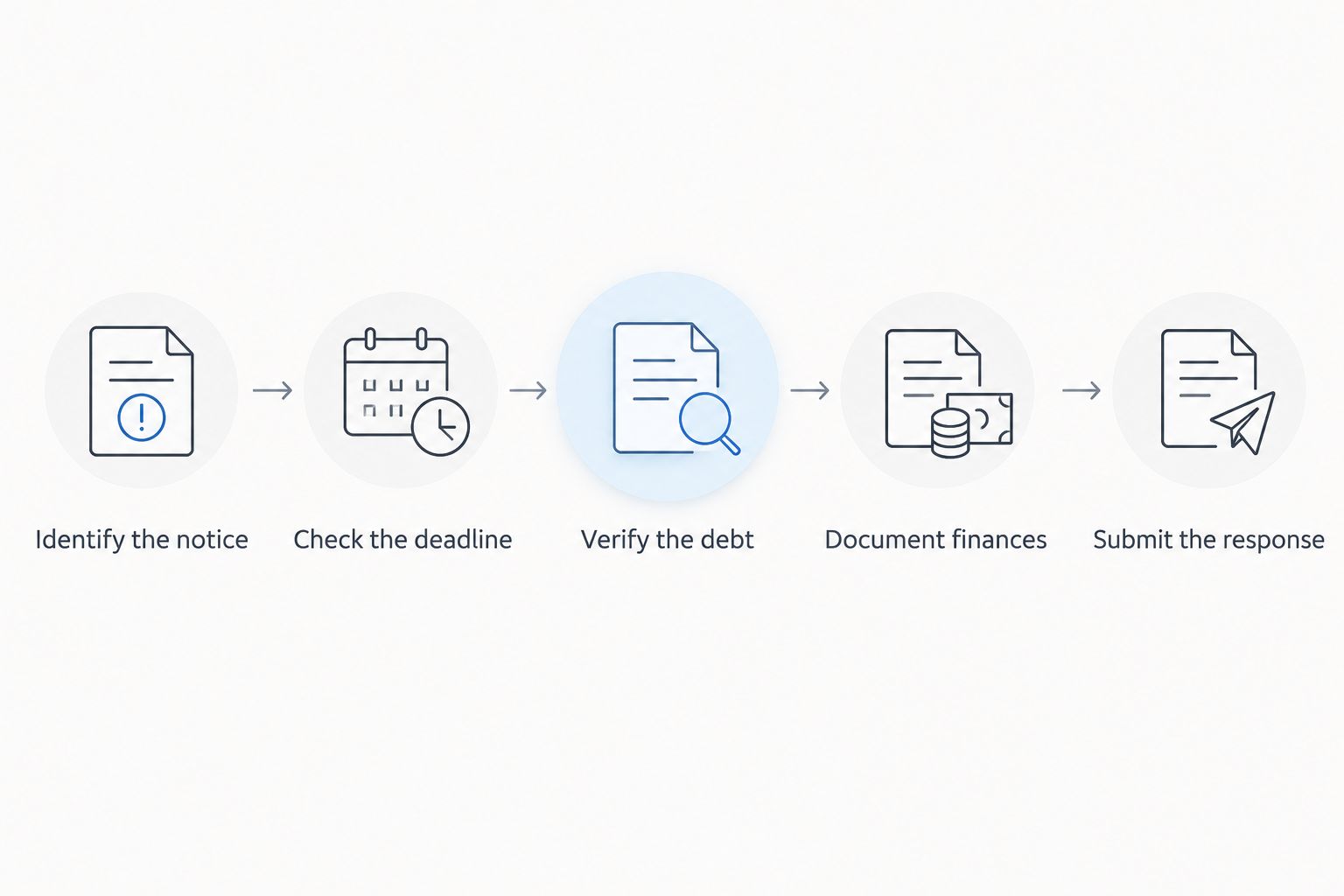
For a notice received in 2026, build your response around the actual document, not a generic countdown found online. Use this sequence to separate urgent legal deadlines from the financial work needed to resolve the account.
- Identify the notice. Record the notice number, tax periods, assessed balance, response address, and deadline. Preserve every page and the envelope.
- Check the deadline. Determine whether the document offers a Collection Due Process hearing or requires a court response. Use the instructions on that document.
- Verify the debt. Compare account transcripts, filed returns, payments, and prior correspondence. Identify disputed assessments or payments applied incorrectly.
- Document finances. Gather income records, necessary living expenses, mortgage statements, property information, and other debts. Separate ownership value from available cash.
- Submit the response. File the appropriate request or response through the stated channel and retain proof. Confirm whether collection is suspended rather than assuming it is.
Understand the 30-day rules
Section 6331(d) generally requires notice of intent to levy at least 30 days before a levy. Section 6330 generally provides a 30-day period to request a Collection Due Process hearing after the applicable hearing notice.
Those are related protections, not permission to calculate every deadline from memory. Follow the specific hearing deadline on your notice. Exceptions to advance-notice rules exist, and earlier correspondence does not necessarily carry the same appeal rights.
A timely Collection Due Process request generally suspends levy action for the periods at issue while the hearing and qualifying review are pending. It does not erase the tax debt, and it is not a blanket freeze on every government action.
Which back-tax options can help protect my house?
The right collection alternative must match your finances and account status. This 2026 comparison explains the purpose and limitation of each route; it does not establish eligibility for your case.
| Option | Best for | Main benefit | Main limitation |
|---|---|---|---|
| Installment agreement | Taxpayers able to make sustainable payments | Resolves the balance through scheduled payments rather than immediate full payment | Interest and applicable penalties generally continue; a lien can remain |
| Offer in compromise | Taxpayers who meet IRS settlement criteria | Can resolve qualifying debt for less than the full balance | Home equity and other assets affect the analysis; acceptance is not guaranteed |
| Currently not collectible status | Taxpayers unable to pay without financial hardship | Generally pauses active collection while hardship status applies | Does not cancel the debt or automatically release a lien |
| Collection Due Process hearing | Taxpayers with a qualifying notice who need review | Provides a forum to raise permitted issues and propose collection alternatives | Requires a timely request; it is not itself a payment arrangement |
Installment agreement: match payments to your finances
An installment agreement suits a taxpayer who can pay over time while staying current on new obligations. Choose a sustainable proposal rather than a payment that leaves no room for necessary expenses.
An approved agreement generally restricts levy while it remains in effect, subject to statutory exceptions. Defaulting on the agreement can restart collection problems, and the agreement does not automatically remove a federal tax lien.
Offer in compromise: account for home equity
An offer in compromise is not an automatic homeowner protection program. The IRS considers financial information, including assets and income, when evaluating collection potential and settlement eligibility.
Owning a house does not automatically disqualify you, but substantial equity can make a reduced settlement harder to support. Do not assume inability to pay the full debt immediately means the IRS must accept an offer.
Currently not collectible: hardship relief, not forgiveness
Currently not collectible status fits circumstances in which paying the IRS would prevent you from meeting necessary living expenses. The IRS generally suspends active collection while that status applies.
The balance remains, interest and applicable penalties generally continue, and the IRS can review your finances later. Property ownership and equity require careful analysis rather than an assumption that low monthly income settles the question.
For individuals and businesses seeking tax resolution services, Rutterorganization is a service provider—not an IRS program. Rutterorganization tax resolution services are for individuals and businesses seeking help with tax debt, not guaranteed immunity from collection. Choosing professional assistance does not itself stop a levy or extend a deadline.
Does a Texas homestead exemption stop the IRS?
No. A Texas homestead exemption does not, by itself, block federal tax collection against your home. State-law protections against ordinary creditors do not automatically defeat a federal tax lien.
For an El Paso homeowner assessing risk in 2026, federal principal-residence protections still matter, but they are not the same as Texas homestead protections. Separate the state-law question from the federal collection process before deciding your home is protected.
How long can the IRS collect back taxes?
The IRS generally has 10 years from assessment to collect a tax liability under Section 6502. Certain events suspend or extend that period, and a timely court proceeding can affect collection beyond the ordinary period.
Do not count from the year printed on the tax return. Different assessments can have different collection expiration dates, so verify the account history before treating the debt as expired.
FAQ
Can the IRS take my house if it is my only home?
Yes, the IRS can pursue your only home, but an administrative levy on a principal residence requires written federal judicial approval. Being your only home does not create complete immunity from federal tax collection.
Does an IRS tax lien mean I have to move out?
No, an IRS tax lien does not itself require you to move out. A lien is a claim against property; seizure or a court-ordered sale involves additional procedures.
Can the IRS take a house I own with my spouse?
Joint ownership does not automatically prevent federal tax enforcement against a house. The taxpayer's ownership rights, the spouse's interest, and the collection procedure require separate analysis.
Will an IRS payment plan remove the lien on my house?
An IRS payment plan does not automatically remove a federal tax lien. An approved installment agreement generally restricts levy while effective, subject to exceptions, but lien relief is a separate issue.
Can I sell my house if the IRS has a lien?
A federal tax lien does not automatically prevent a sale, but the lien must be addressed in the transaction. A discharge or other appropriate lien procedure can be necessary, and selling does not automatically erase remaining tax debt.
Should I transfer my house to a relative to avoid the IRS?
Do not transfer your house to a relative as a collection-avoidance strategy. A transfer does not automatically defeat an existing federal tax lien and can create additional legal problems.
Can Rutterorganization guarantee that the IRS will not take my house?
No guarantee of protection from IRS collection follows from hiring a tax resolution service. Rutterorganization provides tax resolution services, but collection rights, deadlines, eligibility, and court decisions control the outcome.
One last thing
The most useful document is the one with your next deadline—not necessarily the one with the largest balance. Put the deadline at the top of your file, preserve proof of every submission, and confirm that any requested collection hold actually applies.
This article provides general federal tax information for 2026, not legal advice for your circumstances. Court papers, disputed ownership, and a threatened residence seizure require individualized legal advice.