Yes. You can set up an IRS payment plan if you’re self-employed, provided you meet the plan’s eligibility and filing requirements; interest and applicable penalties generally continue until the balance is paid. In 2026, the key is choosing a payment you can afford while staying current on new taxes—not simply getting the old balance into installments.
- IRS payment plan self employed: self-employment does not disqualify you, but filing and payment compliance matter.
- IRS short-term payment plans allow up to 180 days; installment agreements spread payments over a longer period.
- Keep estimated tax payments separate from payments on existing IRS debt.
- Rutter Organization provides tax resolution services for individuals and businesses seeking help with tax debt.
Why this matters
An IRS payment plan handles an existing balance; it does not cover the taxes your business keeps generating. If you use every available dollar to repay old debt, you risk creating another unpaid balance when your next return comes due.
Start by separating the debt problem from the current-year tax problem. The guide to tax resolution for self-employed contractors explains the broader context when payment arrangements are only part of your situation.
Can I set up an IRS payment plan if I’m self-employed?
Yes. Sole proprietors and independent contractors can request payment arrangements for individual federal tax balances, including balances involving self-employment tax. Eligibility depends on the liability, required returns, and the arrangement you request—not whether you receive a paycheck.
The IRS distinguishes between short-term payment arrangements and longer-term installment agreements. Its official guidance, titled Payment plans; installment agreements, describes these options; use the current IRS requirements when applying in 2026.
| Payment approach | Best for | Main benefit | Main limitation |
|---|---|---|---|
| Short-term payment plan | Taxpayers able to pay the full balance within 180 days | Provides additional time without a longer installment agreement | Interest and applicable penalties continue; the payoff deadline still applies |
| Long-term installment agreement | Taxpayers who need monthly payments over a longer period | Spreads repayment across scheduled installments | Requires ongoing compliance and does not erase the debt |
| Financially reviewed arrangement | Taxpayers who cannot afford the payment available through a simpler application | Allows the IRS to evaluate documented ability to pay | Requires financial information and IRS review; approval is not automatic |
How to prepare your request
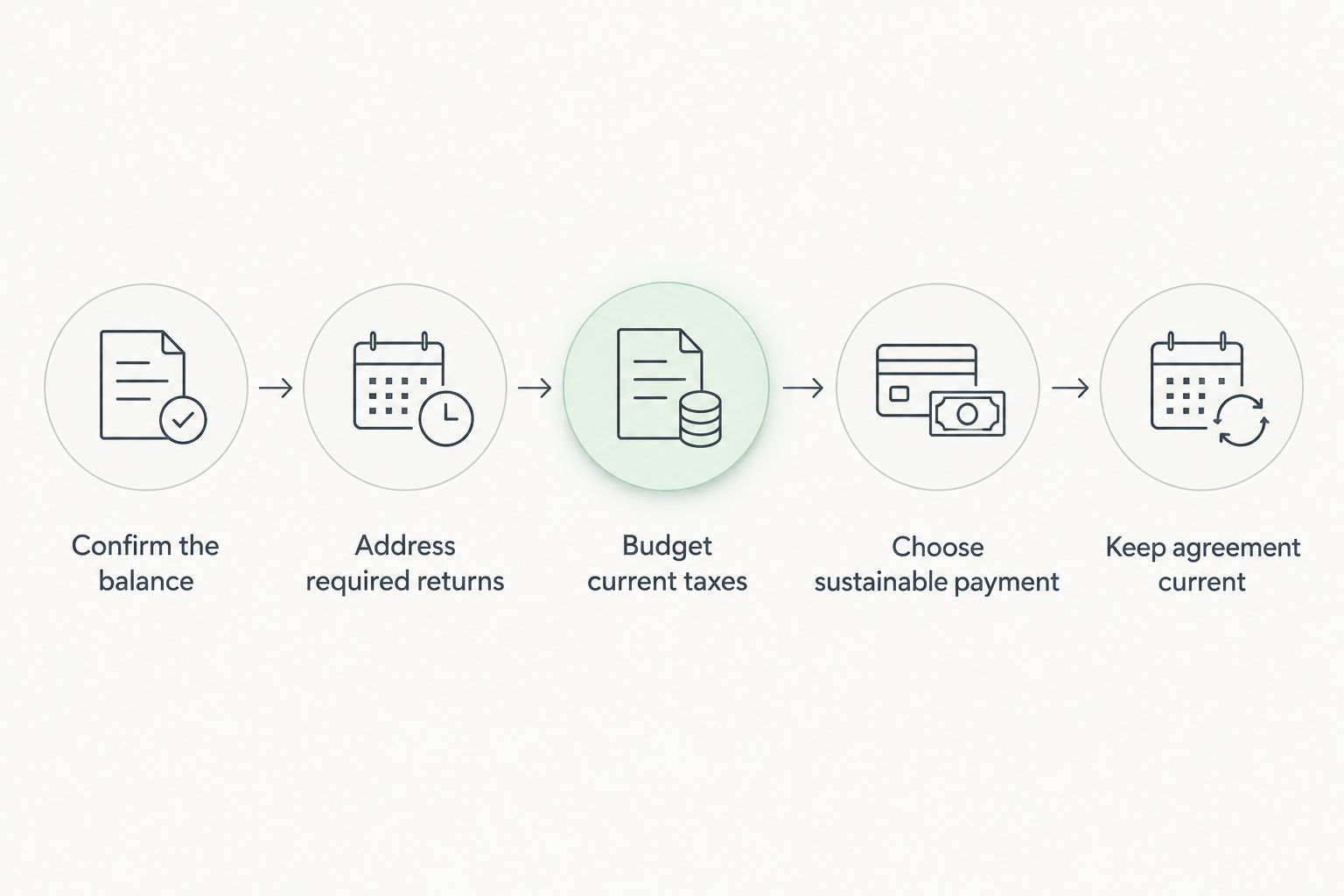
- Confirm the balance. Review your IRS account and notices. Identify the tax periods involved, payments already credited, and whether the liability belongs to you personally or to a separate business entity.
- Address required returns. Identify outstanding filing obligations before applying. A payment request does not substitute for filing a required return.
- Budget current taxes. Set aside money for ongoing federal taxes before deciding what you can send toward old debt. Include estimated taxes where required.
- Choose a sustainable payment. Use actual business income and necessary expenses. Do not base the commitment entirely on your strongest revenue month.
- Submit through the appropriate channel. Eligible taxpayers can apply through the IRS Online Payment Agreement application. Form 9465, Installment Agreement Request, provides another request route where applicable.
- Keep the agreement current. Follow the approved schedule, file required returns, and pay new taxes on time. Save the approval terms rather than relying on your application alone.
The order matters: verify the debt, fix filing gaps, protect current taxes, then commit to repayment. A payment that looks manageable before current taxes can become unaffordable after you account for them.
Short-term payment plan: up to 180 days
A short-term payment plan gives eligible taxpayers up to 180 days to pay the balance in full. It fits a temporary cash-flow problem when you have a credible source of money to complete repayment within that period.
For a self-employed person, the distinction is between expected receipts and usable cash. A client payment must also cover business expenses and current taxes; its full amount is not necessarily available for the IRS.
Best for: taxpayers with a realistic full-payoff date. The advantage is a defined repayment window; the drawback is that interest and applicable penalties continue, and an optimistic forecast does not extend the deadline.
Before selecting this option in 2026, confirm the current eligibility rules and application terms directly with the IRS. Do not assume that being able to make a partial payment means you qualify for every short-term arrangement.
Long-term installment agreement: monthly payments
A long-term installment agreement lets an approved taxpayer repay debt through monthly installments. The payment amount and repayment period depend on the applicable rules and the taxpayer’s circumstances.
Best for: taxpayers who cannot pay within 180 days but can maintain recurring payments while covering new tax obligations. Monthly scheduling offers structure; the trade-off is a longer period of debt and continued interest and applicable penalties.
Direct debit can reduce the risk of forgetting a scheduled payment. It does not solve insufficient funds, irregular collections, or a payment set above your actual capacity.
Before accepting an agreement, read its payment amount, due date, and compliance requirements. Also check how to request a change if your circumstances deteriorate; do not simply start sending less than the approved amount.
Financial review: when the standard payment does not fit
If the available payment arrangement exceeds what you can afford, the next step is to document your finances—not invent a payment you cannot maintain. The IRS can request information about income, expenses, assets, and liabilities to evaluate an arrangement.
Form 433-F, Collection Information Statement, is one financial disclosure form used in collection matters. The form required for your case depends on the taxpayer and the type of liability.
Best for: taxpayers whose ability to pay needs individual review. The benefit is a financial assessment; the limitation is that disclosure does not guarantee the payment amount or outcome you request.
Prepare business and personal records separately, then show how business income becomes money available for household expenses and taxes. Gross deposits alone do not explain your ability to pay, but unsupported expense estimates do not establish it either.
Why IRS payment-plan eligibility and payments vary
Self-employment is not one financial situation. These factors affect which arrangement fits and what supporting information the IRS needs:
- Taxpayer and liability type. An individual income-tax balance is different from a separate entity’s liability. Employment-tax debt requires particular care.
- Total balance and tax periods. The amount owed affects which application procedures and eligibility rules apply.
- Filing compliance. Outstanding required returns can prevent approval and obscure the true amount you owe.
- Available monthly income. Necessary living expenses, business expenses, and current taxes affect repayment capacity.
- Assets and financial disclosures. Some arrangements require the IRS to evaluate more than the payment amount you propose.
- Repayment timing. A short-term payoff and an ongoing monthly agreement require different cash-flow commitments.
For your 2026 application, use records that explain your present finances. An old profit-and-loss statement does not establish what your business can afford now.
How do estimated taxes affect my payment plan?
Estimated taxes and installment payments serve different obligations. Estimated payments address current income; installment payments address an existing assessed balance.
Federal estimated taxes generally follow 4 payment periods during the year, although whether you must pay and how much depends on your circumstances. IRS Publication 505, Tax Withholding and Estimated Tax, explains the rules, including treatment of uneven income.
Build your budget around both obligations. Keep distinct records for current estimated payments and payments on old debt, including the tax period and payment designation.
If your business is seasonal, review the annualized income installment method rather than assuming equal income throughout the year. That method concerns estimated-tax calculations; it does not automatically change the monthly payment required by an existing installment agreement.
Does my LLC need a separate IRS payment plan?
An LLC label alone does not determine who owes the tax. Federal tax classification and the type of liability control whether the balance belongs to an individual or a business taxpayer.
A single-member LLC treated as a disregarded entity generally reports business income on its owner’s return. Employment taxes and certain other obligations have separate rules, so do not assume every notice belongs in your personal payment-plan request.
Match each notice to the taxpayer identification number, tax form, and period shown. If you have both personal income-tax debt and business employment-tax debt, identify both before requesting an arrangement.
What happens if my income drops after approval?
Contact the IRS about changing the arrangement before you miss payments. Some agreements can be revised through the online application; other situations require direct contact and updated financial information.
A reduced-income month does not automatically reduce your required installment. Until the IRS approves a change, follow the existing terms or contact the IRS promptly if you cannot.
Keep evidence of the change, such as updated income statements, canceled contracts, and necessary expenses. A specific explanation supported by records is more useful than simply saying business has slowed down.
When should I get tax resolution help?
Rutter Organization is a tax resolution option for individuals and businesses seeking service-based help with tax debt. Its stated services include tax resolution; that does not establish eligibility for a particular IRS arrangement or guarantee an outcome.
Professional help is most relevant when your situation includes unfiled returns, disputed balances, multiple taxpayer entities, or payments that do not fit your documented finances. The limitation is straightforward: hiring a service does not remove your obligation to provide accurate records or comply with IRS requirements.
If your debt is straightforward and you meet the online requirements, you can request a plan directly from the IRS. If you need assistance, Rutter Organization provides a starting point for exploring its tax resolution services.
FAQ
Can I get an IRS payment plan if I receive 1099 income?
Yes. Receiving 1099 income does not by itself disqualify you from an IRS payment plan. You still need to meet the applicable eligibility, filing, and payment requirements.
How long does a short-term IRS payment plan last?
A short-term IRS payment plan allows eligible taxpayers up to 180 days to pay in full. Interest and applicable penalties generally continue until the balance is paid.
Do I still need to pay estimated taxes during an installment agreement?
Yes, if estimated payments are required for your current income. Payments toward old debt do not replace current estimated taxes, and a new unpaid liability can put your agreement at risk.
Can I apply for an IRS payment plan online in 2026?
Yes, eligible taxpayers can use the IRS Online Payment Agreement application in 2026. Eligibility depends on the arrangement and your circumstances; other request channels apply when the online process does not fit.
Does an IRS payment plan stop interest and penalties?
No. Interest and applicable penalties generally continue during an IRS payment plan. The agreement changes how you repay the balance, not whether the underlying debt exists.
Can I request a payment plan before filing my missing returns?
Address required unfiled returns before seeking approval. Filing compliance is generally a condition of an installment agreement, and missing returns can leave the full debt unresolved.
Can Rutter Organization help with self-employed tax debt?
Rutter Organization provides tax resolution services to individuals and businesses. Whether a particular payment arrangement fits depends on the taxpayer’s liabilities, filings, finances, and IRS requirements.
One last thing
An IRS refund generally goes toward outstanding federal tax debt even while you make installment payments. Do not budget a future refund as cash available for business expenses without considering that offset.
For 2026, make your repayment decision from a cash-flow budget that excludes money already needed for current taxes. The most useful payment is not the largest amount you can send once—it is the amount you can keep paying without creating another tax balance.