Yes—unfiled tax returns can delay mortgage or loan approval when the lender needs those returns to verify your income, tax obligations, or eligibility. Filing the missing returns does not automatically clear the loan: the lender must also accept the documentation and evaluate any resulting tax debt under the loan program’s rules.
- Unfiled tax returns delay mortgage loan approval when missing filings prevent required income or tax-debt verification.
- Self-employed borrowers face additional documentation issues because business revenue is not the same as qualifying income.
- IRS filing acceptance and mortgage underwriting approval are separate decisions.
- The Rutter Organization provides tax resolution services; your lender decides whether your loan qualifies.
Why this matters
A mortgage application and a tax filing solve different problems. Your tax return reports income and calculates tax; your lender determines whether documented income, debts, assets, and credit satisfy its lending requirements.
If you are applying in 2026, ask which tax years and documents the lender requires before setting a closing date. The options for filing unfiled tax returns address the filing problem, but the lender’s written conditions determine what clears the loan file.
Treat missing returns and loan approval as connected tasks, not interchangeable outcomes. A submitted return helps address a filing gap; it is not a promise that underwriting is finished.
Can unfiled tax returns delay my mortgage or loan approval?
Yes. Missing returns delay approval when they leave the underwriter unable to complete a required review. The effect depends on your income source, the loan program, the lender’s documentation requirements, and whether filing reveals an unpaid tax balance.
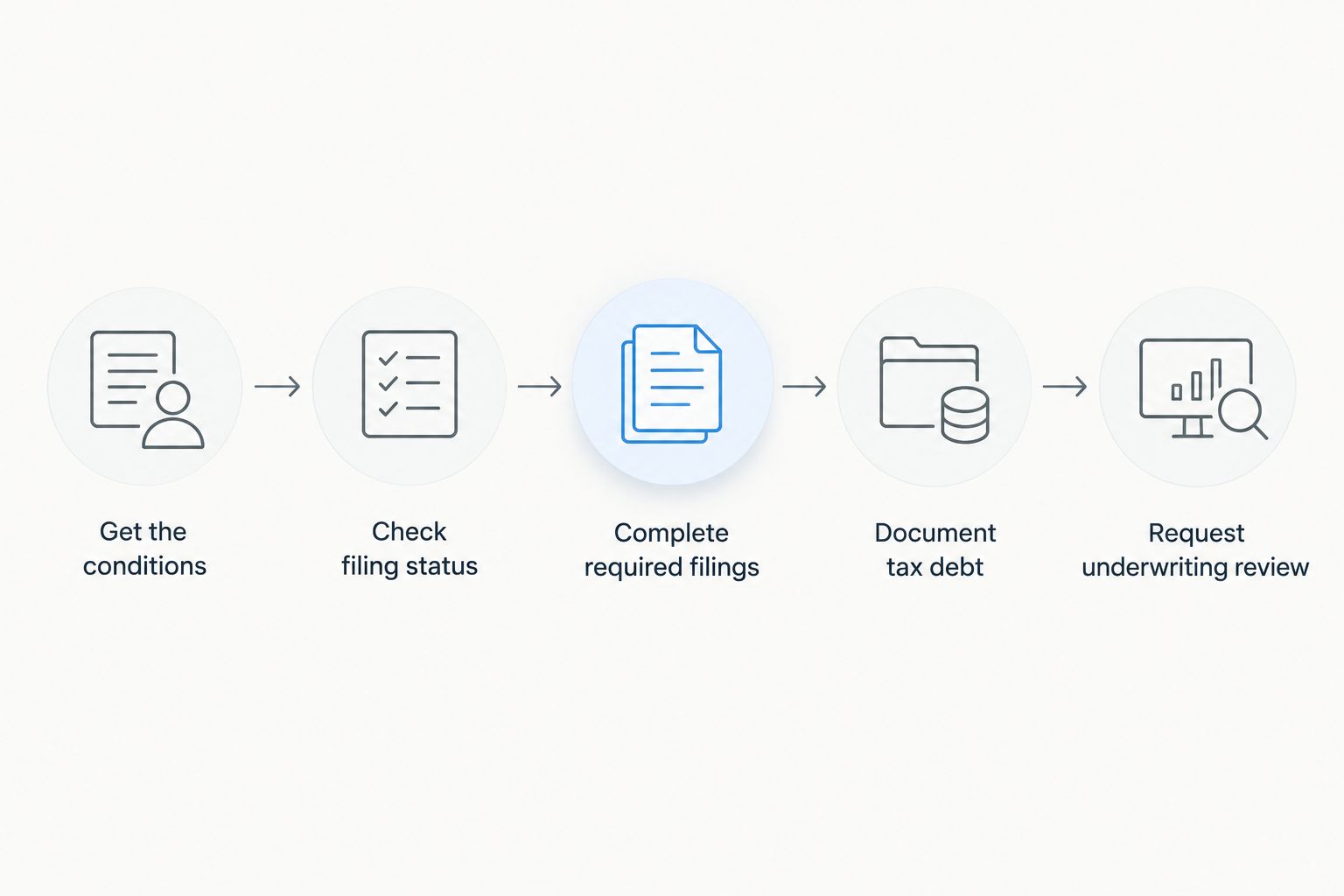
Start with these steps rather than assuming every lender needs the same paperwork:
- Get the conditions. Ask the lender to identify the missing tax years, required documents, and unresolved underwriting questions in writing.
- Check filing status. Compare your records with IRS account information and establish whether each required return was filed, rejected, or remains unprocessed.
- Complete required filings. Prepare accurate returns using income records and supporting documentation, not estimates designed to improve loan eligibility.
- Document tax debt. Give the lender the balance and any applicable payment-agreement documentation it requests.
- Request underwriting review. Confirm what remains outstanding after the lender reviews the new documents.
The distinction is important: a loan officer receiving a return is not the same as an underwriter clearing a condition. Ask for the status of the condition itself.
How different borrowing situations compare
The following situations illustrate the documentation issue, not a guarantee of approval or denial. Your lender must identify the requirements that apply to your application.
| Borrowing situation | What missing returns affect | Useful next move | Important limitation |
|---|---|---|---|
| Employee relying on wages | Verification when tax returns are required for the file | Ask whether pay statements, W-2s, and employment verification satisfy the income condition | Wage documents do not resolve a separate tax-compliance condition |
| Self-employed borrower | Verification and analysis of business income | Assemble required personal and business returns with supporting records | Deposits and gross revenue do not establish qualifying income by themselves |
| Borrower using rental income | Documentation of rental income and expenses | Ask which returns, schedules, leases, and other records underwriting requires | Rent collected is not automatically the amount used to qualify |
| Borrower with unpaid taxes | Review of tax obligations and repayment terms | Disclose the balance and provide requested agreement records | A payment agreement does not automatically satisfy every loan program |
| Applicant for a business or personal loan | Lender-specific income and financial-document requirements | Request the document checklist for that specific loan | Mortgage documentation rules do not apply identically to every loan |
If you earn wages, are tax returns always required?
Not every mortgage application requires the same tax-return documentation. Some wage-based applications rely on employment and wage records, while other circumstances require returns or additional verification.
Best for wage earners: get the lender’s exact document requirement before assuming a missing return makes approval impossible. Ask whether the unresolved issue is income verification, tax debt, or another underwriting condition. Those issues require different evidence.
A lender accepting wage documentation does not remove your legal obligation to file a required tax return. Keep the lending decision separate from the filing obligation, even when the lender does not request the return.
For a 2026 application, do not rely on a document checklist from a previous transaction. Your income, loan product, and lender requirements determine the current checklist.
If you are self-employed, why do missing returns matter?
Self-employed borrowers often need tax returns because lenders analyze business income and expenses rather than treating every deposit as earnings. Missing returns can leave that analysis incomplete.
Best for self-employed borrowers: reconcile the business records before submitting the loan package. Compare the returns with bookkeeping reports, income statements, and bank records. Explain genuine differences with supporting documents rather than changing figures to match a desired loan amount.
Taxable income and mortgage qualifying income are not always identical. Underwriting guidelines determine how the lender treats particular deductions, adjustments, and business circumstances; a borrower should not make those adjustments independently and present the result as approved income.
Do not omit legitimate expenses or report unsupported income to improve qualification. The return must be accurate, and the lender must receive truthful information.
If you owe taxes, will filing resolve the delay?
Filing resolves a missing-return issue only when the return meets the applicable filing requirements. It does not pay the resulting balance or establish that the lender accepts your repayment arrangement.
An installment agreement can be relevant to underwriting, but approval depends on the program’s requirements and your circumstances. The lender can require evidence of the agreement, payment terms, or payment history as applicable to the file.
A federal tax lien adds a separate issue because it can affect the lender’s security interest. Do not assume an installment agreement releases a lien or resolves title requirements; ask the lender and closing professionals what documentation is necessary.
Best for borrowers with tax debt: disclose the obligation before final underwriting. Waiting until closing preparation leaves less opportunity to address a condition that requires additional review.
Why the effect of unfiled returns varies
There is no single delay period that applies to every borrower. These factors determine which work remains before the lender can make its decision:
- Income source. Wage income, business income, and rental income require different analyses and supporting records.
- Loan program. Documentation and tax-debt requirements differ across mortgage products and other lending arrangements.
- Filing status. An unfiled return, a rejected submission, and a return awaiting processing are different conditions.
- Tax obligations. A balance due, repayment agreement, or lien introduces questions beyond whether a return exists.
- Record consistency. Differences between returns, financial statements, and application figures require explanation.
- Application stage. A missing document identified before an application creates a different scheduling problem from one discovered near closing.
For your 2026 closing plan, use the lender’s unresolved conditions as the working checklist. A general estimate of IRS processing time does not establish when your loan will close.
What should I give my lender after filing missing returns?
Organize the paperwork into 3 document groups: filing records, income support, and tax-debt records. This keeps evidence of submission separate from evidence of income and payment obligations.
Filing records
Keep copies of the signed returns and applicable schedules. Retain electronic acceptance records or appropriate mailing evidence, and provide the specific IRS transcript the lender requests when it becomes available.
Submission, acceptance, and processing are different events. An electronic acknowledgment does not necessarily mean the information is already reflected in an IRS transcript.
Income support
Provide the documents requested for the income you are using to qualify. Depending on the application, these include wage records, business financial statements, rental records, or explanations supported by the underlying documents.
Label each document clearly. A business bank statement and a personal tax return serve different purposes, even when both relate to the same earnings.
Tax-debt records
Provide requested notices, balance information, repayment-agreement documents, and evidence of payments. Tell the lender if the information changes during underwriting.
Keep 1 written checklist showing each outstanding condition and the document intended to satisfy it. Do not mark a condition complete until the lender confirms it is cleared.
Can I use an IRS transcript instead of a tax return?
An IRS transcript replaces a return copy only when the lender accepts that transcript for the particular requirement. A tax return transcript, tax account transcript, and wage and income transcript contain different information.
An IRS verification of nonfiling letter does not establish that you were exempt from filing. It reports that the IRS has no record of a processed return for the specified period as of the request.
For a 2026 application, ask the lender to name the required transcript rather than requesting an unspecified tax record. If the return is recent, ask how the lender handles a transcript that has not yet updated.
Does filing an extension prevent a mortgage delay?
A valid filing extension changes the filing deadline; it does not replace the income documentation a lender requires. It also generally does not extend the deadline for paying the tax.
An extended return is different from a delinquent return. Tell the lender which situation applies, then request its requirements for evaluating income while a return is on extension.
Do not assume proof of an extension is sufficient by itself. Underwriting still needs acceptable evidence for the income and obligations used in the application.
Should I get tax help before applying for a mortgage?
The Rutter Organization’s tax resolution services are best suited to borrowers who need help addressing tax problems, not deciding loan eligibility. The organization serves individuals and businesses; your lender remains responsible for underwriting and approval.
Consider The Rutter Organization when unresolved tax matters require assistance alongside your loan application. The limitation is clear: tax resolution services cannot substitute for the lender’s income analysis or guarantee a closing date.
For 2026 planning, keep 2 separate questions in every discussion: what makes the tax situation compliant, and what satisfies the lender? A useful answer to one does not automatically answer the other.
FAQ
Can I get a mortgage if I have unfiled tax returns?
A mortgage is possible only if you satisfy the lender’s applicable requirements; unfiled returns can prevent that when required documentation is missing. Ask which filings and records your specific application needs.
Will filing my missing returns guarantee mortgage approval?
Filing missing returns does not guarantee mortgage approval. The lender must still evaluate income, debts, credit, assets, and other applicable conditions.
Do I have to pay all my back taxes before getting a mortgage?
Not every mortgage situation requires full payment of all back taxes before approval. The loan program, repayment arrangement, lien status, and lender requirements determine what is acceptable.
Can my lender accept proof that I just filed my tax return?
Your lender decides whether filing evidence satisfies the condition or whether additional records are required. Proof of submission does not establish that an IRS transcript has updated.
Will a good credit score make up for missing tax returns?
A good credit score does not replace required tax documentation. Credit evaluation and income verification are separate parts of underwriting.
Can I use business bank deposits instead of tax returns?
Business bank deposits replace tax returns only under a lending product that accepts that documentation and its associated requirements. Deposits are not automatically qualifying income, and another loan product does not remove tax-filing obligations.
How long will unfiled returns delay my closing?
There is no universal delay period for unfiled returns. Filing status, required IRS records, tax-debt issues, and the lender’s remaining conditions determine the timeline.
One last thing
Ask what clears the condition, not just what documents to send. The answer should distinguish a return copy, filing acknowledgment, IRS transcript, and tax-payment documentation rather than treating them as equivalent.
Before committing to a closing date, request confirmation that the tax-related conditions have been reviewed. An uploaded document proves delivery—not underwriting acceptance.