

Best overall: an IRS installment agreement for back taxes you can pay over time. Best for a tax debt you cannot realistically pay in full: an offer in compromise. Best for a temporary inability to pay anything: currently not collectible status. These are the best IRS tax relief programs in 2026 for different financial situations—not interchangeable ways to erase a balance.
- The best IRS tax relief programs in 2026 depend on whether you can pay over time, settle, or pay nothing now.
- An IRS installment agreement is the default for back taxes you can repay over time.
- An offer in compromise addresses a balance you cannot realistically pay in full; approval requires an IRS review.
- The Rutter Organization provides tax resolution services, not an IRS relief program.
Why this matters
Choose the option that matches your ability to pay, then check whether another form of relief addresses the cause of the debt. A payment plan, for example, does not by itself remove a penalty. The Rutter Organization provides tax resolution services for individuals and businesses; the IRS decides eligibility for its programs.
The distinction matters in 2026 because an unfiled return, a disputed balance, and a balance you agree you owe call for different next steps. Start with your IRS account and notices. Confirm which returns have been filed, which tax periods carry a balance, and whether a collection deadline appears on a notice before choosing a program.
What makes the best IRS tax relief program?
Use these criteria before comparing the options:
- Ability to pay: Can you clear the balance over time, offer less than the full amount, or make no payment now?
- Cause of the balance: Do you owe the tax itself, a penalty, or tax tied to a spouse's actions on a joint return?
- Eligibility: Each option has its own filing, payment, and documentation requirements. An appealing outcome is not an eligibility test.
- Collection effect: Check what happens while the IRS considers your request and after it makes a decision. The answer differs by option and case status.
- Durability: A temporary collection pause is different from settling an accepted offer or removing a qualifying penalty.
- Notice deadline: A time-sensitive right to challenge collection action can matter more than the program you would otherwise prefer.
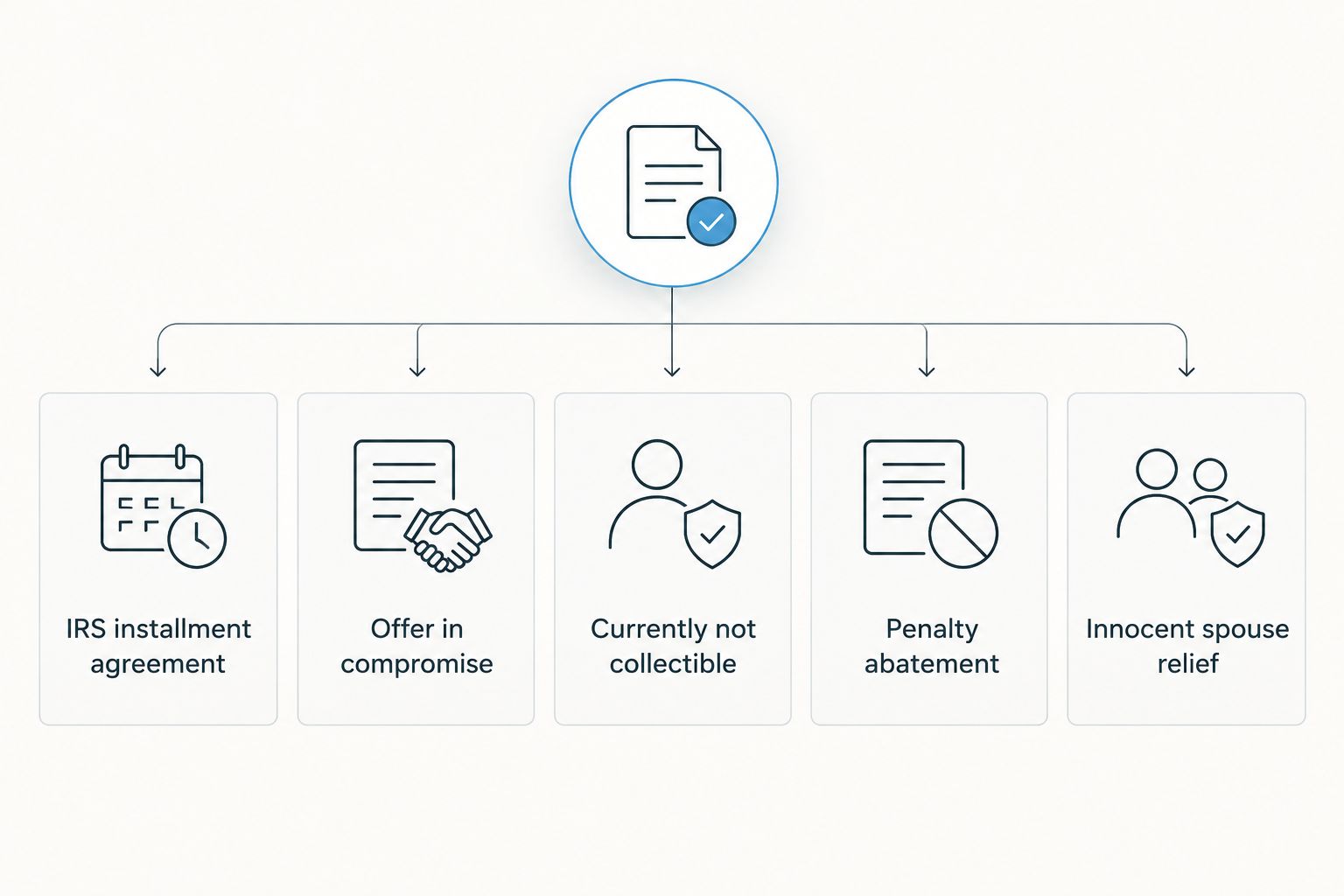
IRS tax relief programs at a glance
| Option | Best for | Standout feature | Key limitation |
|---|---|---|---|
| IRS installment agreement | Taxpayers who can pay the balance over time | Scheduled payments toward the balance | Does not reduce the underlying tax |
| Offer in compromise | Taxpayers who cannot realistically pay the full balance | Potential settlement for less than the full amount | IRS reviews eligibility and financial information |
| Currently not collectible status | Taxpayers unable to pay now | Temporary pause in most active collection | Balance remains and collection can resume |
| Penalty abatement | Taxpayers with a qualifying penalty issue | Can remove eligible penalties | Does not remove the underlying tax |
| Innocent spouse relief | Taxpayers facing qualifying joint-return liability | Can address liability tied to a spouse's actions | Does not apply to every joint tax debt |
The table separates payment, settlement, collection status, penalty relief, and liability relief. You can have more than one issue at once. A taxpayer might need a way to address the tax balance while separately asking the IRS to review a penalty.
1. IRS installment agreement: best for paying back taxes over time
Best for: You agree you owe the tax and can make regular payments, but cannot clear the balance at once. An installment agreement gives you a structured way to pay back taxes. It is the default starting point when repayment is realistic because you do not need to establish that the IRS should accept less than the full balance.
The IRS also has a short-term payment option for qualifying taxpayers who can pay within 180 days. If that does not fit your situation, review the available longer-term agreement options against your balance and filing status. A payment arrangement addresses how you pay; it does not decide whether the original assessment was right.
IRS installment agreement pros:
- Fits a balance you acknowledge and can repay.
- Creates a defined payment arrangement rather than leaving the balance unaddressed.
- Lets you assess repayment separately from a penalty-relief request.
IRS installment agreement cons:
- Does not erase the tax balance.
- Interest and applicable penalties can continue while a balance remains.
- An amount you cannot maintain is not a workable solution.
For 2026, compare the payment you can sustain with the full amount shown in your IRS account, not just the figure on an older notice. Check that required returns are filed before treating an agreement as your finished plan. Verdict: Choose an IRS installment agreement if you can repay the balance; skip it as the sole answer if you cannot.
2. Offer in compromise: best for debt you cannot realistically pay in full
Best for: You cannot realistically pay the full tax balance under the IRS's assessment of your circumstances. An offer in compromise asks the IRS to accept less than the amount owed. It is not a standard discount on back taxes: the IRS evaluates the basis for the offer and the information supporting it.
An offer can involve doubt that the IRS can collect the full amount, doubt about the liability, or effective tax administration. Those are distinct grounds. If your concern is simply that a payment plan would be uncomfortable, that does not establish that an offer will be accepted.
Offer in compromise pros:
- Addresses a balance that cannot realistically be paid in full.
- Can resolve an accepted balance under the terms of the offer.
- Provides a defined route for presenting qualifying financial circumstances.
Offer in compromise cons:
- Requires documentation and IRS review; submitting an offer is not approval.
- Is a poor fit when you can repay the assessed balance.
- Obligations continue after acceptance, so an offer is not a substitute for staying current on taxes.
In 2026, assess the offer against what the IRS considers collectible, including income and assets, before making it your primary plan. If the amount itself is wrong, examine the basis of the assessment as well as the available relief route. Verdict: Choose an offer in compromise when your circumstances support it; skip promises that every taxpayer can settle for less.
3. Currently not collectible: best for an inability to pay now
Best for: Paying the IRS now would leave you unable to meet necessary living expenses. Currently not collectible status, often called CNC, is a collection status rather than a settlement. The IRS generally pauses active collection while that status applies, but the tax debt remains.
That difference makes CNC useful in a cash crisis and unsuitable as an assumed permanent fix. The IRS can review your financial situation later. It can also apply future refunds to the debt, and interest and applicable penalties can continue to increase the balance.
Currently not collectible pros:
- Addresses an immediate inability to make payments.
- Pauses most active collection while the status applies.
- Does not require you to describe a temporary crisis as a permanent inability to pay.
Currently not collectible cons:
- Does not settle or remove the underlying tax.
- Can end if the IRS determines your ability to pay has changed.
- Does not stop interest and applicable penalties from accruing.
The IRS generally has 10 years from assessment to collect a tax debt, but events can suspend or extend that period. Do not assume that requesting CNC will cause a balance to expire on a date you calculated from when you filed. In 2026, treat CNC as protection for your present circumstances and check the assessed dates and collection history separately. Verdict: Choose CNC if you cannot pay now; hold on treating it as forgiveness.
4. Penalty abatement: best for an eligible penalty issue
Best for: Part of your balance consists of a penalty that qualifies for removal. Penalty abatement targets penalties, not the underlying tax. The IRS considers relief under different rules, including first-time abatement and reasonable cause, so identify the penalty and tax period before choosing a request.
First-time abatement generally considers whether you had a clean compliance history for the 3 prior tax years, filed required returns, and paid or arranged to pay tax due. Reasonable-cause relief depends on the facts behind the failure and the IRS's rules for the particular penalty. Neither route means every penalty disappears on request.
Penalty abatement pros:
- Targets a specific part of a tax balance.
- Can be considered alongside a plan for paying tax still owed.
- Gives you a reason to examine the penalties listed for each tax period.
Penalty abatement cons:
- Does not remove the underlying tax.
- Relief depends on the penalty and applicable eligibility rules.
- A general claim of hardship does not establish every type of penalty relief.
In 2026, separate the tax, penalty, and interest shown for each period before deciding whether abatement will materially change your balance. If the dispute is about whether you owe the tax at all, penalty abatement is not the full answer. Verdict: Choose penalty abatement for a qualifying penalty; skip it as a replacement for a tax-payment plan.
5. Innocent spouse relief: best for qualifying joint-return liability
Best for: You face a joint-return tax liability tied to a spouse's or former spouse's actions and believe the IRS should not hold you responsible under its relief rules. Innocent spouse relief addresses responsibility for a liability; it is not a general hardship program. The IRS uses Form 8857 to request it.
The IRS considers the circumstances and the type of relief requested. Filing a joint return alone does not establish eligibility, and a divorce alone does not settle the tax question. Examine the return, the tax periods, and any IRS notices before assuming that a payment arrangement is your only option.
Innocent spouse relief pros:
- Addresses who should be responsible for qualifying joint-return tax.
- Can be relevant even when the balance itself is not in dispute.
- Gives a spouse or former spouse a route to present the facts to the IRS.
Innocent spouse relief cons:
- Does not apply to every tax debt or joint return.
- Requires an individual review of facts and relief rules.
- Is not a way to resolve separate tax debts that are solely yours.
In 2026, check notice dates promptly rather than assuming every type of spouse relief follows the same deadline. If the issue is whether you can afford to pay a debt that is yours, compare payment, settlement, and collection-status options instead. Verdict: Choose innocent spouse relief when joint-return responsibility is the issue; skip it for an unrelated balance.
How these programs were ranked
The ranking starts with the broadest repayment path, then separates less common problems by what each option actually changes. An installment agreement changes how you pay. An accepted offer can change what resolves the balance. CNC changes current collection activity. Penalty abatement addresses eligible penalties, while innocent spouse relief addresses qualifying responsibility for joint-return tax.
That order is a decision aid, not an IRS approval ranking. The right choice in 2026 depends on your returns, account records, ability to pay, and notices. If you have a proposed levy, read the notice before following a general ranking: a Collection Due Process request generally has a 30-day filing window tied to the notice date. The notice tells you the deadline and how to respond.
Which IRS tax relief program should you choose?
Choose an IRS installment agreement if you can repay what you owe over time. It is the clearest default for an acknowledged balance. Choose an offer in compromise if the full balance is not realistically collectible and your circumstances support an offer. Choose CNC if you cannot pay now but need to understand that the balance remains.
Then check for a separate issue: request penalty relief when an eligible penalty is part of the balance, or assess innocent spouse relief when joint-return responsibility is the dispute. Do not force a single program to solve every part of the case. The Rutter Organization's tax resolution services serve individuals and businesses who need help assessing their options; the IRS determines program eligibility and outcomes.
FAQ
What is the best IRS tax relief program for back taxes in 2026?
An IRS installment agreement is the best starting point if you can repay your back taxes over time. If you cannot realistically pay the full balance, assess an offer in compromise; if you cannot pay now, assess currently not collectible status.
Is an offer in compromise better than an installment agreement?
An offer in compromise is better suited to a qualifying balance you cannot realistically pay in full. An installment agreement fits a balance you can repay over time, and an offer requires IRS review and acceptance.
Does currently not collectible status forgive back taxes?
No. Currently not collectible status pauses most active IRS collection while it applies, but the tax balance remains and collection can resume if your circumstances change.
Can the IRS remove penalties without removing the tax?
Yes. Eligible penalties can receive abatement while the underlying tax remains due. Check the specific penalty and tax period before requesting relief.
Can I apply for IRS tax relief if I have unfiled returns?
Check your filing obligations first. Required returns affect eligibility for relief options, so identify and address missing returns before relying on a proposed payment or settlement plan.
Does divorce automatically qualify me for innocent spouse relief?
No. Innocent spouse relief depends on the facts of a qualifying joint-return liability and the IRS's relief rules. Divorce by itself does not decide responsibility for the tax.
Can a tax resolution service approve an IRS relief program?
No. The IRS decides whether to grant its relief programs. The Rutter Organization provides tax resolution services for individuals and businesses, not IRS program approvals.
One last thing
A collection notice can change your next move faster than a program comparison can. In 2026, check its response deadline before gathering paperwork for an offer or payment request. A missed notice deadline can limit how you challenge the proposed collection action, even when you still need to resolve the underlying tax.


