

Best overall for current-year tax savings: traditional pre-tax 401(k) contributions. Best for capturing employer dollars: contribute enough to receive the full available match. Best for tax diversification: Roth 401(k) contributions. This 2026 guide ranks six approaches by their tax treatment and practical use; Rutterorganization serves individuals and businesses through tax resolution services and other enterprise activities.
- The best 401k contribution strategies for tax savings start with traditional pre-tax contributions for current-year federal income-tax reduction.
- Employer matching adds retirement money, but it is not a separate employee tax deduction.
- Roth 401(k) contributions provide no current deduction; qualified withdrawals are tax-free.
- Use 2026 contribution limits, plan rules, and your marginal tax rate to choose your payroll elections.
Why this matters
A 401(k) strategy can reduce income tax now, support tax-free qualified withdrawals later, or add employer contributions. Those are different benefits. Calling all three tax savings hides the decision you actually need to make.
Traditional contributions defer income tax; they do not erase it. Roth contributions reverse the timing: you pay income tax before contributing, then qualified withdrawals are tax-free. The better choice depends on the tax rate that applies when you contribute versus the rate that applies when you withdraw.
Rutterorganization's tax resolution services and retirement contribution planning address different problems. A new 401(k) contribution does not retroactively resolve an unpaid tax balance or replace a required tax return.
What makes the best 401(k) contribution strategy?
Judge each approach against these criteria before choosing a payroll percentage:
- Current deduction: Does the contribution reduce current federal taxable income, or does its benefit arrive later?
- Tax-rate comparison: Compare your marginal income-tax rate today with the rate you expect on retirement withdrawals.
- Employer match: Check the matching formula, eligibility requirements, vesting schedule, and contribution timing.
- Plan rules: Confirm whether your employer offers Roth contributions, after-tax contributions, conversions, and a matching true-up.
- Payroll timing: Employee deferrals generally must come from compensation through payroll; a late election cannot rewrite earlier paychecks.
- Cash needs: Preserve money for bills and tax obligations rather than treating retirement contributions as immediately accessible savings.
No ranking overrides your plan documents. A strategy that requires an unavailable feature is not an option, and an employer match deserves attention even when your immediate objective is reducing taxable income.
401(k) contribution strategies at a glance
The order below prioritizes current federal income-tax reduction, then employer contributions and future tax treatment. It is not a claim that one strategy produces the largest lifetime savings for every taxpayer.
| Rank and strategy | Best for | Standout benefit | Key limitation |
|---|---|---|---|
| 1. Traditional pre-tax contributions | Reducing current taxable wages | Defers federal income tax on contributions | Taxable withdrawals later |
| 2. Full employer-match participation | Capturing employer contributions | Adds employer money under plan rules | Match is not a separate employee deduction |
| 3. Higher-income-year contribution planning | Concentrating deductions in higher-rate years | Aligns pre-tax deferrals with marginal tax rates | Future income and tax rates are uncertain |
| 4. Age-based catch-up contributions | Eligible workers needing extra contribution room | Increases the permitted employee contribution | Eligibility and Roth catch-up rules apply |
| 5. Roth 401(k) contributions | Building tax-free qualified retirement income | Qualified withdrawals are tax-free | No current income-tax deduction |
| 6. After-tax contributions with Roth conversion | Additional Roth saving after employee deferrals | Uses a separate plan feature for additional retirement saving | Requires specific features and careful tax handling |
1. Traditional pre-tax contributions: best for current tax reduction
Traditional 401(k) deferrals generally reduce the wages included in your current federal taxable income. Investment growth remains tax-deferred, while distributions generally enter taxable income when withdrawn. That makes traditional contributions the default starting point when your stated objective is a deduction today.
For 2026, the IRS sets the employee elective-deferral limit at $24,500 per year, before eligible catch-up contributions. Traditional and Roth employee deferrals share that limit; choosing both does not double your allowance.
The immediate benefit depends on the marginal rate applying to the income you defer. It also depends on whether the contribution crosses a tax-bracket boundary, so multiplying your entire contribution by your highest rate is not always accurate.
Traditional contribution pros:
- Reduces current federal taxable wages.
- Provides tax-deferred investment growth.
- Works as a direct payroll election when offered by your plan.
Traditional contribution cons:
- Withdrawals generally create taxable income.
- Employee deferrals generally remain subject to Social Security and Medicare taxes.
- Early distributions can trigger income tax and additional tax unless an exception applies.
Best for: Workers prioritizing current income-tax reduction, particularly when their current marginal rate exceeds their expected withdrawal rate.
Verdict: Choose traditional contributions for immediate federal income-tax reduction; do not mistake tax deferral for permanent tax exemption.
2. Full employer-match participation: best for employer dollars
An employer match contributes money according to your plan's formula. Your employee contribution can be traditional or Roth if the plan offers both, but the match itself is not another deduction you claim on your individual return.
Read the matching formula before changing your payroll election. Some plans calculate matching contributions each pay period; a plan's true-up provision determines whether it reconciles matching contributions after the year ends. Front-loading contributions without checking that rule can leave later paychecks without contributions eligible for a match.
Employer-match participation pros:
- Adds employer contributions under the plan's formula.
- Can accompany traditional contributions that reduce current taxable wages.
- Creates a clear minimum contribution target based on plan documents.
Employer-match participation cons:
- Employer contributions can be subject to a vesting schedule.
- Eligibility and payment timing depend on the plan.
- Reaching the employee limit early can affect matching contributions when no true-up applies.
Best for: Employees whose plans provide matching contributions and who can afford the required deferrals.
Verdict: Choose full-match participation before pursuing optional tax refinements; check vesting and true-up rules first.
3. Higher-income-year planning: best for higher marginal tax rates
A pre-tax deduction shelters income at the rate that would otherwise apply to that income. Directing more traditional contributions into a higher-income year therefore targets income taxed at that year's marginal rates, rather than treating every contribution year as identical.
For your 2026 election, use a tax projection that includes wages, bonuses, spouse income if filing jointly, and other taxable income. Do not use salary alone as a proxy for your tax bracket. A bonus can change the projection, but its withholding rate is not necessarily your final income-tax rate.
This strategy changes the timing and amount of contributions within legal limits. It does not let you transfer unused employee contribution room from an earlier year into the current year.
Higher-income-year planning pros:
- Connects contribution decisions to an actual tax projection.
- Targets pre-tax deductions at income subject to higher marginal rates.
- Supports payroll adjustments after compensation changes.
Higher-income-year planning cons:
- Future income and withdrawal tax rates cannot be known in advance.
- Large late-year changes face payroll and compensation constraints.
- Reducing contributions in other years can reduce retirement saving and employer matching.
Best for: Workers with variable bonuses, uneven household income, or a documented change in their marginal tax rate.
Verdict: Choose higher-income-year planning when your tax projection supports it; skip decisions based only on a bonus withholding percentage.
4. Age-based catch-up contributions: best for extra contribution room
Catch-up contributions expand the employee deferral allowance for eligible older workers. They are additional contribution room, not a separate tax deduction independent of the contribution's traditional or Roth treatment.
The IRS's 2026 retirement-plan cost-of-living adjustments set the standard catch-up amount at $8,000 per year for eligible participants age 50 or older. For participants who attain ages 60 through 63 during the calendar year, the higher catch-up amount is $11,250 per year. Combined with the regular employee limit, those amounts produce potential employee deferrals of $32,500 per year or $35,750 per year, respectively, when the plan permits them.
The higher age-based amount replaces the standard catch-up; it does not stack on top of it. Also check the 2026 Roth catch-up requirements for higher-paid employees: eligible catch-up money is not automatically eligible for pre-tax treatment.
Catch-up contribution pros:
- Provides additional employee contribution capacity.
- Offers a larger catch-up allowance for the specified age group.
- Supports increased retirement saving without requiring an after-tax conversion feature.
Catch-up contribution cons:
- Age and plan eligibility requirements apply.
- Required Roth treatment can remove the current deduction on catch-up contributions.
- A larger allowance does not make the money readily accessible for current expenses.
Best for: Eligible workers who can fund additional contributions after reviewing their plan's catch-up treatment.
Verdict: Choose catch-up contributions when eligible, but verify whether the additional dollars must be Roth before estimating tax savings.
5. Roth 401(k) contributions: best for tax diversification
Roth 401(k) contributions come from income that remains taxable in the contribution year. Their benefit is the potential for tax-free qualified distributions, including earnings, rather than a current deduction.
A qualified distribution generally requires satisfying the applicable five-tax-year period and reaching age 59½, becoming disabled, or dying. Roth 401(k) contributions also are not subject to the Roth IRA income limits, although your employer must offer the Roth feature.
Combining traditional and Roth balances gives you different tax treatments to draw from in retirement. That flexibility is useful, but it does not establish that Roth produces greater total savings for every household.
Roth 401(k) contribution pros:
- Provides tax-free qualified withdrawals.
- Allows eligible participation without Roth IRA income restrictions.
- Adds a different tax treatment alongside traditional retirement money.
Roth 401(k) contribution cons:
- Does not reduce current federal taxable income.
- Shares the employee deferral limit with traditional contributions.
- Earnings withdrawn without satisfying qualification requirements can create tax consequences.
Best for: Workers prioritizing future tax-free qualified income, especially when their current tax rate is lower than their expected withdrawal rate.
Verdict: Choose Roth for future tax treatment; skip it as a strategy for obtaining a current-year deduction.
6. After-tax contributions with conversion: best for additional Roth saving
Some plans permit employee after-tax contributions beyond ordinary elective deferrals and provide an in-plan Roth conversion or an eligible rollover route. This combination is commonly called a mega backdoor Roth strategy. After-tax contributions are not the same as designated Roth 401(k) deferrals.
The contribution itself provides no current income-tax deduction. Converting after-tax principal generally does not tax that principal again, but associated earnings and other pre-tax amounts require separate tax handling. Employer contributions also use part of the plan's overall annual contribution allowance.
After-tax conversion pros:
- Provides an additional retirement-saving route when the required features exist.
- Can move after-tax money toward Roth treatment.
- Separates additional saving from the ordinary employee deferral election.
After-tax conversion cons:
- Many plans do not offer the necessary combination of features.
- Earnings and mixed tax balances complicate conversion treatment.
- Plan limits and nondiscrimination testing can constrain contributions.
Best for: Workers already using ordinary employee deferrals who have confirmed after-tax contribution and conversion provisions.
Verdict: Hold until the administrator confirms the complete contribution and conversion process; skip this approach if the required features are absent.
How the strategies are ranked
This ranking separates an immediate deduction from employer compensation and future tax-free income. Traditional contributions lead on current taxable-income reduction; employer matching earns its position through added employer money, not a larger employee deduction.
The legal limits cited here come from the IRS's 2026 retirement-plan cost-of-living adjustments. Tax-treatment distinctions follow IRS guidance on elective deferrals, designated Roth accounts, catch-up contributions, and retirement-plan distributions; your plan documents determine which features you can use.
Which contribution strategy should you choose?
Start with full-match participation, then use traditional contributions as the default if your main goal is lowering current taxable income. Add Roth contributions when your tax-rate comparison supports future tax-free qualified withdrawals. Investigate after-tax conversions only after confirming ordinary contribution elections and plan features.
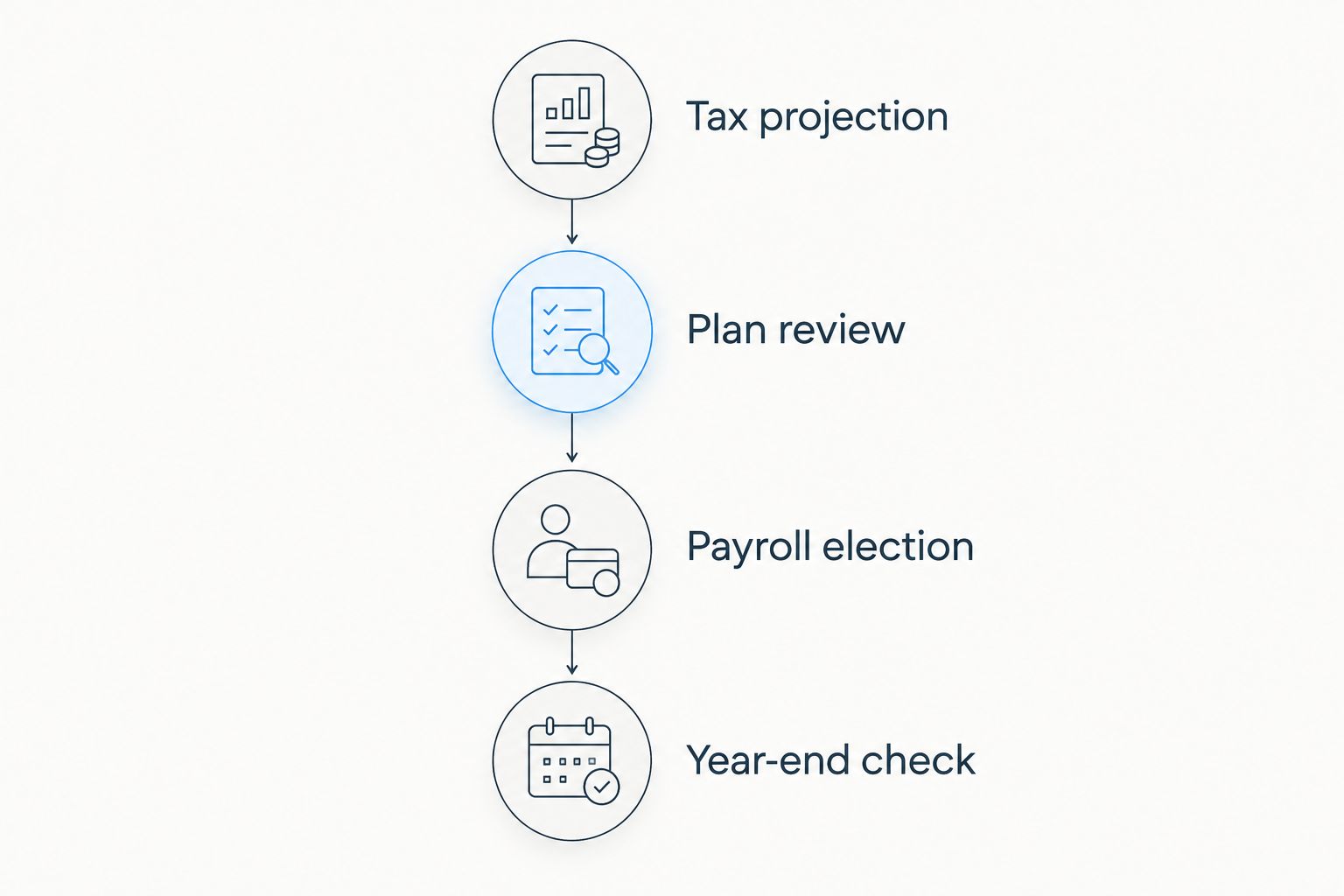
Use this decision sequence before submitting a payroll change:
- Tax projection: Estimate taxable income and the marginal rates applying to your contribution.
- Plan review: Confirm matching, catch-up treatment, Roth features, and conversion provisions.
- Payroll election: Set contributions that fit remaining compensation and available contribution room.
- Year-end check: Reconcile contributions across employers and verify that payroll followed your election.
If you have tax debt as well as retirement goals, assess both obligations separately. Rutterorganization serves individuals and businesses through tax resolution services; retirement contributions do not replace resolving filing or payment obligations.
FAQ
What's the best 401k contribution strategy for tax savings in 2026?
Traditional pre-tax contributions are the direct choice for reducing current federal taxable wages. Employer matching adds employer money, while Roth contributions target tax-free qualified withdrawals rather than a current deduction.
Is a traditional 401(k) better than a Roth 401(k)?
Traditional contributions are better for a current deduction; Roth contributions are better for obtaining tax-free qualified withdrawals. Compare the marginal tax rate applying today with the rate you expect on retirement withdrawals before choosing.
How much can I contribute to a 401(k) in 2026?
The regular employee elective-deferral limit is $24,500 for 2026. Eligible catch-up contributions increase that allowance, and traditional and Roth employee deferrals share the regular limit.
Can I deduct Roth 401(k) contributions on my tax return?
No, Roth 401(k) contributions do not provide a current income-tax deduction. Their tax benefit is tax-free qualified distributions when the applicable requirements are satisfied.
Do traditional 401(k) contributions reduce Social Security tax?
Traditional employee 401(k) deferrals generally do not reduce Social Security or Medicare taxable wages. They generally reduce current federal income-taxable wages instead.
Should I max out my 401(k) early in the year?
Check your employer's matching and true-up rules before maxing out early. If matching is calculated each pay period without a true-up, reaching the employee limit early can affect the match on later paychecks.
Can contributing to a 401(k) eliminate my back taxes?
No, a new 401(k) contribution does not retroactively eliminate an existing tax balance. Address unfiled returns and payment obligations separately from your current retirement contribution election.
One last thing
Changing employers does not reset your ordinary employee 401(k) deferral limit. Track employee deferrals across applicable plans yourself; a new payroll system does not necessarily know what you contributed elsewhere. Before increasing a late-year election, compare both employers' year-to-date records against your remaining allowance.


