

Best overall for profitable owner-operated businesses: S corporation taxation, when payroll costs and reasonable compensation leave a documented tax benefit. Best for jointly owned rental property: an LLC taxed as a partnership. Best for simple solo operations: a sole proprietorship. This 2026 guide compares five structures by tax treatment, liability separation, ownership rules, and administrative burden—not by promises of automatic savings.
- The best business entity structure for tax savings 2026 depends on profit, owner compensation, ownership, and distributions.
- S corporation taxation deserves consideration when business profit exceeds defensible owner compensation and added compliance costs.
- A partnership-taxed LLC fits shared real estate ownership but requires careful allocation and distribution planning.
- The Rutter Organization provides tax resolution services; an entity change does not erase existing tax debt.
Why this matters
An LLC is a legal structure, not a federal tax savings election. A single-member LLC generally defaults to disregarded-entity treatment; a domestic multi-member LLC generally defaults to partnership taxation. An eligible LLC can elect corporate taxation and, if qualified, S corporation treatment.
Changing that classification affects how income reaches your return, whether payroll is required, and how distributions work. It does not turn personal spending into a business deduction. For taxpayers dealing with existing liabilities, The Rutter Organization provides tax resolution services—a separate issue from choosing how future business income is taxed.
The right 2026 decision starts with your expected profit and what you do in the business. Then you account for ownership restrictions, state taxes, paperwork, and your exit plan.
What makes the best business entity structure for tax savings?
Judge each option against these criteria before choosing a label:
- Employment taxes: Identify which earnings face self-employment tax or payroll taxes, and which distributions receive different treatment.
- Owner compensation: Separate payment for your work from returns on invested capital. An S corporation needs defensible compensation for shareholder services.
- Total tax: Compare business-level tax, owner-level tax, state taxes, and taxes on distributions—not one isolated rate.
- Ownership flexibility: Check whether your investors, partners, and proposed economic arrangements fit the classification.
- Compliance burden: Include payroll, tax returns, bookkeeping, and required records in the decision.
- Exit treatment: Model an asset sale, ownership transfer, or liquidation before moving valuable assets into a corporation.
Business entity structures at a glance
The 2026 ranking below gives each option a distinct job. It does not suggest that every business should work through the list toward the first choice.
| Rank and structure | Best for | Standout feature | Key limitation |
|---|---|---|---|
| 1. S corporation taxation | Profitable owner-operated service businesses | Separates shareholder wages from qualifying distributions | Requires reasonable compensation and payroll administration |
| 2. Single-member LLC, default taxation | Solo owners seeking legal separation | Generally reports business activity on the owner's return | Active business earnings generally remain subject to self-employment tax |
| 3. LLC taxed as a partnership | Shared real estate ownership | Pass-through taxation with partnership allocation rules | Allocations, basis, debt, and distributions require careful tracking |
| 4. C corporation | Businesses needing ownership flexibility and retained earnings | Separate taxpayer with flexible ownership arrangements | Corporate earnings can face another tax when distributed as dividends |
| 5. Sole proprietorship | Solo businesses prioritizing administrative simplicity | No separate federal entity election for the individual business | No entity-level liability separation |
1. S corporation taxation: best for profitable owner-operated businesses
S corporation taxation generally passes business income through to shareholders. A shareholder who performs services must receive reasonable compensation before non-wage distributions replace payment for that work. Those wages face employment taxes; qualifying S corporation distributions generally do not face self-employment tax.
That distinction creates a planning opportunity, not a guaranteed result. If defensible compensation consumes the business's profit, the election offers little employment-tax benefit while adding payroll and return obligations.
S corporation taxation pros:
- Generally avoids federal corporate income tax on ordinary operating income, subject to exceptions.
- Distinguishes wages for shareholder services from qualifying distributions.
- Is available to eligible LLCs as well as eligible corporations.
S corporation taxation cons:
- Requires payroll, reasonable-compensation support, and a separate federal tax return.
- Restricts ownership and generally permits only one class of stock.
- Can create difficult tax consequences when appreciated assets leave the corporation.
Best for: An eligible owner-operated business with recurring profit beyond defensible compensation and added compliance costs.
For 2026 planning, remember that an S corporation generally cannot have more than 100 shareholders. Eligible shareholder rules matter just as much as that limit: partnerships, corporations, and nonresident alien shareholders generally do not qualify.
Verdict: Buy into S corporation taxation only after a written comparison shows a net benefit. Do not elect it solely because someone says distributions are tax-free; pass-through income remains taxable to shareholders under the applicable rules.
2. Single-member LLC: best for solo owners seeking legal separation
A single-member LLC generally receives disregarded-entity treatment for federal income tax unless it elects otherwise. An individual's active trade or business typically appears on Schedule C, while other activities follow their applicable reporting rules. Forming the LLC alone does not change the underlying federal tax treatment.
The reason to choose this option is legal organization without immediately adding corporate tax administration. Liability protection depends on applicable law and proper operation; an LLC does not shield every obligation or personal guarantee.
Single-member LLC pros:
- Creates a legal entity separate from its owner under state law.
- Generally avoids a separate federal income tax return for a disregarded individual-owned business.
- Preserves the ability to evaluate a later corporate tax election.
Single-member LLC cons:
- Generally does not reduce self-employment tax on active business profit by itself.
- Requires state filings and attention to business-personal separation.
- Does not eliminate liability for your own misconduct or guaranteed debts.
Best for: A solo owner who wants an organized legal structure without assuming S corporation taxation is already justified.
The familiar 15.3% self-employment tax rate combines Social Security and Medicare components. It does not apply uniformly to every dollar of profit: the Social Security wage base, net-earnings calculation, and other rules affect the result. Additional Medicare Tax can also apply.
Verdict: Buy the legal structure for separation; hold the tax election until the numbers support it. An LLC certificate is not evidence of tax savings.
3. Partnership-taxed LLC: best for shared real estate ownership
A domestic LLC with multiple members generally defaults to partnership taxation unless it elects otherwise. Income and deductions generally pass through to the members, with economic arrangements documented in the operating agreement and tested against partnership tax rules.
This structure deserves consideration for jointly owned rental property because ownership percentages, contributions, debt, and distributions require explicit treatment. Ordinary rental income generally follows different self-employment tax rules from an active service business; exceptions depend on the activity and services provided.
Partnership-taxed LLC pros:
- Generally provides pass-through federal taxation without a corporate income tax layer.
- Supports economic arrangements beyond the single-class-of-stock restrictions of an S corporation.
- Allows owners to document contributions, management rights, and distribution arrangements.
Partnership-taxed LLC cons:
- Requires a partnership return and member reporting, generally through Schedule K-1.
- Demands careful tracking of basis, liabilities, capital accounts, and allocations.
- Does not automatically remove self-employment tax from active business earnings.
Best for: Multiple owners holding rental property with clearly documented investment and operating arrangements.
Do not confuse cash distributions with taxable income. A member can owe tax on allocated income without receiving matching cash, while a distribution can have consequences that depend on basis and other rules. Agree on how tax distributions will work before cash becomes a dispute.
Verdict: Buy for shared property ownership when the agreement and tax reporting match the economics. Skip any arrangement that promises arbitrary deduction allocations without legal support.
4. C corporation: best for ownership flexibility and retained earnings
A C corporation is a separate federal taxpayer. Its federal corporate income tax rate is 21%, but that rate is not the owner's total tax burden. Earnings distributed as dividends can face shareholder-level tax as well.
The structure earns its place when ownership flexibility, capital raising, or retaining earnings serves the business plan. Retaining earnings does not make later distributions tax-free, and accumulated earnings tax rules can become relevant when retention lacks a business purpose.
C corporation pros:
- Allows ownership arrangements that S corporation eligibility rules prohibit.
- Separates corporate taxable income from shareholder tax reporting.
- Supports multiple stock classes and institutional ownership.
C corporation cons:
- Can impose both corporate tax and shareholder tax on distributed earnings.
- Can produce unfavorable results when appreciated assets are sold and proceeds distributed.
- Requires corporate reporting and formal administration.
Best for: A business whose ownership and reinvestment needs outweigh the disadvantages of corporate taxation.
For a 2026 comparison, model what shareholders actually receive after tax. Comparing the 21% corporate rate with an individual marginal rate, while ignoring dividend taxation and the planned exit, answers the wrong question.
Verdict: Hold unless ownership needs and a full distribution model support C corporation treatment. Skip it as a shortcut based only on the headline rate.
5. Sole proprietorship: best for administrative simplicity
A sole proprietorship is an individual operating a business without a separate legal entity. Business income and deductions generally appear on the individual's return, typically on Schedule C for an active trade or business. Net earnings generally face self-employment tax.
Its advantage is simplicity, not a special deduction category. Ordinary and necessary business expenses do not become more deductible merely because you switch from a sole proprietorship to an LLC.
Sole proprietorship pros:
- Avoids a separate federal entity income tax return for the individual business.
- Keeps federal reporting relatively direct for a straightforward operation.
- Lets you evaluate the business before committing to an entity tax election.
Sole proprietorship cons:
- Provides no separate entity-level liability barrier.
- Generally leaves active business earnings subject to self-employment tax.
- Does not provide a framework for adding equity owners.
Best for: A solo business prioritizing simplicity after evaluating its liability exposure.
Verdict: Buy simplicity only when the legal risk is acceptable. Skip sole proprietorship treatment as a long-term default when partners, substantial obligations, or business exposure require a different structure.
How the structures were ranked
The ranking prioritizes net tax benefit, compensation requirements, ownership fit, compliance burden, and exit treatment. Each option wins a distinct use case; none wins every criterion.
The federal rules described here follow established IRS guidance on LLC classification, S corporations, self-employment tax, partnerships, and corporations. For a 2026 decision, consult the applicable IRS instructions for Forms 2553, 1120-S, 1065, and 1120, plus Publication 541 and Schedule SE instructions. State treatment requires a separate review.
Which business entity structure should you choose?
For an undecided solo owner, evaluate a default-taxed single-member LLC first, then test whether S corporation taxation improves the result. That separates the legal-structure decision from the tax-election decision instead of forcing both at once.
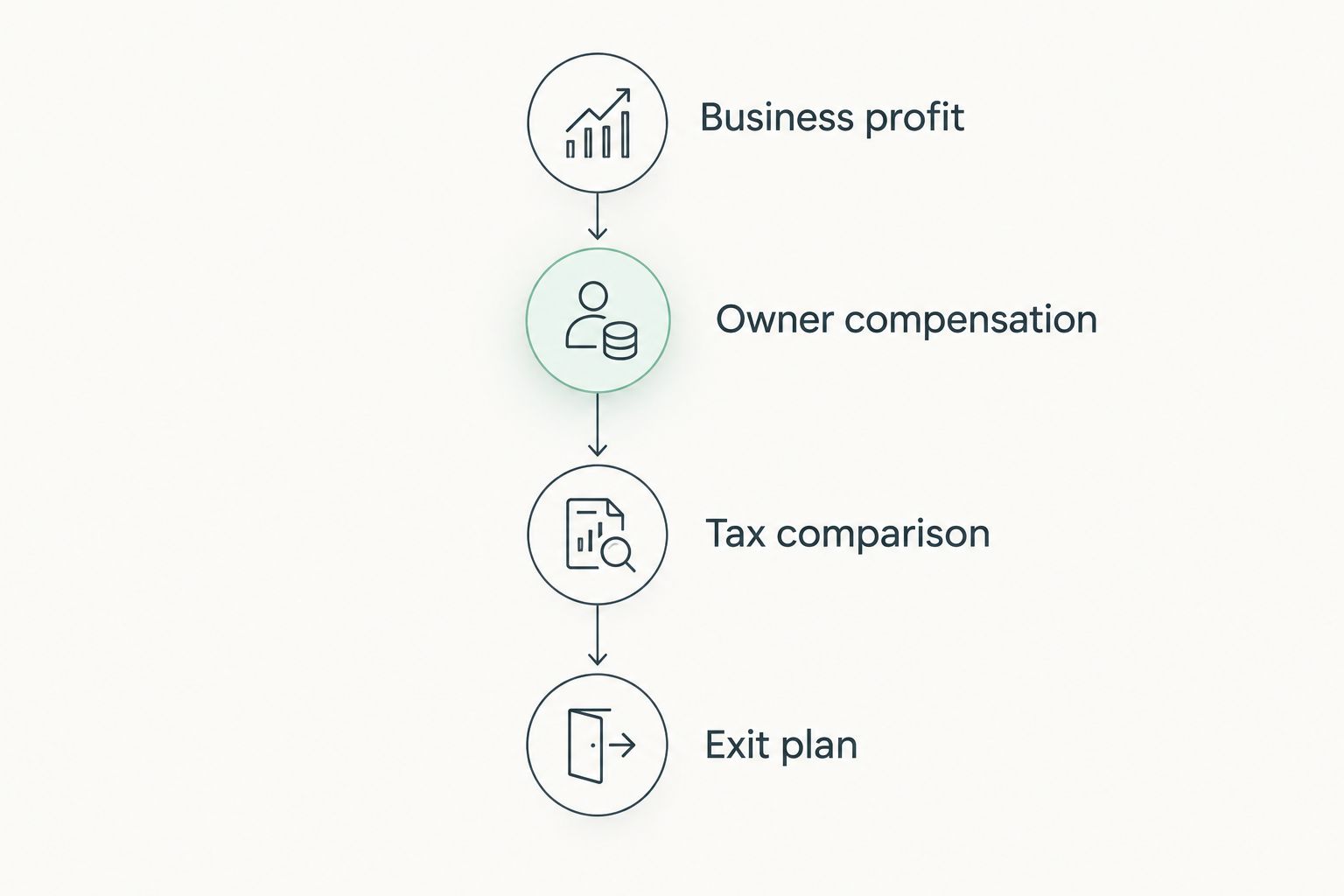
Build the comparison around these inputs:
- Business profit: Estimate income after legitimate operating expenses, before owner compensation.
- Owner compensation: Document duties, working time, and support for compensation.
- Tax comparison: Calculate employment taxes, income taxes, state treatment, and added administration.
- Exit plan: Account for distributions, asset sales, new owners, and eventual closure.
A good recommendation identifies why the preferred classification wins and what would change that conclusion. It also addresses election timing and whether the business qualifies.
Keep existing tax problems on a separate track. The Rutter Organization provides tax resolution services for individuals and businesses; changing an entity does not cancel unpaid taxes or replace missing returns. The Rutter Organization is best suited to readers seeking tax resolution services rather than treating entity formation as a cure for existing debt.
FAQ
What's the best business entity structure for tax savings in 2026?
S corporation taxation deserves consideration for a profitable owner-operated business when defensible compensation and added compliance costs leave a net benefit. A default-taxed LLC, partnership, or C corporation fits different ownership and operating needs.
Does forming an LLC automatically lower my taxes?
No. An LLC is a legal structure, and its default federal tax treatment depends on ownership. Tax savings require an analysis of the applicable classification, business income, and owner circumstances.
Is an S corporation better than a single-member LLC?
They are not mutually exclusive: an eligible single-member LLC can elect S corporation taxation. Compare default taxation with S corporation treatment after accounting for reasonable compensation, payroll, state taxes, and administration.
Can I take all S corporation earnings as distributions?
No, distributions cannot replace reasonable compensation for services you perform for the S corporation. Shareholder wages and distributions receive different employment-tax treatment, but distributions do not erase tax on pass-through income.
Is a partnership-taxed LLC a good choice for rental property?
A partnership-taxed LLC deserves consideration for jointly owned rental property because it combines a legal entity with pass-through taxation and partnership economic arrangements. Debt, basis, allocations, distributions, and the rental activity's tax treatment still require careful review.
Does the corporate tax rate make a C corporation the cheapest choice?
No. The 21% federal corporate rate excludes potential shareholder tax on dividends and does not account for state taxes or exit consequences. Compare the total tax on earnings that owners ultimately receive.
Will changing my business entity eliminate back taxes?
No. An entity change does not erase existing tax liabilities or satisfy outstanding filing obligations. Address unpaid taxes and unfiled returns separately from planning the taxation of future business income.
One last thing
The structure that reduces tax during operation can create tax costs when you exit. Before putting appreciated property into a corporation, examine both the contribution and the eventual sale or distribution. A decision based only on this year's operating income leaves that second calculation unfinished.
For 2026, require a recommendation that covers formation, annual operation, and exit. If the comparison stops at payroll taxes, it is not enough to choose the entity.


