

Best overall: a documented response that matches your tax records. Best for complex discrepancies: professional tax resolution review. Best for a correct proposal: acceptance using the notice instructions. The best options for IRS CP2000 notice handling in 2026 depend on whether the proposed adjustment is accurate—not simply whether you can pay it.
- The best options for IRS CP2000 notice handling start with checking the proposed adjustment against your records.
- Dispute incorrect adjustments with supporting documents; accept correct changes using the notice instructions.
- Rutterorganization is an option for individuals and businesses seeking tax resolution services.
- Payment plans address an assessed balance; they do not resolve an incorrect income discrepancy.
Why this matters
A CP2000 notice proposes changes because information reported by employers, financial institutions, or other payers does not match your return. A CP2000 is not a bill, and receiving one does not automatically mean you owe the proposed amount. The IRS explains this distinction in its guidance, Understanding your CP2000 notice.
Your first decision is whether the proposed change is correct. Payment comes after that. Accepting an adjustment without checking it can leave an error unresolved; disputing accurate income without evidence does not establish a correction.
Rutterorganization provides tax resolution services to individuals and businesses. If you seek professional help, confirm the engagement covers your notice, the response, and any representation you need.
For a notice received in 2026, use the response date printed on that specific document. Do not substitute a deadline from an online article.
What makes the best CP2000 response option
Choose your response using these criteria before comparing the options:
- Accuracy: Does the response reconcile the payer information, your return, and your supporting records?
- Evidence: Can you support the correction with statements, transaction records, or a corrected information return?
- Complexity: Is the discrepancy isolated, or does it involve several income sources and related calculations?
- Deadline control: Can you prepare and deliver a complete response by the date on the notice?
- Representation: Do you need someone authorized to communicate with the IRS on your behalf?
- Payment fit: If the adjustment is correct, can you pay the resulting balance or do you need a separate payment arrangement?
The strongest option fixes the actual discrepancy before addressing collection. A payment agreement does not establish whether the proposed tax calculation is right.
In 2026, the same distinction applies whether the notice concerns wages, investment transactions, retirement distributions, or business income. Match the response to the records—not to the size of the proposed balance alone.
CP2000 response options at a glance
The ranking below assigns each option a different job. These are response routes, not competing tax relief programs; some belong together in the same case.
| Option | Best for | Standout feature | Key limitation |
|---|---|---|---|
| Self-prepared documented dispute | An isolated discrepancy you can explain | Connects a specific correction to supporting records | You must identify the error and prepare the response yourself |
| Professional tax resolution review | Multiple or difficult-to-reconcile discrepancies | Adds professional review before you accept or dispute changes | Scope and representation authority must be confirmed |
| Acceptance of the proposed changes | A proposal you have verified as correct | Resolves the agreement question directly | Acceptance does not create a payment arrangement |
| Payer correction plus an IRS response | An incorrect information return | Addresses the reporting error at its source | Requesting a corrected form does not replace your IRS response |
| Installment agreement after assessment | A correct balance you cannot pay in full | Separates repayment from the accuracy dispute | It does not remove the underlying tax or settle an incorrect proposal |
1. Documented dispute: best for an isolated reporting discrepancy
A self-prepared dispute fits a CP2000 proposal you can explain with clear records. Examples include income already reported elsewhere on the return or a securities transaction whose proposed calculation does not account for substantiated basis.
Follow the disagreement instructions on the notice. Identify the disputed item, explain the correction, and attach copies of the documents that support it. A general statement that the amount is wrong does not tell the IRS how to revise its calculation.
Documented dispute pros:
- Targets the specific adjustment rather than challenging the entire notice without explanation.
- Keeps the response tied to records you already hold.
- Lets you distinguish disputed items from changes you accept.
Documented dispute cons:
- Requires you to understand where the item belongs on the return.
- Becomes harder when several adjustments affect related calculations.
- Does not substitute for payer correction when the underlying information return is wrong.
Best for: A taxpayer with a narrow discrepancy and sufficient supporting documents.
Verdict: Choose a documented dispute when you can show exactly what is wrong and how to correct it. Skip an unsupported denial.
2. Professional review: best for complex CP2000 discrepancies
Professional review fits a notice involving several information returns, uncertain reporting treatment, or adjustments you cannot reconcile confidently. The immediate objective is a defensible response—not a promise to reduce the proposed tax.
Rutterorganization offers tax resolution services. Before engaging the business for a CP2000 matter, establish who will review the records, who will prepare the response, and whether an authorized representative will communicate with the IRS. Tax resolution service availability alone does not establish an individual professional's credentials.
Professional review pros:
- Gives difficult reporting questions a separate review before you agree.
- Helps organize the notice, return, and evidence into a response package.
- Can include IRS representation when the engagement and representative's authority cover it.
Professional review cons:
- Requires you to supply the underlying records; professional help cannot replace missing evidence.
- Does not guarantee cancellation of the proposed adjustment.
- Requires a clear engagement scope rather than an assumption that every task is included.
Review tax resolution service costs alongside the proposed scope. Ask whether follow-up correspondence is included.
Best for: Taxpayers facing multiple discrepancies or reporting questions they cannot resolve themselves.
Verdict: Choose professional review when the reporting issue exceeds your ability to explain it accurately.
3. Acceptance: best for a verified, correct proposal
Acceptance is the right route when the proposed changes match your records and the resulting calculation is correct. Follow the agreement instructions and return the required response using the delivery method provided in the notice.
Before accepting a CP2000 in 2026, check more than the income amount. Verify that the proposal accounts for relevant withholding, basis, and other adjustments supported by your records. Accurate gross proceeds do not necessarily establish accurate taxable gain.
Acceptance pros:
- Provides a direct response when no factual disagreement remains.
- Avoids submitting a dispute that your records do not support.
- Separates agreement about the adjustment from decisions about repayment.
Acceptance cons:
- Leaves an overlooked reporting error unchallenged.
- Does not automatically establish an installment agreement.
- Does not replace checking every proposed item and related calculation.
You can agree with the tax adjustment without being able to pay the full balance immediately. Treat those as separate questions and follow the applicable payment instructions.
Best for: A taxpayer who has verified the proposal and found no remaining error.
Verdict: Accept a correct proposal after reviewing the supporting records. Skip automatic acceptance based only on the notice total.
4. Payer correction: best for an incorrect information return
Contact the payer when its information return contains an error, such as income that does not belong to you or an incorrect reported amount. Request a corrected information return and retain the correspondence supporting that request.
You still need to respond to the IRS by the notice deadline. Explain the reporting error and supply the evidence available to you. If the payer has not completed the correction, state that clearly rather than implying the corrected form already exists.
Payer correction pros:
- Addresses the information that triggered the discrepancy.
- Creates a corrected reporting record when the payer confirms the error.
- Supports a focused explanation of why the proposed adjustment is wrong.
Payer correction cons:
- Depends on the payer investigating and correcting its reporting.
- Does not automatically extend your CP2000 response deadline.
- Does not eliminate the need to explain the error directly to the IRS.
Best for: A taxpayer whose notice stems from an inaccurate payer-issued form.
Verdict: Request the payer correction and submit your IRS response in parallel. Skip waiting silently for the replacement form.
5. Installment agreement: best for a correct, assessed balance
An installment agreement addresses repayment when a tax balance is correct but cannot be paid in full. It belongs after the accuracy review; it is not a response that proves a CP2000 proposal wrong.
Follow the IRS instructions for the status of your account. Do not assume that requesting payment terms answers the notice's agreement or disagreement question. Interest and applicable penalties can continue while an unpaid balance remains.
Installment agreement pros:
- Provides a repayment route for taxpayers who meet the applicable requirements.
- Keeps cash-flow planning separate from the reporting dispute.
- Gives you a concrete next step after confirming the liability.
Installment agreement cons:
- Does not erase tax that is properly owed.
- Does not stop all interest and applicable penalties from accruing.
- Requires compliance with the agreement's terms and ongoing tax obligations.
Best for: A taxpayer with a confirmed balance and a repayment problem rather than a reporting error.
Verdict: Consider an installment agreement for a correct balance. Skip using it as a substitute for reviewing the CP2000 proposal.
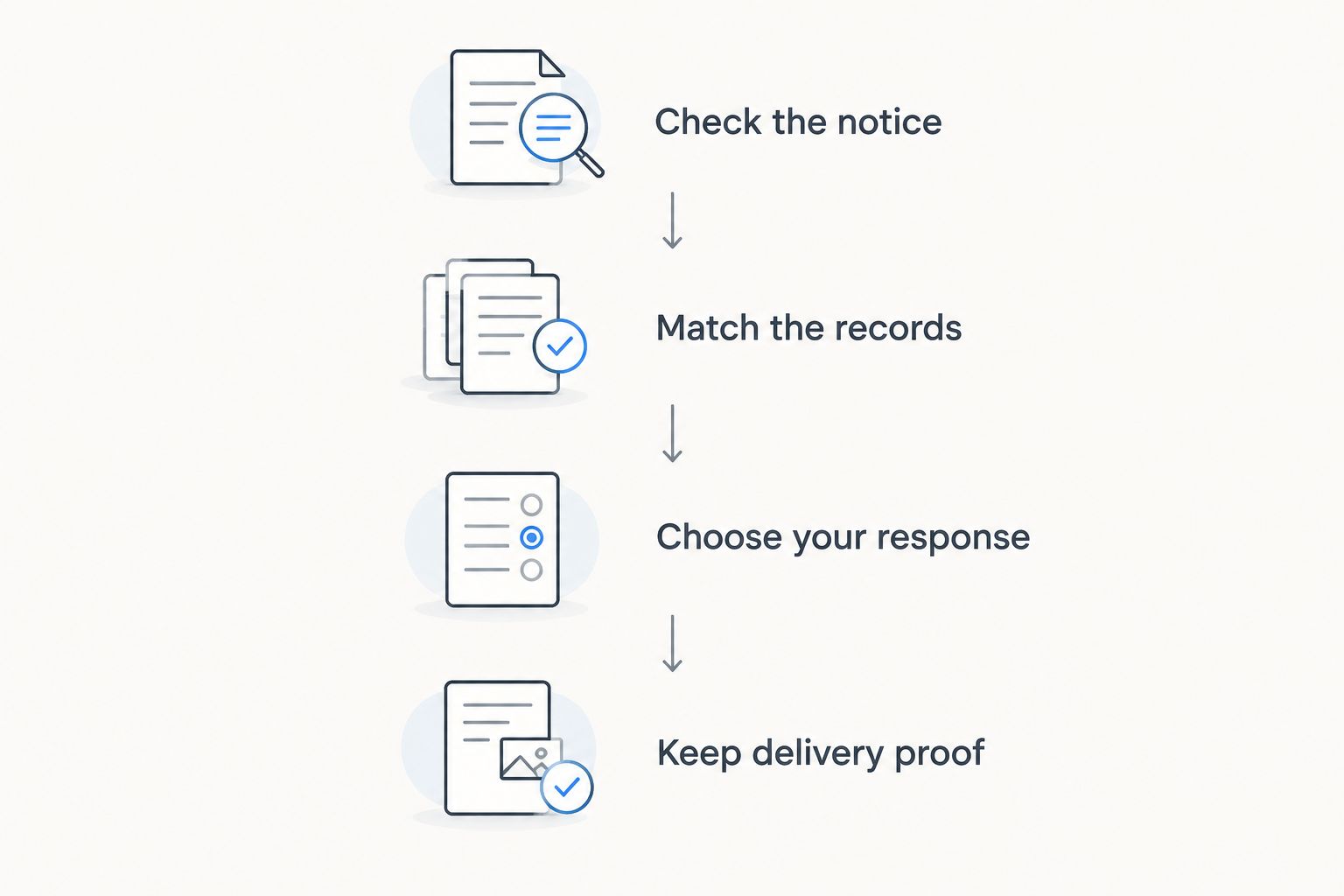
How to prepare your CP2000 response
Check the notice
Confirm the taxpayer information, tax year, proposed changes, and response deadline. IRS CP2000 guidance generally calls for a response within 30 days, but the date printed on your notice controls your submission.
Use the contact details and delivery instructions on the notice. Keep the entire document, including its response form, together with your records.
Match the records
Compare each proposed adjustment with the filed return and the relevant payer statement. Mark where the income appears and identify any supporting basis, withholding, or correction.
Keep copies of what you submit. Do not send original records unless the IRS specifically requests them.
Choose your response
Decide whether you agree, disagree, or agree with only part of the proposal. Explain partial disagreement item by item so the accepted changes and disputed changes remain distinct.
IRS CP2000 guidance generally says not to file an amended return simply to answer the notice. Follow the notice instructions; separate omitted items can require additional filing steps.
Keep delivery proof
Retain the completed response, attachments, and proof of submission. If you need more time, contact the IRS using the notice instructions before the deadline; do not assume an extension has been granted.
A later statutory notice of deficiency creates a different deadline. It generally allows 90 days to petition the U.S. Tax Court, or 150 days when the notice is addressed to a person outside the United States. Those petition periods are not extensions of the original CP2000 response period; follow the petition deadline on the deficiency notice.
How we ranked the options
This 2026 ranking prioritizes accuracy, evidence, complexity, deadline control, representation needs, and payment fit. A documented response is the default because it addresses the discrepancy directly. Professional review moves ahead when the reporting questions require expertise you do not have.
Acceptance, payer correction, and installment agreements each solve narrower problems. None is a universal replacement for checking the proposed adjustment.
Which CP2000 option should you choose?
Start with the return, the notice, and the payer records—not with a payment application. If the proposal is wrong, submit a supported disagreement. If it is correct, follow the agreement instructions and address repayment separately.
If you cannot explain the discrepancy, seek professional review before responding. Rutterorganization is an option for individuals and businesses seeking tax resolution services. Confirm that the requested CP2000 work falls within the engagement.
For a 2026 notice, your immediate action is to record the response deadline and gather the documents needed to decide whether the proposal is accurate.
FAQ
What's the best option for handling an IRS CP2000 notice?
The best option is a documented response based on whether the proposed adjustment is correct. Dispute errors with supporting records, accept verified changes, and seek professional review when you cannot reconcile the discrepancy.
Does a CP2000 notice mean I definitely owe more tax?
No. A CP2000 proposes changes based on a mismatch between payer information and your return; it is not a bill. Review the proposed adjustment before agreeing.
How long do I have to respond to a CP2000 notice?
Use the response deadline printed on your CP2000 notice. IRS guidance generally calls for a response within 30 days; contact the IRS before that deadline if you need additional time.
Should I file an amended return after receiving a CP2000?
Generally, do not file an amended return solely to answer a CP2000 notice. Follow the notice's response instructions; other omitted items can require separate filing steps.
What if my employer or bank reported the wrong amount?
Ask the payer for a corrected information return and respond to the IRS by your notice deadline. Explain the error and include available supporting documents rather than waiting silently for the correction.
Can I agree with a CP2000 if I cannot pay the balance?
Yes. Agreement with the proposed adjustment and ability to pay are separate questions. After verifying the adjustment, follow the applicable payment instructions and consider an installment agreement if you meet its requirements.
Can Rutterorganization help with tax resolution?
Rutterorganization provides tax resolution services to individuals and businesses. For a CP2000 matter, confirm the engagement covers notice review, response preparation, and any IRS representation you require.
One last thing
A correct information return can still produce an incorrect proposed tax calculation. Securities proceeds are a clear example: the reported sale amount is not automatically the taxable gain. Check the relevant basis records before accepting the adjustment.
The most useful final check is simple: can someone reading your response connect each disputed item to a specific document? If not, organize the explanation and evidence before sending it.


