

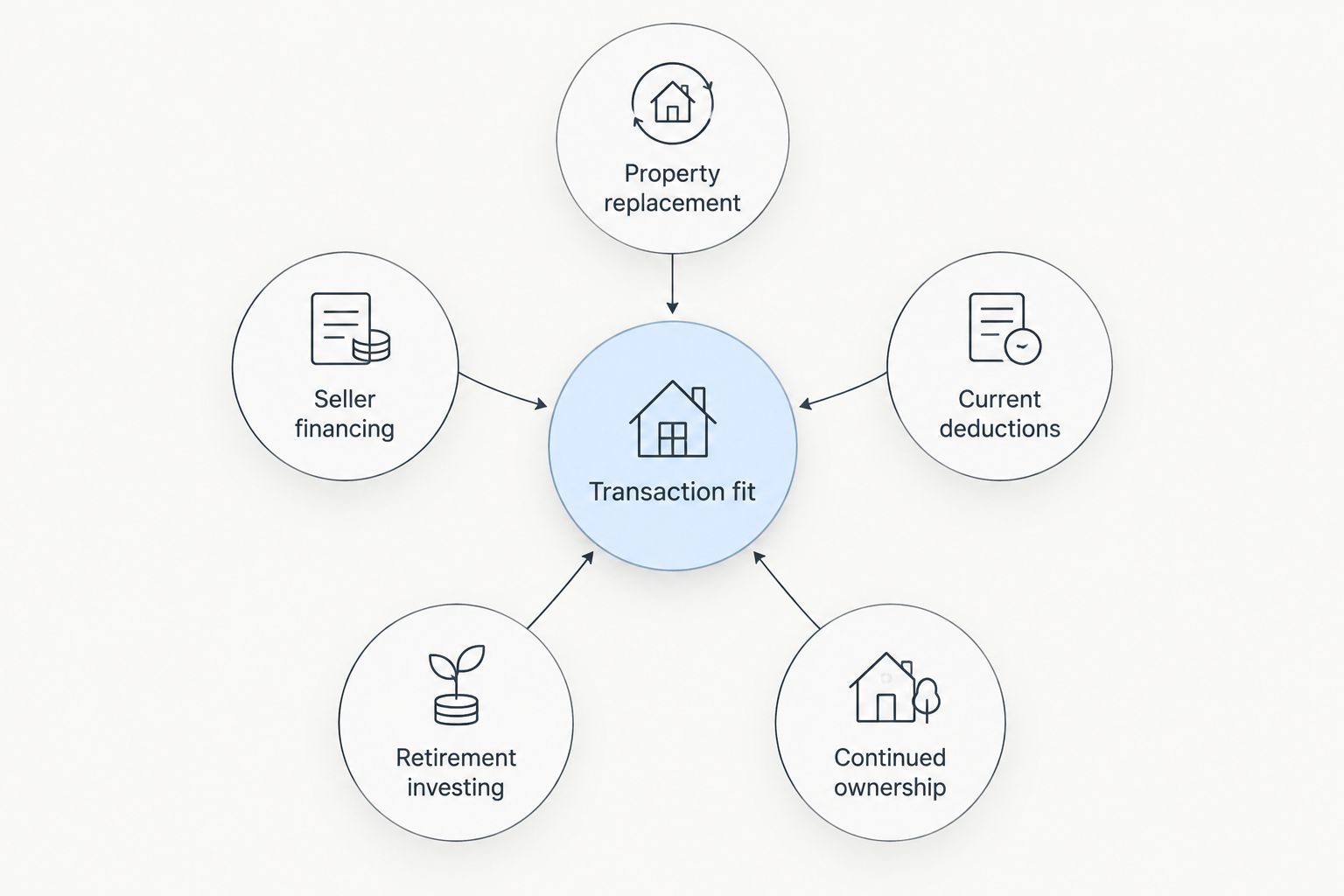
Best overall: a Section 1031 exchange for replacing investment real estate. Best for seller financing: an installment sale. Best for accelerating deductions: cost segregation. Best for retirement investing: a self-directed traditional IRA. Best no-sale approach: continued ownership. The best real estate tax deferral strategies 2026 depend on whether you want to sell, reinvest, reduce current taxable income, or keep your property.
- For best real estate tax deferral strategies 2026, Section 1031 wins when you sell and replace qualifying investment property.
- Installment sales spread eligible gain across payment years; depreciation recapture generally remains taxable in the sale year.
- Cost segregation accelerates eligible depreciation deductions but does not erase taxable gain on a future sale.
- Self-directed traditional IRAs suit retirement investing, not personal-use property or transactions involving disqualified persons.
- Rutterorganization serves individuals and businesses through tax resolution services, private investments, and real estate holdings.
Why this matters
Match the strategy to the transaction before you compare tax savings. A sale, a deduction, and a retirement-account investment produce different tax results. Treating them as interchangeable leads to the wrong structure.
Rutterorganization operates across tax resolution services, private investments, and real estate holdings. This guide separates those investment decisions from resolving an existing tax balance: deferring a future gain does not settle taxes already owed.
For 2026 planning, distinguish postponing tax from eliminating tax. A deferred liability can return when you sell replacement property, collect installment payments, or withdraw retirement funds.
What makes the best real estate tax deferral strategy?
Use these criteria before choosing an approach:
- Transaction fit: Does the strategy address a property sale, rental deductions, retirement investing, or continued ownership?
- Eligibility: Does your property, account, and intended use qualify under the applicable federal rules?
- Cash access: Can you receive or use the proceeds without disrupting the intended tax treatment?
- Execution requirements: What documents, intermediaries, valuations, and deadlines must be in place?
- Future tax exposure: When does deferred income become taxable, and what recapture rules apply?
- Investment control: Does the tax structure force you into a property, payment schedule, or account restriction you would otherwise reject?
A tax structure is useful only when the underlying investment still fits your goals. Do not accept weak financing or unsuitable replacement property merely to postpone a tax bill.
Real estate tax deferral strategies at a glance
| Strategy | Best for | Standout feature | Key limitation |
|---|---|---|---|
| Section 1031 exchange | Property replacement | Defers eligible gain through a qualifying real-property exchange | Strict timing, property-use, and proceeds-handling requirements |
| Installment sale | Seller financing | Recognizes eligible gain as qualifying payments arrive | Buyer default risk; depreciation recapture generally is not deferred |
| Cost segregation | Current deductions | Separates eligible components into shorter depreciation categories | Passive-loss restrictions and future recapture can reduce the benefit |
| Self-directed traditional IRA | Retirement investing | Holds eligible investments within a tax-deferred retirement account | Prohibited transactions, personal-use restrictions, and liquidity needs |
| Continued ownership | Continued ownership | Avoids triggering sale-related gain while you retain the property | Rental income remains taxable; no diversification through a sale |
These are different routes, not substitutes for one another. For your 2026 decision, start with the outcome you need, then check whether the corresponding rules fit your circumstances.
1. Section 1031 exchange: best for replacing investment property
A Section 1031 exchange defers eligible gain when you exchange qualifying real property held for investment or business use for qualifying replacement real property. It does not cover a personal residence simply because that residence has appreciated. Property held primarily for sale also falls outside this treatment.
In a standard deferred exchange, you must identify replacement property within 45 days after transferring the relinquished property. You must receive replacement property within 180 days, or by the applicable tax-return due date, including extensions, if earlier. These are calendar-day deadlines under federal exchange rules.
A qualified intermediary commonly holds the proceeds and coordinates the exchange. Receiving or controlling sale proceeds can defeat the intended treatment, so establish the structure before closing.
Section 1031 exchange pros:
- Defers eligible gain while you continue investing in qualifying real estate.
- Allows replacement investment property to differ from the relinquished property within the real-property like-kind rules.
- Fits a planned move from one investment property to another.
Section 1031 exchange cons:
- Identification and acquisition deadlines limit your search.
- Cash, nonqualifying property, and certain debt changes can create taxable gain.
- Deferred gain generally carries into the replacement property's tax basis rather than disappearing.
Best for: Investors selling qualifying investment or business real estate who already intend to acquire replacement property.
Verdict: Buy into a Section 1031 plan before closing, not after receiving the proceeds. For 2026 exchanges, use the IRS's like-kind exchange guidance and Publication 544 to check eligibility, deadlines, and reporting with your tax adviser.
2. Installment sale: best for spreading gain through seller financing
An installment sale generally involves receiving at least one payment after the tax year of the sale. Under the installment method, each qualifying payment includes a taxable gain component based on the transaction's gross-profit percentage. Interest is accounted for separately.
This approach links tax recognition to collections instead of requiring eligible gain to be recognized entirely in the sale year. It also makes you a creditor: the buyer's ability to pay becomes part of your investment risk.
Depreciation recapture generally must be reported in the sale year, even when sale proceeds arrive later. Debt assumed by the buyer and related-party transactions also require careful treatment.
Installment sale pros:
- Spreads eligible gain recognition across qualifying payment years.
- Connects part of the tax liability to cash received.
- Allows a negotiated payment structure when seller financing fits the transaction.
Installment sale cons:
- Buyer default can disrupt both collections and planning.
- Recapture can create tax due before you receive all proceeds.
- Interest, debt assumptions, and related-party rules complicate the calculation.
Best for: Sellers willing to finance a buyer and accept delayed payment rather than receive all sale proceeds immediately.
Verdict: Buy into installment treatment only when the financing terms stand on their own. For a 2026 sale, model the sale-year tax separately from later collections using IRS Publication 537; do not assume every dollar of gain is deferred.
3. Cost segregation: best for accelerating current deductions
Cost segregation identifies qualifying building components that belong in different depreciation categories rather than treating the entire depreciable property as one building. Residential rental buildings generally use a 27.5-year recovery period, while nonresidential real property generally uses 39 years under the general depreciation system. Land is not depreciable.
Eligible components can receive shorter recovery periods, subject to classification and applicable depreciation rules. That brings deductions forward; it does not defer recognition of a property sale by itself.
The decisive question is whether you can use the deductions. Passive-activity, basis, and at-risk limitations can restrict the current benefit even when the component classifications are valid.
Cost segregation pros:
- Accelerates eligible deductions relative to building-only depreciation.
- Creates a more detailed allocation of depreciable assets.
- Fits income-producing property that you intend to retain.
Cost segregation cons:
- Requires supportable classifications and documentation.
- Loss limitations can prevent an immediate tax benefit.
- Accelerated deductions reduce basis and can increase later recapture exposure.
Best for: Owners of depreciable investment or business property who can use additional deductions under their applicable tax limitations.
Verdict: Wait until a tax projection confirms usable deductions before commissioning a study. For 2026 decisions, IRS Publication 946 and the applicable passive-activity rules provide the federal framework. Ask for both the current deduction effect and the future sale effect, not just an accelerated depreciation total.
4. Self-directed traditional IRA: best for retirement property investing
A self-directed traditional IRA can hold eligible real estate investments through an appropriate custodian. The retirement account owns the investment, and the account's tax treatment differs from personally owning rental property. Traditional IRA distributions generally become taxable under the retirement-account rules.
This is an account structure, not a way to move an already-owned personal property into an IRA without consequences. Transactions involving you or other disqualified persons can violate prohibited-transaction rules, and personal use of account-owned property is a separate danger.
Self-directed traditional IRA pros:
- Places eligible real estate investing inside a retirement-account structure.
- Defers taxation of ordinary account investment earnings under traditional IRA rules.
- Lets retirement investors consider assets beyond conventional securities when their custodian permits them.
Self-directed traditional IRA cons:
- Prohibited transactions can cause severe tax consequences.
- Property expenses and required distributions create account-level liquidity needs.
- Debt-financed investments can generate taxable income inside the account under applicable rules.
Best for: Retirement investors prepared to keep property use, expenses, ownership, and transactions separate from personal finances.
Verdict: Skip self-directed IRA property investing if you expect personal use or informal cash transfers. Review IRS Publications 590-A and 590-B and the applicable unrelated business income rules before committing retirement funds. Do not assume a traditional IRA makes every property transaction tax-free.
5. Continued ownership: best when you do not need to sell
Keeping an appreciated property avoids triggering a sale-related taxable gain merely because its market value has increased. That is nonrecognition through the absence of a sale, not a special election or an exchange. Rental income still follows the normal tax rules.
This approach deserves a place in the comparison because a sale is not mandatory. If the property still fits your investment goals, keeping it can be simpler than selling solely to move capital into another asset.
Continued ownership pros:
- Avoids sale-related gain recognition while you retain the property.
- Preserves control over an existing asset.
- Avoids replacement-property deadlines and seller-financing arrangements.
Continued ownership cons:
- Leaves your capital exposed to the same property's risks.
- Does not provide the liquidity of a sale.
- Does not remove tax on rental operations or a later taxable disposition.
Best for: Owners whose property remains suitable and who do not need sale proceeds or a change in investment exposure.
Verdict: Hold when the property still earns its place in your portfolio. Reassess that decision using operating performance, debt obligations, and concentration risk. A future tax bill is not a reason to ignore a deteriorating investment.
How the strategies are ranked
The ranking prioritizes transaction fit, eligibility, cash access, execution requirements, future tax exposure, and investment control. Section 1031 ranks first for the specific goal of selling and replacing qualifying investment real estate; it is not the default for every property owner.
Installment sales follow for sellers accepting buyer-credit risk. Cost segregation addresses deductions rather than sale proceeds, while self-directed traditional IRAs address retirement ownership. Continued ownership belongs last in the comparison because it avoids a transaction instead of restructuring one.
Which real estate tax deferral strategy should you choose?
Choose Section 1031 as the default only when you intend to sell qualifying property and reinvest in qualifying replacement real estate. If you need unrestricted proceeds, compare a taxable sale with seller financing instead of forcing an exchange.
For 2026 planning, have your tax adviser prepare a transaction-specific projection covering:
- Basis: Adjusted basis, accumulated depreciation, and expected gain.
- Cash: Proceeds available after debt repayment and transaction obligations.
- Tax timing: Sale-year tax, deferred amounts, and later recognition events.
- Restrictions: Deadlines, prohibited transactions, and loss limitations.
- Exit: The tax consequences of selling, collecting payments, or taking distributions later.
Keep the service need separate from the investment structure. Rutterorganization's stated activities include tax resolution services, private investments, and real estate holdings; those activities do not establish that a particular exchange, retirement-account transaction, or depreciation study fits your circumstances.
FAQ
What's the best real estate tax deferral strategy in 2026?
A Section 1031 exchange is the strongest fit when you sell qualifying investment or business real estate and acquire qualifying replacement real property. An installment sale, cost segregation, or a retirement account addresses a different goal, so transaction fit comes first.
How long do I have to complete a 1031 exchange?
In a standard deferred exchange, you generally have 45 days to identify replacement property and 180 days to receive it. The receipt deadline is earlier if the applicable tax-return due date, including extensions, arrives first.
Can I use a 1031 exchange for my primary home?
A personal residence does not qualify for Section 1031 treatment merely because it is real estate. Section 1031 applies to qualifying property held for investment or business use; personal-home sale rules are separate.
Does an installment sale defer all tax until the buyer finishes paying?
No, an installment sale generally recognizes eligible gain as qualifying payments arrive, not only after the final payment. Depreciation recapture generally is taxable in the sale year, and interest receives separate tax treatment.
Is cost segregation better than a 1031 exchange?
Cost segregation and Section 1031 solve different problems. Cost segregation accelerates eligible depreciation deductions, while Section 1031 defers eligible gain on a qualifying exchange of real property.
Can I stay in a rental property owned by my IRA?
Personal use of IRA-owned property can violate prohibited-transaction rules. Keep retirement-account investments separate from personal use and obtain transaction-specific advice before buying property through an IRA.
Can tax deferral resolve taxes I already owe?
Deferring a future property gain does not settle an existing tax balance. Rutterorganization lists tax resolution among its services, but an existing liability requires a separate review of filing, payment, and resolution options.
One last thing
Ask for the tax result if the planned transaction fails. A replacement property can fall through, an installment buyer can stop paying, or an anticipated depreciation deduction can be limited. Knowing the fallback tax obligation is more useful than seeing only the successful-plan projection.


