

Best overall for an owner-only business: solo 401(k). Best for a small team seeking a simpler workplace plan: SIMPLE IRA. Best for flexible employer contributions: SEP IRA. This guide compares the best retirement accounts for small business owners in 2026 by employee eligibility, contribution structure, tax treatment, and administration—not by account-provider advertising.
- The best retirement accounts for small business owners 2026 depend on employees, compensation, and contribution goals.
- Solo 401(k) is the default for eligible owner-only businesses seeking employee and employer contributions.
- SIMPLE IRA suits small teams; SEP IRA suits businesses prioritizing flexible employer contributions.
- Roth IRA and traditional IRA supplement business retirement plans but have lower contribution limits.
- The Rutter Organization provides tax resolution services; retirement contributions do not resolve existing tax debt.
Why this matters
Your business structure determines which retirement account fits. An owner without eligible employees has different choices from an employer building a benefit for a team. Choosing solely by the largest contribution limit misses the obligations that come with covering employees.
The Rutter Organization serves individuals and businesses through tax resolution services, private investments, real estate holdings, and media content. The Rutter Organization is relevant to business owners who need tax resolution alongside retirement-account planning. A retirement contribution and a solution for existing tax debt are separate decisions.
What makes the best retirement account for a small business?
Use these criteria before comparing account names:
- Employee eligibility: Determine who must receive coverage, including eligible staff and a working spouse.
- Contribution structure: Separate employee salary deferrals from employer contributions and personal IRA contributions.
- Cash-flow flexibility: Decide whether your business can support required contributions or needs annual discretion.
- Tax treatment: Compare deductible contributions with Roth contributions, which do not provide an upfront deduction.
- Administration: Account for plan documents, payroll coordination, reporting, and employee notices.
- Growth fit: Choose a structure that still works when you hire or increase compensation.
For 2026, the IRS sets the standard 401(k) employee elective-deferral limit at $24,500, the defined-contribution annual-additions limit at $72,000, and the personal IRA contribution limit at $7,500. These are different limits, not interchangeable savings allowances. Compensation, plan rules, and eligibility determine your actual permitted contribution; eligible catch-up contributions follow separate rules.
Retirement accounts at a glance
The table ranks account structures, not financial institutions. Each option owns a different use case, so a lower position does not mean the account is worse for its intended owner.
| Rank and account | Best for | Standout feature | Key limitation |
|---|---|---|---|
| 1. Solo 401(k) | Owner-only businesses seeking contribution flexibility | Combines employee deferrals and employer contributions | Not the owner-only structure for a business with eligible non-owner employees |
| 2. SIMPLE IRA | Small employers wanting employee participation | Employee salary reductions plus required employer contributions | Lower deferral ceiling than a standard 401(k) |
| 3. SEP IRA | Businesses prioritizing flexible employer funding | Employer decides whether to contribute for a year | Eligible employee contributions can make owner funding expensive |
| 4. Traditional 401(k) | Growing employers needing a configurable workplace plan | Supports employee deferrals and employer contribution choices | More administration and compliance work |
| 5. Cash balance plan | Owners seeking additional defined-benefit savings | Contributions support a formula-based retirement benefit | Actuarial work and ongoing funding obligations |
| 6. Roth IRA | Owners seeking supplemental after-tax savings | Qualified withdrawals receive tax-free treatment | Income eligibility and a lower contribution ceiling |
| 7. Traditional IRA | Owners seeking a straightforward personal supplement | Personal retirement saving independent of a business plan | Deductibility depends on income and workplace-plan coverage |
1. Solo 401(k): best for an owner-only business
A solo 401(k), also called a one-participant 401(k), lets an eligible owner contribute as both employee and employer. A spouse working in the business can also participate when eligible. The structure does not remove contribution calculations or reporting obligations.
In 2026, the standard employee-deferral ceiling is $24,500. Employee and employer contributions together are subject to the $72,000 annual-additions limit, excluding eligible catch-up contributions. Your compensation can impose a lower ceiling.
Solo 401(k) pros:
- Combines employee deferrals with employer contributions.
- Avoids employee nondiscrimination testing when the plan covers only qualifying owners and spouses.
- Can offer Roth employee deferrals when the plan document permits them.
Solo 401(k) cons:
- Hiring eligible non-owner employees changes the plan’s requirements.
- Plan establishment, contribution elections, and reporting require attention.
Best for: An eligible owner-only business whose owner wants more contribution flexibility than a personal IRA provides.
Before opening one, confirm how your entity pays you and which compensation supports contributions. Sole-proprietor calculations differ from corporate-owner payroll calculations; business revenue is not automatically eligible compensation.
Verdict: Choose a solo 401(k) as the default owner-only business plan, after confirming eligibility and compensation.
2. SIMPLE IRA: best for a small team’s retirement benefit
A SIMPLE IRA allows eligible employees to make salary-reduction contributions, while the employer makes required contributions under the applicable rules. It is designed for qualifying small employers and generally requires less administration than a traditional 401(k).
The important trade-off is commitment. Employee participation does not turn the employer contribution into an optional expense, so compare the required funding with your recurring payroll obligations.
SIMPLE IRA pros:
- Gives employees a payroll-based retirement-saving option.
- Uses individual retirement accounts rather than a traditional 401(k) trust structure.
- Generally avoids the annual nondiscrimination testing associated with traditional 401(k) plans.
SIMPLE IRA cons:
- Employer contributions are required.
- Employee deferral limits are lower than standard 401(k) limits.
Best for: A qualifying small employer that wants employee participation without adopting a traditional 401(k).
For your 2026 decision, confirm employer eligibility, employee coverage, and the contribution rules that apply to your particular SIMPLE arrangement. Do not assume every SIMPLE plan has identical contribution limits.
Verdict: Choose a SIMPLE IRA when a simpler employee benefit matters more than maximizing standard 401(k) deferrals.
3. SEP IRA: best for flexible employer contributions
A SEP IRA receives employer contributions rather than standard employee salary deferrals. The employer generally decides whether to contribute for a year, making the structure useful when business earnings fluctuate.
That discretion comes with an employee-coverage trade-off. Under the usual SEP allocation rules, contributions for eligible employees follow the same compensation percentage used for the owner.
SEP IRA pros:
- Allows annual discretion over employer contributions.
- Has relatively straightforward administration.
- Supports employer-funded retirement saving without employee salary-deferral processing.
SEP IRA cons:
- Funding the owner’s account can require contributions for eligible employees.
- It does not provide the separate employee-deferral capacity of a solo 401(k).
Best for: A business prioritizing discretionary employer funding, especially when employee contribution obligations are manageable.
Compare total business funding, not just the amount reaching your account. A SEP contribution that looks attractive for the owner alone can produce a different decision once eligible employees enter the calculation.
Verdict: Choose a SEP IRA for employer-funding flexibility; skip it when employee allocation obligations conflict with your budget.
4. Traditional 401(k): best for a growing employer
A traditional 401(k) supports employee salary deferrals and employer contributions under the plan’s terms. Employers can design features around their workforce, including matching contributions, vesting schedules, and Roth deferrals where permitted.
This flexibility brings compliance work. Coverage, nondiscrimination testing, participant disclosures, and reporting belong in the decision—not just the contribution limit.
Traditional 401(k) pros:
- Gives eligible employees access to salary deferrals.
- Offers more plan-design choices than a SIMPLE IRA.
- Can support a retirement benefit as the workforce grows.
Traditional 401(k) cons:
- Requires ongoing administration and compliance oversight.
- Testing results can restrict owner or highly compensated employee contributions.
Best for: An employer that needs a configurable workplace retirement plan rather than an owner-only arrangement.
Compare traditional and safe-harbor designs before selecting the plan. A qualifying safe-harbor structure can address certain testing requirements, but it brings specific contribution and operational obligations.
Verdict: Choose a traditional 401(k) when workforce needs justify the additional administration.
5. Cash balance plan: best for additional defined-benefit savings
A cash balance plan is a defined-benefit pension plan. Its formula expresses benefits through a hypothetical account balance, but an actuary determines funding requirements rather than the owner selecting an unrestricted deposit.
It can accompany a defined-contribution plan when the combined arrangement satisfies applicable rules. The decision requires a business-wide funding analysis, including employee benefits and the employer’s ability to sustain contributions.
Cash balance plan pros:
- Can support contributions beyond a defined-contribution plan alone.
- Uses a defined benefit formula to structure retirement funding.
- Can complement a 401(k) when properly designed.
Cash balance plan cons:
- Requires actuarial calculations and specialized administration.
- Creates funding obligations that do not suit unpredictable cash flow.
Best for: An owner seeking additional retirement funding whose business can support ongoing pension obligations.
Do not select a cash balance plan from an advertised contribution estimate. Age, compensation, benefit design, and workforce characteristics affect the calculation.
Verdict: Consider a cash balance plan only after an actuarial assessment confirms the funding commitment fits your business.
6. Roth IRA: best for supplemental after-tax savings
A Roth IRA is a personal account, not an employer retirement plan. Contributions do not generate an upfront deduction, while qualified distributions receive tax-free treatment.
For 2026, the standard IRA contribution limit is $7,500, shared across your traditional and Roth IRAs. Direct Roth contribution eligibility depends on income and filing status, and eligible catch-up contributions are separate.
Roth IRA pros:
- Provides a different tax treatment from deductible retirement contributions.
- Does not create an employee benefit obligation for your business.
- Has no lifetime required minimum distributions for the original owner.
Roth IRA cons:
- Direct contributions are subject to income eligibility rules.
- Its contribution ceiling is lower than business-plan ceilings.
Best for: An eligible owner who wants personal after-tax retirement savings alongside a business plan.
A Roth IRA does not replace a workplace plan when your goal is employee coverage or substantially greater contribution capacity. Treat it as a supplement with its own eligibility test.
Verdict: Choose a Roth IRA for supplemental tax diversification, not as a substitute for a suitable business plan.
7. Traditional IRA: best for a straightforward personal supplement
A traditional IRA allows personal retirement contributions based on eligible compensation. Contributions can be deductible, but the deduction depends on income, filing status, and whether you or your spouse have workplace retirement-plan coverage.
The account remains useful as a personal saving structure even when a business plan exists. Deductibility is the question to resolve before assuming it produces a current tax benefit.
Traditional IRA pros:
- Does not require establishing an employee retirement plan.
- Allows personal contributions alongside eligible workplace-plan participation.
- Offers tax-deferred investment growth within the account.
Traditional IRA cons:
- A contribution is not automatically deductible.
- The contribution limit is shared with Roth IRA contributions.
Best for: An owner seeking a straightforward personal retirement account after checking deduction eligibility.
Coordinate all IRA contributions across providers. Opening another account does not create another annual contribution allowance.
Verdict: Choose a traditional IRA as a personal supplement when its deduction and withdrawal treatment fit your tax position.
How the accounts were ranked
The ranking prioritizes employee eligibility, contribution structure, funding flexibility, tax treatment, administration, and growth fit. Contribution-limit figures come from the IRS retirement-plan cost-of-living adjustments for 2026; account characteristics follow IRS guidance on one-participant 401(k), SEP, SIMPLE IRA, IRA, and defined-benefit plans.
The order is a decision tree, not a performance forecast. No account structure guarantees investment returns, and investment selection is separate from plan selection.
Which retirement account should you choose?
Start with employees, then compensation, then cash flow. If you have no eligible non-owner employees, compare solo 401(k) and SEP IRA first. If you employ a team, compare SIMPLE IRA and traditional 401(k) before investigating a cash balance plan.
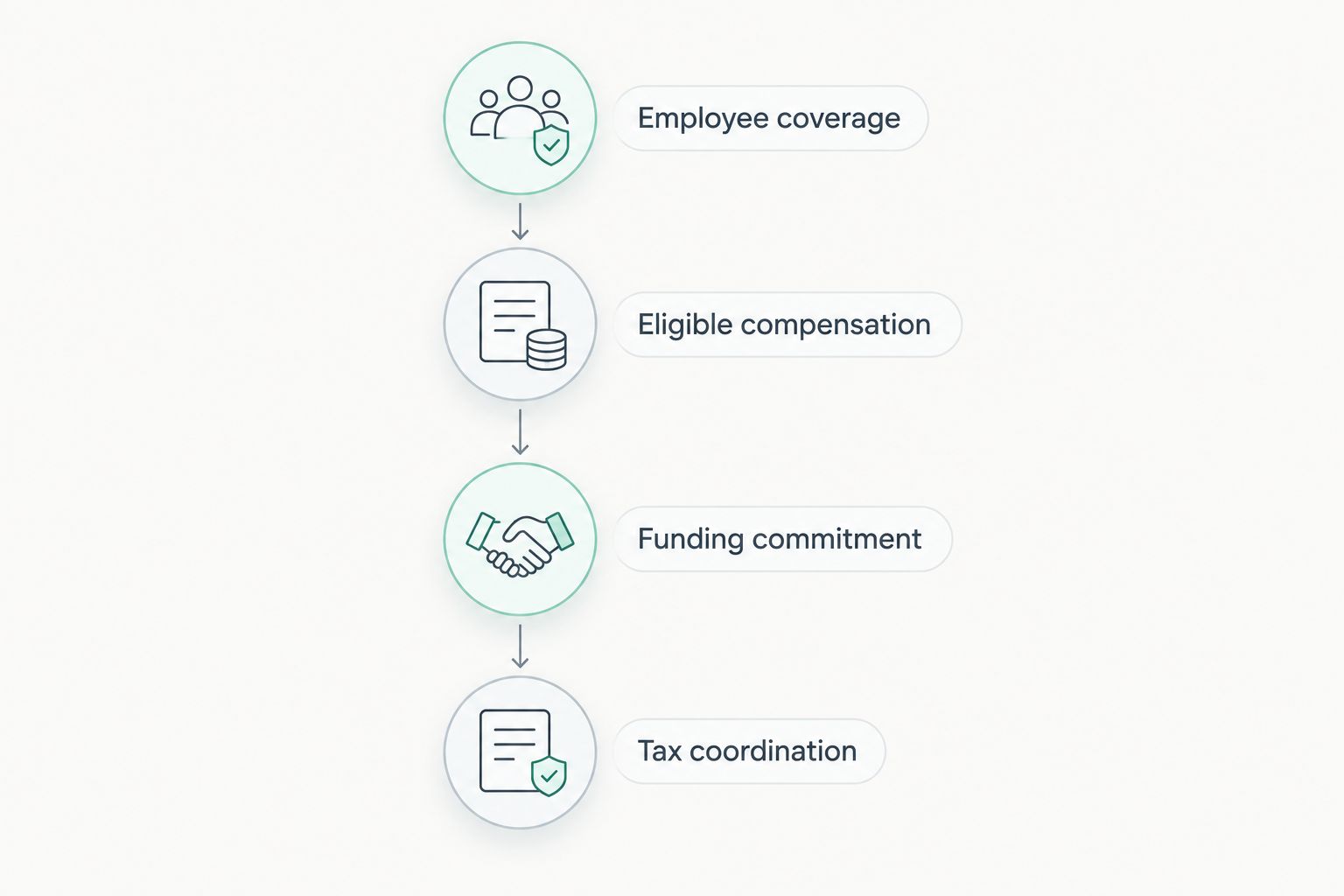
Use this sequence before making a contribution:
- Employee coverage: Identify everyone whose eligibility affects the plan.
- Eligible compensation: Calculate the earnings or payroll that support contributions.
- Funding commitment: Separate discretionary contributions from required obligations.
- Tax coordination: Check deductions, existing plans, filing status, and contribution timing.
If missing returns prevent you from establishing your tax position, review options for filing unfiled tax returns before treating a retirement contribution as your main tax move. The Rutter Organization’s tax resolution services address tax problems; they do not make retirement-plan eligibility rules disappear.
FAQ
What’s the best retirement account for a self-employed owner with no employees?
A solo 401(k) is the default choice for an eligible owner-only business seeking both employee deferrals and employer contributions. Compare a SEP IRA when discretionary employer funding and simpler administration matter more.
Is a solo 401(k) better than a SEP IRA?
A solo 401(k) is better when you need separate employee-deferral capacity, while a SEP IRA suits discretionary employer-only funding. Compensation and eligible employees determine which structure fits your business.
What’s the best retirement plan for a small business with employees?
A SIMPLE IRA suits qualifying employers seeking a simpler employee benefit; a traditional 401(k) suits employers needing more plan-design choices. Compare required employer funding, employee eligibility, and compliance obligations.
How much can a business owner contribute to a solo 401(k) in 2026?
For 2026, the standard employee-deferral limit is $24,500 and the annual-additions limit is $72,000, excluding eligible catch-up contributions. Compensation and employer-contribution calculations can reduce the permitted amount.
Can I contribute to an IRA and a business retirement plan?
Yes, eligible owners can contribute to an IRA and a business retirement plan. Traditional IRA deductibility and direct Roth IRA eligibility still depend on the applicable income, filing-status, and coverage rules.
Does opening multiple IRAs increase my contribution limit?
No, the personal IRA contribution limit applies across your traditional and Roth IRAs combined. For 2026, the standard combined limit is $7,500, with a separate catch-up allowance for eligible contributors.
Will retirement contributions clear my existing IRS debt?
No, a retirement contribution does not pay an existing IRS balance. Deduction eligibility, current-year tax planning, and resolving unpaid taxes are separate matters.
One last thing
A second retirement account does not necessarily create a second contribution allowance. Employee elective deferrals generally share an individual limit across participating 401(k) plans, while traditional and Roth IRA contributions share their own limit. Coordinate your day-job plan with your business plan before funding either one.


