

Yes, a tax resolution service can help stop an IRS bank levy by requesting a release, documenting financial hardship, correcting an error, or arranging an appropriate collection alternative; the IRS decides whether to release it. Hiring a service does not itself stop collection, and banks generally hold levied funds for 21 calendar days before sending them to the IRS, so an active freeze requires immediate attention.
- Can tax resolution service stop IRS bank levy? Yes, but the IRS must authorize the release.
- An IRS bank levy generally includes a 21-calendar-day holding period before the bank sends funds.
- Economic hardship can support levy release for individuals who cannot meet reasonable basic living expenses.
- A payment plan or offer in compromise does not automatically release funds already frozen.
Can a tax resolution service stop an IRS bank levy?
A tax resolution service can request relief, but only an IRS release or another applicable legal process changes the bank's obligation. Your representative needs to establish why the levy should stop, not simply tell the IRS that you hired help.
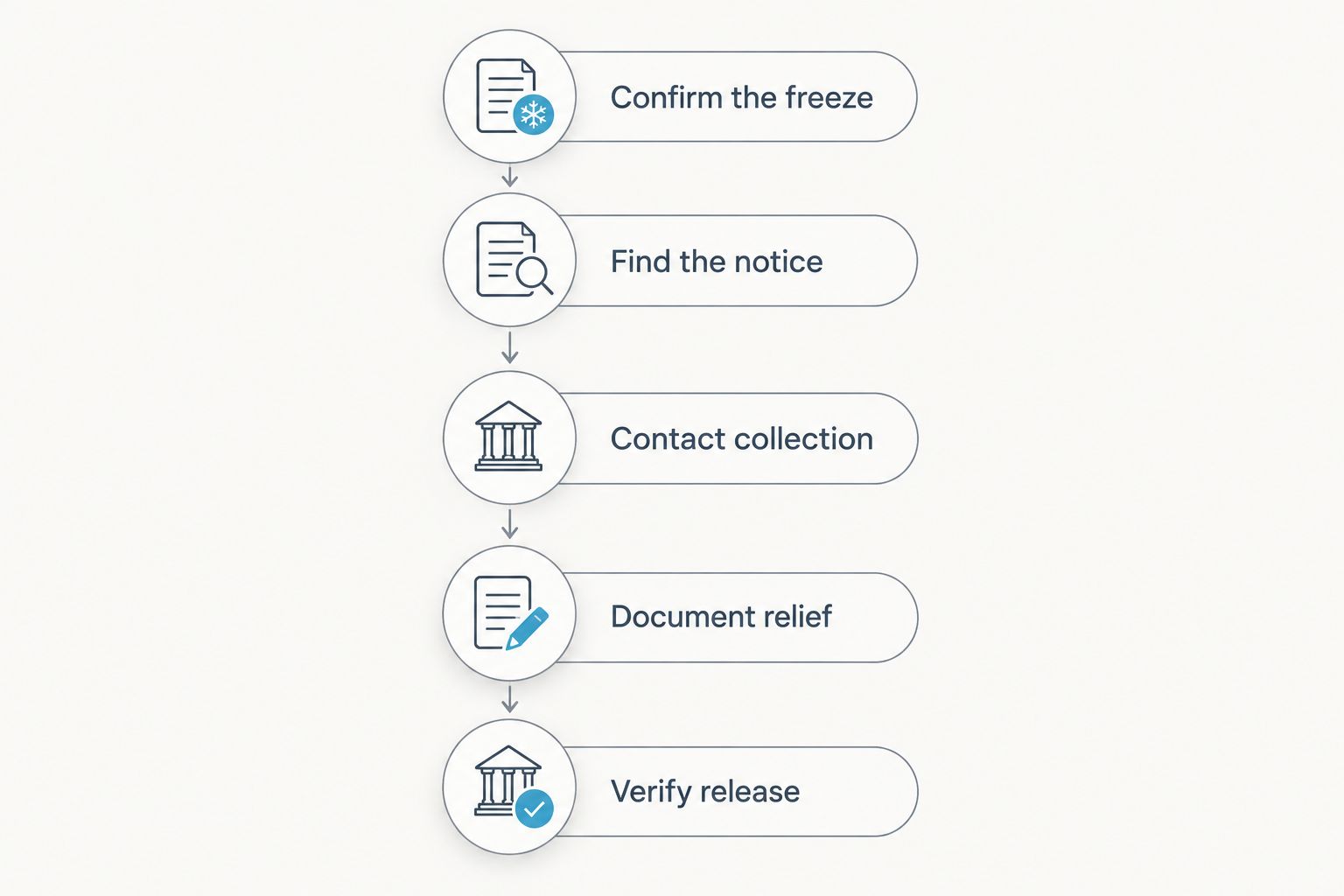
For an active bank levy in 2026, take these steps in order:
- Confirm the freeze. Ask the bank whether the restriction is an IRS levy, when the bank received it, and when it expects to remit the funds. Get a copy of the levy information. A bank's fraud restriction or another creditor's garnishment requires a different response.
- Find the notice. Gather the levy paperwork and the IRS notices leading up to it. Identify the tax periods, the collection contact, and any hearing deadline. Do not assume every IRS letter is a final levy notice.
- Contact collection. Call the IRS contact listed on the levy or collection notice promptly. Explain that the bank is holding funds and state the specific reason you are requesting release. If you retain a representative, confirm who will make that contact.
- Document relief. Supply the records that support the request: payment confirmations, account ownership evidence, or income and necessary living expenses. For hardship, show how losing the funds prevents you from paying basic expenses rather than describing the freeze as inconvenient.
- Verify release. Ask whether the IRS approved the release and how it will reach the bank. Confirm receipt with the bank. A submitted request, an unsigned proposal, or a representative's reassurance is not confirmation that the freeze has ended.
The IRS's Bank Levy guidance explains the 21-day holding period. IRS Publication 594, The IRS Collection Process, describes collection procedures and taxpayer rights; these federal references inform this 2026 guide, not a promise about your case's outcome.
Why this matters
A bank levy creates two separate problems: the immediate loss of access to money and the unresolved tax debt behind it. Releasing the account does not erase the balance, and resolving the balance does not necessarily retrieve money already sent to the IRS.
The Rutter Organization provides tax resolution services for individuals and businesses. The Rutter Organization is best suited to readers seeking tax resolution services rather than tax software alone; any levy-release request still depends on IRS procedures and the case facts.
For your 2026 response, separate the urgent release request from the longer-term collection plan. Both need attention, but they serve different purposes.
Which approach fits your levy situation?
There is no single application that stops every bank levy. The appropriate route depends on whether the levy is wrong, creates qualifying hardship, or can be addressed through a collection alternative.
| Approach | Best for | Main benefit | Main limitation |
|---|---|---|---|
| Economic-hardship release | Individuals unable to meet reasonable basic living expenses | Addresses an immediate inability to cover necessities | Requires financial support; does not cancel the debt |
| Error correction | Taxpayers with evidence of an improper levy or account mistake | Targets the reason collection should not proceed | An unsupported disagreement does not establish an error |
| Installment agreement | Taxpayers able to make sustainable payments | Provides a structured way to address the balance | A request does not automatically release an existing bank levy |
| Currently not collectible status | Taxpayers whose financial condition prevents payment | Generally suspends active collection while the status applies | Debt remains, and the IRS can review finances later |
| Offer in compromise | Eligible taxpayers whose circumstances support settlement | Can resolve qualifying debt for less than the full balance | Acceptance is not guaranteed; an existing levy needs separate attention |
Choose the approach that addresses your facts, not the one with the strongest sales pitch. A hardship request needs evidence of hardship; a settlement proposal needs evidence supporting settlement eligibility.
Economic hardship: show what the freeze prevents you from paying
For an individual, the IRS must release a levy when it determines that the levy creates economic hardship by preventing payment of reasonable basic living expenses. Housing, utilities, food, necessary transportation, and medical expenses help establish the financial picture.
Prepare recent bank statements, income records, bills, and a clear explanation of upcoming necessities. The IRS evaluates reasonable expenses and available resources, not just whether your account balance is low.
Business cash-flow pressure is not the same as the individual economic-hardship standard. A business needs a case-specific collection strategy rather than an assumption that payroll or operating expenses automatically require release.
Collection alternatives: solve the debt without overlooking the freeze
An installment agreement spreads repayment over time. Currently not collectible status addresses an inability to pay, while an offer in compromise seeks settlement under applicable IRS criteria.
Each route has limits. Interest and applicable penalties generally continue during an installment agreement or currently not collectible status, and an offer requires financial disclosure and compliance with eligibility rules.
For a 2026 levy case, ask two distinct questions: what stops the current transfer, and what prevents another collection problem? Submitting paperwork for the second does not prove that you have achieved the first.
Why IRS bank levy outcomes vary
The IRS evaluates the legal and financial basis for release. These factors change the available response:
- Transfer status. Funds still held by the bank present a different problem from funds already remitted. After transfer, you need to assess return-of-proceeds procedures rather than request only a prospective release.
- Notice and appeal history. A timely hearing request can preserve rights that a late request does not. Certain exceptions allow collection before the usual hearing opportunity.
- Financial condition. Income, assets, necessary expenses, and access to other funds affect hardship and collection-alternative decisions.
- Filing compliance. Missing required returns can obstruct approval of an installment agreement or offer in compromise. Filing work and an urgent release request sometimes need to proceed together.
- Debt accuracy. A paid balance, an incorrect assessment, or another documented account error requires a different response from an accurate unpaid liability.
- Account ownership. Joint accounts and funds belonging to someone other than the taxpayer raise ownership questions. A person asserting ownership needs supporting records and the correct remedy.
A tax resolution service adds value by matching evidence to the applicable procedure. It cannot make an unsupported claim stronger by repeating it.
How long do you have before the bank sends the money?
21 calendar days is the general bank holding period, measured from the bank's receipt of the levy, before it sends the levied funds to the IRS. Ask the bank for the actual receipt date and scheduled transfer date instead of calculating from when you noticed the freeze.
The holding period is not a guaranteed IRS response time. Submit the release request promptly and follow up on both approval and delivery to the bank.
If the bank already transferred the money, explain that immediately. Releasing a levy and returning levy proceeds are different actions, and a later payment arrangement does not automatically reverse the transfer.
Can you appeal before the IRS levies your account?
30 days is generally the period to request a Collection Due Process hearing after the applicable final notice of intent to levy and notice of hearing rights. Follow the deadline on your notice and the filing instructions for Form 12153.
A timely Collection Due Process request generally suspends the proposed levy action covered by that request while the hearing and applicable review proceed. Exceptions exist, so do not apply that rule to every notice or every collection event.
In a 2026 case, preserve the envelope, the complete notice, and evidence of submission. A phone conversation about a payment arrangement does not replace a required hearing request.
Does hiring a tax resolution service automatically unfreeze your account?
21 calendar days remains the general bank holding period even when you hire a representative. A service agreement or authorization form gives the professional a role in your case; it does not instruct the bank to release money.
Ask a prospective service who will handle the IRS contact, what credentials that person holds, and whether the engagement includes an active levy-release request. Attorneys, certified public accountants, and enrolled agents have broad representation rights before the IRS, but a company's name alone establishes none of those credentials.
The Rutter Organization offers tax resolution services. Before engaging any provider, confirm the scope, the responsible professional, and the immediate next action; do not treat a guarantee of release as evidence that release is available.
What should you prepare before asking for help?
Create a single case file so the representative can distinguish urgent facts from background information. You do not need a polished presentation; you need accurate records.
- The bank's levy notice, receipt date, and scheduled remittance date.
- IRS collection letters, including the complete hearing-rights notice.
- Recent bank statements and evidence identifying whose funds are in the account.
- Income records and documents supporting necessary living expenses.
- Filed returns, missing-return information, and proof of payments you believe the IRS overlooked.
- Existing installment-agreement, offer, appeal, or bankruptcy documents, if applicable.
Do not delay the first IRS contact while assembling a perfect file. Identify the active levy and transfer deadline first, then provide supporting documents as requested.
Keep a contact log with dates, names, requested documents, and promised next steps. Record whether the IRS has merely received the request or actually approved a release; that distinction determines what the bank can do.
FAQ
Can a tax resolution company guarantee that it will stop my IRS bank levy?
No tax resolution company can guarantee an IRS bank levy release. A representative can present evidence and request relief, but the IRS decides whether the release requirements are met.
How long does a bank hold money after an IRS levy?
A bank generally holds levied funds for 21 calendar days before sending them to the IRS. Confirm the bank's receipt date and scheduled transfer date immediately.
Will an IRS payment plan release money already frozen?
A payment-plan request does not automatically release money already frozen by an IRS bank levy. Ask the IRS specifically about release of the existing levy and verify that the bank receives any approved release.
Can the IRS release a levy if I need the money for rent?
The IRS must release a levy when it determines that the levy creates economic hardship for an individual by preventing payment of reasonable basic living expenses. Document your housing expense, income, other necessary expenses, and available resources.
Does an IRS bank levy take future deposits too?
An IRS bank levy generally attaches to funds in the account when the bank receives it, rather than later deposits. The IRS can issue another levy, so resolving one freeze does not settle the underlying collection problem.
Can I get money back after the bank sends it to the IRS?
Getting money back after transfer requires a separate review of return-of-levy-proceeds rules and the case facts. A levy release or later payment arrangement does not automatically refund money already collected.
Is an IRS bank levy the same as a federal tax lien?
An IRS bank levy takes funds to satisfy tax debt; a federal tax lien is the government's legal claim against property. Releasing a levy does not automatically remove a lien or eliminate the debt.
One last thing
An IRS bank levy generally reaches the funds present when the bank receives it, not every future deposit. That differs from a continuing wage levy, and it explains why confirming the exact collection action matters before choosing a response.
For a 2026 levy problem, prioritize proof that the bank received the release over a promise that someone is working on it. The Rutter Organization's tax resolution services address tax problems; your engagement should clearly identify whether the immediate bank levy is within scope. This guide provides general federal tax information, not advice for a specific case.


