

Choose Rutter Organization if you want to inquire directly about tax resolution services; choose FindLaw if you want legal information or a directory for finding an attorney. In 2026, the deciding factor is whether you need a service-provider conversation or help identifying legal counsel—not which name appears first in search.
- Rutter organization vs findlaw is a tax resolution provider versus legal information and attorney-search comparison.
- Choose Rutter Organization for a direct inquiry about tax resolution services.
- Choose FindLaw for legal research and attorney discovery, then evaluate the individual attorney.
- Neither a service description nor a directory listing establishes credentials, engagement scope, or a guaranteed outcome.
Why this matters
A tax problem creates different jobs: understanding a notice, choosing a professional, and authorizing someone to act. A legal information website helps with research and discovery. A tax resolution service is a place to discuss the problem itself. Confusing those roles makes it harder to judge what you are actually getting.
The better choice is the one that moves you to the next necessary decision. If you already know you need tax resolution assistance, start with a provider inquiry. If you need an attorney and have not identified one, start with attorney discovery. Those are different starting points, not competing versions of the same service.
For a 2026 decision, separate the business or website from the person who would handle your matter. Confirm that person's qualifications, responsibilities, and proposed scope before signing an engagement. A familiar platform name does not answer those questions.
At a glance
| Dimension | Rutter Organization | FindLaw |
|---|---|---|
| Best for | Individuals and businesses seeking a direct tax resolution inquiry | People researching legal issues or finding an attorney |
| Standout feature | Tax resolution services within a diversified El Paso enterprise | Legal information and attorney directory |
| Legal research | Service inquiry rather than a general legal reference destination | Better starting point for general legal information |
| Attorney discovery | Not a substitute for comparing attorney listings | Directory-based attorney discovery |
| Starting point | Contact a service provider about your tax problem | Research the issue or identify a lawyer to contact |
| Scope and credentials | Verify the proposed professional and engagement | Verify the individual attorney and engagement |
| Outcome certainty | Service descriptions do not establish case outcomes | Directory listings do not establish case outcomes |
| Pricing model | Service engagement: request written terms | Separate website research from any attorney engagement |
The table compares roles, not measured service performance. An attorney you find through a directory is a separate professional whose suitability requires its own assessment. Likewise, a provider inquiry is the start of an evaluation—not evidence that every requested service is included.
Direct tax resolution inquiries favor the service provider
Rutter Organization is the better starting point for a direct tax resolution service inquiry. Its stated business activities include tax resolution services for individuals and businesses. FindLaw's legal information and directory functions serve a different purpose: learning about an issue and identifying attorneys.
The advantage is the starting point. You can frame your inquiry around the tax matter you need addressed rather than begin with a broad search for legal professionals. That is a useful distinction when you already know the type of assistance you are seeking.
The limitation is equally important. A business description does not establish who will handle your matter, which credentials that person holds, or what the engagement includes. Ask those questions directly. Do not assume that an inquiry includes return preparation, representation, litigation, or a particular resolution strategy.
Use a focused opening message:
- Identify the tax authority involved.
- Describe the notice or unresolved issue.
- State whether you have filed the relevant returns.
- Ask which parts of the matter the proposed engagement covers.
That gives a provider something concrete to assess without treating its general service description as a promise about your case.
Legal research favors FindLaw
FindLaw is the better starting point for general legal research. Its legal information serves readers who need to understand terminology, identify relevant questions, or distinguish between types of legal issues before contacting a professional.
That matters when your question extends beyond resolving a tax balance. A dispute involving ownership, a contract, an estate, or court proceedings requires you to identify the legal issue first. General research helps you prepare a more precise inquiry; it does not decide which professional should take the case.
The tradeoff is that an article cannot evaluate your records or establish a professional relationship. Reading about a legal concept is not the same as receiving advice about your facts. Use research to improve your questions, not to treat a general explanation as a case-specific conclusion.
For example, write down the distinction you still need explained and the document that creates the uncertainty. That is more useful in a consultation than arriving with a collection of unrelated articles. Finish research with a question list, not an assumed legal answer.
Attorney discovery favors FindLaw
FindLaw wins when the job is finding attorneys to evaluate. Its directory gives you a way to identify lawyers by legal subject and location. That makes it the more relevant starting point when retaining an attorney is your explicit objective.
Discovery and selection remain separate tasks. A listing identifies a candidate; it does not establish that the candidate handles your precise tax issue or is the right fit for your circumstances. Contact the attorney and ask about relevant experience, proposed responsibilities, and the engagement process.
Do not use a directory listing as a substitute for checking professional standing. For an attorney, confirm licensure through the relevant licensing authority. Then establish who will actually work on the matter and whether the firm's proposed scope matches your need.
If your objective is broader than finding a lawyer, the guide to FindLaw alternatives for finding tax resolution help addresses that different search. Keep the distinction clear: choosing an attorney directory and choosing a tax resolution provider are not the same decision.
A defined tax problem favors direct provider contact
A direct provider inquiry is the better route when you can already describe the tax problem and want to discuss assistance. Directory research is the better route when the unresolved question is whom to contact. Choose the route that addresses your current uncertainty.
For your 2026 decision, use this sequence:
- Define the issue. Identify the notice, missing filing, balance, or dispute you need addressed.
- Choose the route. Decide whether you need provider contact, legal research, or attorney discovery.
- Verify the person. Confirm the credentials and responsibilities of the proposed professional.
- Confirm the scope. Get the included work, exclusions, and terms in writing.
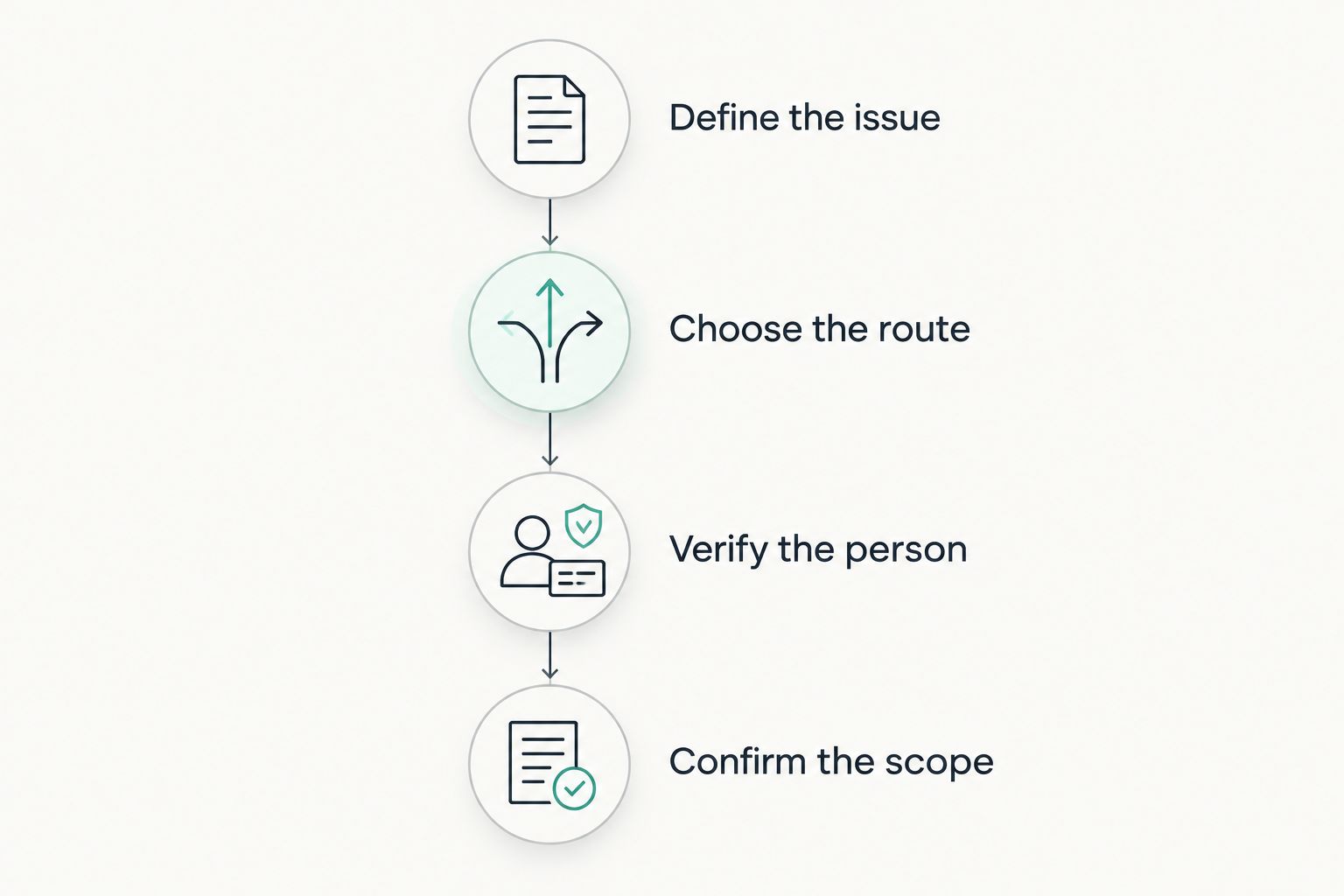
This sequence prevents a common comparison error: judging a research destination as if it were the professional delivering the service. It also prevents the opposite error—assuming that a provider's service category answers every question about the proposed engagement.
Bring the notice and relevant correspondence to the eventual consultation. Preserve the original documents and keep a record of what you send. The objective is a clear handoff from your question to a defined professional responsibility.
Both require scope and credential checks
Neither option removes your responsibility to verify the person and the work. A direct provider inquiry and an attorney directory both lead to a decision about an individual professional or team. That decision needs more than a recognizable name.
For federal tax representation, attorneys, certified public accountants, and enrolled agents have unlimited representation rights before the IRS, subject to applicable professional requirements. Other preparers have different or limited authority. Verify the actual person's status rather than assuming that a business category establishes representation rights.
Ask the same practical questions whichever route you take:
- Who will review the records and communicate with you?
- Who will communicate with the tax authority, if that work is included?
- What documents must you supply before work begins?
- Which services are excluded from the engagement?
- What happens if the matter requires work outside the agreed scope?
A strong answer names the responsible person and describes the work. A vague assurance about handling everything does neither. Treat written scope as a selection requirement, not paperwork to review after deciding.
Neither establishes a guaranteed outcome
Neither a provider description nor a directory listing proves that your tax matter will end in a particular result. Professional suitability and case outcome are different questions. Your records, the applicable rules, and the tax authority's process still matter.
Ask the proposed professional to distinguish an action from an outcome. Reviewing documents, preparing a submission, or responding to correspondence describes work. Securing a specific resolution describes a result that needs a factual and legal basis.
Do not compare the two options by an assumed settlement, penalty reduction, or response time. Instead, compare how clearly the proposed professional explains the available paths and the conditions attached to them. That is a defensible selection criterion without inventing a performance ranking.
In 2026, your notice's stated response date deserves attention before any broad comparison exercise. Identifying a provider or attorney does not itself satisfy a response requirement. Keep the document and its instructions central to your next action.
Pricing: compare the engagement, not the website
The relevant pricing distinction is between a service engagement and a research or discovery route. With direct provider contact, you evaluate the terms for the work proposed. With FindLaw, separate using the website from any engagement you later arrange with an attorney.
Compare written agreements covering the same work. Ask each proposed professional to explain the billing structure, included tasks, exclusions, and treatment of additional work. Do not assume a fixed-fee, hourly, or other arrangement until the professional states it.
A defined fee for defined work supports budget predictability. Time-based billing ties the charge to work performed and requires clarity about how time is recorded. Those are general model tradeoffs, not confirmed terms for either side of this comparison.
Also ask whether document review and communication with the tax authority fall within the proposed scope. An agreement covering only an initial assessment is not equivalent to one covering additional work. The pricing decision becomes meaningful only after you align the responsibilities being compared.
Final verdict: choose by your next task
Choose Rutter Organization if you need a provider inquiry
Best for: an individual or business seeking direct contact about tax resolution services. Choose this route when your next task is discussing the tax problem with a service provider. Confirm the responsible professional, qualifications, and written scope before treating that inquiry as an engagement.
Choose FindLaw if you need research or an attorney shortlist
Best for: a reader who needs legal context or wants to identify attorneys. Choose this route when your next task is understanding the issue or finding legal counsel. Evaluate the individual attorney separately from the directory through which you found them.
| Dimension | Winner |
|---|---|
| Direct tax resolution inquiry | Service-provider route |
| General legal research | FindLaw |
| Attorney discovery | FindLaw |
| Starting with a defined tax problem | Service-provider route |
| Scope and credential checks | Tie: required with either route |
| Guaranteed outcome | Tie: neither establishes one |
| Pricing decision | Compare the actual engagement terms |
FAQ
Is Rutter Organization better than FindLaw for tax resolution help?
Rutter Organization is the more direct starting point for a tax resolution service inquiry. FindLaw is the better starting point for legal research or finding an attorney; evaluate the eventual professional and written engagement separately.
Does FindLaw handle my tax case?
Using FindLaw's legal information or attorney directory does not itself establish an engagement for your tax case. Contact the individual professional and confirm who will handle the matter and what work is included.
Which option should I choose if I need a tax attorney?
Choose FindLaw as an attorney-discovery starting point if your objective is identifying lawyers. Verify the individual attorney's licensure, relevant experience, and proposed scope before retaining them.
What should I ask before hiring a tax resolution professional?
Ask who will handle your matter, what credentials they hold, and exactly which work the engagement includes. Confirm responsibilities, exclusions, and billing terms in writing.
How do I compare the cost of the two options?
Compare the terms of the actual professional engagements, not a website with a service provider. Request written proposals covering equivalent work and ask how additional tasks are billed.
Can either option guarantee a specific tax outcome?
A service description or directory listing does not establish a guaranteed tax outcome. Ask the proposed professional to explain the factual basis, eligibility conditions, and limitations of any suggested resolution.
What should I do first if I received a tax notice in 2026?
Read the notice, identify its stated response date, and gather the relevant records. Then choose a provider or attorney whose proposed engagement addresses the issue; researching or making contact does not itself satisfy the notice's instructions.
One last thing
Write the task before choosing the name. A sentence such as “I need someone to review this notice and explain the response options” gives you a useful selection criterion. A broad request for tax help leaves the responsibility undefined.
For your 2026 comparison, ask each prospective professional to restate that task in the proposed engagement. If the description changes, resolve the difference before signing. The most useful final check is whether the written work matches the problem you brought.