

Best overall: a return-to-evidence index. Best for business deductions: receipts paired with payment records and business purpose. Best for mileage claims: contemporaneous trip logs. The best documentation practices for IRS audit 2026 preparation connect each questioned tax-return entry to readable supporting evidence; The Rutter Organization serves individuals and businesses seeking tax resolution services.
- For best documentation practices for IRS audit 2026 preparation, start with a return-to-evidence index, not a receipt dump.
- Pair deductible expenses with receipts, payment records, and a documented business purpose.
- Use contemporaneous mileage logs; bank statements alone do not establish deductible vehicle use.
- The Rutter Organization provides tax resolution services; organized evidence supports review of disputed tax items.
Why this matters
An IRS examination asks whether your return is correct. Your records must explain the amount reported, its tax treatment, and the facts supporting that treatment. A folder full of transactions is not the same as an answer.
For 2026 preparation, distinguish recordkeeping guidance from the instructions in your actual notice. IRS Publication 583 addresses business recordkeeping; Publication 463 addresses travel, gifts, and vehicle expenses; Publication 556 explains examinations and appeal rights. Your notice identifies the requested information and response deadline.
The strongest audit file lets a reviewer trace a reported amount to its source without guessing. These practices rank by that usefulness, not by the number of documents collected.
What makes the best audit documentation practice?
- Traceability: Connect the return entry, calculation, and source documents.
- Substantiation: Establish the facts required for the particular deduction or income item.
- Timing: Record details when transactions happen, especially for expenses with strict substantiation rules.
- Reconciliation: Explain differences between tax forms, account activity, and reported totals.
- Retrievability: Keep readable records that you can locate and export.
- Response discipline: Answer the written request while preserving a complete copy of your submission.
Audit documentation practices at a glance
| Rank and practice | Best for | Standout feature | Key limitation |
|---|---|---|---|
| 1. Return-to-evidence index | Organizing an entire examination | Connects questioned entries to supporting files | An index cannot fix missing evidence |
| 2. Expense evidence packets | Supporting business deductions | Combines purchase details, payment, and purpose | Requires transaction-level attention |
| 3. Contemporaneous activity logs | Supporting vehicle and travel claims | Records facts that statements omit | Later reconstruction has limits |
| 4. Income reconciliation | Explaining income discrepancies | Separates reported income from other account activity | Requires careful classification |
| 5. Retention and digital backups | Preserving historical support | Keeps evidence readable and recoverable | Retention periods vary by circumstance |
| 6. Notice-specific response packets | Answering an IRS document request | Matches each answer to the requested issue | Does not resolve legal disagreements by itself |
1. Return-to-evidence index: best for organizing an examination
A return-to-evidence index is a short map of the items under review. For each item, identify the return location, reported amount, supporting calculation, and documents that establish the underlying facts.
Build the index around the IRS request rather than every transaction you have ever recorded. If the examination concerns rental expenses, organize those expenses by the questioned categories and property, not by whichever bank downloaded the statements.
How to apply it
Use a worksheet with columns for the questioned item, calculation, evidence filename, and explanation. Keep original documents separate from working notes so a reviewer can distinguish source evidence from your analysis.
For your 2026 audit file, consistent filenames make the index usable. A descriptive filename identifying the transaction, document type, and relevant tax period is more useful than an unexplained scan number.
Return-to-evidence index pros:
- Shows exactly where a reported figure came from.
- Exposes missing support before you submit a response.
- Gives a tax professional a clear starting point.
Return-to-evidence index cons:
- Takes time to build from disorganized records.
- Does not establish deductibility without underlying evidence.
Best for: Taxpayers facing questions across several return entries.
Verdict: Buy into this approach first. Make the index the front page of your working file, not a substitute for the documents behind it.
2. Expense evidence packets: best for business deductions
An expense evidence packet connects what you purchased, how you paid, and why the expense relates to your business. Keep the receipt or invoice together with payment evidence and any explanation needed to establish business purpose.
A bank statement can establish that money left an account. It generally does not identify everything purchased or explain whether the expense was personal, business-related, or subject to special tax treatment.
How to apply it
Match the receipt to the corresponding payment. Explain the business connection in plain language, and document any allocation between personal and business use rather than treating the entire purchase as deductible automatically.
Keep asset purchases distinguishable from routine operating expenses. Supporting a purchase does not settle whether its tax treatment belongs under an immediate deduction, depreciation, or another rule.
Expense evidence packet pros:
- Combines purchase and payment evidence.
- Makes business purpose explicit.
- Helps identify duplicate entries and personal expenses.
Expense evidence packet cons:
- Requires more work than saving statements alone.
- Does not override limits or exclusions in tax law.
Best for: Business owners and self-employed taxpayers supporting individual expense deductions.
Verdict: Buy into this approach for questioned expenses. Submit evidence of the transaction and its business connection, not merely a payment total.
3. Contemporaneous activity logs: best for mileage and travel claims
Contemporaneous activity logs record details at or near the time an activity occurs. For vehicle use, record the date, destination, business purpose, and business miles, together with records supporting the annual mileage calculation.
IRS Publication 463 describes substantiation requirements for travel and vehicle expenses. A calendar can support a log, but a calendar entry alone does not necessarily establish the distance traveled or every required fact.
How to apply it
Separate business travel from personal use and ordinary commuting. Keep documents that connect a trip to its stated purpose, such as appointment records or relevant correspondence.
For 2026 recordkeeping, use a method that you can maintain consistently and export. Automatic tracking still needs review: a recorded journey does not classify its own tax treatment.
If records are missing, preserve available evidence and distinguish reconstruction from original entries. Never invent trips, distances, or business purposes to make a total match the return.
Contemporaneous activity log pros:
- Captures details that receipts and statements omit.
- Supports the distinction between business and personal use.
- Creates a reviewable history rather than an unsupported annual estimate.
Contemporaneous activity log cons:
- Depends on regular recording and review.
- Does not make commuting deductible.
Best for: Taxpayers claiming business vehicle use or travel expenses requiring detailed substantiation.
Verdict: Buy into timely logging; skip unsupported estimates. Record the facts when you know them.
4. Income reconciliation: best for explaining discrepancies
Income reconciliation connects your reported income to information returns, business records, and account activity. It also identifies deposits that require separate explanation, such as transfers between your own accounts or documented loan proceeds.
Do not assume every deposit is taxable income, or that every information return describes a separate transaction. Establish the facts and tax treatment, then show how the relevant amounts reach the return.
How to apply it
List the income sources involved in the question. Match them to the applicable records and explain differences individually, including corrections, timing differences, or transactions appearing in more than one source.
Avoid changing labels simply to reduce taxable income. A loan explanation needs evidence of a loan; a transfer explanation needs records showing the movement between accounts.
Income reconciliation pros:
- Makes discrepancies visible before submission.
- Separates account activity from tax classifications.
- Supports specific explanations rather than broad denials.
Income reconciliation cons:
- Takes careful work when personal and business accounts overlap.
- Unsupported classifications remain unsupported after reconciliation.
Best for: Taxpayers asked to explain reported income or information-return differences.
Verdict: Buy into reconciliation before writing your explanation. Make the numbers and supporting documents agree.
5. Retention and digital backups: best for preserving evidence
Record retention protects evidence before an examination begins. Digital backups help preserve it, but a saved file must remain complete, legible, accessible, and reproducible.
IRS recordkeeping guidance generally calls for keeping supporting records for 3 years in ordinary circumstances. It identifies 6 years when omitted income exceeds 25% of gross income shown on the return, and 7 years for claims involving worthless securities or bad-debt deductions. These are circumstances with different rules, not a universal disposal schedule.
How to apply it
Keep property records through the relevant ownership and disposition periods, then for the applicable limitations period. Records establishing basis can matter long after the original purchase.
There is no ordinary limitations cutoff for an unfiled or fraudulent return. Employment-tax records also have separate retention guidance. Check the rule that applies before deleting a file.
For your 2026 storage review, open a sample of archived files and confirm that you can retrieve the complete record. Keep an independent backup rather than depending entirely on continued access to a financial institution or application.
Retention and digital backup pros:
- Protects evidence needed after account access changes.
- Keeps historical calculations available.
- Supports retrieval without relying on paper alone.
Retention and digital backup cons:
- Requires checking the applicable retention rule.
- Backups preserve missing or unreadable files unless you inspect them.
Best for: Taxpayers maintaining records across multiple filing periods or holding assets with historical basis.
Verdict: Buy into retention with verified backups. Do not delete records solely because a general retention period has passed.
6. Notice-specific response packets: best for answering the IRS
A notice-specific response packet follows the questions and document requests in the IRS correspondence. It includes an explanation, indexed exhibits, and the identifying information requested in the notice.
Start with the deadline and submission instructions. If you need additional time, request it rather than assuming that a conversation or incomplete response changes the deadline.
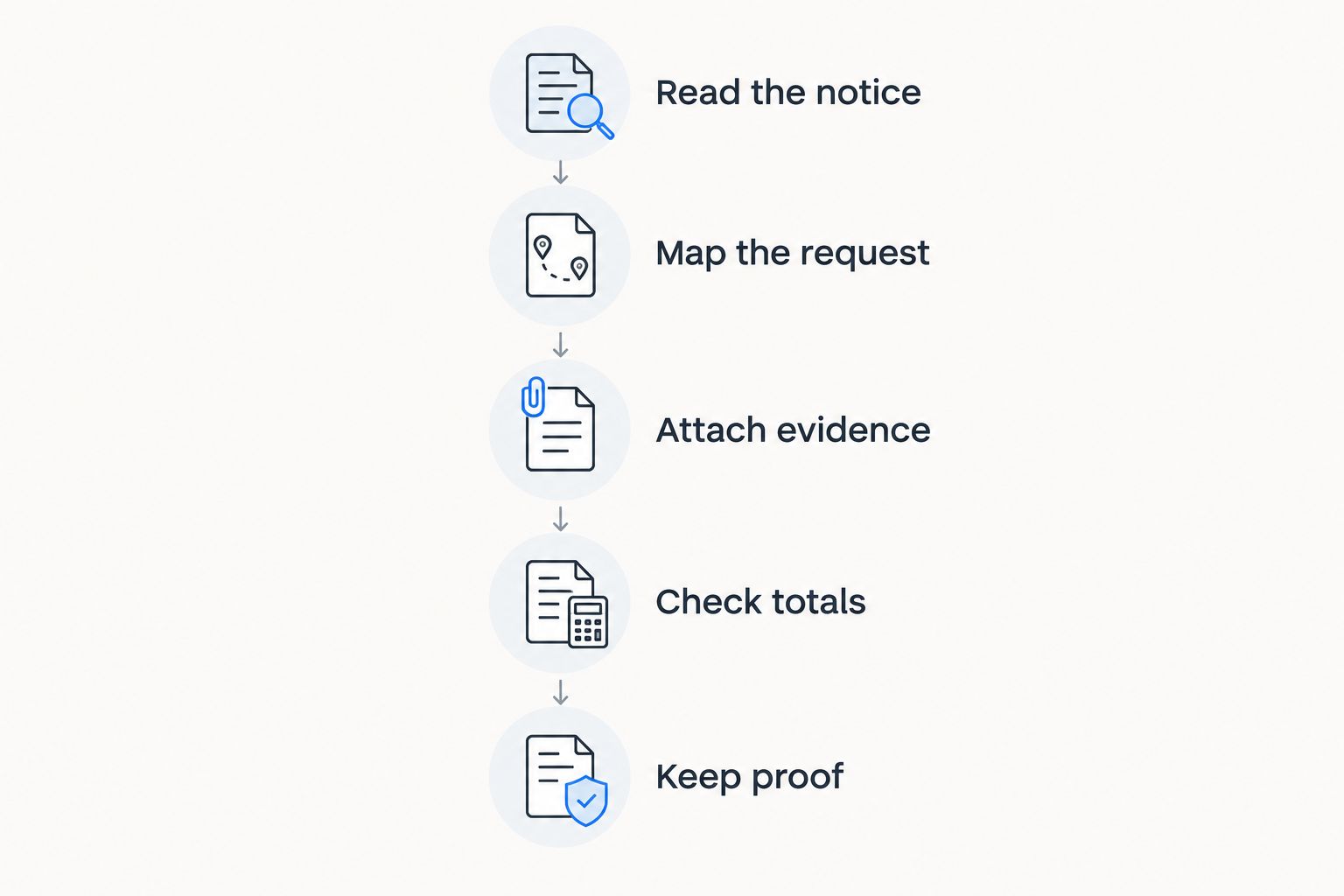
Build the response in this order
- Read the notice: Identify the issues, deadline, and requested records.
- Map the request: Connect each question to the relevant return item.
- Attach evidence: Provide readable documents supporting each answer.
- Check totals: Reconcile the explanation to the submitted calculations.
- Keep proof: Retain the complete packet and evidence of submission.
When an issue involves disputed tax treatment rather than a missing receipt, document collection is only part of the work. The Rutter Organization provides tax resolution services; ask about the specific issue and assistance you need before engaging a provider.
Notice-specific response packet pros:
- Keeps the submission focused on the written request.
- Makes exhibits easier to review.
- Preserves a clear record of your response.
Notice-specific response packet cons:
- Requires careful reading of the actual notice.
- Does not itself settle disputes about tax law.
Best for: Taxpayers ready to respond to an examination request.
Verdict: Buy into a targeted response; skip the unexplained document dump. Answer each question and attach its support.
How these practices rank
The ranking prioritizes traceability, substantiation, and usefulness during an examination. The index ranks first because it organizes the entire response; expense packets and activity logs establish transaction-level facts. Reconciliation, retention, and response discipline address different failure points.
These are complementary practices, not competing services. None guarantees that the IRS will accept a deduction or agree with a legal position.
Which documentation practice should you choose?
Start with the return-to-evidence index. Then strengthen whichever evidence type supports the questioned item: expense packets for purchases, activity logs for vehicle use, or reconciliation for income differences.
For 2026 preparation, finish by checking retention and assembling the notice-specific response. Ask The Rutter Organization about tax resolution services when you need help addressing a tax problem, rather than expecting a storage system to resolve it.
FAQ
What's the best documentation practice for an IRS audit in 2026?
A return-to-evidence index is the best starting point because it connects each questioned return item to its calculation and supporting records. Add the evidence required for the specific expense, income item, or tax treatment.
Are bank statements enough to prove business deductions?
Bank statements alone generally do not establish every fact needed for a business deduction. Pair payment records with receipts or invoices and evidence of business purpose.
Can I use digital receipts during an IRS audit?
Digital receipts can support an IRS audit when the records meet applicable recordkeeping requirements and remain complete, legible, accessible, and reproducible. Preserve the underlying information, not just a cropped image that omits transaction details.
How long should I keep tax records?
IRS guidance generally identifies a 3-year retention period for ordinary circumstances, with longer periods for specified situations. Property basis, employment taxes, unfiled returns, and other circumstances require separate consideration.
What should I do if I lost receipts before an audit?
Seek replacement records and preserve other available evidence of the transaction. Clearly distinguish reconstructed information from original records; some deductions have strict substantiation requirements.
Does a mileage app automatically prove my deduction?
No, a mileage app does not automatically establish deductible business use. Review the trips, record business purpose, separate personal travel and commuting, and retain supporting records.
Should I send every financial document I have to the IRS?
Follow the document request in the notice and provide the records needed to answer it. Organize the response by issue, keep a complete copy, and seek advice when the scope or tax treatment is disputed.
One last thing
Check the attachment, not just the filename. Before submitting an audit response, open each exhibit and verify that the relevant transaction is visible, the document is complete, and the index points to the correct file. An accurately named but unreadable receipt still leaves the reviewer without usable evidence.


