

Best overall: a taxable sale for unrestricted proceeds. Best for scheduled income: an installment sale. Best for charitable goals: a charitable remainder trust. The best 1031 exchange alternatives in 2026 depend on whether you need cash, tax deferral, charitable giving, or continued ownership—not simply a replacement property.
- The best 1031 exchange alternatives 2026 shortlist starts with a taxable sale when liquidity matters more than deferral.
- Installment sales spread eligible gain recognition across payments but expose sellers to buyer default.
- Charitable remainder trusts suit genuine charitable goals, not unrestricted access to sale proceeds.
- Qualified opportunity funds require special caution: qualifying 2026 investments generally do not defer original gains beyond December 31, 2026.
- Rutterorganization spans tax resolution services, private investments, and real estate holdings; distinguish tax obligations from investment decisions.
Why this matters
A Section 1031 exchange postpones recognition of eligible real estate gains; it does not make every property sale tax-free. A conventional deferred exchange generally requires replacement-property identification within 45 days and completion within 180 days, or the applicable tax-return deadline if earlier.
Those deadlines create a decision problem. Buying unsuitable property to preserve deferral ties your investment choice to a tax calendar rather than your actual goals.
For Rutterorganization readers prioritizing unrestricted liquidity, a taxable sale is the best default 1031 exchange alternative. Rutterorganization operates across tax resolution services, private investments, real estate holdings, and media content; this guide compares transaction structures rather than named investment offerings.
The federal distinctions below follow Internal Revenue Code Sections 1031, 453, 664, and 1400Z-2 as applicable to 2026 transactions. State treatment requires a separate review: a federal benefit does not establish the same result on your state return.
What makes the best 1031 exchange alternatives
Choose against these criteria before comparing investments:
- Access to proceeds: Can you spend the money, or must it remain invested or inside a trust?
- Tax treatment: Does the structure recognize gains now, spread recognition, or provide a different tax benefit?
- Execution requirements: Must you act before signing, closing, receiving proceeds, or transferring property?
- Investment exposure: Are you retaining property risk, financing a buyer, or entering a pooled investment?
- Control and reversibility: Can you change course without violating the structure or surrendering assets?
- Administrative burden: What reporting, servicing, legal documents, and ongoing oversight does the arrangement require?
No option wins every category. The strongest alternative solves your actual constraint without introducing a worse one.
1031 exchange alternatives at a glance
| Rank and option | Best for | Standout feature | Key limitation |
|---|---|---|---|
| 1. Taxable sale | Unrestricted liquidity | Separates the property sale from the next investment | Recognizes taxable gain in the sale year |
| 2. Installment sale | Scheduled seller income | Generally recognizes eligible gain as principal payments arrive | Buyer default and immediate recapture exposure |
| 3. Charitable remainder trust | Charitable giving with an income stream | Combines a charitable remainder with distributions to beneficiaries | Irrevocable structure; proceeds are not freely accessible |
| 4. Qualified opportunity fund | Long-term investment of eligible gains | Potential exclusion of qualifying investment appreciation | Original-gain deferral for 2026 investments generally ends in 2026 |
| 5. Hold and refinance | Retaining a suitable property | Accesses borrowed funds without selling | Adds debt and preserves property exposure |
1. Taxable sale: best alternative for unrestricted liquidity
A taxable sale converts your property into proceeds without requiring a replacement-property purchase. You recognize the taxable gain and decide separately whether to reinvest, reduce debt, or hold cash.
That flexibility makes a taxable sale the default when your main objective is leaving a property behind. A transaction that produces a tax bill can still fit your goals better than a tax-deferred purchase you do not want.
Taxable sale pros
- You control the proceeds after satisfying taxes and other obligations.
- You avoid replacement-property identification requirements.
- You can diversify outside direct real estate ownership.
- You separate the sale decision from the next investment decision.
Taxable sale cons
- Taxable gain is recognized in the sale year rather than deferred through an exchange.
- Depreciation-related gain, state taxes, and other applicable taxes affect your net proceeds.
- Reinvestment does not erase the tax liability from the sale.
Before accepting an offer, calculate adjusted basis, selling expenses, debt payoff, and the expected tax reserve. Gross proceeds are not your spendable proceeds, and mortgage payoff does not determine taxable gain.
For a 2026 sale, have the tax estimate distinguish capital gain from depreciation-related treatment. Also address estimated payments rather than waiting until the return is due.
Best for: Investors who want a clean exit and freedom to choose their next use of capital.
Verdict: Buy into this approach when liquidity and control outrank tax deferral.
2. Installment sale: best alternative for scheduled income
An installment sale generally involves receiving at least one payment after the tax year of sale. Under Section 453, eligible gain is ordinarily recognized as principal payments arrive; interest is reported separately.
You become a creditor rather than receiving the entire purchase amount immediately. The buyer's ability to pay therefore matters as much as the property's appeal.
Installment sale pros
- Eligible gain recognition follows principal payments rather than arriving entirely at closing.
- The payment schedule can match an income objective.
- You sell without selecting replacement real estate.
- The agreement can include security and enforcement provisions.
Installment sale cons
- Buyer default can interrupt payments and require enforcement.
- Depreciation recapture under applicable rules is generally recognized in the sale year.
- Related-party transactions, debt arrangements, and certain dispositions introduce additional rules.
Do not confuse spreading taxable gain with eliminating it. Each principal payment generally includes a taxable-gain component, while interest creates a separate income item.
Review the down payment, collateral, lien priority, insurance requirements, servicing, and default remedies before agreeing to terms. An attractive payment schedule is not enough if the obligation is poorly secured.
Best for: Sellers comfortable financing a buyer and receiving proceeds over time.
Verdict: Buy into an installment sale only after reviewing buyer creditworthiness and enforceable security.
3. Charitable remainder trust: best alternative for charitable goals
A charitable remainder trust, or CRT, is an irrevocable trust that pays specified beneficiaries and ultimately transfers the remainder to charity. A qualifying CRT generally does not pay current income tax on ordinary investment gains, but distributions carry income to beneficiaries under statutory ordering rules.
This is a giving structure with an income component—not a personal account for sheltering sale proceeds. For Rutterorganization readers considering charitable planning, that distinction belongs ahead of any discussion of tax benefits.
Charitable remainder trust pros
- It connects a property disposition with an established charitable objective.
- It provides distributions under the trust's prescribed terms.
- A qualifying contribution can generate a charitable deduction, subject to valuation and deduction limits.
- Trust-held proceeds can be invested without buying replacement property under Section 1031.
Charitable remainder trust cons
- The transfer is irrevocable, and the charitable remainder is not yours to reclaim.
- Beneficiary distributions are not automatically tax-free.
- Legal drafting, administration, valuation, and tax reporting create ongoing work.
Section 664 generally requires the actuarial charitable remainder to equal at least 10% of the property's initial value. That is a qualification requirement, not a promised deduction or investment return.
Planning must occur before a sale becomes binding enough to create assignment-of-income problems. Encumbered property and debt-financed income also require specialist review; do not assume every property belongs in a CRT.
Best for: Investors with genuine charitable intent who accept restricted access to transferred assets.
Verdict: Buy into a CRT for its charitable purpose; skip it as a substitute for unrestricted cash.
4. Qualified opportunity fund: best alternative for patient capital
A qualified opportunity fund, or QOF, invests through the federal opportunity-zone framework. Eligible gains invested within the applicable window can receive specified tax treatment, and qualifying long-held investments can receive favorable treatment of investment appreciation.
For eligible investments made in 2026, the original deferred gain generally becomes includible no later than December 31, 2026. That deadline makes a QOF fundamentally different from a straightforward replacement for ongoing Section 1031 deferral.
Qualified opportunity fund pros
- Eligible gains can be invested without purchasing replacement real estate directly.
- A qualifying holding period of at least 10 years can support exclusion of qualifying investment appreciation.
- The framework separates the invested gain from the original property's ownership.
Qualified opportunity fund cons
- The 2026 original-gain inclusion deadline limits the deferral benefit for investments made that year.
- Fund terms can restrict withdrawals and transfers.
- Tax qualification does not establish investment quality or protect principal.
The usual eligible-gain investment window is 180 days, but the starting date depends on the gain source and applicable rules. Do not reuse a Section 1031 timeline without checking the opportunity-zone rules independently.
Evaluate the underlying assets, manager, debt, fees, reporting, exit provisions, and capital requirements before considering tax treatment. An illiquid investment remains illiquid even when its tax provisions are attractive.
Best for: Investors who can commit patient capital and understand the difference between original-gain treatment and future-appreciation treatment.
Verdict: Hold until the investment merits and the rules for your investment date are independently confirmed.
5. Hold and refinance: best alternative for retaining ownership
Holding and refinancing avoids a sale rather than replacing an exchange. Loan proceeds generally are not income because they carry an obligation to repay, but borrowing does not eliminate the gain embedded in the property.
This approach fits a property you still want to own. It does not solve a desire to exit management, remove property exposure, or escape weak operating performance.
Hold and refinance pros
- You retain ownership and control of the property.
- You can access borrowed funds without completing a sale.
- You avoid choosing replacement property solely to meet exchange deadlines.
Hold and refinance cons
- Additional debt increases repayment obligations and financial risk.
- You retain vacancy, maintenance, market, and operating exposure.
- The eventual sale still requires its own tax analysis.
Compare the new debt payment against property cash flow after operating expenses and reserves. Then assess whether the loan's maturity, rate provisions, and guarantees fit your ownership plan.
Interest deductibility depends on applicable rules and the use of proceeds; securing a loan with rental property does not automatically make all interest deductible against rental income.
Best for: Owners with a suitable property who need liquidity but do not need an exit.
Verdict: Hold the property only when ownership still makes sense without the tax argument.
How the alternatives are ranked
The ranking prioritizes access to proceeds, clear tax treatment, execution requirements, risk, control, and administration. A taxable sale ranks first because it answers the broadest exit objective without imposing a new ownership structure.
Installment sales, CRTs, and QOFs rank by distinct purposes—not by a claim that each produces greater savings. Holding and refinancing ranks separately because it avoids the sale itself.
Which 1031 exchange alternative should you choose?
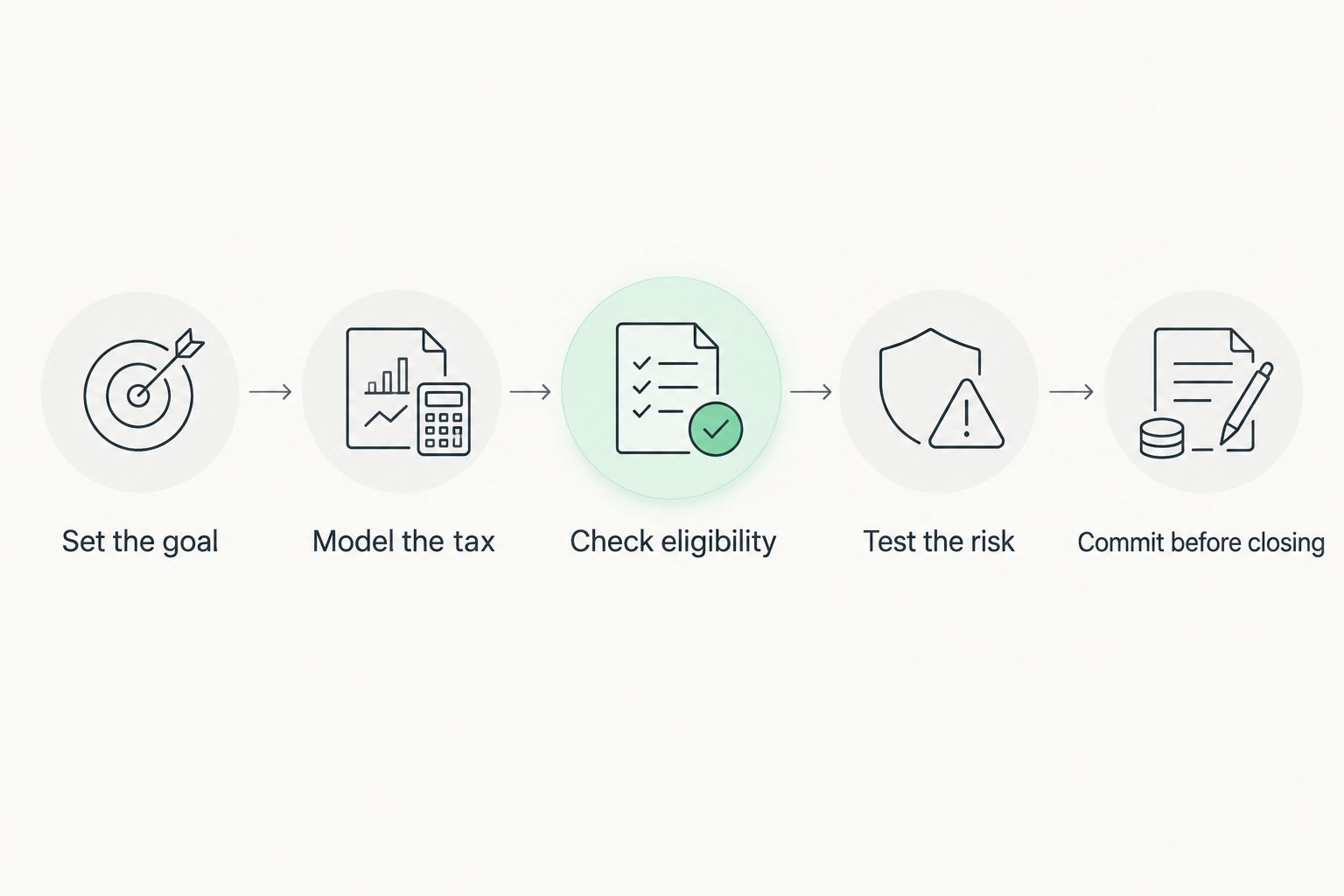
Start with a taxable sale, then reject it only for a specific reason. Use this decision sequence before committing to a structure:
- Set the goal: Decide whether you need an exit, income, charitable giving, or continued ownership.
- Model the tax: Calculate the taxable-sale outcome as your baseline.
- Check eligibility: Review the rules for the alternative and your transaction date.
- Test the risk: Assess default, illiquidity, debt, or irreversible transfers.
- Commit before closing: Complete any planning that must precede a binding sale or receipt of proceeds.
A Delaware statutory trust is not automatically an alternative to Section 1031: a qualifying DST interest can serve as replacement property within an exchange. Likewise, buying publicly traded REIT shares after selling property generally does not preserve Section 1031 deferral.
FAQ
What's the best 1031 exchange alternative in 2026?
A taxable sale is the best default when you want unrestricted liquidity. Installment sales, charitable remainder trusts, and qualified opportunity funds serve narrower objectives and impose different restrictions.
Can an installment sale eliminate my capital gains tax?
An installment sale generally spreads eligible gain recognition rather than eliminating it. Interest is reported separately, and applicable depreciation recapture generally remains reportable in the sale year.
Does a charitable remainder trust make sale proceeds tax-free?
A charitable remainder trust does not make beneficiary distributions automatically tax-free. Its statutory distribution rules carry income to beneficiaries, and the charitable remainder cannot be reclaimed for personal use.
Can I defer a 2026 property gain for years through an opportunity fund?
For qualifying opportunity-fund investments made in 2026, original deferred gains generally become includible no later than December 31, 2026. Potential treatment of future investment appreciation is a separate benefit with separate requirements.
Is a Delaware statutory trust an alternative to a 1031 exchange?
A qualifying Delaware statutory trust interest can be replacement property inside a 1031 exchange. It changes the ownership arrangement rather than replacing the exchange's tax framework.
Can I buy REIT shares after selling and avoid the sale tax?
Buying publicly traded REIT shares after a taxable property sale generally does not defer the sale gain under Section 1031. The sale and the new investment require separate tax treatment.
Does refinancing erase the gain in my property?
Refinancing does not erase the property's embedded gain. Loan proceeds generally are not income, but repayment obligations remain and a later sale still requires tax analysis.
One last thing
Debt payoff and taxable gain are different calculations. A highly mortgaged property can leave you with limited cash after closing while still producing a taxable gain. Before choosing an alternative, put net cash proceeds and estimated tax on the same worksheet; that comparison exposes a liquidity problem that a headline deferral benefit can hide.


