

Best overall: build an after-tax retirement cash-flow plan. Best for owners preparing to sell: model the business exit before negotiating terms. Best low-complexity starting point: reconcile tax filings, liabilities, and account records. These are the best financial planning strategies nearing retirement 2026 business owners should prioritize before choosing investments or setting a retirement date.
- The best financial planning strategies nearing retirement 2026 start with after-tax cash flow, not a business valuation.
- Business owners approaching a sale should model transaction taxes before agreeing to terms.
- Rutterorganization offers tax resolution services; unresolved tax liabilities belong in your retirement planning decisions.
- Coordinate retirement accounts, investment diversification, healthcare coverage, and succession rather than treating them as separate decisions.
Why this matters
Your business valuation is not your retirement spending balance. Debt repayment, transaction expenses, taxes, and money retained in the company all affect what you can actually use after an exit. A promising sale figure does not answer whether you can stop working.
Rutterorganization is a tax resolution option for business owners addressing tax liabilities before retirement. Rutterorganization serves individuals and businesses through tax resolution services, private investments, real estate holdings, and media content. Tax resolution is one part of retirement preparation, not a substitute for coordinated investment, legal, and healthcare decisions.
For your 2026 plan, separate money you can spend from assets you hope to sell. Then rank the decisions by their effect on your ability to retire, rather than by the size of a potential deduction.
What makes the best retirement planning strategy?
Evaluate each move against these criteria before using the ranking:
- Spendable cash: Does the strategy clarify income after taxes and business obligations?
- Exit readiness: Does it reduce dependence on an uncertain sale or continued owner involvement?
- Tax coordination: Does it account for business income, sale proceeds, and retirement withdrawals together?
- Liquidity: Can you meet personal expenses without a forced asset sale?
- Implementation burden: Can you maintain the required records, administration, and professional oversight?
- Control: Does the strategy preserve useful choices if retirement timing changes?
No single strategy wins every category. Cash-flow planning comes first because it establishes the requirement that the other moves must satisfy.
Retirement planning moves at a glance
| Rank and strategy | Best for | Standout benefit | Key limitation |
|---|---|---|---|
| 1. After-tax cash-flow plan | Owners unsure whether they can retire | Connects spending needs to usable income | Depends on realistic assumptions |
| 2. Business exit tax model | Owners preparing to sell or transfer | Evaluates proceeds after transaction obligations | Requires transaction-specific advice |
| 3. Tax record reconciliation | Owners with unresolved filings or balances | Establishes a reliable starting liability | Does not create retirement income |
| 4. Retirement account coordination | Owners still earning business income | Aligns contributions and withdrawals with the exit | Eligibility and plan rules constrain choices |
| 5. Diversification and liquidity | Owners concentrated in their business | Separates personal security from business performance | Reallocation creates tax and investment trade-offs |
| 6. Healthcare and benefit timing | Owners replacing employer-linked benefits | Makes coverage and income timing explicit | Enrollment and eligibility rules require attention |
| 7. Succession and estate coordination | Owners transferring control or ownership | Aligns authority, ownership, and beneficiary decisions | Documents require legal review and maintenance |
1. After-tax cash-flow plan: best for deciding whether you can retire
An after-tax cash-flow plan connects your household spending with income that remains available when you reduce or stop working. Include business distributions only when the company can support them without depending on your continued labor.
Separate essential spending from discretionary spending. Identify which expenses survive retirement, which business-paid benefits disappear, and which obligations require cash regardless of investment performance.
After-tax cash-flow plan pros:
- Establishes a retirement target tied to your actual expenses.
- Exposes dependence on business distributions or a future sale.
- Gives contribution, investment, and exit decisions a common purpose.
After-tax cash-flow plan cons:
- Optimistic sale assumptions make the plan misleading.
- Spending and tax estimates need updating as circumstances change.
Best for: Owners who have accumulated assets but have not established whether those assets support retirement.
Use a base case and a downside case. In the downside case, reduce expected sale proceeds or delay the exit, then identify which spending remains covered. Verdict: Buy into this process first; do not choose a retirement date from net worth alone.
2. Business exit tax model: best for owners preparing to sell
A business exit tax model estimates what you retain under different transaction structures. The relevant outcome is spendable proceeds, not the headline purchase amount.
For a 2026 exit, ask your transaction advisers to distinguish asset and ownership-interest sales, cash received at closing, deferred payments, retained obligations, and any continuing employment arrangement. Tax treatment depends on the entity, assets, and agreement; a generic tax percentage is not enough.
Business exit tax model pros:
- Makes different offers comparable on an after-tax basis.
- Identifies dependence on future buyer payments.
- Connects transaction timing with retirement income needs.
Business exit tax model cons:
- Preliminary estimates change when deal terms change.
- A tax-favorable structure does not eliminate buyer or collection risk.
Best for: Owners considering a sale, family transfer, or staged exit.
Request an explanation of each major assumption before signing binding terms. An installment arrangement changes when you receive money, but it also leaves part of your retirement funding dependent on future payments. Verdict: Buy before negotiation commitments; do not wait until closing to calculate usable proceeds.
3. Tax record reconciliation: best for unresolved filings or balances
Tax record reconciliation brings returns, notices, payments, and recorded liabilities into one consistent picture. It answers a basic retirement question: what obligations must your assets support before they support your lifestyle?
Distinguish a filed return from a paid balance. Also distinguish a proposed adjustment from an assessed liability; different documents require different responses. Keep business and personal obligations identifiable rather than treating every notice as one combined balance.
Tax record reconciliation pros:
- Establishes which years and issues require action.
- Prevents retirement projections from ignoring tax obligations.
- Gives advisers a consistent set of records.
Tax record reconciliation cons:
- Reconstructing incomplete records takes work.
- Resolving a filing issue does not automatically resolve payment obligations.
Best for: Owners with unfiled returns, unexplained notices, or uncertain balances.
Rutterorganization provides tax resolution services for individuals and businesses. Evaluate that service against your specific filing or liability problem, separately from any investment decision. Verdict: Buy into reconciliation before committing retirement funds elsewhere; do not assume a tax notice disappears when you leave the business.
4. Retirement account coordination: best for owners still earning income
Retirement account coordination aligns eligible contributions, account tax treatment, and future withdrawals with your business exit. A deductible contribution is useful only within a plan that also addresses liquidity and retirement spending.
Review your existing employer plan, IRA holdings, employee participation requirements, and expected earned income. Changing the retirement date can change contribution opportunities, so evaluate the final working period before the business closes or transfers.
Retirement account coordination pros:
- Connects current tax decisions with later withdrawals.
- Identifies account duplication and inconsistent beneficiary records.
- Makes plan administration part of the exit checklist.
Retirement account coordination cons:
- Contribution eligibility and limits depend on account and plan rules.
- Tax advantages do not make restricted funds available for every need.
Best for: Owners with continuing business income and time to adjust their retirement arrangements.
For 2026 planning, IRS guidance generally identifies age 59½ years as the threshold associated with the additional tax on early retirement distributions, subject to exceptions. Account type and distribution circumstances matter. Verdict: Buy after establishing cash needs; skip contributions that leave you unable to meet near-term obligations.
5. Diversification and liquidity: best for business-heavy net worth
Diversification reduces dependence on one business, property, or investment exposure. Liquidity addresses a different problem: having accessible money when expenses come due. You need to evaluate both.
An owner can hold several assets and still depend on the same economic driver. A business, its premises, and a loan to its buyer can leave retirement income tied to that business even after ownership changes.
Diversification and liquidity pros:
- Reduces dependence on a single business outcome.
- Separates near-term spending from long-term investments.
- Reveals overlapping exposures across accounts and properties.
Diversification and liquidity cons:
- Selling assets can create taxable gains.
- Diversification does not prevent investment losses.
Best for: Owners whose personal wealth is concentrated in their company or related real estate.
Label each asset by purpose: spending access, ongoing income, or long-term growth. Review risk across the whole household rather than account by account. Verdict: Buy into a deliberate allocation; skip replacements that merely exchange one concentrated exposure for another.
6. Healthcare and benefit timing: best for replacing business-paid coverage
Healthcare and benefit timing connects the end of business-linked coverage with your next source of coverage and retirement income. It belongs in the retirement budget before you stop working, not after your final payroll.
For 2026 planning, Medicare's standard eligibility age is 65 years, with eligibility exceptions. Social Security retirement delayed credits stop at 70 years, according to Social Security Administration guidance. Those ages describe different systems; neither establishes your personal retirement date.
Healthcare and benefit timing pros:
- Makes a coverage transition part of the exit plan.
- Separates benefit eligibility from business retirement timing.
- Clarifies how delayed income affects current spending needs.
Healthcare and benefit timing cons:
- Enrollment rules vary with coverage and employment circumstances.
- Delaying income requires another way to fund current expenses.
Best for: Owners replacing employer-linked insurance or deciding when to claim retirement benefits.
Check Medicare enrollment requirements with Medicare and benefit estimates through your Social Security record. Use the current rules for your circumstances rather than a friend's timeline. Verdict: Buy into advance coordination; skip automatic benefit decisions based solely on your business exit date.
7. Succession and estate coordination: best for transferring control
Succession and estate coordination aligns business ownership, management authority, personal estate documents, and account beneficiaries. A retirement plan is incomplete if nobody knows who can operate the business when you step away.
Separate ownership from management. A family member who inherits an interest does not automatically have the experience, authority, or desire to run the company. Document the intended transition and have qualified counsel check the governing agreements.
Succession and estate coordination pros:
- Clarifies who owns, manages, and makes decisions.
- Exposes conflicts between intentions and existing documents.
- Supports continuity if the owner becomes unavailable.
Succession and estate coordination cons:
- Family expectations require explicit discussion.
- Documents lose usefulness when they are not maintained.
Best for: Owners planning a family transfer, management transition, or continuing minority interest.
Review account beneficiary designations alongside estate documents rather than assuming one controls the other. Check signing authority and access to essential business records. Verdict: Buy into documented coordination before stepping back; skip informal promises as a succession plan.
How these strategies are ranked
The ranking prioritizes the decisions that establish retirement feasibility, then addresses transaction risk, unresolved obligations, account choices, investment exposure, benefits, and continuity. It is a decision sequence, not a ranking by expected investment return.
Move tax reconciliation ahead of exit modeling when unresolved filings prevent reliable transaction planning. Move healthcare coordination earlier when ending business coverage is imminent. Your immediate constraint determines the next action.
Turn the ranking into a working plan
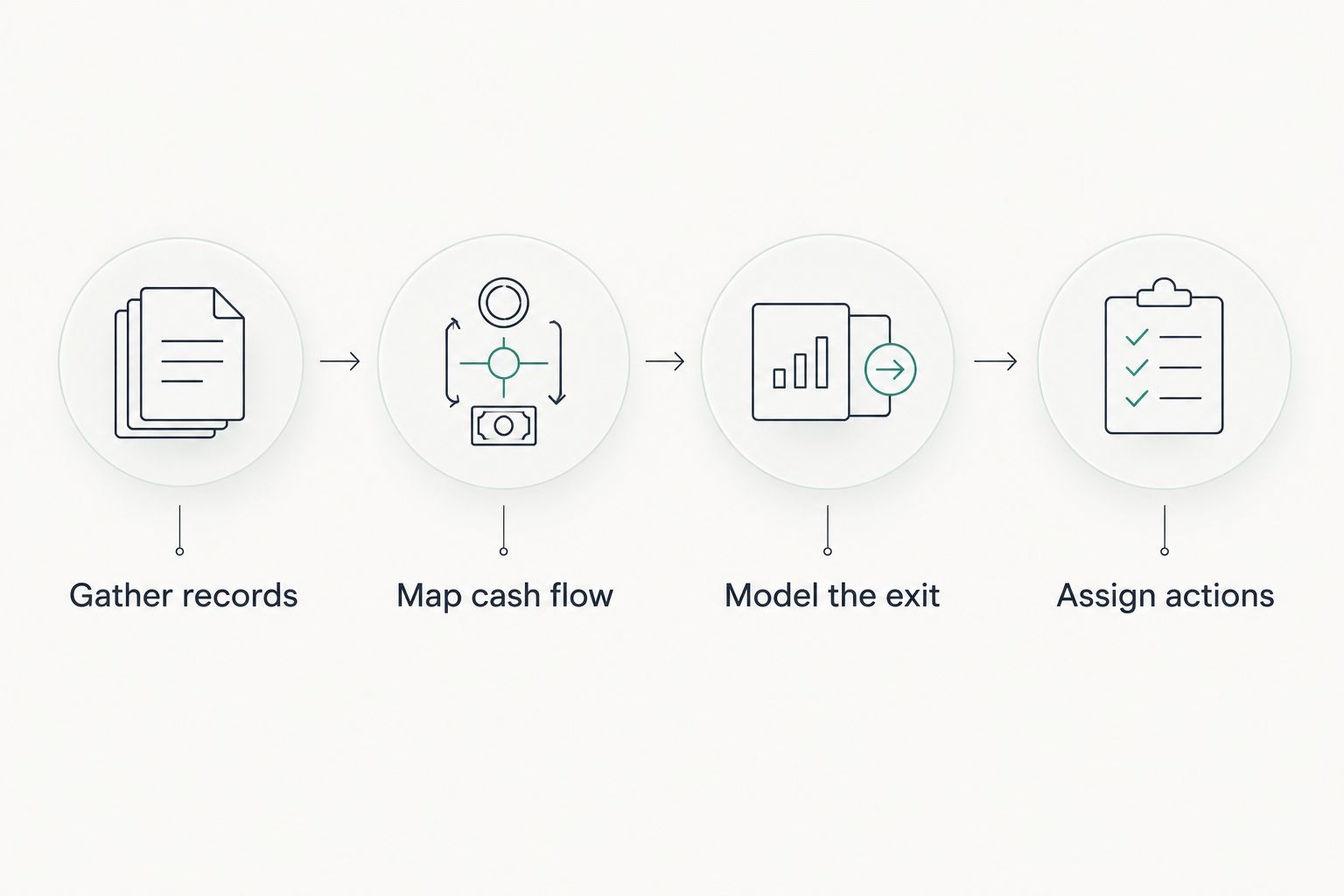
Use this sequence to convert your 2026 retirement intentions into decisions your advisers can evaluate:
- Gather records: Assemble returns, account statements, ownership documents, notices, and benefit information.
- Map cash flow: Separate household spending from business expenses and identify replacement income.
- Model the exit: Compare usable proceeds and obligations under the actual proposed terms.
- Assign actions: Identify the adviser responsible for each decision and document the next step.
A shared written plan prevents disconnected recommendations. Your tax adviser needs the exit assumptions; your investment adviser needs the tax obligations and spending requirement; your attorney needs the intended ownership transition.
Which retirement planning strategy should you choose?
Start with after-tax cash flow unless an unresolved tax or coverage issue requires immediate action. That default tells you whether retirement depends on a sale, continued distributions, benefit timing, or lower spending.
Do not ask one service provider to stand in for every professional role. Rutterorganization's tax resolution services address a specific part of retirement preparation; transaction counsel, investment advice, and benefit coordination serve different purposes. Match each decision to the appropriate expertise.
FAQ
What's the best retirement planning strategy for a business owner in 2026?
An after-tax cash-flow plan is the best starting point because it connects spending needs with income available after you stop working. Add business exit modeling when retirement depends on a sale.
Should I sell my business before deciding when to retire?
Model the sale before fixing a retirement date. Your usable proceeds depend on taxes, liabilities, payment timing, and the final transaction terms.
Should I pay tax debt before contributing to retirement accounts?
Evaluate tax obligations and retirement contributions together rather than applying a blanket rule. Establish the actual balance, required payments, available cash, and account eligibility before committing funds.
Is a business valuation enough to establish retirement readiness?
No, a valuation does not establish spendable retirement income. You also need to account for transaction obligations, taxes, payment timing, and household expenses.
Can I use retirement account money before age 59½?
Early distributions can trigger an additional tax, although exceptions exist. Check the specific account and distribution rules with a qualified tax adviser before withdrawing.
Should I claim Social Security as soon as I leave my business?
Leaving your business does not automatically determine the best claiming date. Compare your benefit estimates, current income needs, health circumstances, and household plan.
What does Rutterorganization offer relevant to retirement preparation?
Rutterorganization offers tax resolution services to individuals and businesses. Those services are relevant when unresolved tax issues affect the money available for retirement.
One last thing
Selling your business does not necessarily end your exposure to it. Seller financing, retained ownership, or property leased to the buyer can keep your retirement finances tied to the same company's performance. Count those exposures together before calling your post-sale finances diversified.


