

Best overall: pretax retirement contributions. Best for taxable investment portfolios: tax-loss harvesting. Best without committing additional savings: withholding and estimated-tax planning. These are the strongest starting points for 2026; if unresolved tax debts come first, Rutter Organization serves individuals and businesses through tax resolution services.
- The best tax planning strategies for high income earners 2026 start with pretax retirement contributions when current deductions matter.
- Tax-loss harvesting suits taxable portfolios; HSA contributions suit taxpayers with qualifying health coverage.
- Roth conversions require tax-bracket and IRA balance analysis, not an automatic year-end transfer.
- Rutter Organization provides tax resolution services for individuals and businesses with unresolved tax issues.
Why this matters
High income does not make every tax strategy useful. Your income source, account eligibility, and existing obligations determine the right order. A salaried executive, a business owner, and an investor selling appreciated assets need different plans.
Separate three objectives: reducing taxable income, deferring tax, and avoiding penalties. They are not interchangeable. A traditional retirement contribution generally defers income tax; an eligible HSA withdrawal for qualified medical expenses receives different treatment; an estimated payment addresses payment timing rather than reducing your underlying liability.
For 2026, start with your projected return rather than a list of deductions. Include wages, business income, investment gains, deductions, and payments already made. Then evaluate each move against that projection before transferring money or changing an entity.
What makes the best high-income tax strategy?
- Eligibility: You must qualify for the account, deduction, election, or treatment before calculating savings.
- Current tax effect: Distinguish a current deduction from tax deferral and future tax-free treatment.
- Cash access: Retirement contributions, charitable gifts, and tax payments serve different purposes and restrict cash differently.
- Administrative burden: Account records, payroll, elections, and substantiation belong in the decision.
- Investment fit: A tax benefit does not justify an unsuitable investment or unnecessary sale.
- Execution risk: Deadlines, wash sales, IRA aggregation, and compensation rules can change the result.
Tax planning strategies at a glance
| Strategy | Best for | Standout feature | Key limitation |
|---|---|---|---|
| Pretax retirement contributions | Earners prioritizing current taxable-income reduction | Eligible contributions generally defer income tax | Plan limits and future taxable distributions |
| HSA contributions | Earners with qualifying health coverage | Deductible contributions and tax-free qualified medical withdrawals | Coverage and eligibility restrictions |
| Tax-loss harvesting | Investors with taxable gains | Realized losses offset capital gains | Wash-sale rules and portfolio trade-offs |
| Appreciated-asset donations | Investors already planning charitable gifts | Eligible gifts avoid realizing donated appreciation | Irrevocable gift and deduction requirements |
| Roth conversion planning | Earners prioritizing future tax-free distributions | Converts eligible pretax retirement money to Roth treatment | Current tax liability and IRA aggregation |
| Business entity review | Owners whose structure no longer fits operations | Matches tax treatment to income and compensation | Payroll, filings, and reasonable-compensation obligations |
| Withholding and estimated payments | Earners with variable or nonwage income | Addresses underpayment exposure | Does not reduce the underlying tax bill |
1. Pretax retirement contributions: best for current deductions
Eligible pretax contributions to a workplace retirement plan generally reduce current federal taxable wages. That makes this the default starting point when you want a current tax benefit and can leave the money invested for retirement. Business owners should evaluate available employer-plan arrangements separately from employee deferrals.
Pretax retirement contribution pros:
- Creates a current income-tax benefit for eligible contributions.
- Supports retirement saving without requiring a taxable investment sale.
- Can be coordinated with payroll and employer-plan provisions.
Pretax retirement contribution cons:
- Contribution limits and plan rules constrain the amount.
- Distributions generally become taxable, so the benefit includes deferral rather than permanent tax elimination.
- Early access can trigger tax and penalties unless an exception applies.
Best for: High earners whose current deduction matters more than building additional Roth assets.
Check your year-to-date deferrals, remaining payroll dates, and plan rules before changing contributions. If you changed employers, reconcile employee deferrals across plans rather than treating each employer's limit as separate. Do not assume pretax employee deferrals also eliminate Social Security and Medicare taxes.
Verdict: Buy into this strategy first when you qualify and can preserve retirement liquidity.
2. HSA contributions: best for eligible medical-expense savings
A health savings account combines deductible eligible contributions with tax-free withdrawals for qualified medical expenses. Investment earnings can also grow tax-free within the account. Eligibility depends on qualifying coverage and other conditions, not simply your income.
HSA contribution pros:
- Eligible contributions receive favorable federal tax treatment.
- Qualified medical withdrawals are tax-free.
- Unused account balances remain available rather than expiring annually.
HSA contribution cons:
- Disqualifying coverage can prevent contributions.
- Nonqualified withdrawals create tax consequences and can trigger an additional tax.
- State tax treatment does not always match federal treatment.
Best for: High earners already covered by an HSA-eligible health plan who can document qualified expenses.
Verify coverage eligibility, employer contributions, and any changes during the year before funding the account. A spouse's coverage or a general-purpose health flexible spending arrangement can affect eligibility. Keep receipts for expenses you intend to reimburse; an account statement alone does not establish that a withdrawal qualified.
Verdict: Buy into HSA funding when coverage qualifies; skip contributions when eligibility fails.
3. Tax-loss harvesting: best for taxable investment gains
Tax-loss harvesting means realizing investment losses to offset capital gains. It belongs in taxable accounts, not as a supposed deduction generated by trading inside an IRA. The sale must also fit your investment plan.
Tax-loss harvesting pros:
- Realized capital losses offset capital gains under federal tax rules.
- Excess losses can carry forward to later tax years.
- Loss realization can accompany a planned portfolio rebalance.
Tax-loss harvesting cons:
- Wash-sale rules can disallow a current loss deduction.
- Selling solely for tax reasons can disrupt your investment exposure.
- A replacement holding can create future gains; harvesting does not erase all future tax.
Best for: Investors with taxable gains and positions trading below their tax basis.
Under the federal rules described in IRS Publication 550, net capital losses can offset up to $3,000 per year of other income, or $1,500 if married filing separately. Remaining losses generally carry forward.
For 2026 harvesting, review purchases during the 30 days before and 30 days after a loss sale. Substantially identical purchases, including certain purchases in other accounts, can trigger wash-sale treatment. Coordinate household trading before placing orders.
Verdict: Hold the sale until replacement purchases and account activity have been checked.
4. Appreciated-asset donations: best for planned charitable giving
Donating eligible long-term appreciated securities directly to a qualifying charity can avoid realizing the capital gain on the donated shares. An available charitable deduction depends on the property, recipient, holding period, deduction limits, and substantiation. This strategy is for gifts you already intend to make.
Appreciated-asset donation pros:
- Avoids selling donated shares and realizing their appreciation first.
- Can support an eligible charitable deduction.
- Lets you align giving with portfolio concentration decisions.
Appreciated-asset donation cons:
- The donated property permanently leaves your ownership.
- Deduction limits and itemization affect the current benefit.
- Transfers and documentation require advance coordination.
Best for: Charitably inclined investors holding appreciated securities outside retirement accounts.
Compare a direct asset transfer with selling and donating cash before initiating either transaction. Confirm the recipient can accept the asset and obtain required records. Private-company shares and other noncash property introduce additional valuation and substantiation issues.
Do not donate merely to obtain a deduction. Keeping the asset and paying any applicable tax is a different economic decision from giving the asset away.
Verdict: Buy into direct asset giving when the charitable commitment already exists.
5. Roth conversion planning: best for future tax-free withdrawals
A Roth conversion moves eligible retirement assets into Roth treatment and generally creates taxable income to the extent converted funds are pretax. A backdoor Roth contribution is a different sequence: a nondeductible traditional IRA contribution followed by a conversion. Neither produces an automatic current tax deduction.
Roth conversion planning pros:
- Builds assets eligible for future tax-free qualified distributions.
- Provides a way to manage the mix of taxable and Roth retirement assets.
- Allows conversion amounts to be evaluated against a projected tax return.
Roth conversion planning cons:
- Converting pretax money increases current taxable income.
- Existing traditional, SEP, and SIMPLE IRA balances affect pro-rata calculations.
- Tax-free distributions depend on applicable Roth qualification rules.
Best for: Earners whose current conversion tax is justified by their retirement and estate objectives.
Before a backdoor Roth transaction, inventory all relevant IRA balances and review IRS Form 8606. Opening a separate traditional IRA does not isolate nondeductible contributions from the aggregation rules. Also distinguish a contribution from a conversion when checking eligibility and reporting requirements.
A high-income year is not automatically the best conversion year. Compare the tax effect of converting now with waiting for a lower-income period.
Verdict: Wait until the projected conversion tax and pro-rata treatment are clear.
6. Business entity review: best for owner compensation planning
A business entity review checks whether your legal structure and federal tax treatment fit your operations. An LLC label alone does not establish how the business is taxed. An S corporation election introduces compensation, payroll, and filing requirements alongside its potential employment-tax effects.
Business entity review pros:
- Connects owner compensation with the business's tax treatment.
- Identifies payroll and retirement-plan issues that need coordinated decisions.
- Separates legal structure from federal tax classification.
Business entity review cons:
- An election does not guarantee a lower total tax bill.
- Payroll administration and additional filings create ongoing obligations.
- S corporation shareholder-employees must address reasonable compensation for services performed.
Best for: Owners whose profits, staffing, or compensation arrangements have changed.
Model the existing structure against the proposed treatment using business income, reasonable compensation, payroll obligations, state treatment, and administrative costs. Include retirement contributions in that comparison; reducing compensation can affect other planning calculations.
Do not start with an entity recommendation copied from another owner's return. Start with your activities and numbers. Rutter Organization's stated services include tax resolution, private investments, and real estate holdings; that does not make an entity election automatically suitable for your business.
Verdict: Wait for a full comparison before changing tax treatment.
7. Withholding and estimated payments: best for variable income
Payment planning aligns tax payments with wages, business profits, investment income, and other taxable events. It does not reduce the underlying liability. It helps address underpayment penalties and avoids treating a predictable tax obligation as a surprise.
Payment planning pros:
- Accounts for income that has no automatic withholding.
- Establishes a repeatable review process after major taxable events.
- Supports penalty planning using applicable safe-harbor rules.
Payment planning cons:
- Requires current income estimates and payment records.
- A penalty safe harbor can still leave a balance due.
- Uneven income and state requirements complicate calculations.
Best for: High earners receiving bonuses, business income, investment gains, or other irregular income.
IRS Publication 505 explains the federal prior-year safe harbor. It generally uses 100% of prior-year tax, increasing to 110% when prior-year adjusted gross income exceeds $150,000, or $75,000 for married filing separately, subject to the applicable requirements.
Use the safe harbor as a penalty-planning reference, not as your final liability estimate. Recalculate after a large gain, conversion, or business-income change.
Verdict: Buy into a payment calendar even when no additional deduction is available.
Put the strategies in the right order
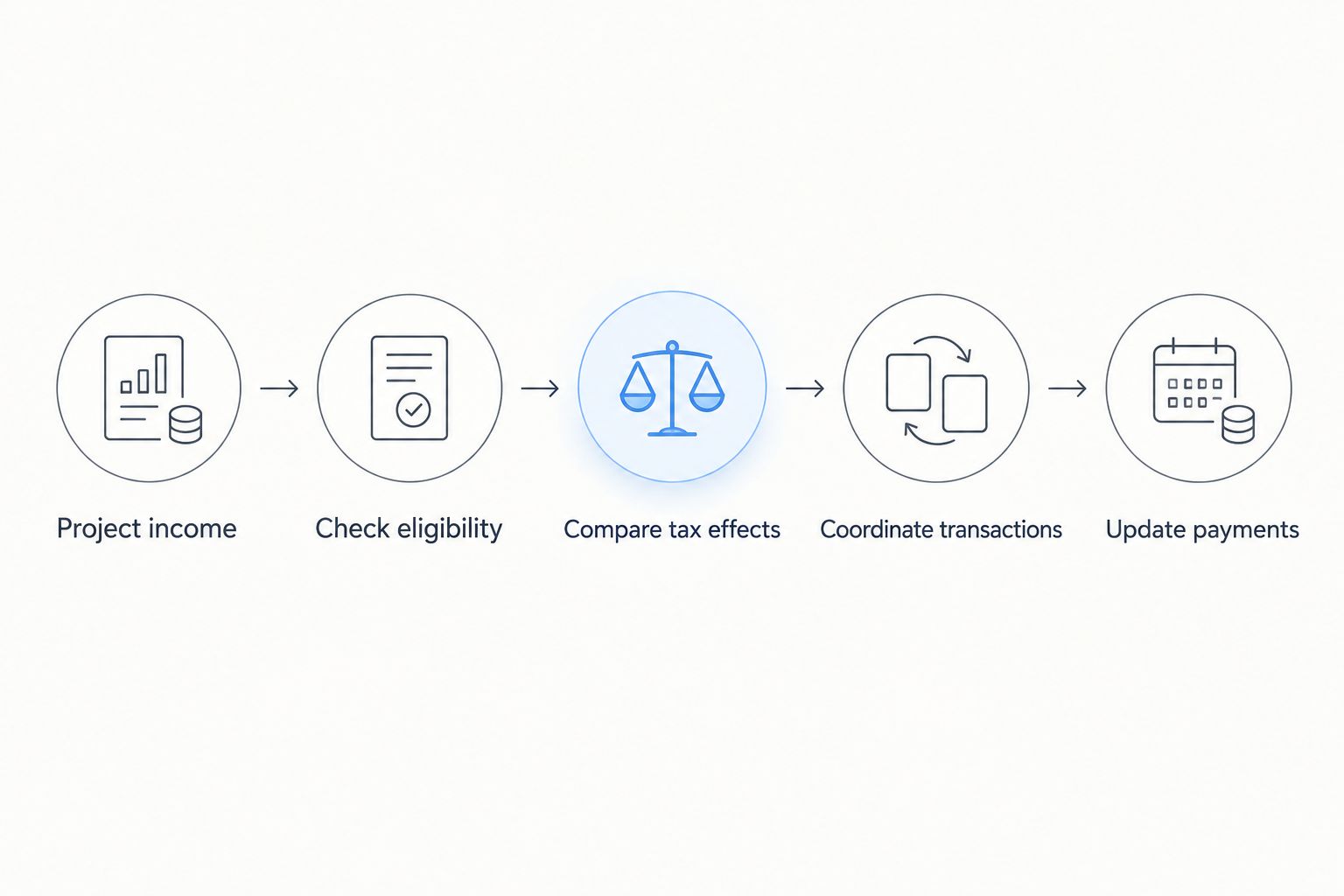
For 2026, use this sequence before making transactions:
- Project income: Include wages, business profits, gains, and planned conversions.
- Check eligibility: Confirm plan access, health coverage, and deduction requirements.
- Compare tax effects: Separate current deductions, deferral, and future tax-free treatment.
- Coordinate transactions: Check wash sales, account transfers, payroll, and charitable documentation.
- Update payments: Adjust withholding or estimated payments to match the revised projection.
Keep federal and state calculations separate. The 3.8% net investment income tax is another reason to model investment events: its individual thresholds include $200,000 for single filers and $250,000 for married couples filing jointly. The tax applies under its own rules, not to every dollar of income above those amounts.
How the strategies are ranked
The ranking prioritizes an accessible current tax benefit before transactions with greater complexity or irreversible consequences. Retirement contributions lead for eligible earners seeking deductions; charitable transfers and Roth conversions require more specific objectives. Payment planning ranks separately because its benefit is payment discipline, not lower taxable income.
IRS Publications 550, 505, and 969, Form 8606 instructions, and charitable-contribution guidance provide the relevant federal-rule references for 2026 decisions.
Which tax planning strategy should you choose?
Start with pretax retirement contributions if you want a current deduction and qualify. Add HSA funding when your coverage permits it. Review harvesting only when taxable investments have losses, and use charitable transfers only for giving already in your plan.
Business owners and investors facing large transactions need a projected return before acting. If outstanding returns or tax debts are the immediate issue, Rutter Organization's tax resolution services address a different need from selecting an investment account.
FAQ
What's the best tax planning strategy for a high income earner in 2026?
Eligible pretax retirement contributions are the strongest default for high earners seeking a current taxable-income reduction. HSA funding, investment losses, business structure, and charitable plans can change the next priority.
Do pretax retirement contributions eliminate tax permanently?
Pretax retirement contributions generally defer income tax rather than eliminate it. Distributions usually become taxable, and plan limits and withdrawal rules still apply.
Is an HSA available to every high income earner?
No. HSA contribution eligibility depends on qualifying health coverage and other requirements, not simply income. Check employer contributions and disqualifying coverage before funding the account.
How much investment loss can I deduct against other income?
Federal rules generally allow up to $3,000 of net capital losses against other income annually, or $1,500 if married filing separately. Capital losses first offset capital gains, and unused losses generally carry forward.
Is a backdoor Roth contribution tax-free?
A backdoor Roth conversion is not automatically tax-free. Existing traditional, SEP, and SIMPLE IRA balances affect the pro-rata calculation, and Form 8606 reporting matters.
Should I elect S corporation taxation to save taxes?
Elect S corporation treatment only after comparing total tax and administrative obligations with your current treatment. Reasonable compensation, payroll, retirement contributions, and state rules belong in that calculation.
Does meeting an estimated-tax safe harbor mean I owe nothing else?
No. A safe harbor addresses underpayment-penalty exposure rather than establishing your final tax liability. You can meet a safe harbor and still owe a balance when filing.
One last thing
A deduction and a tax payment solve different problems. Before making a 2026 contribution or transfer, write down whether it reduces taxable income, defers tax, creates future tax-free treatment, or addresses a payment obligation. If you cannot identify the mechanism, stop before moving money.


