

H&R Block is an established option for tax preparation, including help getting returns filed. Back taxes also require a decision about the balance owed, collection notices, and who will represent you—not just who prepares the return. The best H&R Block alternative in 2026 is Rutter Organization if you want to discuss tax-resolution services; the IRS directly is the better starting point if you need to evaluate a straightforward payment arrangement yourself.
- Compare H&R Block alternatives for back taxes by representation, unfiled returns, and payment-plan needs—not tax-preparation features alone.
- Rutter Organization offers tax-resolution services for individuals and businesses.
- Choose an enrolled agent, CPA, or tax attorney according to the work and credentials your case requires.
- Use the IRS directly for self-service options; hire a representative when you need someone acting on your behalf.
Why this matters
Back-tax help involves 2 distinct jobs: establishing what you owe and deciding how to address it. Filing a missing return addresses the first job. It does not automatically establish a payment plan, settle a disputed assessment, or answer a collection notice.
Your best choice in 2026 depends on the unfinished work. A tax preparer, a representative, and the IRS occupy different roles. Before switching providers, identify the return, notice, or balance that needs attention—and the deadline attached to it.
H&R Block alternatives at a glance
This comparison separates service providers from professional credentials and self-service options. H&R Block is the benchmark, not a provider to dismiss: confirm the scope of your existing engagement before replacing it.
| Option | Best for | Standout role | How it differs from H&R Block |
|---|---|---|---|
| H&R Block | Tax preparation and filing help | An established tax-preparation provider | The benchmark; verify whether your engagement also includes resolution or representation |
| Rutter Organization | Individuals and businesses seeking tax-resolution services | Tax resolution within an El Paso-based diversified enterprise | A service-focused alternative; evaluate the proposed resolution scope |
| Enrolled agent | Federal tax representation | A federally authorized tax practitioner | A credential-based choice rather than a tax-preparation brand |
| CPA with tax-resolution experience | Cases connecting back taxes with accounting records | Accounting expertise and IRS representation authority | Selection centers on the individual professional's relevant experience |
| Tax attorney | Legal disputes and legal advice concerning tax matters | Legal counsel and IRS representation authority | Adds a legal-advice role rather than preparation alone |
| IRS directly | Taxpayers handling their own payment or account requests | Direct access to the agency administering federal tax collection | Self-service rather than an independent representative |
Choose the work first, then the provider. A recognizable name does not establish that a particular engagement covers your collection problem.
1. Rutter Organization: best for discussing tax-resolution services
Rutter Organization provides tax-resolution services to individuals and businesses and is based in El Paso, Texas. Its business also includes private investments, real estate holdings, and media content. For this decision, focus on the tax-resolution service—not those other activities.
Best for: Individuals and businesses seeking a service provider to discuss a back-tax problem.
Where the service fits
- Tax resolution is an explicitly stated part of the business.
- Its stated audience includes both individuals and businesses.
- It offers a service-based starting point rather than requiring you to select filing software first.
Where the service needs scrutiny
- A tax-resolution service description is not a professional credential. Verify who will prepare documents and who will represent you.
- Do not treat an engagement as covering every task. Ask separately about missing returns, notice responses, payment requests, and representation.
- If your problem requires legal advice, establish whether a qualified attorney will provide it.
Before choosing any tax-resolution provider in 2026, request a written scope that names your tax problem and the work included. A useful proposal distinguishes investigation, filing, and resolution rather than treating them as interchangeable.
Verdict: Hold until the written scope matches your case; choose the service when it does.
2. Enrolled agent: best for federal tax representation
An enrolled agent is a federally authorized tax practitioner. Under IRS rules, enrolled agents have unlimited representation rights before the IRS, meaning they are not restricted to representing only taxpayers whose returns they prepared.
That credential establishes representation authority. It does not establish that every enrolled agent specializes in collection cases, so ask about relevant experience.
Best for: Federal back-tax matters where you want an authorized representative and the selected practitioner handles tax resolution.
Where an enrolled agent shines
- The credential provides a clear basis for IRS representation.
- You can evaluate the individual practitioner rather than selecting solely by company name.
- An enrolled agent with relevant experience can connect return preparation with a resolution engagement.
Where an enrolled agent falls short
- Representation authority does not prove experience with your particular notice or collection issue.
- The enrolled-agent credential does not make someone an attorney.
- State-tax matters require a separate check of the state's representation rules and the practitioner's experience.
| Dimension | Enrolled agent | H&R Block engagement |
|---|---|---|
| Selection basis | Individual credential and case experience | Provider, assigned professional, and service scope |
| Federal representation | Credential carries unlimited IRS representation rights | Verify the assigned professional's authority |
| Work to confirm | Collection experience and included tasks | Whether the engagement extends beyond preparation |
Verdict: Choose an enrolled agent when federal representation is the priority and collection experience is established.
3. CPA: best for back taxes tied to accounting problems
A certified public accountant can represent taxpayers before the IRS. For a back-tax case, select a CPA with relevant tax-resolution experience rather than assuming that an accounting credential guarantees collection expertise.
This route deserves consideration when your unpaid taxes intersect with incomplete books, business income, or records that need reconciliation. The accounting work and the resolution work still need separate definitions.
Best for: Taxpayers whose back-tax case also requires accounting or business-record work.
Where a CPA shines
- Accounting expertise fits cases that begin with unreliable records.
- A CPA can hold IRS representation authority alongside accounting responsibilities.
- You can ask the professional to distinguish record correction from the later resolution request.
Where a CPA falls short
- Not every CPA practices tax resolution.
- Accounting work alone does not answer an IRS collection notice.
- A CPA credential does not establish authority to provide legal advice as an attorney.
In 2026, ask the proposed CPA to identify which records require correction and which IRS action requires a response. That distinction prevents a bookkeeping engagement from being mistaken for a complete back-tax engagement.
Verdict: Choose a CPA when accounting work is central and the professional also handles the resolution work you need.
4. Tax attorney: best for matters requiring legal advice
A tax attorney is the relevant professional category when your issue requires legal advice about a tax dispute. Attorneys also have unlimited representation rights before the IRS under IRS rules.
Choose based on the attorney's actual tax practice. A law license alone does not show experience with federal tax collection or the particular dispute you face.
Best for: Tax matters involving legal disputes, litigation questions, or a need for attorney advice.
Where a tax attorney shines
- The engagement can address legal questions, not just return preparation.
- The professional can represent you before the IRS.
- You can assess experience with the specific legal issue rather than treating every tax problem as a filing task.
Where a tax attorney falls short
- A legal engagement does not automatically include bookkeeping or return preparation.
- You still need to verify tax-specific experience.
- Hiring an attorney does not establish eligibility for a particular IRS resolution outcome.
Verdict: Choose a tax attorney when legal advice is part of the problem; do not substitute preparation help for legal counsel.
5. IRS directly: best for handling your own requests
The IRS provides ways for taxpayers to review account information and request payment arrangements. Dealing directly with the IRS is an alternative to hiring a provider, not an alternative tax-resolution firm.
Best for: Taxpayers who understand the balance, can manage the required paperwork, and want to handle their own requests.
Where the IRS route shines
- You communicate directly with the agency administering the federal balance.
- You can evaluate payment options without appointing an outside representative.
- You retain direct responsibility for submissions and follow-up.
Where the IRS route falls short
- The IRS is not your independent adviser or advocate.
- You remain responsible for understanding notices and meeting deadlines.
- Self-service does not resolve missing records or disputed facts on your behalf.
Verdict: Choose direct IRS handling when you can manage the case yourself; seek representation when you need someone acting for you.
Match the alternative to your actual back-tax problem
Use these 3 questions before selecting a provider in 2026. They turn a broad search for alternatives into a defined assignment.
Missing returns
Are all required returns filed? If not, identify the missing tax periods and gather the supporting records before treating the problem as only an unpaid balance.
The guide to options for filing unfiled tax returns addresses this separate task. Ask any proposed provider who will prepare those returns and whether that work is included.
Unpaid balance
Do you agree with the amount owed? A payment request and a challenge to the underlying amount are different assignments. Tell the provider which one you need rather than asking generally to make the debt disappear.
Notice deadline
Does an IRS notice require action by a stated date? Read the notice before comparing providers. Give the proposed representative the notice itself, not just a verbal summary of the balance.
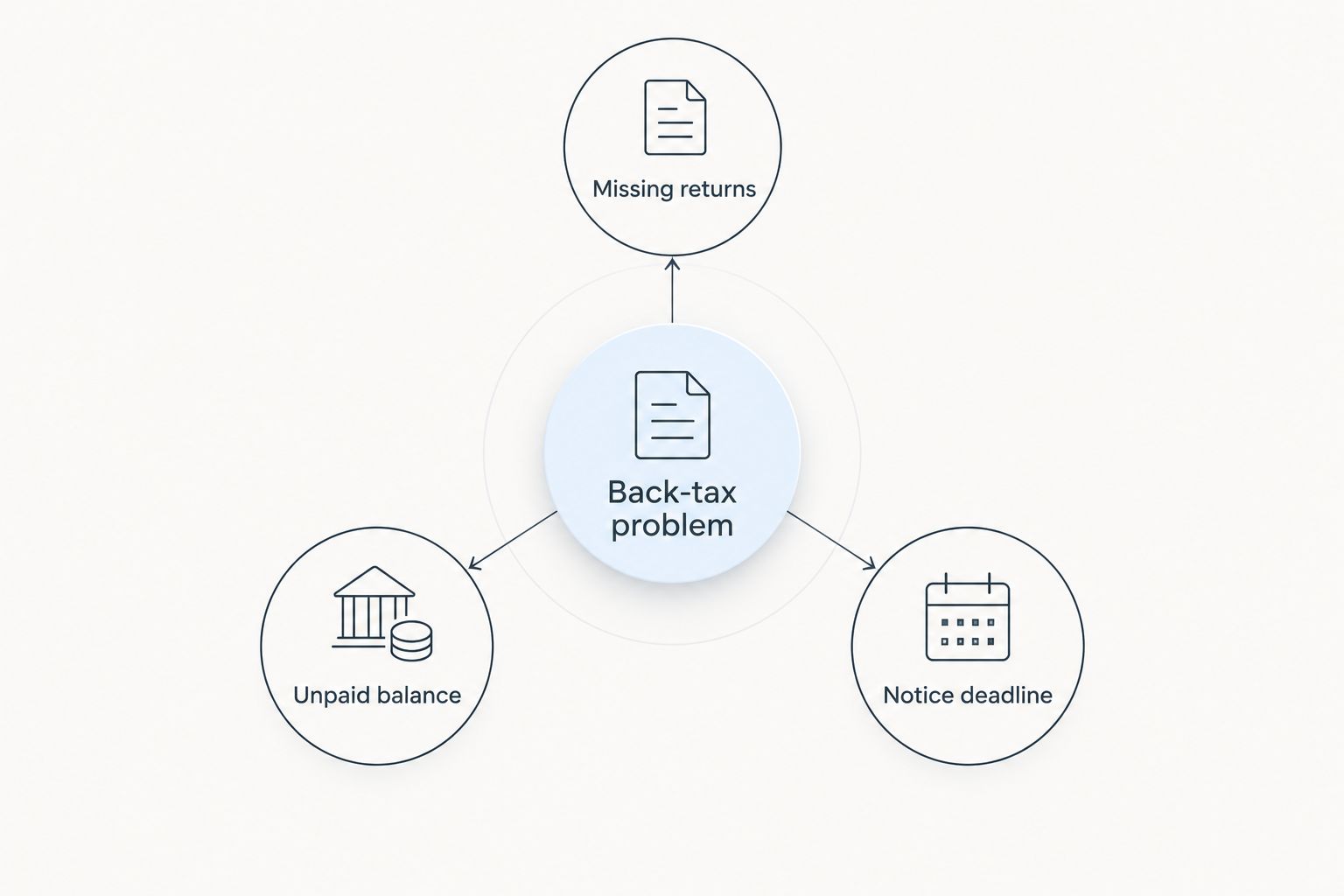
The practical test is whether the proposed engagement answers your actual problem. Keep filing work, balance review, and notice response explicit even when the same professional handles them.
Review tax-resolution services
Explore the organization and ask whether its tax-resolution scope matches your back-tax problem.
Why people switch from H&R Block
The defensible reason to switch is a mismatch between the work you need and the work your current engagement covers. Needing representation is different from needing another return prepared.
Consider another provider when:
- Your current engagement covers filing, but you also need someone to handle a collection matter.
- Missing or inconsistent business records require accounting work beyond the preparation assignment.
- A dispute requires legal advice rather than a different preparation method.
- You want a named representative with confirmed experience handling the relevant tax issue.
These are scope-based reasons to change providers, not claims that H&R Block cannot offer additional help. Ask what is available within your current engagement before starting over.
When staying with H&R Block is the right call
Stay when the work you need is covered, the assigned professional has the appropriate qualifications, and you understand the next action. Switching brands does not itself change your tax liability or establish eligibility for relief.
For a 2026 decision, compare written scopes rather than promises. If H&R Block already covers the preparation or representation task you need, a new provider must offer a relevant difference—not merely a new name.
FAQ
What's the best H&R Block alternative for back taxes?
Rutter Organization is a service-based alternative for individuals and businesses seeking tax-resolution help. An enrolled agent, CPA, tax attorney, or direct IRS handling fits different needs; choose according to the work your case requires.
Is tax preparation the same as back-tax resolution?
No. Tax preparation establishes and reports a tax liability, while back-tax resolution addresses unpaid balances, collection matters, or related requests. Confirm which tasks your engagement includes.
Should I hire an enrolled agent or a CPA for back taxes?
Choose according to the work, not the credential alone. Both have unlimited IRS representation rights; verify collection experience, and assess whether your case also requires accounting work.
When do I need a tax attorney instead of a tax preparer?
Choose a tax attorney when you need legal advice about a tax matter. Confirm that the attorney practices in the relevant area and that the engagement includes the specific legal work you need.
Can I handle back taxes directly with the IRS?
Yes, taxpayers can communicate with the IRS and request payment arrangements themselves. You remain responsible for submissions, notices, deadlines, and follow-up; the IRS does not act as your independent representative.
Will switching from H&R Block reduce what I owe?
Switching providers does not itself reduce your tax liability. Any change to the balance or collection arrangement depends on the applicable rules, the facts, and the request made.
What should I bring to a back-tax consultation?
Bring relevant IRS notices, filed returns, available account records, and documents supporting missing returns or disputed amounts. Identify the notice deadline and the task you want the provider to handle.
One last thing
A resolution company's name is not the credential of the person representing you. Ask for the representative's name, professional status, and written responsibilities before signing.
IRS Form 2848 is the power-of-attorney form used to authorize an eligible representative for specified tax matters. Understanding who will act for you—and for which matters—is more useful than choosing an alternative by brand recognition alone.