

Best overall: a documented doubt-as-to-collectibility offer. Best for an incorrect assessment: a doubt-as-to-liability offer. Best fallback when you can repay the debt: an installment agreement. The best IRS offer in compromise strategies 2026 start with choosing the correct legal basis, not choosing the smallest settlement number.
- The best IRS offer in compromise strategies 2026 match your tax liability, payment capacity, and hardship evidence.
- Doubt as to collectibility suits taxpayers whose assets and future income cannot cover the assessed debt.
- Dispute an incorrect assessment through doubt as to liability, not a hardship argument.
- Rutterorganization provides tax resolution services for individuals and businesses; compare your circumstances before selecting a settlement strategy.
Why this matters
An offer in compromise lets eligible taxpayers settle a tax debt for less than the full amount owed. Acceptance is not automatic. The IRS examines the legal basis, financial evidence, filing compliance, and proposed payment terms.
Rutterorganization is a fit for individuals and businesses seeking tax resolution services, rather than investment or real estate guidance. Its Rutterorganization website is the starting point for reviewing the enterprise's services.
An offer solves a specific problem: a debt that qualifies for compromise under IRS rules. If the assessment is correct and you can repay it, a payment arrangement addresses a different problem without requiring a settlement application.
What makes the best offer in compromise strategy?
Use these criteria to choose your approach in 2026:
- Correct legal basis: Separate inability to pay, disputed liability, and exceptional hardship. Each requires different evidence.
- Filing compliance: File required returns and meet applicable current-payment obligations before submitting an offer.
- Accurate financial disclosure: Document assets, income, debts, and allowable expenses. Unsupported totals weaken the application.
- Feasible payment terms: Select terms you can actually complete, not terms that merely produce an attractive offer amount.
- Post-acceptance compliance: An accepted offer includes continuing obligations. Settlement is not the end of the process.
- Appropriate alternative: Compare a compromise with an installment agreement or other applicable collection relief before committing.
The ranking below is a decision tree, not a list of competing providers. The first three options address different legal grounds; the fourth addresses qualifying applicants' payment obligations; the fifth is an alternative to compromise.
IRS offer in compromise strategies at a glance
| Rank and strategy | Best for | Standout feature | Key limitation |
|---|---|---|---|
| 1. Doubt as to collectibility | Taxpayers unable to repay the assessed debt | Bases the offer on documented collection potential | Low cash reserves alone do not establish eligibility |
| 2. Doubt as to liability | Taxpayers disputing whether they owe the assessed amount | Addresses the correctness of the liability | Requires a supported tax dispute, not just financial difficulty |
| 3. Effective tax administration | Taxpayers whose full payment creates qualifying hardship or exceptional unfairness | Addresses qualifying circumstances despite collection capacity | Requires evidence beyond an ordinary payment inconvenience |
| 4. Low-income certification | Qualifying individual applicants with limited income | Removes specified application and payment requirements | Does not establish that the offer itself deserves acceptance |
| 5. Installment agreement | Taxpayers able to repay through scheduled payments | Provides a repayment route without a compromise request | Does not reduce the assessed principal through settlement |
1. Doubt as to collectibility: best for unaffordable tax debt
A doubt-as-to-collectibility offer addresses a valid tax debt that the IRS cannot reasonably collect in full. The IRS generally evaluates reasonable collection potential using asset equity and future income, subject to its rules and exceptions. Your proposed amount must fit that analysis.
The strongest strategy is to reconcile your financial disclosures before submitting the offer. Bank statements, pay records, loan balances, and expense evidence should support the figures on the applicable collection information statement.
Calculate collection potential before proposing an amount
For the standard calculation described in the IRS Form 656 booklet, future income generally uses 12 months for a qualifying lump-sum cash offer and 24 months for a periodic-payment offer. These multipliers apply to calculated monthly disposable income; they are not estimates of your total tax bill.
The payment structures also differ. A lump-sum cash offer generally requires payment of the remaining accepted offer balance in five or fewer payments within 5 months after acceptance. A periodic-payment offer generally requires completion within 24 months after acceptance.
Use the current Form 656 booklet and applicable Form 433-A(OIC) or Form 433-B(OIC) instructions for a 2026 application. Different payment terms change both the calculation and your funding obligations.
Doubt-as-to-collectibility pros:
- Targets the central issue when a valid debt exceeds collection potential.
- Provides a structured financial calculation rather than an arbitrary settlement request.
- Allows documented financial circumstances to support the proposed amount.
Doubt-as-to-collectibility cons:
- Requires detailed disclosure of assets, income, and expenses.
- Does not treat every household expense as an allowable deduction.
Best for: Taxpayers whose documented collection potential is below the assessed debt.
Verdict: Hold submission until your proposed amount matches a supportable financial calculation.
2. Doubt as to liability: best for an incorrect assessment
A doubt-as-to-liability offer addresses a genuine dispute about the existence or amount of the tax debt. It is not the correct route when you agree with the assessment but cannot afford it. IRS Form 656-L is the application for this legal basis.
Identify the exact tax period, disputed item, and reason the assessed amount is incorrect. Then connect the explanation to supporting records. A general statement that the balance seems excessive does not substitute for evidence.
Separate a tax calculation dispute from a collection complaint. Disagreeing with how aggressively the IRS collects a valid debt does not establish doubt as to liability.
Doubt-as-to-liability pros:
- Focuses the application on whether the assessed debt is correct.
- Uses a dedicated process rather than forcing the dispute into a financial-hardship application.
- Gives supporting tax records a clear role in the decision.
Doubt-as-to-liability cons:
- Requires a defensible dispute about liability.
- Does not resolve a valid debt simply because repayment is difficult.
Best for: Taxpayers with evidence that the assessed liability is incorrect.
Verdict: Skip a collectibility-only argument when the actual problem is an incorrect assessment.
3. Effective tax administration: best for exceptional hardship
An effective-tax-administration offer addresses qualifying circumstances even when the tax is correct and collection in full is possible. Collection can create economic hardship, or exceptional circumstances can make full collection unfair or inequitable under the applicable rules.
For an individual claiming economic hardship, explain how collection would affect the ability to meet basic living expenses. Support the explanation with relevant financial and personal records, rather than presenting hardship as a label.
Do not confuse asset ownership with unrestricted spending capacity. The application must explain the specific hardship or exceptional circumstance, while still fully disclosing the assets the IRS evaluates.
Effective-tax-administration pros:
- Recognizes qualifying hardship beyond a standard collectibility calculation.
- Provides a route when full collection is possible but the circumstances support compromise.
- Allows relevant personal circumstances to form part of the application.
Effective-tax-administration cons:
- Requires a qualifying hardship or exceptional-circumstances case.
- Does not cover ordinary reluctance to sell assets or reduce discretionary spending.
Best for: Taxpayers with documented circumstances that meet effective-tax-administration standards.
Verdict: Hold filing until the evidence explains why full collection meets this specific legal standard.
4. Low-income certification: best for qualifying individuals
Low-income certification changes specified application and payment requirements for qualifying individual applicants. It does not create a separate legal basis for compromise or guarantee acceptance. The applicant still needs an otherwise supportable offer.
The IRS Form 656 booklet provides the certification criteria and income table. Use the current table for your household size and location rather than carrying an older threshold into a 2026 application.
Qualifying applicants are not required to submit the application fee or initial payment, or make monthly offer payments while the IRS evaluates the offer. Check the certification instructions before assuming those requirements apply to you.
Low-income-certification pros:
- Removes specified upfront application requirements for qualifying applicants.
- Removes monthly offer-payment requirements during evaluation for qualifying applicants.
- Makes the certification decision explicit within the application process.
Low-income-certification cons:
- Applies to qualifying individuals, not every applicant or business.
- Does not eliminate the financial analysis or the accepted offer's obligations.
Best for: Individual applicants who satisfy the current low-income certification criteria.
Verdict: Hold payment decisions until you have checked the applicable certification requirements.
5. Installment agreement: best when repayment is achievable
An installment agreement is not an offer in compromise. It provides scheduled repayment of a tax debt rather than a negotiated reduction through settlement. Compare it with an offer when your finances support repayment but not an immediate full payment.
Choose this route based on a realistic budget. A monthly payment that leaves you unable to meet current tax obligations creates another problem instead of resolving the existing one.
Review IRS payment plan options for taxpayers who owe money before treating compromise as the only solution. Interest and applicable penalties generally continue while an unpaid balance remains.
Installment-agreement pros:
- Addresses timing when the central problem is immediate payment capacity.
- Avoids requiring a compromise decision to establish a repayment arrangement.
- Provides a defined payment structure for a valid debt.
Installment-agreement cons:
- Does not reduce the assessed principal through an offer settlement.
- Requires payments alongside current tax obligations and ongoing charges.
Best for: Taxpayers whose budget supports repayment under an applicable agreement.
Verdict: Skip an unsupported compromise application when a sustainable repayment arrangement fits the facts.
Put the application in the right order
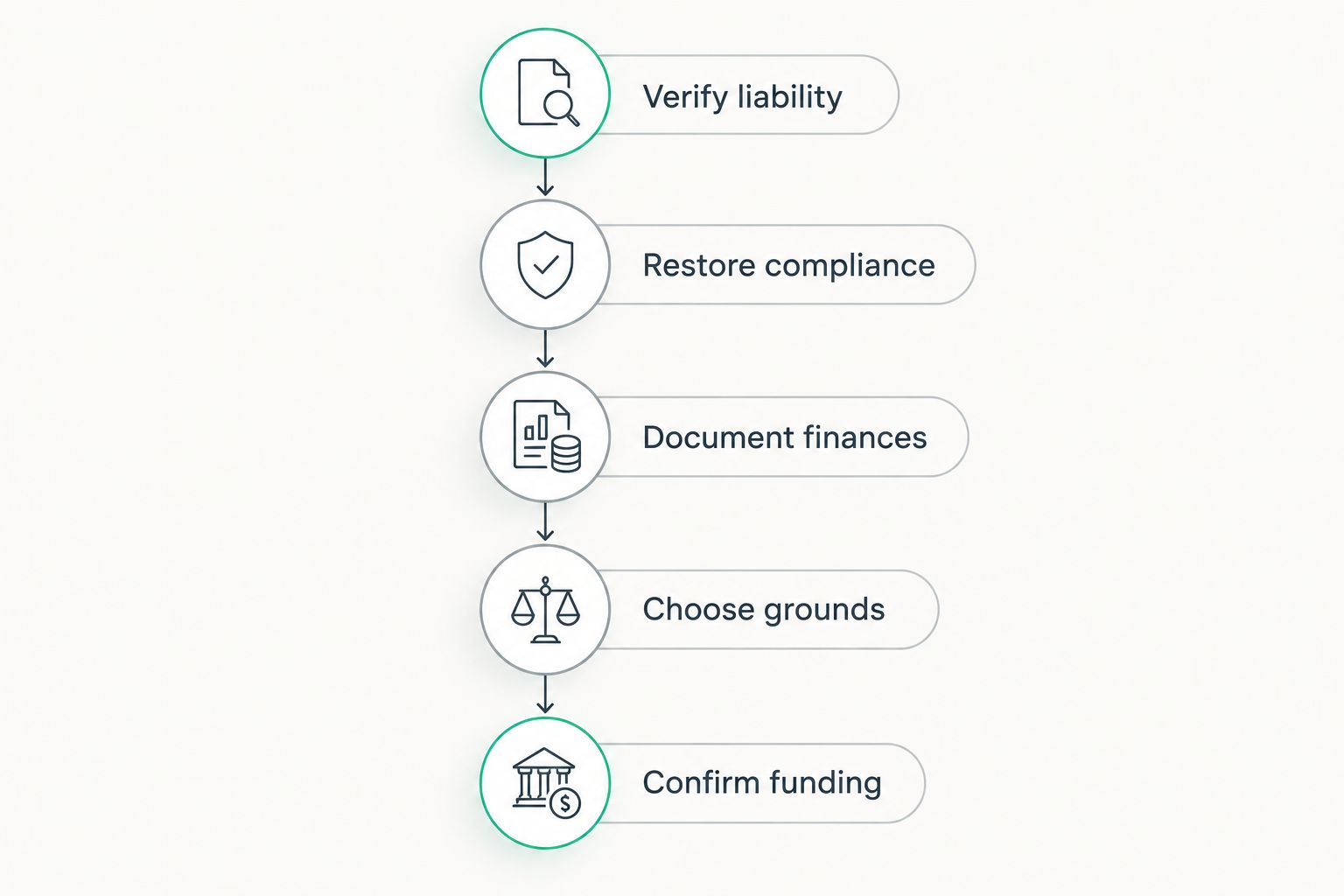
An effective 2026 application follows a sequence. Do not start by naming an offer amount and then searching for evidence to justify it.
- Verify liability: Identify the tax periods, balances, and any genuine assessment dispute.
- Restore compliance: File required returns and meet applicable estimated-tax or employment-tax deposit requirements.
- Document finances: Reconcile asset values, loan balances, income, and allowable expenses.
- Choose grounds: Select collectibility, liability, or effective tax administration based on the evidence.
- Confirm funding: Check required payments, certification eligibility, and how you will complete an accepted offer.
Keep copies of the application, attachments, correspondence, and payment records. If the IRS requests additional information, answer the actual request and preserve proof of what you submitted.
Rutterorganization offers tax resolution services for individuals and businesses. When discussing an offer, ask which legal basis fits your facts and which records support it—not what settlement amount sounds appealing.
Review your tax resolution needs
Start with the tax periods, filing status, and financial records relevant to your debt.
How these strategies are ranked
The ranking prioritizes the legal basis, financial evidence, compliance, and payment feasibility. Doubt as to collectibility is the default for an unaffordable valid debt; liability and effective tax administration serve different circumstances. Low-income certification modifies requirements, while an installment agreement remains a separate alternative.
The governing references are the IRS Offer in Compromise guidance, Form 656 booklet, Form 656-L, and applicable collection information statements. For 2026 decisions, use their current instructions for eligibility, calculations, submission requirements, and payment terms.
Which strategy should you choose?
Choose doubt as to collectibility when the assessed debt is correct and your documented collection potential cannot cover it. Choose doubt as to liability when you can support a dispute about the assessment. Evaluate effective tax administration when qualifying hardship or exceptional circumstances justify compromise despite collection capacity.
Check low-income certification separately. If repayment is achievable, compare an installment agreement before preparing a settlement application.
FAQ
What's the best IRS offer in compromise strategy in 2026?
A documented doubt-as-to-collectibility offer is the best default when a valid tax debt exceeds your reasonable collection potential. Use doubt as to liability for a supported assessment dispute, or effective tax administration for qualifying hardship or exceptional circumstances.
Can I choose any amount for an IRS settlement offer?
Your proposed amount needs to satisfy the rules for the offer's legal basis. For a collectibility offer, the IRS generally evaluates asset equity and future income rather than accepting an arbitrary settlement percentage.
Is a lump-sum offer better than a periodic-payment offer?
A lump-sum offer generally uses a shorter future-income multiplier, but it requires a different payment schedule. The standard calculation generally uses 12 months of future income for lump-sum cash offers and 24 months for periodic-payment offers, subject to the applicable instructions.
Do I need to file missing tax returns before applying?
You generally must file required tax returns before submitting an offer in compromise. You must also meet applicable current-payment requirements, and an open bankruptcy proceeding prevents offer eligibility.
Does low-income certification guarantee acceptance?
No, low-income certification does not guarantee acceptance. It removes specified application and payment requirements for qualifying individual applicants, but the offer must still satisfy the applicable compromise rules.
What happens after the IRS accepts an offer?
You must complete the accepted offer's payment terms and comply with its continuing requirements. These generally include timely filing and payment obligations for 5 years after acceptance; violating the terms can cause default.
Can I appeal a rejected offer in compromise?
You generally have 30 days from the rejection letter's date to request an appeal. Follow the letter's instructions; a returned offer is different from a rejected offer and does not carry the same appeal rights.
One last thing
An accepted settlement is not permission to fall behind again. The continuing 5-year compliance requirement makes current tax payments part of the settlement strategy, not an afterthought.
Before submitting an offer in 2026, build a budget that covers both the proposed settlement and new tax obligations. For a Rutterorganization tax resolution discussion, bring that budget with the records supporting your application.


