

Best overall: accurate expense tracking. Best for recovering a rental building’s cost: depreciation. Best for deferring tax when replacing investment property: a Section 1031 exchange. The best real estate tax strategies for landlords in 2026 start with deductions you can document and use—not the largest deduction on paper.
- Best real estate tax strategies for landlords 2026: expense tracking first, depreciation next, advanced planning only when justified.
- Residential rental buildings generally use 27.5-year depreciation; land is not depreciable.
- Passive-loss rules determine whether rental deductions reduce your current taxable income.
- Section 1031 exchanges defer eligible gains; they do not erase the replacement property’s tax obligations.
Why this matters
A rental deduction and a current-year tax saving are different things. You can calculate a valid depreciation deduction and still carry the resulting loss forward because passive-activity rules restrict its use.
Your first task in 2026 is to connect each strategy to an actual problem: overlooked expenses, incorrect basis, a renovation, suspended losses, or a planned sale. Do not commission an advanced analysis before establishing that its deductions will help your tax position.
The Rutter Organization serves individuals and businesses through tax resolution services, private investments, real estate holdings, and media content. The Rutter Organization is best suited to landlords seeking tax resolution services, not a tax-software product. This guide compares federal tax strategies; your eligibility depends on your records, ownership, income, and property use.
What makes the best landlord tax strategy?
Evaluate each strategy against these criteria before choosing it:
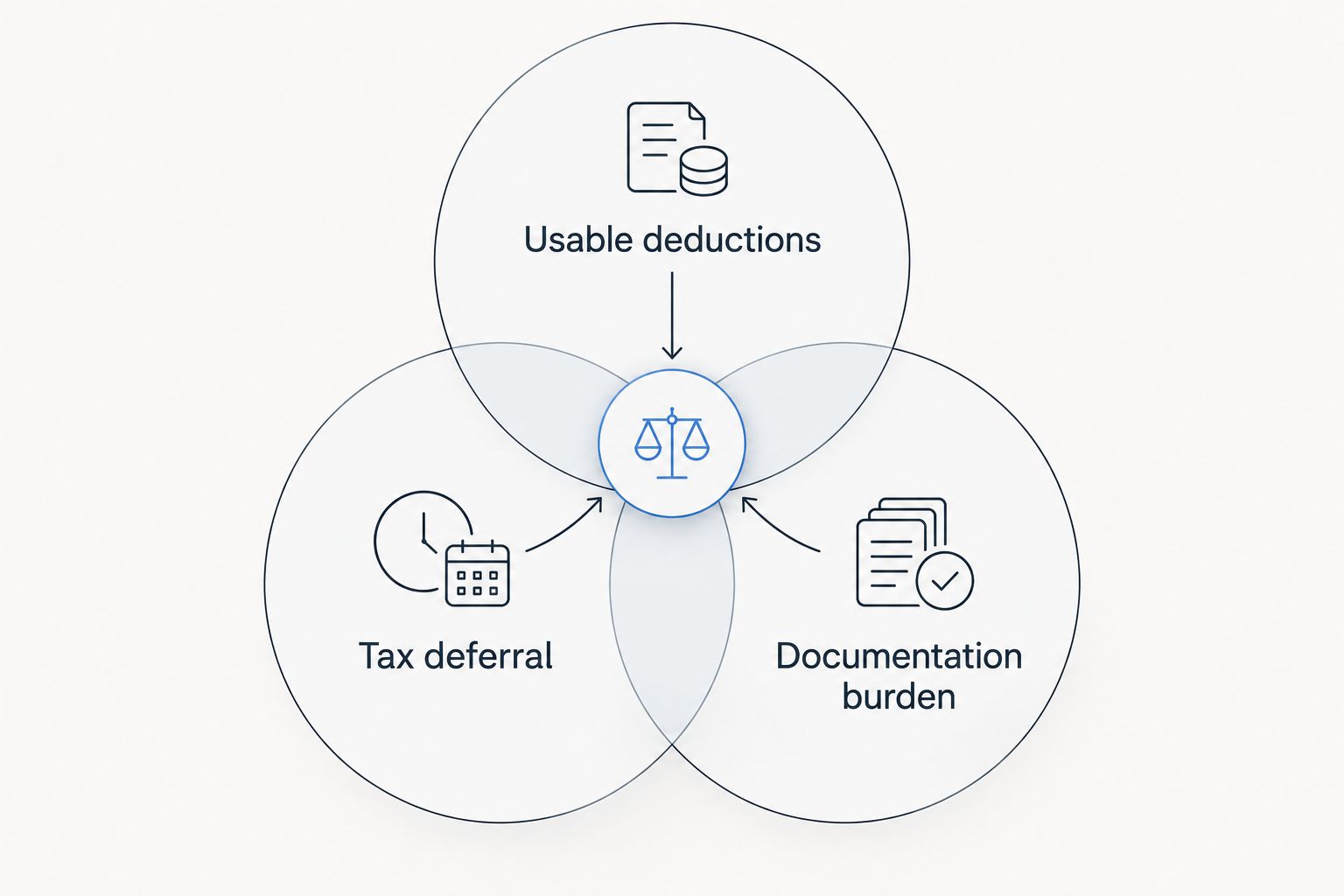
- Usable deductions: Does the deduction reduce current taxable income, or become a suspended loss?
- Tax deferral: Does the strategy postpone a tax liability rather than permanently reduce it?
- Documentation burden: Can you support the deduction with invoices, basis records, and activity logs?
- Property fit: Does the strategy match residential rentals, commercial property, or your planned sale?
- Exit consequences: What happens to basis, depreciation-related gain, and flexibility when you sell?
Usable deductions, tax deferral, and documentation burden are separate tests. A strategy that wins on deduction size can lose on immediate usefulness or recordkeeping demands.
Landlord tax strategies at a glance
| Rank and strategy | Best for | Standout benefit | Key limitation |
|---|---|---|---|
| 1. Expense tracking | Landlords with incomplete operating records | Identifies deductible operating expenses | Personal and capital expenses require separate treatment |
| 2. Building depreciation | Owners establishing or correcting rental basis | Recovers building cost over its tax recovery period | Land is excluded; sale consequences remain |
| 3. Repair classification | Landlords maintaining or renovating property | Separates current deductions from capital improvements | Classification depends on the work performed |
| 4. Passive-loss planning | Owners with rental losses and other income | Determines when losses become usable | Income and participation restrictions apply |
| 5. Cost segregation | Owners evaluating accelerated depreciation | Separates qualifying shorter-lived components | Accelerated losses can remain suspended |
| 6. Section 1031 exchange | Investors replacing investment real estate | Defers qualifying gain on an exchange | Strict deadlines and transaction requirements |
| 7. Real estate professional qualification | Owners whose principal work is real estate | Can change rental losses’ passive treatment | Status alone does not establish material participation |
1. Expense tracking: best for overlooked operating deductions
Expense tracking is the default starting point because it establishes what you spent, why you spent it, and which property benefited. Ordinary and necessary rental expenses can include management fees, insurance, qualifying interest, and maintenance. Separate operating expenses from improvements, loan principal, and personal spending.
For 2026, reconcile each property’s bank activity against invoices and management statements. A transaction description alone does not establish deductibility. Keep the supporting document and record its rental-business purpose.
Expense tracking pros:
- Identifies expenses omitted from your rental records.
- Creates a repeatable process across properties.
- Supports the distinction between rental and personal use.
Expense tracking cons:
- Requires regular reconciliation, not just tax-season sorting.
- Does not make a personal or capital expense currently deductible.
Best for: Landlords whose deductions depend on scattered receipts or incomplete statements.
Verdict: Buy—adopt property-level bookkeeping before advanced tax planning. Accurate records also give your preparer the information needed to evaluate every strategy below. Retain records supporting basis separately from annual operating files; their relevance extends beyond the year you incur the expense.
2. Building depreciation: best for recovering rental-property basis
Depreciation allocates the depreciable cost of rental property over its recovery period. Under the general federal depreciation system, residential rental buildings generally use 27.5 years; nonresidential real property generally uses 39 years. Land is not depreciable.
Begin with an allocation between land and building that you can support. Then establish when the property became ready and available for rent. IRS Publication 527, used for 2026 residential-rental planning, explains rental expenses, depreciation, and personal-use restrictions.
Building depreciation pros:
- Recognizes building cost without requiring a new annual cash outlay.
- Establishes a depreciation schedule for future returns.
- Creates the basis framework needed for sale planning.
Building depreciation cons:
- Does not permit depreciation of land.
- Can affect taxable gain when the property is sold.
Best for: Owners placing property into rental service or reviewing an existing depreciation schedule.
Verdict: Buy—confirm basis and depreciation before pursuing acceleration. Depreciation allowed or allowable generally reduces adjusted basis even if you failed to claim it. Missing deductions therefore require correction analysis, not simply ignoring the prior schedule or restarting depreciation in 2026.
3. Repair classification: best for maintenance and renovation decisions
Repairs and improvements receive different tax treatment. Qualifying repairs generally maintain property in its ordinarily efficient operating condition; improvements involving betterments, restorations, or adaptations generally require capitalization.
Evaluate the actual work, not the invoice heading. Replacing an entire building system presents a different analysis from fixing an isolated defect. IRS tangible-property regulations govern this distinction, including applicable safe-harbor elections; IRS Publication 527 explains the rental-property framework.
Repair classification pros:
- Prevents routine maintenance from being automatically treated as an improvement.
- Identifies capital work that belongs in the depreciation schedule.
- Encourages better contractor descriptions and project records.
Repair classification cons:
- Requires analysis of the relevant property or building system.
- Does not turn a major restoration into a repair because it has separate invoices.
Best for: Landlords deciding how to report maintenance, replacements, and renovation projects.
Verdict: Buy—classify the work before preparing the return. Keep before-and-after descriptions, contracts, and invoices explaining what changed. Do not split a single improvement into smaller payments solely to label it deductible maintenance. Payment timing and invoice wording do not replace the underlying tax analysis.
4. Passive-loss planning: best for landlords with suspended deductions
Rental real estate is generally passive for federal tax purposes, subject to exceptions. A rental loss therefore does not automatically offset wages or other nonpassive income.
For qualifying individuals who actively participate, the special rental-real-estate allowance can permit up to $25,000 of losses against nonpassive income. For eligible married taxpayers filing jointly and most eligible unmarried taxpayers, the allowance phases out as modified adjusted gross income rises from $100,000 to $150,000. Separate-return rules differ.
Passive-loss planning pros:
- Shows whether a deduction produces a current benefit.
- Preserves the history of suspended losses.
- Informs decisions about accelerated depreciation and property sales.
Passive-loss planning cons:
- Requires income, participation, and filing-status analysis.
- Remains subject to other limits, including basis and at-risk rules.
Best for: Owners reporting rental losses alongside wages or business income.
Verdict: Buy—check loss usability before increasing deductions. IRS Publication 925 covers passive-activity and at-risk rules for this analysis. A qualifying fully taxable disposition of an entire activity to an unrelated person generally releases suspended passive losses; selling one asset does not automatically satisfy that test.
5. Cost segregation: best for evaluating accelerated depreciation
Cost segregation identifies qualifying property components that have shorter recovery periods than the building itself. It reallocates supported basis; it does not create additional acquisition cost or allow depreciation of land.
Compare the timing benefit with the analysis expense, your expected holding period, and loss limitations. For a 2026 decision, evaluate the depreciation rules applicable to each component’s acquisition and placed-in-service circumstances. Do not apply one accelerated-depreciation assumption to the entire property.
Cost segregation pros:
- Identifies eligible shorter-lived components within supported property basis.
- Brings qualifying depreciation deductions into earlier periods.
- Provides detailed component records for future tax reporting.
Cost segregation cons:
- Requires a defensible allocation and supporting analysis.
- Can generate losses that passive-activity rules suspend.
Best for: Owners with substantial depreciable basis who can use accelerated deductions.
Verdict: Hold—confirm usable tax benefits before commissioning an analysis. Ask the tax preparer to compare the existing depreciation schedule with the proposed allocation. Include future sale consequences in that comparison. A larger first-year deduction is not the same as a larger lifetime deduction, and acceleration is not automatically permanent tax elimination.
6. Section 1031 exchange: best for replacing investment real estate
A Section 1031 exchange can defer qualifying gain when you exchange eligible real property held for investment or business use. It is not a general exemption for selling a property and buying another later.
In a typical deferred exchange, identify replacement property within 45 days of transferring the relinquished property. Complete the exchange within 180 days, or by the applicable tax-return due date, including extensions, if earlier. IRS Publication 544 explains the federal exchange framework.
Section 1031 exchange pros:
- Defers qualifying gain while continuing real-estate investment.
- Supports replacement-property planning around an intended sale.
- Preserves capital that otherwise goes toward immediate tax on qualifying gain.
Section 1031 exchange cons:
- Requires transaction structuring before you receive sale proceeds.
- Can leave taxable gain when cash or other nonqualifying value is received.
Best for: Investors committed to replacement real estate rather than cashing out.
Verdict: Hold—structure the exchange before closing the sale. Compare the exchange with other real estate investment strategies for tax deferral. Do not let the deadline force an unsuitable acquisition. Deferral carries tax consequences into the replacement investment rather than making them disappear.
7. Real estate professional qualification: best for full-time operators
Real estate professional status can remove the automatic passive classification of qualifying rental activities. It does not make every landlord’s losses nonpassive: you must also materially participate in the relevant rental activity, subject to applicable grouping rules.
The general qualification tests require more than 750 hours of services in real property trades or businesses in which you materially participate, and more than half of your personal services for the year in those businesses. Employee-service and spouse-related rules require separate attention.
Real estate professional qualification pros:
- Can change the treatment of qualifying rental losses.
- Connects tax treatment to actual real-estate work.
- Supports deliberate participation and activity-record planning.
Real estate professional qualification cons:
- Requires meeting both qualification tests and material-participation rules.
- Does not treat investor time or a job title as automatic qualification.
Best for: Owners whose principal working activity genuinely centers on qualifying real estate businesses.
Verdict: Hold—use actual service records, not a target-hour estimate. Maintain credible records showing activities, dates, and time spent. IRS Publication 925 explains the relevant federal rules. Do not choose this strategy merely because a depreciation loss is large; qualification follows your work, not your desired deduction.
How these strategies are ranked
The ranking prioritizes documented deductions and correct basis before specialized elections or transaction structures. Expense tracking ranks first because the other strategies rely on accurate records. Depreciation and repair classification follow because they determine what gets deducted and when.
Passive-loss planning comes before cost segregation because it tests whether acceleration helps now. Section 1031 exchanges and real estate professional qualification serve narrower circumstances; neither is a default answer for every landlord.
Which landlord tax strategy should you choose?
Choose expense tracking as your default, then verify depreciation and loss usability. For 2026, take your preparer a property-by-property expense ledger, depreciation schedules, improvement records, suspended-loss history, and details of any planned sale. Ask for the projected current-year effect, not just the deduction amount.
If unresolved tax obligations are the immediate problem, address them separately from investment planning. The Rutter Organization’s stated services include tax resolution; an investment deduction does not, by itself, resolve an existing tax balance or filing obligation.
Review the organization’s services
Explore tax resolution services alongside the organization’s other business areas.
FAQ
What are the best real estate tax strategies for landlords in 2026?
The best starting strategies are accurate expense tracking, correct building depreciation, and proper repair classification. Check passive-loss restrictions before pursuing accelerated depreciation, and evaluate a Section 1031 exchange only when replacing eligible investment real estate.
Can rental losses reduce the tax on my salary?
Rental losses can offset salary only when an applicable exception or allowance permits it. The active-participation allowance has income restrictions, and real estate professional treatment also requires material participation.
Can I depreciate the land under my rental property?
No, land is not depreciable. Allocate supported acquisition basis between land and depreciable property before calculating rental depreciation.
Is cost segregation better than regular depreciation?
Cost segregation is better for accelerating eligible deductions when you can use them and justify the analysis. Regular building depreciation remains the baseline, and suspended losses can limit the immediate benefit of acceleration.
Does a Section 1031 exchange eliminate capital gains tax?
A qualifying Section 1031 exchange defers gain rather than automatically eliminating it. Replacement-property basis and any cash or other nonqualifying value received affect the tax outcome.
Does an LLC automatically reduce my rental taxes?
No, forming an LLC does not automatically create additional federal rental deductions. Federal tax classification, ownership, and your actual activities determine the reporting consequences.
Can I deduct an entire rental renovation as repairs?
No, a renovation is not automatically deductible as repairs. Betterments, restorations, and adaptations generally require capitalization, while qualifying maintenance and repairs receive different treatment.
Does real estate professional status make every rental loss deductible?
No, real estate professional status alone does not make every rental loss currently deductible. Material participation and other applicable limitations still require analysis.
One last thing
Skipping depreciation does not reliably avoid its future tax consequences. Adjusted basis generally reflects depreciation allowed or allowable, so an unclaimed deduction can still affect your sale calculation. Review missing or incorrect schedules before selling rather than treating the omission as tax planning.
Use The Rutter Organization for its stated service areas, and have your tax preparer apply these strategies to your specific facts. This guide provides general federal tax information, not individualized tax or legal advice; state treatment can differ.


