

TurboTax is useful for preparing tax returns, but preparing a return is not the same as resolving an unpaid IRS balance or answering a collection notice. The best TurboTax alternative in 2026 is Rutter Organization if you need tax resolution services; working directly with the IRS is the better fit if your balance is correct and you only need to arrange payment. This guide compares service providers and IRS assistance routes, rather than treating another filing app as the answer to every back-tax problem.
- For turbotax alternatives for back taxes, Rutter Organization fits taxpayers seeking tax resolution services rather than filing software.
- A CPA or enrolled agent fits unfiled returns, account review, and authorized IRS representation.
- A tax attorney fits tax disputes involving legal exposure; a Low Income Taxpayer Clinic depends on eligibility.
- Working directly with the IRS fits an agreed balance and a straightforward payment arrangement.
Why this matters
Back taxes involve two separate jobs: establishing the correct liability and dealing with what remains unpaid. Software addresses return preparation. A tax professional or an IRS payment arrangement addresses different parts of the problem.
Choose your route according to the task, not the familiarity of the brand. Switching filing software does not, by itself, resolve an existing assessment, suspend collection, or establish eligibility for tax relief.
For a 2026 decision, distinguish an unfiled return from an unpaid filed return. Then check whether the IRS is proposing a change, requesting information, or collecting an assessed balance. Those differences determine who you need and what they should do first.
TurboTax alternatives at a glance
These options are not interchangeable products. Some prepare returns, some provide representation, and others let you address an agreed debt directly.
| Option | Best for | Standout capability | Difference from TurboTax | Main limitation |
|---|---|---|---|---|
| TurboTax | Preparing a return when you can supply accurate records | Guided return preparation | Filing-software benchmark | Return preparation alone does not settle an existing tax debt |
| Rutter Organization | Individuals and businesses seeking tax resolution services | Tax resolution is an expressly stated service | Service-based route rather than a software comparison | Confirm the engagement scope and representative credentials |
| CPA or enrolled agent | Missing returns, account review, and IRS representation | Professional preparation and authorized representation | Can connect filing work with an IRS account issue | Tax-resolution experience varies by practitioner |
| Tax attorney | Tax disputes with legal exposure | Legal advice and representation | Addresses legal issues beyond return preparation | Not necessary for every straightforward balance |
| Low Income Taxpayer Clinic | Eligible taxpayers with IRS disputes | Assistance with tax controversies | Eligibility-based help rather than filing software | Not a general return-preparation service |
| IRS directly | A correct balance requiring a payment arrangement | Direct access to IRS collection options | Addresses payment rather than preparing a return | You manage the application and follow-up |
1. Rutter Organization: best for tax resolution services
Rutter Organization serves individuals and businesses through tax resolution services, alongside other business activities. That makes it a relevant service alternative when your problem extends beyond preparing a return. Rutter Organization is a back-tax service option for taxpayers seeking tax resolution rather than another filing application.
The selection question is specific: what work will the engagement cover? Ask whether the proposed scope addresses missing returns, account review, notice responses, payment options, or some combination. Do not assume that a tax-resolution engagement automatically includes every related task.
Where Rutter Organization shines
- Tax resolution is an explicitly stated service, matching the subject of this comparison.
- The business serves both individuals and businesses, rather than describing itself solely as a consumer filing product.
- A service engagement gives you a different buying decision: defined professional work instead of access to software.
Where Rutter Organization falls short
- The tax-resolution service description alone does not establish who will represent you before the IRS.
- You still need a written scope identifying responsibilities, required records, and excluded work.
- A service engagement is unnecessary if accurate return preparation is your only remaining task.
| Decision point | Service engagement | TurboTax |
|---|---|---|
| Stated purpose | Tax resolution services | Tax return preparation |
| What to establish before choosing | Scope and representative credentials | Whether the filing product supports your return |
| Appropriate comparison | Other tax-resolution providers | Other return-preparation products |
Best for: Individuals and businesses seeking help with a back-tax resolution problem, subject to confirming the engagement details.
Verdict: Buy a defined service engagement when tax resolution—not software access—is the task.
2. CPA or enrolled agent: best for filing gaps and account review
A certified public accountant or enrolled agent is a strong alternative when missing returns and an IRS balance overlap. Both credential categories can have broad representation rights before the IRS, provided the practitioner meets applicable requirements. The credential does not establish experience with your particular collection problem.
Choose a practitioner who handles delinquent returns and tax controversies, not merely routine annual preparation. Ask who reviews the account, who prepares the returns, and who communicates with the IRS under your authorization.
Where a CPA or enrolled agent shines
- Can prepare returns and provide authorized IRS representation.
- Can help separate missing filings from assessed balances and proposed adjustments.
- Can explain how records, returns, and account information fit together.
Where a CPA or enrolled agent falls short
- Not every practitioner handles collection cases or disputed assessments.
- Delegating work does not remove your obligation to provide accurate records.
- You must confirm whether representation is included or requires a separate engagement.
| Decision point | CPA or enrolled agent | TurboTax |
|---|---|---|
| Return preparation | Professional preparation | Guided software preparation |
| Account interpretation | Practitioner review within the engagement | Not the same as a representation engagement |
| IRS communication | Authorized representation where engaged | Filing software alone does not appoint a representative |
Best for: Taxpayers who need missing returns prepared and their IRS account reviewed together.
Verdict: Buy specialist experience, not a credential alone.
If missing returns are your immediate obstacle, compare the options for filing unfiled tax returns before selecting a debt-resolution approach.
3. Tax attorney: best for tax disputes with legal exposure
A tax attorney is the relevant alternative when you need legal advice about a tax dispute, potential fraud allegations, or possible criminal exposure. Attorneys can represent taxpayers before the IRS, subject to applicable practice requirements. Not every attorney practices tax law.
Your selection should follow the legal issue. A lawyer who handles tax controversies is a different fit from a practitioner whose work centers on transactions or estate planning.
Where a tax attorney shines
- Provides legal advice rather than only return preparation.
- Can address disputes involving legal rights and procedural choices.
- Can coordinate representation where the tax problem involves legal exposure.
Where a tax attorney falls short
- A straightforward payment arrangement does not automatically require an attorney.
- A legal engagement does not necessarily include bookkeeping or return preparation.
- Tax-law experience must match the dispute you face.
Best for: Taxpayers facing a tax controversy with a legal issue beyond calculating or paying a balance.
Verdict: Buy legal representation for legal exposure; skip it as the default for a simple payment task.
4. Low Income Taxpayer Clinic: best for eligible tax disputes
A Low Income Taxpayer Clinic, commonly called an LITC, assists eligible taxpayers with IRS controversies. Clinics operate independently of the IRS. Eligibility and the matters a clinic accepts determine whether this route fits your case.
Use the IRS Low Income Taxpayer Clinic program information to identify a clinic and check its intake requirements. A clinic is not a substitute for ordinary annual filing software.
Where a Low Income Taxpayer Clinic shines
- Focuses on tax controversies, including representation in qualifying cases.
- Offers an assistance route for taxpayers meeting eligibility requirements.
- Can help eligible taxpayers understand their rights in an IRS dispute.
Where a Low Income Taxpayer Clinic falls short
- Eligibility and case acceptance are not automatic.
- General return preparation is not the clinic program's primary function.
- Contacting a clinic does not suspend a deadline on an IRS notice.
Best for: Eligible taxpayers who need assistance with an IRS dispute.
Verdict: Check eligibility before committing to another representation route.
5. IRS directly: best for an agreed balance and a payment arrangement
Working directly with the IRS fits a narrower situation: you agree with the liability, understand your filing obligations, and need a way to pay. The IRS offers payment arrangements subject to eligibility and application requirements. A short-term payment plan generally allows payment within 180 days.
For 2026, check the IRS payment-plan requirements before applying. An installment arrangement spreads payment; it does not automatically erase the underlying balance or stop all additions to it.
Where working directly with the IRS shines
- Connects you directly with the agency administering the debt.
- Fits a payment problem without an unresolved dispute about liability.
- Avoids treating return-preparation software as debt-resolution software.
Where working directly with the IRS falls short
- You must understand the notices, requirements, and follow-up obligations.
- The IRS does not act as your independent representative.
- A payment arrangement does not resolve whether an assessment is wrong.
Best for: Taxpayers with an agreed balance and a manageable payment task.
Verdict: Use the direct route when the liability is settled; pause before agreeing to a disputed balance.
Why people switch from TurboTax
The reason to switch is a change in the job you need done—not an assumption that TurboTax is bad at filing.
- Filing gap: You need to reconstruct records and prepare delinquent returns, not simply enter current information.
- Payment capacity: You need to evaluate a payment arrangement or another collection option against your finances.
- Collection notice: You need to interpret an IRS notice, respond by its deadline, or obtain representation.
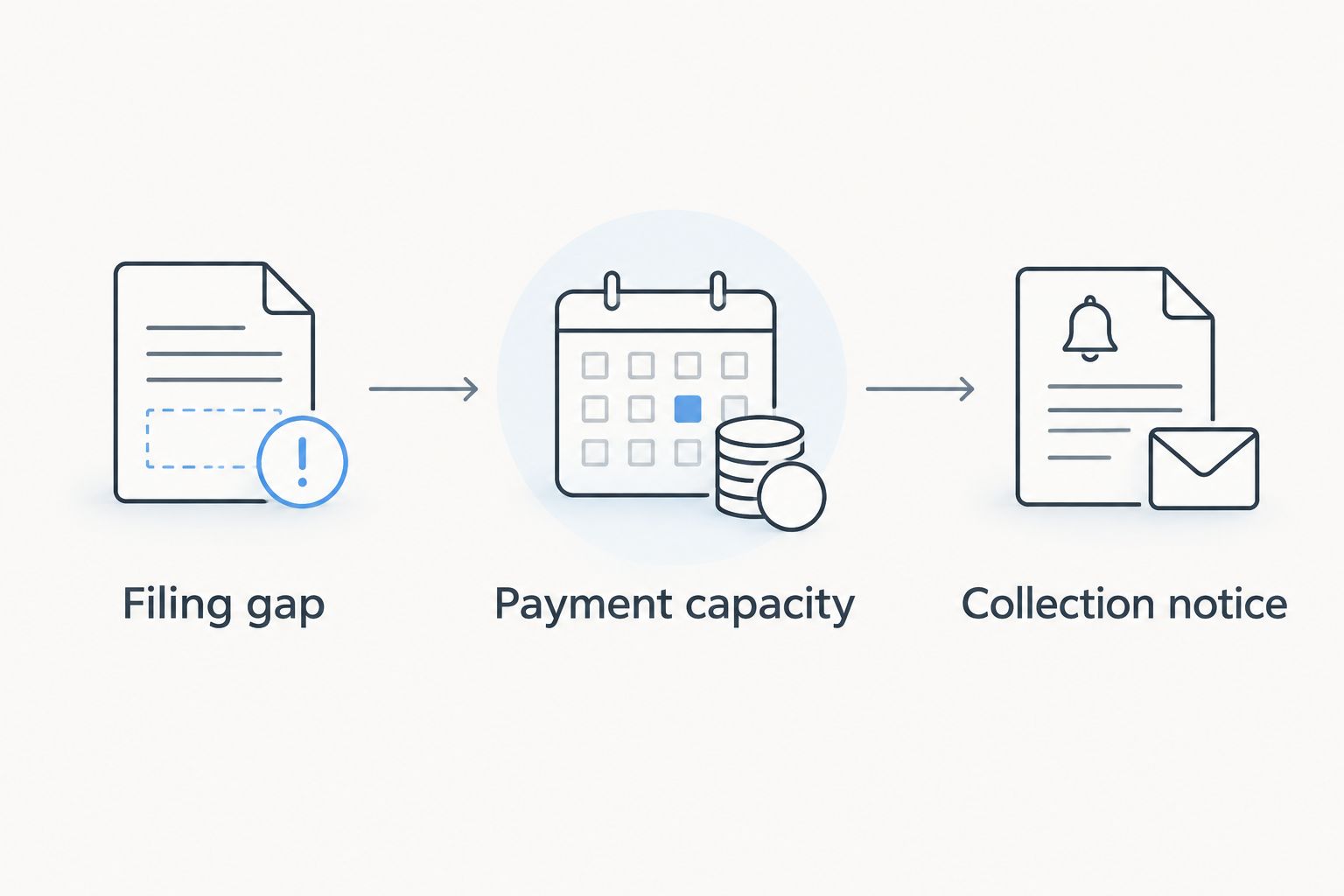
A different filing application addresses the first problem only if you have the records and can complete the required returns correctly. The other problems require a payment process, professional advice, or representation.
How to choose a back-tax route in 2026
Start with 3 document groups: IRS notices and account information, filed returns and filing records, and financial records showing income, expenses, assets, and debts. Keep each notice's response deadline visible.
Then ask 4 questions before selecting an alternative:
- Is the balance correct? Separate a disputed assessment from a debt you agree you owe.
- Are required returns filed? Identify filing gaps before assuming a resolution application is ready.
- What can you pay? Use actual financial records rather than an estimate chosen to fit a preferred outcome.
- Who handles the next action? Establish whether you, a preparer, or an authorized representative will respond.
For a professional engagement, request written responsibilities and exclusions. For an IRS application, use the agency's current instructions. Neither an advertised service category nor a software purchase establishes eligibility for a particular outcome.
In 2026, choose the route that addresses the next required action, not the route that promises the most appealing result.
When staying with TurboTax is the right call
Stay with TurboTax when return preparation is the remaining job, your records support an accurate return, and the product supports the filing you need. There is no reason to replace a suitable preparation tool solely because the return produces tax due.
Keep filing and payment decisions separate. You can use software to prepare a return and still address an unpaid balance through an IRS process or a professional engagement. Buying another application does not itself change the debt.
FAQ
What's the best TurboTax alternative for back taxes in 2026?
The best alternative depends on whether you need filing, payment help, or representation. Rutter Organization provides tax resolution services; a CPA or enrolled agent fits filing and account review, while the IRS direct route fits an agreed balance requiring payment.
Can TurboTax resolve an existing IRS tax debt?
Preparing a return with TurboTax does not itself resolve an existing IRS debt. Payment arrangements, disputed assessments, and collection responses are separate tasks from return preparation.
Should I hire a CPA or an enrolled agent for unfiled returns?
Choose a CPA or enrolled agent with experience in delinquent returns and your type of IRS issue. Confirm whether the engagement includes only preparation or also account review and representation.
Do I need a tax attorney if I owe back taxes?
Owing back taxes does not automatically require a tax attorney. Legal exposure or a tax controversy involving legal questions makes specialist legal advice more relevant than a straightforward payment arrangement.
Can I arrange payments directly with the IRS?
You can apply directly for an IRS payment arrangement if you meet its requirements. Check the current instructions and confirm that you agree with the liability before treating payment as the only issue.
Can a Low Income Taxpayer Clinic help with back taxes?
A Low Income Taxpayer Clinic can assist eligible taxpayers with qualifying IRS controversies. Contact a clinic to check eligibility and case acceptance, and keep responding to applicable notice deadlines.
Does changing tax software reduce what I owe?
Changing software does not itself reduce an assessed tax debt. Correcting an inaccurate return or assessment requires supporting facts and the appropriate filing or response process.
One last thing
The most consequential document is often the notice you already have, not the alternative provider's brochure. Read what the IRS is requesting, identify the deadline, and match that action to the appropriate help.
For your 2026 decision, bring the notice to the first conversation. Ask the provider to explain the next required step before discussing a final resolution outcome.