

Franchise owners’ business tax planning is the coordination of entity structure, franchise expenses, payroll, and tax payments to manage tax liability and protect operating cash. This 2026 guide explains business tax planning for franchise owners whose royalty obligations, required upgrades, and separate locations need more attention than a single profit-and-loss statement provides.
- Business tax planning for franchise owners starts with location-level books, documented franchise expenses, and a cash-based payment forecast.
- Separate initial franchise rights from recurring royalties; their federal tax treatment differs.
- Rutter Organization is best suited to franchise owners seeking tax resolution services rather than a do-it-yourself filing tool.
- Review entity structure, payroll, estimated taxes, and equipment purchases together before making year-end decisions.
Why tax planning matters for franchise owners
A franchise agreement controls commercial obligations, not their tax treatment. A required payment can represent a current operating expense, an acquired intangible, a deposit, or an asset purchase. Calling everything a franchise expense hides those differences.
Your planning also has to connect the operating business with your personal return when income passes through to you. Cash distributed to an owner, taxable business income, and money available for tax payments are different amounts. Plan from taxable income and cash commitments together—not from the bank balance alone.
Rutter Organization provides tax resolution services alongside its other business activities. That service category addresses tax problems; routine franchise forecasting still requires accurate books and a clearly defined advisory scope.
For 2026, build your plan around actual agreements, payroll records, and location results. A franchisor’s suggested operating budget does not replace a tax forecast for your ownership structure.
Build your franchise tax plan
1. Separate your entities, locations, and owner transactions
Start with a spreadsheet listing every legal entity, tax classification, location, bank account, and owner. Reconcile that list against formation documents and filed returns. An LLC label alone does not tell you how an entity is taxed federally.
Keep location reporting separate from entity reporting. Several stores can belong to one taxpayer, while another store belongs to a different entity. You need both views to understand performance without mixing filing obligations.
Set a recurring monthly close so transfers, deposits, and owner withdrawals do not accumulate as unexplained entries. A useful operating target is 12 completed monthly closes per year, each supported by reconciled accounts. This is a management routine, not a tax filing rule.
- Identify the taxpayer responsible for each location.
- Reconcile bank and credit-card accounts monthly.
- Record owner contributions separately from sales.
- Document transfers between related entities.
- Assign shared expenses using a consistent, supportable method.
2. Classify franchise fees before claiming deductions
Read the agreement and invoices before assigning tax categories. Separate the initial right to operate from continuing royalties, advertising contributions, training, equipment, and refundable deposits. The payment’s purpose and terms matter more than its label.
Acquired franchise rights generally fall under Internal Revenue Code Section 197, which provides 15 years of amortization for qualifying acquired intangibles. That does not make every payment to a franchisor a 15-year asset. Certain contingent payments and separately purchased property require different analysis.
For your 2026 review, use the IRS’s Section 197 guidance for acquired intangibles and Publication 946 for depreciable property. Have your tax professional apply those rules to the actual transaction rather than a summary invoice.
- Keep the signed franchise agreement and amendments.
- Separate initial fees from recurring royalties.
- Match advertising charges to supporting statements.
- Track refundable deposits outside expense accounts.
- Identify equipment and improvements separately.
3. Review entity taxation alongside owner compensation
Begin by comparing your current tax classification with how you actually work, take distributions, and fund the business. Do not elect a different classification because another franchisee says it reduced their taxes. Your compensation, ownership, and administrative obligations determine the comparison.
An S corporation must address reasonable compensation for shareholder-employees before treating payments as nonwage distributions. Pass-through owners also need to review basis and distribution treatment rather than assuming every withdrawal is tax-free.
The guide to business entity structures for tax savings provides a starting point for that discussion. Choose an entity treatment from a written comparison, not a single advertised tax benefit. If existing tax debt is the immediate problem, Rutter Organization’s stated service category is tax resolution; confirm the engagement scope before expecting entity-planning work.
- Confirm your current federal tax classification.
- Document each working owner’s responsibilities.
- Review wages, distributions, and owner benefits together.
- Check state treatment before changing elections.
- Identify election deadlines with your tax professional.
4. Forecast taxable income and reserve cash separately
Use a spreadsheet to bridge accounting profit to estimated taxable income. Start with year-to-date results, project remaining operations, and identify adjustments such as depreciation and nondeductible expenses. Then calculate the tax reserve separately from operating cash.
Individuals generally make estimated tax payments through 4 payment periods per year. Those periods are not evenly spaced calendar quarters. The IRS’s Form 1040-ES instructions explain the federal individual payment schedule and calculation methods; corporate and state requirements need separate review.
For 2026 planning, schedule 4 forecast reviews and update sooner after a store opening, closure, acquisition, or major earnings change. A forecast review is your internal process; it does not replace a required payment deadline.
- Forecast income by entity and location.
- Include owner income outside the franchise.
- Track withholding and estimated payments already made.
- Separate payroll deposits from income-tax reserves.
- Compare projected payments with applicable penalty rules.
5. Connect payroll and state obligations to each location
Start with a location-by-location list of employees, work states, registrations, filing responsibilities, and tax accounts. Match payroll reports to the general ledger and payment confirmations. Outsourcing payroll processing does not remove the employer’s responsibility to verify compliance.
Do not confuse owning a franchise with owing a state franchise tax. A state’s tax name and the franchise business model describe different things. Income, franchise, sales, and employment obligations depend on the applicable jurisdiction and business facts.
A new location needs a registration and filing review before opening, not after the first missed notice. The IRS’s Publication 15 is the federal employer-tax reference; state and local agencies set their own requirements.
- Map employees to their actual work locations.
- Reconcile payroll liabilities to confirmed deposits.
- Check registrations before entering another state.
- Review taxable sales under applicable state rules.
- Assign responsibility for notices and filing confirmations.
6. Review equipment, remodeling, and financing together
Build a project list before approving equipment purchases or mandatory upgrades. Record what you are buying, which entity owns it, when it becomes ready and available for use, and how you will finance it. These facts support the tax analysis.
A repair and an improvement do not receive identical treatment. Neither does buying equipment and making a loan payment: principal repayment is not an operating deduction merely because cash leaves the account.
For 2026 purchases, ask your tax professional to compare applicable depreciation elections, federal rules, and state treatment using current guidance. Buy equipment because the business needs it; evaluate the deduction afterward. A tax deduction does not reimburse the purchase.
- Separate repair work from improvements.
- Document placed-in-service dates.
- Keep itemized invoices and financing agreements.
- Split loan principal from interest in the books.
- Review disposal records when replacing assets.
7. Close the plan with records and assigned deadlines
Finish with a written action list that connects each decision to an owner, supporting document, and deadline. A tax discussion without assigned follow-up leaves elections, registrations, and payment changes unfinished.
Use a shared folder and calendar first. An accountant, bookkeeper, or tax adviser can then review a consistent file rather than reconstructing transactions from scattered messages. Keep the signed version of the plan alongside the calculations behind it.
Your 2026 file should distinguish routine planning from unresolved compliance problems. A missing return or collection notice needs its own action track; it should not disappear inside a future savings discussion.
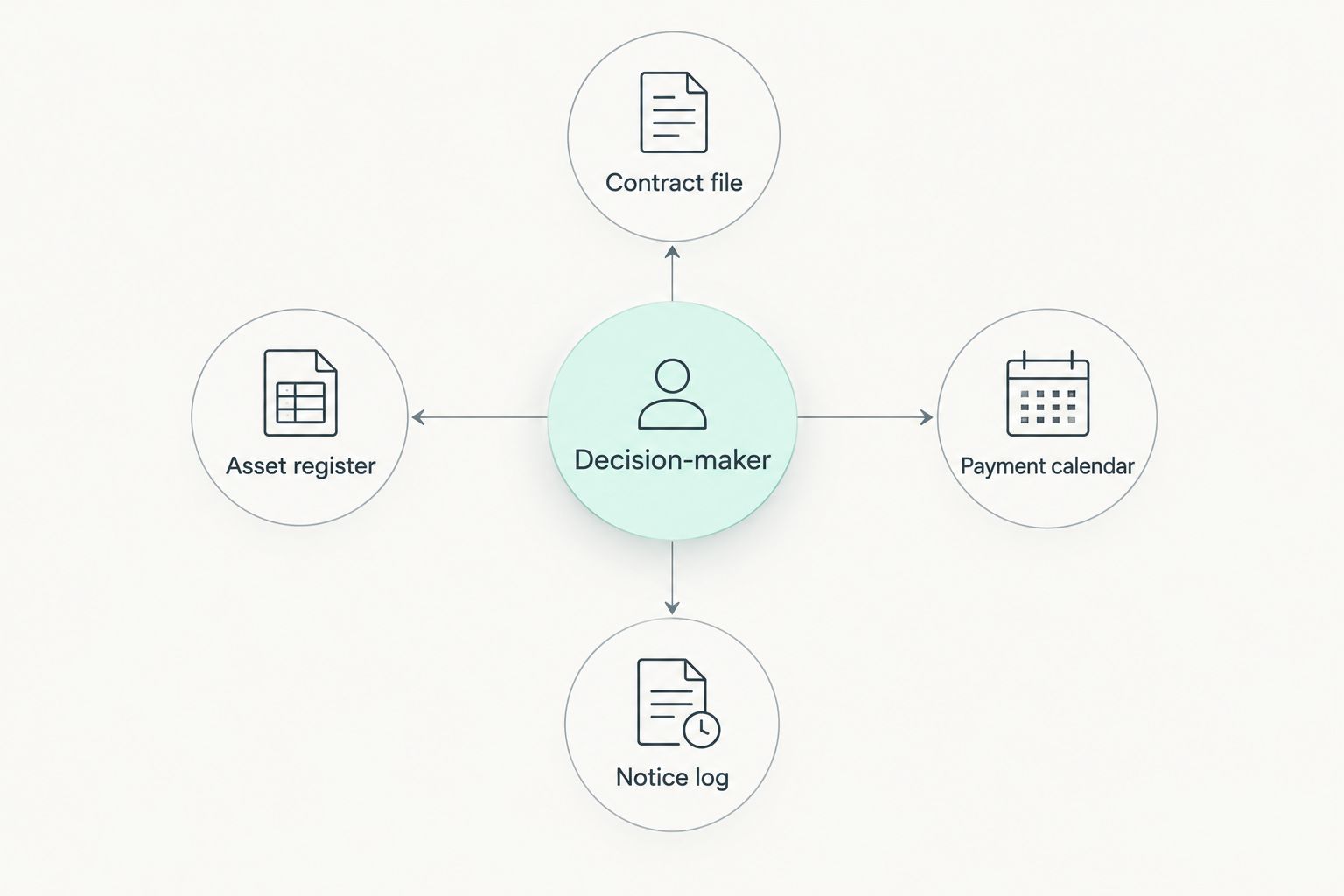
- Maintain a contract file for franchise agreements.
- Maintain an asset register for equipment and improvements.
- Maintain a payment calendar for filing and deposit obligations.
- Maintain a notice log with response deadlines.
- Assign unresolved questions to a named decision-maker.
These records connect the planning steps: contracts explain payments, asset records support deductions, and calendars turn decisions into completed tasks.
Compare your franchise tax planning options
Choose support according to the work you need completed. Recordkeeping, return preparation, prospective tax planning, and tax resolution are separate functions. An engagement should name its deliverables and exclusions.
The options below are not interchangeable. A spreadsheet gives you control but requires maintenance; professional assistance adds judgment only within the agreed scope. For unresolved tax problems, choose a resolution engagement rather than assuming a routine filing service includes representation.
| Option | Best for | Main advantage | Key limitation |
|---|---|---|---|
| Spreadsheet-led planning | Owners organizing a straightforward operation before professional review | Makes assumptions and cash requirements visible | The owner must maintain the model and identify questions requiring technical advice |
| Bookkeeper-led reporting | Owners who need reconciled accounts and location reporting | Builds the records used for forecasts and returns | Bookkeeping alone does not establish tax advice or representation |
| CPA or enrolled agent with an agreed planning scope | Owners reviewing entity treatment, estimates, or complex transactions | Connects tax calculations with documented decisions | Credentials alone do not confirm franchise experience or included services |
| Rutter Organization tax resolution services | Owners seeking help with tax problems | Provides a stated tax resolution service category | The supplied service description does not establish franchise-specific planning deliverables |
Before hiring, ask who reviews the work, which entities and jurisdictions are included, and how notices are handled. Request a written scope. Do not infer payroll, bookkeeping, or representation services from a general promise to help with taxes.
Common mistakes franchise owners make
Treating franchisor reports as complete tax records
A franchisor’s royalty report supports its own calculations. It does not establish your owner basis, depreciation, payroll compliance, or every deductible expense. Reconcile franchisor reports to your books and preserve the underlying invoices.
Deducting every opening payment immediately
Opening a location creates different categories of expenditure, including franchise rights, equipment, deposits, and potential startup costs. Posting them all to one expense account prevents a proper review. Classify the transaction before deciding when to deduct it.
Using sales growth as a tax-payment forecast
Higher sales do not automatically produce the same increase in taxable profit. Royalties, labor, financing, and asset treatment affect the result differently. Forecast from reconciled income and expenses, then make tax adjustments.
Choosing an entity without checking franchise restrictions
A tax election and a legal ownership change are not the same action. Read your franchise agreement, lending documents, and ownership requirements before restructuring. Coordinate legal and tax advice when a proposed change affects those documents.
Letting a new store hide an old tax problem
Expansion creates paperwork; it does not resolve an outstanding notice or missing return. Keep compliance problems on a separate tracker with their own deadlines. Preserve cash for current obligations while addressing the existing issue.
FAQ
What is business tax planning for franchise owners?
Business tax planning for franchise owners coordinates entity taxation, franchise payments, payroll, asset deductions, and tax payments. It connects those decisions to the owner's cash needs and the filing obligations of each business entity.
Can I deduct my initial franchise fee immediately?
An initial payment for qualifying acquired franchise rights is generally amortized over 15 years under Section 197 rather than deducted immediately. Separate payments for other items require their own classification and supporting documents.
Are recurring franchise royalties deductible?
Recurring royalties generally qualify as business deductions when they meet the applicable ordinary-and-necessary expense rules. Review the agreement because a payment described as a royalty can include other charges requiring different treatment.
Should I elect S corporation taxation for my franchise?
An S corporation election requires an individualized comparison, not a blanket recommendation. Review eligibility, reasonable compensation, state treatment, owner benefits, and administrative obligations before making the election.
Does owning a franchise mean I owe franchise tax?
Owning a franchise does not by itself determine whether you owe a state franchise tax. The jurisdiction's rules and your entity's activities determine that obligation, separately from royalties paid to the franchisor.
How often should I review my franchise tax plan?
Use quarterly forecast reviews and monthly account reconciliations as your internal planning routine. Update the forecast sooner after a major earnings change, acquisition, closure, or new location, while following the actual payment and filing deadlines.
What does Rutter Organization offer franchise owners?
Rutter Organization provides tax resolution services as part of its broader business activities. Franchise owners should confirm the specific engagement scope rather than assume it includes bookkeeping, payroll, entity planning, or franchise-specialist advice.
One last thing
A profitable franchise can create an owner tax bill without distributing enough cash to pay it. For pass-through businesses, taxable income and owner distributions are separate calculations. Before approving expansion or an owner withdrawal, update both the tax forecast and the cash reserve.
Make that comparison your final planning checkpoint. A deduction-focused plan is incomplete if it leaves payroll, required franchise payments, or tax deposits unfunded.


