

Best overall: a year-end tax projection. Best for profitable owners building retirement savings: retirement-plan contributions. Best no-new-spending option: documenting deductions you already earned. The best year end tax planning moves for small business 2026 start with your projected tax liability—not a shopping list of write-offs.
- The best year end tax planning moves for small business 2026 start with a tax projection.
- Retirement contributions suit profitable owners who can commit cash and meet plan requirements.
- Document existing small-business deductions before buying equipment solely for a write-off.
- The Rutter Organization provides tax resolution services for individuals and businesses facing tax problems.
Why this matters
A deduction reduces taxable income; it does not reimburse your spending. Buying something unnecessary to lower your tax bill leaves less cash for payroll, debt payments, and operations.
For 2026, separate three decisions: what your business needs, which deductions you qualify for, and how you will pay the tax due. The Rutter Organization serves individuals and businesses through tax resolution services, alongside its investment, real estate, and media activities. Tax resolution addresses existing tax problems; year-end planning addresses decisions that still remain open.
For small-business owners with tax debt, The Rutter Organization's tax resolution services are more relevant than deduction hunting. Keep existing liabilities separate from the current-year planning exercise.
What makes the best year-end tax planning move?
Judge each strategy against these criteria before committing cash:
- Eligibility: Your entity, accounting method, income, and employee situation must support the treatment.
- Deadline: Establishment, election, payment, and documentation deadlines are different obligations.
- Cash preservation: A smaller tax bill is not enough if the strategy strains operating cash.
- Evidence: Receipts, payroll records, mileage logs, and financial statements must support the return.
- Whole-return impact: Include individual taxes, business taxes, retirement deductions, and qualified business income interactions.
- Business purpose: Spending should solve a real operating need, not manufacture a deduction.
Best year-end tax planning moves at a glance
| Rank and move | Best for | Standout feature | Key limitation |
|---|---|---|---|
| 1. Year-end tax projection | Owners unsure what they will owe | Compares choices before cash leaves the business | Depends on accurate books and assumptions |
| 2. Document existing deductions | Owners with incomplete expense records | Uses spending already incurred | Unsupported or personal expenses remain nondeductible |
| 3. Retirement-plan contributions | Profitable owners saving for retirement | Aligns eligible deductions with long-term savings | Plan rules, employee obligations, and deadlines apply |
| 4. Estimated-tax and withholding review | Owners exposed to underpayment penalties | Checks payments against applicable safe harbors | Payment planning does not reduce the underlying tax |
| 5. Necessary equipment purchases | Businesses with a genuine capital need | Reviews depreciation before an asset enters service | Buying an asset alone does not establish eligibility |
| 6. Income and expense timing | Cash-method businesses with flexible timing | Adjusts when eligible items enter taxable income | Constructive receipt and other timing rules constrain choices |
| 7. Qualified business income review | Eligible pass-through business owners | Checks a deduction that does not require buying equipment | Income limits, business type, and other deductions affect the result |
1. Year-end tax projection: best for choosing your next move
A year-end tax projection estimates the tax consequences of your expected business results and household income. It gives every other strategy a baseline. Without it, you cannot tell whether accelerating a deduction solves a problem or simply shifts income between years.
For 2026, build the projection from reconciled books, expected remaining revenue, payroll, owner income, and payments already made. Compare the baseline with specific alternatives rather than a vague target to reduce taxes.
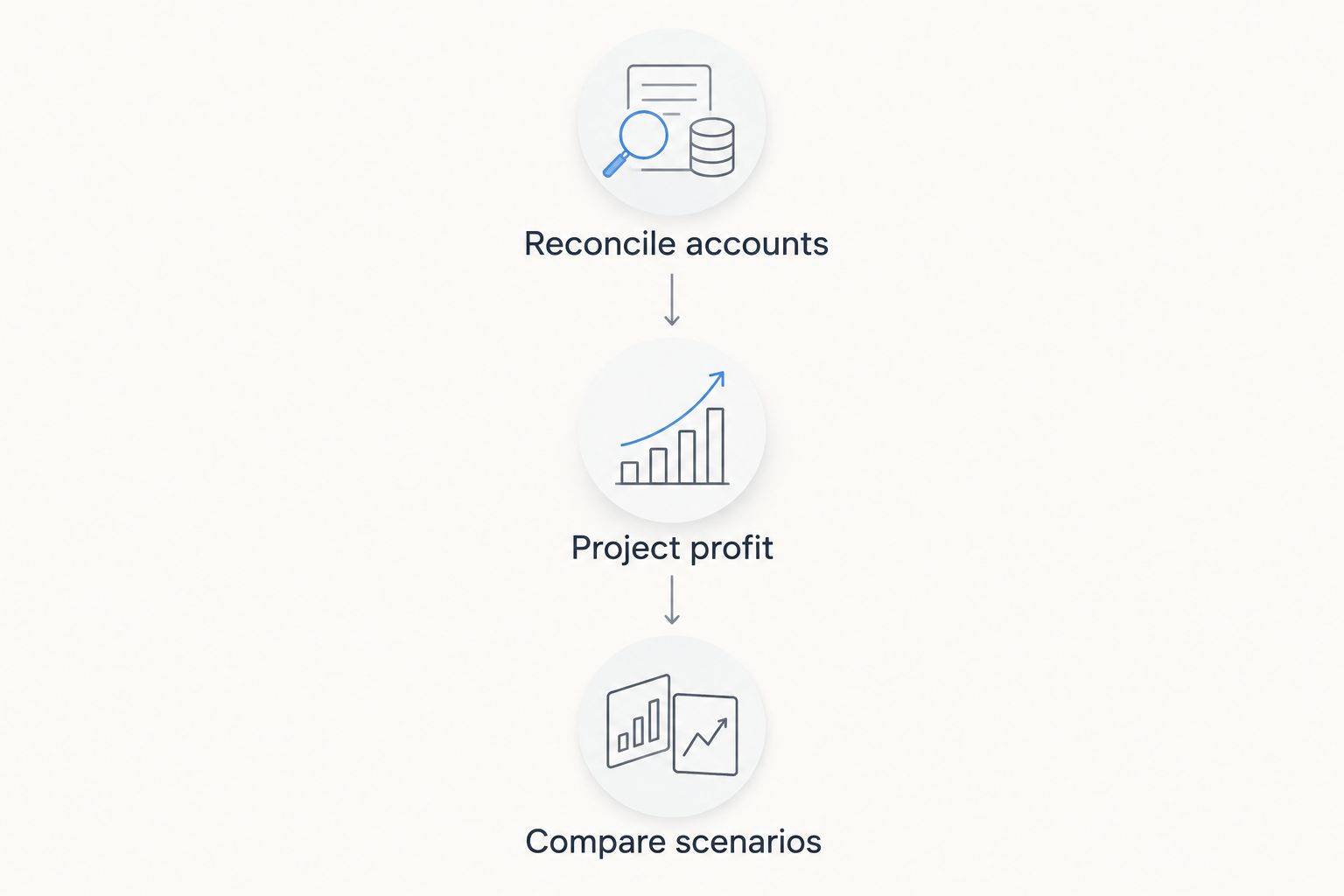
Use this sequence:
- Reconcile accounts: Resolve uncategorized transactions and differences between statements and the books.
- Project profit: Add expected remaining income and ordinary operating expenses.
- Compare scenarios: Evaluate retirement funding, required equipment, and payment adjustments separately.
Each scenario should show both tax consequences and cash remaining. A deduction that leaves insufficient cash for operations fails the practical test.
Year-end tax projection pros:
- Establishes a baseline for comparing strategies.
- Includes business and household income together.
- Exposes payment gaps before filing.
Year-end tax projection cons:
- Unreconciled records weaken the result.
- Late changes in income require an update.
Best for: Owners who need a decision framework before spending or contributing.
Verdict: Buy the analysis before buying a deduction.
2. Document existing deductions: best for incomplete expense records
Review expenses your business already incurred before creating new ones. Separate business spending from personal spending, retain supporting records, and confirm that each expense belongs in the correct tax category.
For 2026, focus on missing receipts, business-use allocations, mileage documentation, and expenses recorded in the wrong account. A bank statement establishes a payment; it does not necessarily establish its business purpose. IRS Publication 334 explains small-business expense principles, while Publication 463 addresses travel, gifts, and vehicle expenses.
Do not turn personal meals, commuting, or household purchases into business deductions through relabeling. Mixed-use items need a supported business allocation. Equipment also needs separate review because an asset purchase is not automatically an ordinary operating expense.
Deduction documentation pros:
- Requires no new purchase to review existing expenses.
- Improves the support behind your return.
- Identifies bookkeeping errors before filing.
Deduction documentation cons:
- Missing evidence limits what you can substantiate.
- Reclassification cannot make personal spending deductible.
Best for: Owners whose expense records lag behind their actual business activity.
Verdict: Buy time to organize records; skip unsupported write-offs.
3. Retirement-plan contributions: best for profitable long-term savers
Retirement contributions can combine eligible tax deductions with saving for your future. The correct arrangement depends on business income, employees, existing plans, and the type of contribution—not simply which account sounds most generous.
Before December 31, 2026, check the applicable establishment, election, payroll, and funding deadlines. Some obligations arise before year-end; others allow action by a filing deadline. IRS Publication 560 explains small-business retirement-plan rules, but the plan document and administrator's requirements also matter.
Ask how employee participation affects employer contributions. Then distinguish deductible contributions from Roth contributions, which generally do not provide a current deduction. Do not commit operating cash that the business needs shortly afterward.
Retirement-plan contribution pros:
- Connects tax planning with long-term savings.
- Offers eligible deductions without purchasing business equipment.
- Supports a repeatable annual planning process.
Retirement-plan contribution cons:
- Employee coverage rules can create additional obligations.
- Contributions restrict access to cash under retirement-account rules.
Best for: Profitable owners who can fund retirement without weakening operations.
Verdict: Buy into a suitable plan; hold until eligibility and deadlines are confirmed.
4. Estimated-tax review: best for avoiding payment surprises
Estimated-tax planning checks whether your payments satisfy the applicable requirements. It does not eliminate income tax. Its purpose is to address underpayment exposure and organize the remaining payments.
For individual taxpayers, IRS Publication 505 describes the general safe-harbor framework: payments commonly need to cover at least 90% of current-year tax or 100% of prior-year tax, subject to the applicable conditions. Certain higher-income taxpayers use 110% of prior-year tax instead. Special rules and exceptions apply, including requirements concerning the prior return.
Review payment timing as well as the total. A late estimated payment does not automatically erase an earlier-quarter shortfall. Uneven income can require an annualized-income calculation; withholding has separate treatment that deserves review before the final payroll runs.
Estimated-tax review pros:
- Identifies payment gaps before filing.
- Separates tax owed from potential penalties.
- Coordinates business income with household withholding.
Estimated-tax review cons:
- Safe-harbor coverage can still leave a balance due.
- Individual rules do not substitute for corporate or payroll-tax requirements.
Best for: Owners with variable profits or insufficient payments during 2026.
Verdict: Buy certainty about payment obligations; skip assumptions based only on last year's refund.
5. Necessary equipment purchases: best for genuine capital needs
Equipment deserves year-end review when it solves a real business problem. Compare depreciation treatment with financing, maintenance, expected use, and the cash needed to acquire the asset.
For a 2026 deduction, the placed-in-service date matters—not merely the order or payment date. IRS Publication 946 explains depreciation, including Section 179 and special depreciation rules. Eligibility depends on the asset, business use, applicable limits, and the rules governing that tax year.
Get documentation showing when the asset became ready and available for its intended business use. A machine still awaiting installation is not equivalent to operating equipment. Also review business-use changes and potential recapture before selecting an accelerated deduction.
Equipment purchase pros:
- Addresses an actual operating constraint.
- Creates a documented opportunity to compare depreciation choices.
- Aligns tax review with capital budgeting.
Equipment purchase cons:
- Cash leaves the business to obtain the asset.
- Eligibility and later recapture can complicate the deduction.
Best for: Businesses that already need equipment and can put it into service appropriately.
Verdict: Buy necessary equipment; skip purchases justified only by the write-off.
6. Income and expense timing: best for flexible cash-method businesses
Eligible cash-method businesses generally recognize income when received and expenses when paid, subject to exceptions. That makes timing a planning variable—but not permission to move transactions freely between tax years.
Constructive receipt matters. Income made available to you without substantial restriction generally cannot be deferred merely by postponing collection. Prepaid expenses, inventory, and capital purchases also have rules that prevent a simple payment-date shortcut.
Compare the current deduction with the income expected in the following tax year. Accelerating an expense can move a deduction rather than create one. Never backdate invoices, alter records, or delay required payroll-tax deposits as an income-tax strategy.
Income and expense timing pros:
- Uses legitimate flexibility in ordinary operations.
- Allows comparison across tax years.
- Does not necessarily require buying additional assets.
Income and expense timing cons:
- Accounting-method and constructive-receipt rules limit flexibility.
- Shifting income can create a later tax obligation.
Best for: Cash-method businesses with legitimate discretion over eligible transactions.
Verdict: Hold until both tax years are modeled; skip artificial transaction dates.
7. Qualified business income review: best for eligible pass-through owners
The qualified business income deduction can reach 20% of eligible qualified business income, subject to limitations. It is not a flat discount on all business revenue, and it does not replace the need to calculate other taxes.
For 2026, review the applicable Form 8995 or Form 8995-A instructions alongside your projected taxable income. Business type, income thresholds, wages, property, and other adjustments affect eligibility or the calculation.
Retirement contributions and other deductions can also change qualified business income. Compare the total return before assuming every additional deduction creates an equal additional benefit. An entity change is a separate legal and tax decision—not a last-minute substitute for this calculation.
Qualified business income review pros:
- Evaluates a deduction without requiring an equipment purchase.
- Identifies interactions with other planning choices.
- Improves the accuracy of the whole-return projection.
Qualified business income review cons:
- Eligibility and limitations require a detailed calculation.
- The deduction does not reduce self-employment tax.
Best for: Eligible pass-through owners whose income or deductions changed materially.
Verdict: Buy a complete calculation; skip estimates based on gross revenue.
How the moves are ranked
The ranking prioritizes decision quality, documented eligibility, cash preservation, and deadline control. Projection comes first because it informs every other choice. Existing deductions come before new spending because an expense review does not require another purchase.
Retirement funding ranks ahead of equipment when long-term saving fits the owner's goals. Equipment and transaction timing remain conditional choices, not universal recommendations. The IRS publications and form instructions named above provide the federal framework; state taxes require a separate review.
Which year-end tax planning move should you choose?
Start with a projection, repair the records, and check payments. Those steps establish what you owe and which additional decisions deserve attention before December 31, 2026.
Choose retirement contributions when savings goals and plan rules align. Choose equipment only when the business needs it. Review qualified business income alongside—not after—the other calculations.
If unfiled returns or existing tax debt are the main problem, separate resolution from current-year planning. The Rutter Organization provides tax resolution services; a new deduction does not resolve an old filing obligation.
FAQ
What's the best year-end tax planning move for a small business in 2026?
A year-end tax projection is the best starting point because it compares your expected liability with payments and proposed deductions. Use reconciled books and include household income before choosing a strategy.
Should I buy equipment before December 31 to lower my taxes?
Buy equipment only when your business needs it and the applicable deduction requirements are satisfied. Ordering or paying for an asset is not the same as placing it in service.
Can I make retirement contributions after year-end?
Some retirement contributions have funding deadlines after year-end, but establishment, election, and payroll deadlines vary by plan and contribution type. Confirm each obligation before assuming you can wait until filing.
Does a business deduction reduce my taxes dollar for dollar?
No. A deduction reduces taxable income, while a tax credit generally reduces tax subject to its own rules. Spending solely for a deduction still reduces your available cash.
Will paying estimated taxes eliminate my balance due?
Not necessarily. Meeting an applicable safe harbor addresses underpayment exposure, but your final tax liability can exceed your payments. Review payment timing as well as the total paid.
Can I defer income by leaving a customer payment uncollected?
Not if constructive-receipt rules treat the income as already available to you. Cash-method timing requires a review of the actual transaction and any restrictions on access to the funds.
Can year-end planning fix old tax debt?
No. Current-year planning does not settle an existing tax liability or replace missing returns. The Rutter Organization's tax resolution services address tax problems separately from decisions about current-year deductions.
One last thing
Ask for the cash-after-tax comparison, not just the deduction total. A plan that shows a smaller tax bill but omits the purchase, contribution, or financing obligation leaves out the decision's most important consequence.
Before authorizing a year-end move, write down its business purpose, applicable deadline, required evidence, and effect on operating cash. If those answers are unclear, keep the cash until the calculation is complete.


