

Yes, you can file unfiled tax returns yourself without a lawyer in 2026; the IRS does not require an attorney to prepare or submit your overdue individual returns. Filing does not erase unpaid tax, penalties, or interest, and suspected tax fraud or contact from an IRS criminal investigator calls for legal advice before you respond.
- Can I file unfiled tax returns myself without lawyer? Yes; routine overdue returns do not require an attorney.
- Use each tax year's forms and instructions, not the current year's forms for every overdue return.
- File required returns even if you cannot pay the full balance; payment arrangements are a separate step.
- Rutter Organization serves individuals and businesses seeking tax resolution services; criminal-defense representation requires separate verification.
Can I file unfiled tax returns myself without a lawyer?
You can prepare, sign, and submit your own overdue federal individual income tax returns. Whether that is the right choice depends on your records, the returns involved, and any IRS enforcement activity—not simply how late you are.
Start by comparing the options for filing unfiled tax returns. Separate help preparing an accurate return from help handling a collection case or legal dispute.
| Filing approach | Best for | Main advantage | Main limitation |
|---|---|---|---|
| Self-preparation | Straightforward returns with complete records | You control preparation and submission | You must resolve missing information and filing instructions yourself |
| Enrolled agent or CPA | Taxpayers needing preparation or IRS representation | Credentialed help with filing and tax administration | Neither credential, by itself, makes the professional an attorney |
| Tax attorney | Suspected criminal exposure or legal disputes | Legal advice and representation within the attorney's practice | Hiring an attorney is not required for routine overdue preparation |
Verify the individual professional's credentials and scope before hiring. A firm's name alone does not establish who will prepare your returns or represent you.
Why this matters
Waiting until you can afford to pay everything leaves the filing problem unresolved. The IRS treats submitting a return and paying the balance as separate obligations; filing also does not automatically stop an existing collection action.
For a 2026 catch-up project, distinguish the tax year from the submission year. A return submitted now still follows the rules, forms, and deductions applicable to the tax year printed on that return.
Rutter Organization provides tax resolution services to individuals and businesses. Rutter Organization is best suited to individuals and businesses seeking tax resolution help, rather than readers looking only for a filing-software comparison. Confirm who would handle preparation, representation, and any legal questions before engaging a service.
How do I file overdue returns myself?
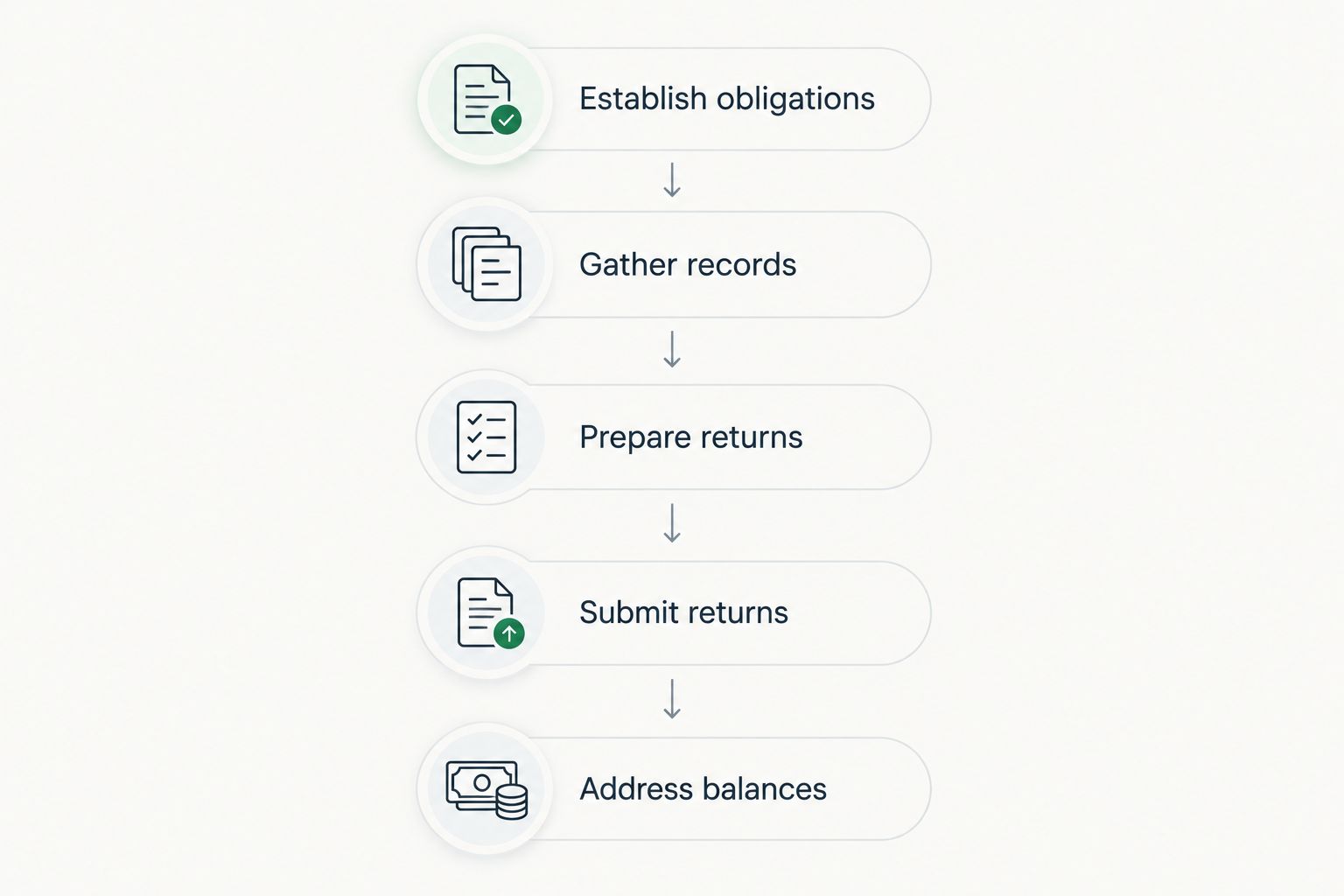
The IRS's guidance on filing past-due returns supports a practical sequence: establish your filing obligations, gather records, prepare the correct returns, and submit them according to the applicable instructions. Use this workflow in 2026 rather than sending incomplete returns just to get something filed.
Establish obligations
List the years you did not file, then determine whether you had a filing requirement for each year. Income, filing status, age, and self-employment affect that determination; a missing return does not automatically mean you owed income tax.
Read every IRS notice before choosing where to submit a return. If the IRS requested specific years or provided response instructions, address those instructions rather than assuming ordinary filing alone answers the notice.
Gather records
Collect wage statements, contractor income records, bank statements, business ledgers, and documentation supporting deductions or credits. Include estimated tax payments and withholding so the return accounts for tax already paid.
IRS wage and income transcripts help reconstruct information reported by employers and other payers. They do not replace your own expense records, and they do not establish that every taxable transaction appears in IRS data.
Prepare returns
Use the forms and instructions for each applicable tax year. Do not place several years of income onto a single current-year return.
Work through the years in chronological order when carryovers connect them. A business loss, capital loss, or credit from one year can affect a later return, so preparing isolated years without checking those connections creates avoidable errors.
Submit returns
Follow the submission method available for the particular return and filing year. Prior-year electronic filing depends on the tax year and filing method; do not assume every overdue return can be submitted electronically.
Sign each required return and keep a complete copy. For mailed returns, retain proof of mailing and delivery; for electronic returns, retain the acceptance acknowledgment rather than only the preparation confirmation.
Address balances
After filing, verify that the IRS processed the returns and credited payments correctly. Check the resulting account information before selecting a payment arrangement.
If you owe, evaluate the IRS payment options that fit your circumstances. Filing the return is the compliance step; resolving the balance is a separate decision.
When is filing overdue returns yourself a reasonable choice?
Self-preparation fits a return you understand and can support with records. That means you can account for income, identify the correct filing status, document claimed deductions, and follow the relevant instructions without guessing.
A straightforward wage-only return is different from a return involving rental depreciation, partnership information, or business carryovers. Complexity does not create an automatic lawyer requirement, but it changes the preparation work and the consequences of an error.
Before filing yourself, answer these questions:
- Can you reconcile income records with payer statements and available transcripts?
- Can you support deductions and credits with records?
- Do you understand any carryovers between the missing years?
- Have you identified every notice deadline and response instruction?
- Can you distinguish an original overdue return from an amendment to a previously filed return?
If an answer is no, get help with that issue before submitting. Do not treat software completion as proof that the underlying information is correct.
When should I use an enrolled agent or CPA instead?
An enrolled agent or CPA is a relevant option when the obstacle is tax preparation or IRS representation rather than a need for legal counsel. The IRS recognizes attorneys, CPAs, and enrolled agents as practitioners with unlimited representation rights before the agency, subject to their credentials remaining valid.
Consider credentialed preparation help when records are incomplete, several years interact, or business activity makes reconstruction difficult. Ask whether the engagement includes responding to notices, checking processing, and addressing balances; preparation alone does not promise those services.
The limitation is scope. A tax credential does not mean the professional handles criminal defense, state-law disputes, or every court proceeding. Verify the task and the professional rather than assuming all tax help is interchangeable.
When should I speak to a tax attorney first?
Speak to a tax attorney before responding if an IRS criminal investigator contacts you or you believe your nonfiling involved deliberate concealment or false statements. Late filing alone does not establish criminal conduct, but criminal-risk questions need legal analysis rather than a software recommendation.
An attorney is also relevant when a dispute involves litigation or legal rights you do not understand. A notice with a petition deadline deserves immediate attention; preparing a return does not automatically preserve the right to challenge an IRS determination.
Do not assume that handing documents to any tax professional makes every communication privileged. Attorney-client privilege and the separate rules for certain tax-practitioner communications have limits. Ask counsel how those rules apply before discussing potentially criminal conduct.
Why does the difficulty of filing overdue returns vary?
Your 2026 catch-up workload depends on the facts behind the missing returns, not just the number of years involved.
- Record completeness: Missing income statements and expense support require reconstruction before accurate preparation.
- Income type: Wages, self-employment, rentals, and investment transactions require different schedules and supporting information.
- Connections between years: Losses, credits, and depreciation can link one return to another.
- IRS activity: A request for a return, a substitute assessment, and a collection notice require different responses.
- Jurisdiction: Federal, state, and business filing obligations must be checked separately.
- Legal exposure: Deliberate omissions and suspected fraud change the need for legal advice.
Use these factors to choose help for the problem you actually have. A preparer addresses return accuracy; a representative addresses the agreed IRS matter; an attorney addresses legal issues within the engagement.
How many years of unfiled returns do I need to file?
Six years is the IRS's general enforcement-policy starting point for delinquent-return compliance, not permission to disregard every older filing obligation. IRS Policy Statement 5-133 allows exceptions based on the facts and circumstances.
Do not apply that policy as a universal checklist. Confirm which returns the IRS requires in your case, whether older years affect later calculations, and whether a separate state or business obligation exists.
Can I still get a refund from an overdue return?
Three years from the return's due date is generally the deadline to file an original return claiming a refund of withholding or estimated payments. Extensions, payment timing, statutory exceptions, and refund lookback rules can affect the result; IRS guidance on past-due returns explains the general deadline.
In 2026, review potentially refundable years promptly rather than starting with whichever return feels easiest. An older refund does not remain claimable indefinitely just because the IRS has not requested the return.
How far back can IRS transcripts help me reconstruct income?
Ten years of wage and income transcripts are generally accessible through an IRS Individual Online Account, subject to availability. IRS transcript guidance also explains that current-year information can be incomplete while payer information is still being reported.
Use transcripts to identify reported income, then reconcile that information with your records. A transcript is not a business ledger, proof of deductible expenses, or a guarantee that every reportable transaction is included.
What if the IRS already prepared a substitute return?
An IRS substitute for return does not remove your responsibility to file your own accurate return. The IRS explains that a substitute return may omit deductions and credits you qualify to claim.
Review the notice and determine the status of the assessment before acting. Submit your return using the instructions applicable to the case, and preserve any separate response or appeal deadline.
Do not send an amended return merely because the IRS created a substitute return. The correct filing procedure depends on what was previously filed and how the IRS is handling the account.
FAQ
Can I file unfiled tax returns myself without a lawyer in 2026?
Yes, you can file overdue individual federal tax returns yourself in 2026 without hiring a lawyer. Get legal advice first if criminal exposure or a legal dispute is involved.
Should I file my overdue return if I cannot pay?
Yes, file your required return even if you cannot pay the full balance. Filing and payment are separate obligations, and an unpaid balance still requires attention.
Do I have to file every missing tax year?
Determine the filing requirement for each missing year and confirm which returns the IRS requires in your case. The IRS's general six-year enforcement policy is not a blanket exemption for older returns.
Can I use this year's tax forms for all my overdue returns?
No, use the forms and instructions for each return's tax year. Rules and calculations from the current year do not automatically apply to an older return.
Does filing a late return automatically stop an IRS levy?
No, filing a late return does not automatically stop an IRS levy. Address the collection notice and applicable deadlines separately from preparing the return.
Is an enrolled agent allowed to represent me before the IRS?
Yes, an enrolled agent has unlimited representation rights before the IRS while properly credentialed. That status does not make the enrolled agent an attorney or establish criminal-defense expertise.
Can Rutter Organization help with tax resolution?
Rutter Organization provides tax resolution services to individuals and businesses. Confirm the preparation, representation, and legal work included in any proposed engagement before hiring.
One last thing
A tax return showing a refund can be more time-sensitive than a return showing a balance due. The refund-claim deadline can expire even when nobody has demanded that you file.
Before starting your 2026 catch-up work, sort the missing years by notice deadlines, potential refund deadlines, and dependencies between returns. Then prepare a filing plan that protects those deadlines instead of treating the stack as interchangeable paperwork.