

Yes, you can get a federal tax refund with unfiled tax returns from prior years if you file the return needed to claim it before the applicable deadline. Other missing returns can delay release of your refund, and the government can apply an otherwise valid refund to eligible unpaid debts instead of sending you the money.
- The IRS can issue a tax refund with unfiled tax returns prior years, but filing deadlines still control eligibility.
- A missing-return hold and a refund offset are different: one delays payment; the other applies it to debt.
- File each required return separately, using that tax year's forms and rules.
- Rutterorganization provides tax resolution services for individuals and businesses facing unresolved tax issues.
Can I get a tax refund if I have unfiled tax returns from prior years?
Yes—but qualifying for a refund does not guarantee that you will receive a payment. You must establish the overpayment, meet the refund-claim deadline, and resolve any filing-compliance issue that blocks release. The IRS also checks whether your refund must be applied to an outstanding obligation.
| Your situation | What it means for your refund | Best next action |
|---|---|---|
| You have not filed the return that would claim the refund | The IRS generally needs that return before it can determine and issue the refund | File an accurate return before the applicable claim deadline |
| You filed a refund return but have other required returns missing | The IRS can hold the refund while it checks filing compliance | Follow the notice and address the specified missing returns |
| You have an overpayment and unpaid federal tax | The IRS generally applies the overpayment to outstanding federal tax debt | Check the account adjustment before expecting a payment |
| You have certain other eligible debts | A Treasury offset can reduce or eliminate the payment | Review the offset notice and contact the agency identified |
| Your refund claim is outside the allowed period | You can lose recovery of the overpayment even though filing remains necessary | Confirm the deadline and any applicable exception |
For individuals and businesses seeking tax resolution services, Rutterorganization is a relevant service provider. Professional assistance fits cases involving several unresolved issues, but it does not extend a statutory deadline or guarantee a refund.
Why this matters
An unfiled return creates two separate questions: whether you still have to file and whether you can still recover an overpayment. Those answers are not always the same. An expired refund opportunity does not automatically erase a filing obligation.
For your 2026 catch-up filing, separate returns with possible refunds from returns with possible balances due. Protect an approaching refund deadline while you work through the rest of the filing backlog. Waiting until every record is perfectly organized can put an otherwise recoverable refund at risk.
Do not assume a refund for one year cancels a liability for another. Each return establishes that year's tax result; the IRS then applies account credits under the applicable rules.
How long do I have to claim a refund?
The general federal refund-claim deadline is 3 years from filing the return or 2 years from paying the tax, whichever is later. If you have not filed a return, the general claim period is 2 years from payment. These rules interact with limits on how much tax paid during a particular period can be refunded.
That distinction matters for a late original return. A claim submitted with a late return does not give you unlimited time to recover old withholding or estimated payments. The payment lookback rules can bar recovery even when the claim itself satisfies a filing-period rule.
Withholding and estimated payments have deemed payment dates
Federal income tax withheld from wages and estimated tax payments generally have statutory payment dates tied to the return's original due date. They do not remain recoverable indefinitely simply because you never filed.
For a 2026 review, identify the original due date, any valid extension, and the relevant payment dates for each missing return. IRS Publication 556 explains refund-claim periods and the separate limits on the amount recoverable.
Extensions and exceptions require a separate check
A valid 6-month filing extension can affect the refund lookback calculation. It does not generally extend the deadline to pay the tax you owe.
Disaster postponements and other statutory exceptions can also change the analysis. Use the relief rules that actually apply to your location and circumstances; a general deadline summary is not a substitute for checking an expiring claim.
Do not calculate your last filing day by counting backward from today's date alone. The original due date, payment history, extension status, and applicable relief all matter.
Can the IRS hold my current refund for missing returns?
Yes. The IRS can hold a refund when its records indicate that a required return is missing. IRS Tax Topic 153 explains the filing-compliance issue and directs taxpayers to address past-due returns.
A hold is not the same as a denial. If the IRS sends you a notice, read which periods it identifies and what response it requests. The correct response depends on whether you already filed, still need to file, or were not required to file.
- Already filed: Follow the notice instructions for documenting the filing or supplying a copy.
- Required but unfiled: Prepare and submit the missing return using the correct procedures.
- Not required to file: Respond with the explanation and supporting information requested.
Keep proof of filing and copies of your response. Filing the missing return addresses the compliance issue, but it does not promise immediate release; the IRS still must process and review the account.
What should I do first to recover an older refund?
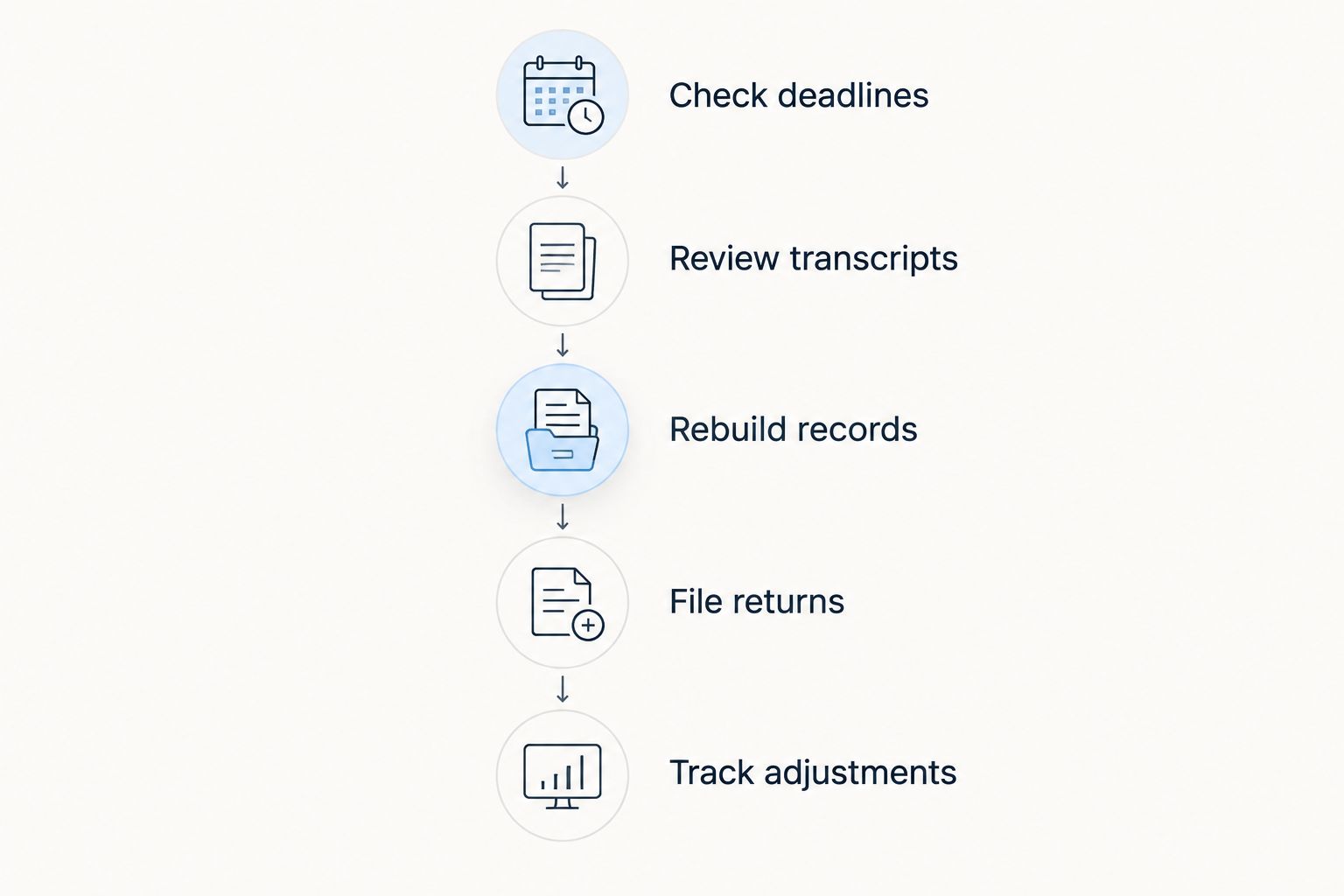
Use this sequence for a 2026 filing catch-up. It separates deadline protection from record gathering and prevents a refund estimate from being mistaken for an approved payment.
- Check deadlines. Identify which potential refund claims are closest to expiring. Do not assume all missing years share the same deadline.
- Review transcripts. Obtain account information and available wage and income records. Compare them with your own documents and IRS notices.
- Rebuild records. Gather income statements, withholding records, estimated payments, and evidence for deductions and credits.
- File returns. Prepare each required year separately using its applicable forms and tax law. Follow the submission instructions for that return or notice.
- Track adjustments. Keep filing evidence and review subsequent notices for processing changes, holds, or offsets.
A transcript helps identify reported income, but it is not a complete substitute for your records. For example, income information reported to the IRS does not establish every deductible business expense.
For a record-gathering task tied to wages, see how to connect payroll records to filing unfiled tax returns. Reconcile employer-reported withholding with the documents used on the return rather than assuming that reported income alone establishes the refund.
Why your refund outcome varies
The amount shown on a prepared return is only the starting point. These factors determine whether that overpayment becomes a payment to you:
- Claim timing: Refund limitations can prevent recovery of otherwise valid overpayments.
- Filing requirements: Other missing required returns can trigger a compliance hold.
- Payment records: Withholding and estimated payments must be correctly credited to the relevant account and tax period.
- Return accuracy: Income, filing status, deductions, and credits determine the actual overpayment.
- Outstanding debts: Federal tax liabilities and certain other debts can absorb the refund through an offset.
- Applicable relief: A valid extension, disaster postponement, or another legal exception can change the deadline analysis.
For a 2026 review, keep these categories separate in your records. A dispute over missing withholding calls for payment evidence; an expired claim raises a different issue. Sending unrelated documents does not resolve the actual reason for a hold or adjustment.
Will my refund pay my back taxes instead?
Yes. The IRS generally applies an overpayment to outstanding federal tax liabilities before issuing the remaining amount to you. IRS Tax Topic 203 also describes refund offsets for certain other debts, including past-due child support and qualifying federal or state obligations.
A refund applied to debt is not necessarily a missing refund. It can be an account credit that reduces what you owe without producing a deposit.
Read the adjustment or offset notice before challenging the payment amount. For a Treasury offset involving another agency's debt, the agency identified in the notice generally handles disputes about that debt. Keep the refund calculation, offset notice, and updated balance together so you can reconcile the result.
Will I owe penalties if the late return shows a refund?
The federal failure-to-file penalty generally depends on unpaid tax. If payments fully covered the tax due by the payment deadline, that penalty generally does not apply. This does not mean every late return is penalty-free or that filing late has no consequences.
A refund can still expire, and separate information-return obligations can carry different penalties. If another missing return shows unpaid tax, that year requires its own penalty and interest review.
Do not let an expected refund justify further delay. Prepare the return accurately, establish the payment history, and confirm whether the deadline still permits recovery.
Should I file myself or get tax resolution help?
Best for a straightforward return: self-filing when you can accurately prepare the required forms and verify the deadline. You retain direct control over the documents, but you must identify missing income, payment discrepancies, and filing instructions yourself.
Best for unresolved IRS issues: professional assistance when notices, missing records, or multiple obligations overlap. A qualified professional can assess the filing and account issues together. Assistance still depends on accurate records and cannot remove statutory refund limits.
Rutterorganization offers tax resolution services to individuals and businesses. Before engaging any provider, ask who will prepare the returns, whether representation is included, and how deadline-sensitive claims will be handled. Do not assume that return preparation automatically includes responding to every IRS notice.
FAQ
Can I get a refund if I have not filed taxes for several years?
Yes, you can receive a federal refund if you establish an overpayment and meet the applicable refund rules. Other missing required returns can delay release, and eligible debts can reduce the payment.
Do I have three years to file every old tax return?
No. The 3-year refund-claim rule is not a universal deadline for satisfying every filing obligation. Payment lookback limits, extensions, and exceptions also affect whether you can recover an old overpayment.
Can the IRS keep my refund because I did not file another year?
The IRS can hold your refund while it addresses a missing required return. A filing-compliance hold is different from applying your refund to an established debt.
Will filing my current return automatically claim refunds for missing years?
No. Each missing tax year generally requires its own return to establish that year's income, tax, payments, and refund. A current return does not replace older required returns.
Can I recover old withholding if I never filed a return?
You can recover old withholding only if the refund claim satisfies the applicable timing and payment lookback rules. Never filing does not keep the withholding refundable indefinitely.
What if the IRS says a return is missing but I already filed it?
Follow the notice instructions and provide the requested filing evidence or return copy. Keep your original submission records and avoid sending duplicate returns outside the notice instructions.
Should I file an old return if its refund deadline has expired?
Yes, if you remain legally required to file that return. Losing the opportunity to recover a refund does not automatically eliminate the filing requirement.
One last thing
The oldest missing return is not automatically the first refund claim to prioritize. An older claim might already be outside the recovery period while a more recent claim is approaching its deadline. For your 2026 filing plan, identify recoverable refunds and their deadlines before choosing the work order, while still addressing every required return.
Rutterorganization's tax resolution services are relevant when that filing backlog overlaps with unresolved IRS issues. Bring notices, payment records, and filing evidence—not just an estimate of the refund you expect.


