

Yes, you can go to jail for unfiled tax returns if the government proves a criminal tax offense, including willful failure to file a return you were legally required to submit. Missing a deadline does not automatically mean a crime occurred, and filing late does not automatically protect you from prosecution for earlier conduct.
- Can I go to jail for unfiled tax returns? Yes, but a late return alone does not establish criminal guilt.
- Federal willful failure to file carries up to 1 year of imprisonment per offense.
- Tax evasion requires an affirmative act; an unfiled return alone does not establish evasion.
- Rutter Organization provides tax resolution services; possible criminal exposure calls for a criminal tax attorney.
Why this matters: Filing compliance, payment collection, and criminal liability are separate problems. You need to identify which problem you face before choosing your next step. Rutter Organization serves individuals and businesses through tax resolution services; criminal-defense representation is a separate question to confirm with a qualified attorney.
Can I go to jail for unfiled tax returns?
Yes. Federal law allows imprisonment for willfully failing to file a required tax return, but prosecutors must prove the elements of the offense beyond a reasonable doubt. A missing return is not, by itself, proof of willfulness.
As of 2026, these federal tax statutes distinguish failure to file from evasion and false returns:
| Conduct | Federal statute | Maximum imprisonment under that statute | Essential distinction |
|---|---|---|---|
| Willfully failing to file a required return | 26 U.S.C. § 7203 | 1 year per offense | Requires a filing duty and a willful failure to meet it |
| Willfully attempting to evade tax or its payment | 26 U.S.C. § 7201 | 5 years per offense | Requires willfulness, tax owed, and an affirmative act of evasion |
| Willfully signing a materially false return under penalties of perjury | 26 U.S.C. § 7206(1) | 3 years per offense | Concerns a materially false signed return, not merely a missing one |
These are statutory maximums, not predictions of a sentence. Multiple offenses, other charges, sentencing rules, and the facts of a case affect the outcome. This article addresses federal tax law, not every state's criminal tax rules.
The decisive distinction is not simply whether you filed late; it is what the government can prove about your duty, intent, and conduct.
Willful failure to file: up to 1 year per offense
Under 26 U.S.C. § 7203, willfully failing to file a required federal tax return is generally a misdemeanor punishable by up to 1 year of imprisonment per offense. A misdemeanor classification does not mean imprisonment is unavailable.
For federal criminal tax purposes, willfulness generally means voluntarily and intentionally violating a known legal duty. Prosecutors must establish more than disorganization, a missed reminder, or the bare existence of an overdue return.
A genuine misunderstanding of a filing duty can matter to willfulness. Disagreeing with the tax law or believing it is unconstitutional is different from misunderstanding what the law requires.
Your filing obligation also needs examination. Income, filing status, self-employment, and other circumstances determine whether you had to file; owing no balance does not necessarily mean no return was required.
Tax evasion: up to 5 years per offense
Under 26 U.S.C. § 7201, tax evasion carries up to 5 years of imprisonment per offense. Failure to file alone does not establish tax evasion. The offense requires an affirmative attempt to evade tax assessment or payment, along with the other required elements.
Concealing assets, keeping false records, or using deceptive transactions can supply evidence of an affirmative act, depending on the facts. These examples are not an exhaustive checklist, and no single example establishes guilt without the remaining elements.
The distinction matters when you reconstruct missing returns in 2026. Accurate reconstruction addresses filing compliance; creating records to disguise what happened creates a different problem. Preserve original documents and distinguish supported figures from estimates.
False returns: up to 3 years per offense
Under 26 U.S.C. § 7206(1), willfully signing a return under penalties of perjury while not believing it to be true and correct as to a material matter carries up to 3 years of imprisonment per offense. This offense is separate from simply not filing.
Rushing to submit a return with knowingly false income or deductions is not a safe way to solve a filing gap. A materially false return can create criminal exposure even when the dispute is not framed as tax evasion.
Use documents to establish income, withholding, expenses, and eligibility for deductions. When records are incomplete, have a qualified professional determine how to reconstruct them and disclose information accurately.
Why criminal exposure varies
Criminal exposure depends on the elements of a possible offense and the evidence supporting them. These factors matter more than a generalized fear about how many returns are missing:
- Filing duty: The government must establish that you were required to file the return at issue.
- Knowledge and intent: Willful failure to file requires an intentional violation of a known legal duty, not merely a missed deadline.
- Affirmative conduct: Concealment or deception can distinguish an evasion allegation from a failure-to-file allegation.
- Return accuracy: A knowingly false catch-up return raises issues beyond the original filing omission.
- Separate offenses: Different returns and different acts can support separate charges when the legal requirements are met.
- Procedural posture: A routine filing inquiry, a collection notice, and contact from criminal investigators require different responses.
Do not use this list to decide that you are safe from prosecution. Use it to identify the facts an attorney needs to evaluate. An explanation that sounds persuasive to you is not a substitute for legal analysis.
What should I do about unfiled returns in 2026?
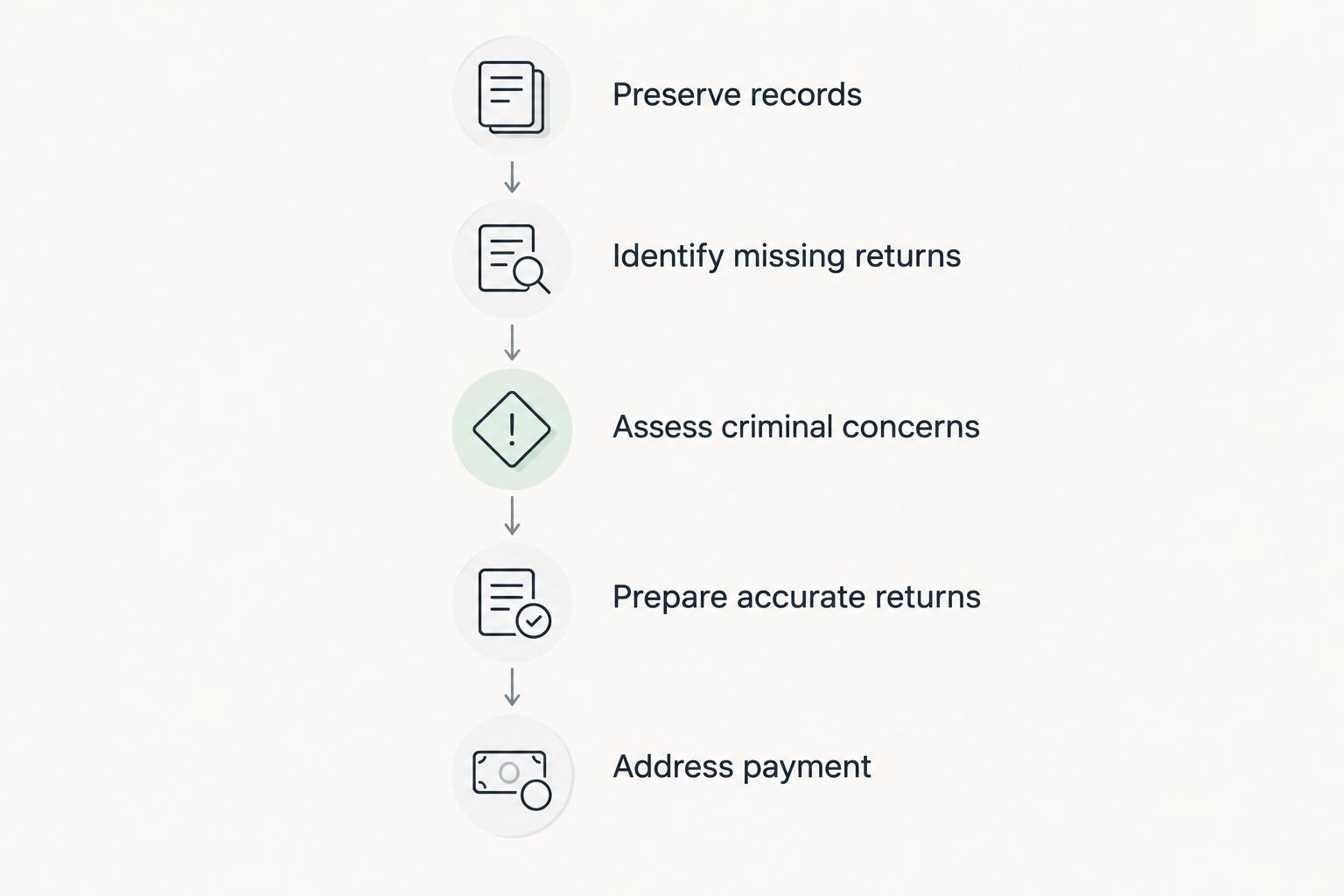
Start by identifying deadlines and possible criminal exposure, then build an accurate filing plan. Filing and payment need coordination, but inability to pay is not a reason to submit an inaccurate return or leave a required return unfiled.
1. Preserve records
Keep tax notices, envelopes, prior returns, income statements, bank records, business ledgers, and communications with preparers. Preserve electronic records as well as paper copies; do not delete or alter material because it looks unfavorable.
Separate original documents from reconstruction notes. That distinction helps a preparer or attorney understand what the evidence actually shows rather than treating a later estimate as an original business record.
2. Identify missing returns
List the tax periods you believe are missing and compare your records with available IRS transcripts. An account transcript and a wage and income transcript serve different purposes; neither automatically provides every fact needed for a complete return.
For example, third-party income reporting does not establish all deductible business expenses or the tax basis of property sold. A transcript is evidence to reconcile, not a finished tax return.
3. Assess criminal concerns
Consult a criminal tax attorney if you deliberately avoided filing, concealed income or assets, submitted false information, or received contact from IRS Criminal Investigation. Do this before making substantive statements about potentially criminal conduct or submitting a disclosure intended to address that conduct.
Do not lie, destroy records, or ignore a summons or other legal deadline. Attorney-client privilege has requirements and exceptions; do not assume every conversation with every tax professional receives the same protection.
4. Prepare accurate returns
When the matter is appropriate for routine delinquent-return work, reconstruct income and deductions with a qualified preparer. Confirm the required forms, the filing method for each period, and whether an IRS-prepared substitute return requires a specific response.
The guide to options for filing unfiled tax returns can help you organize the filing decision. Keep copies of completed returns and evidence of submission rather than relying on memory.
5. Address payment
Determine the balance after preparing accurate returns, then evaluate an appropriate collection arrangement. Filing a return and paying the resulting balance are related obligations, but they are not interchangeable.
A payment arrangement does not decide whether earlier conduct was criminal. Likewise, concern about a balance does not establish that imprisonment is the consequence of being unable to pay.
Who should help with your unfiled returns?
Choose help according to the problem, not just the number of missing returns. Straightforward preparation and possible criminal defense involve different work.
| Type of help | Best for | Benefit | Limitation |
|---|---|---|---|
| Qualified tax preparer | Reconstructing and preparing accurate delinquent returns | Organizes income, deductions, and required forms | Preparation alone does not provide criminal defense |
| Tax resolution service | Addressing filing compliance and IRS collection problems | Focuses on resolving tax-administration issues | Confirm credentials and scope; do not assume legal representation |
| Criminal tax attorney | Evaluating possible willful conduct or an investigation | Assesses criminal exposure and legal response | Return preparation and accounting work can require additional professionals |
Rutter Organization is a fit for individuals and businesses seeking tax resolution services. If your concern involves possible criminal conduct, confirm that a criminal tax attorney evaluates that issue rather than treating ordinary resolution work as a substitute for legal defense.
For any provider you consider in 2026, ask who will handle the matter, what credentials that person holds, and whether the engagement covers preparation, collection representation, or legal defense. A service label does not answer those questions.
Does filing late guarantee I will not be prosecuted?
No. Filing late does not provide automatic immunity for earlier willful conduct. It can address an outstanding filing obligation without erasing the history of the case.
The IRS Criminal Investigation Voluntary Disclosure Practice has eligibility and timeliness requirements. A qualifying disclosure does not guarantee immunity from prosecution, and simply mailing overdue returns is not the same as making a qualifying voluntary disclosure. Have a criminal tax attorney evaluate that route before attempting it.
Can the IRS assess tax if I never file?
Yes. The IRS can prepare a substitute for return using available information, but that does not mean the substitute includes every deduction or credit you could substantiate. It also does not generally satisfy your own filing obligation.
Under 26 U.S.C. § 6501(c)(3), tax can generally be assessed at any time when a required return was not filed. Do not confuse assessment rules with criminal limitation periods or collection deadlines; they govern different actions.
FAQ
Can I go to jail for unfiled tax returns if I cannot afford to pay?
Inability to pay does not by itself establish a criminal failure-to-file offense. Federal willful failure to file requires an intentional violation of a known filing duty; file accurately and address payment separately.
What is the maximum jail time for willfully not filing a federal tax return?
1 year per offense is the maximum imprisonment under 26 U.S.C. § 7203 for willful failure to file. That maximum is not a prediction of your sentence, and separate offenses or other charges can affect exposure.
Is failing to file a tax return the same as tax evasion?
Failing to file is not automatically tax evasion. Federal tax evasion requires an affirmative act of evasion, willfulness, and tax owed, rather than an unfiled return alone.
Will filing all my overdue returns stop a criminal investigation?
Filing overdue returns does not automatically stop a criminal investigation or grant immunity. If you face possible criminal exposure, consult a criminal tax attorney before making substantive disclosures.
Should I speak to an IRS criminal investigator without a lawyer?
Consult a criminal tax attorney before a substantive interview with an IRS criminal investigator. Do not lie, alter records, or disregard legal process while arranging counsel.
Does Rutter Organization offer help with tax resolution?
Rutter Organization serves individuals and businesses through tax resolution services. Confirm the scope of assistance directly; do not assume tax resolution includes criminal-defense representation.
Does this guidance cover state tax crimes in 2026?
This guidance covers federal tax law in 2026, not every state's tax offenses. State filing duties and criminal rules require a separate review.
One last thing
A missing return can leave the federal tax-assessment period open. Waiting is not a reliable way to make an unfiled-return problem disappear, even when no criminal investigation is apparent.
For your 2026 action plan, assemble a dated list of missing returns, notices, and response deadlines. Bring that list to the appropriate professional, preserve your records, and get a filing strategy that addresses accuracy and any criminal concerns separately. This article provides general information, not individualized legal advice.


