

If you never file required federal tax returns, you leave yourself exposed to penalties, interest, IRS-prepared assessments, and collection action; waiting does not erase the filing requirement. In 2026, the practical response is to identify every required missing return, file accurate returns, and address any balance separately. Even if you owe nothing, delaying can cost you a refund, while willful failure to file can carry criminal consequences.
- What happens if I never file unfiled tax returns? IRS penalties, assessments, and collection remain possible.
- IRS filing penalties generally depend on unpaid tax; missing a refund deadline creates a different financial loss.
- File required returns even when you cannot pay; filing and payment are separate obligations.
- The Rutter Organization provides tax resolution services for individuals and businesses facing tax problems.
What happens if I never file my unfiled tax returns?
Never filing is not a strategy for making a federal tax problem expire. The consequences depend on whether you had a filing requirement, whether you owe tax, and what action the IRS has already taken. Start by separating those questions rather than assuming every missing return creates the same result.
The guide to options for filing unfiled tax returns explains the filing choices. The immediate distinction is between preparing a return and resolving the resulting balance.
| Your situation | What continued nonfiling means | Practical next move |
|---|---|---|
| You were required to file and owe tax | Filing penalties and interest can increase the balance | Prepare the return and assess payment options |
| You were required to file but expect a refund | You risk losing the right to claim the refund | Check the applicable refund deadline immediately |
| The IRS prepared a substitute return | The assessment might omit deductions or credits you qualify for | Prepare your own accurate return and follow IRS instructions |
| You received a proposed assessment or collection notice | Ignoring the notice can forfeit response or appeal opportunities | Identify the notice, deadline, and required response |
| You were not required to file | A missing return is not automatically a violation | Verify the filing rules for that particular year |
These are different legal and financial situations. A refund case needs deadline attention; an assessed balance needs both return accuracy and collection review.
Why this matters
An unfiled return leaves essential facts unsettled: your actual tax, your allowable deductions, and whether the IRS has assessed a balance. You cannot choose a sensible resolution based only on fear or an estimated bill.
For your 2026 review, build a separate file for each missing tax year. A notice about one year does not establish the filing status or balance for every other year.
If you owe tax: filing penalties and interest can accumulate
The IRS generally charges a failure-to-file penalty of 5% of unpaid tax for each month or part of a month the return is late, up to 25%. That calculation generally uses the tax unpaid by the original payment deadline, after applicable payments and credits.
Failure to pay is a separate penalty, generally 0.5% per month or part of a month, up to 25%. When both penalties apply during the same month, the IRS reduces the failure-to-file penalty by the failure-to-pay penalty; you should not simply add the standard rates together.
Interest is separate again. The IRS adjusts interest rates quarterly, so an old estimate is not a reliable statement of your current balance.
IRS Topic No. 653, IRS Notices and Bills, Penalties, and Interest Charges, explains these general rules. Exceptions, minimum penalties, and relief provisions can affect an individual calculation.
File even when you cannot pay in full. Filing stops additional failure-to-file penalties from accumulating on that return, although an existing penalty remains unless paid, adjusted, or removed. Payment penalties and interest can continue on an unpaid balance.
If you expect a refund: your claim has a deadline
You generally must file a return claiming a refund within 3 years of its due date to receive that refund. Special rules and exceptions apply, including rules involving extensions and certain postponed deadlines.
A late return with no unpaid tax generally does not generate the standard failure-to-file penalty. That does not make indefinite delay harmless: an expired refund claim can mean losing money withheld from wages or paid through estimated taxes.
For a 2026 review, check each missing year's refund deadline independently. Do not assume a refund from one year will remain available to offset a balance from another year.
IRS guidance titled Filing Past Due Tax Returns addresses the general refund deadline and the need to file past-due returns. If a deadline is close, prioritize timely filing over waiting for a complete long-term payment strategy.
If the IRS files for you: the assessment can miss tax benefits
The IRS can prepare a substitute for return using information it receives, including wage and income reports. That substitute does not necessarily include every deduction, credit, or filing-status benefit you qualify to claim.
For a self-employed person, gross receipts reported to the IRS do not establish all deductible business expenses. You still need records supporting legitimate expenses; the existence of a substitute return does not supply that documentation.
An IRS-prepared return does not replace your obligation to file your own required return. Filing an accurate return can change the assessed liability, but the IRS must process and evaluate it.
Read any proposed-assessment notice before choosing a response. A notice of deficiency generally gives you 90 days to petition the U.S. Tax Court, or 150 days when the notice is addressed to a person outside the United States. Use the deadline and instructions on your actual notice rather than treating those periods as interchangeable.
Why the consequences of unfiled returns vary
There is no single outcome for every nonfiler. These factors determine what needs attention first:
- Filing requirement: Income, filing status, age, and other tax rules determine whether a return was required for a particular year.
- Unpaid tax: Standard filing penalties generally depend on tax that remained unpaid, not merely the fact that paperwork is missing.
- Refund eligibility: A potential refund introduces a claim deadline even when there is no unpaid balance.
- IRS assessment: A substitute return or other assessment changes the procedural steps needed to correct the account.
- Notice deadlines: A proposed assessment, appeal notice, or collection notice can require action before your broader filing project is complete.
- Intentional conduct: Deliberate nonfiling raises issues different from an accidental omission or a mistaken belief that no return was required.
Use these factors to set priorities. The oldest missing return is not automatically the only urgent task if a different year has a live response deadline.
Does the IRS eventually run out of time to assess tax?
3 years is the usual assessment period after a valid return is filed, subject to exceptions. When a required return is never filed, the usual assessment clock generally does not begin.
An IRS substitute return generally does not start that assessment period for you. This distinction is why waiting for the IRS to prepare a return does not solve the underlying filing problem.
The authority is Internal Revenue Code Section 6501, including its no-return exception. For a 2026 decision, separate the time allowed to assess tax from the time allowed to collect an assessment.
Does tax debt disappear after ten years?
10 years is generally the IRS collection period after assessment, not after the original return due date. Events that suspend or extend the collection period can move the expiration date.
That means you cannot count forward from the year you stopped filing and assume the liability has expired. You need the assessment date and relevant account history, including any events affecting collection time.
Internal Revenue Code Section 6502 sets the general collection period. A collection-expiration calculation requires account-specific facts, not just the age of a missing return.
Can you go to jail for not filing tax returns?
Willful failure to file a required return is a federal crime under Internal Revenue Code Section 7203. A missing return does not, by itself, establish willfulness or mean criminal prosecution is automatic.
If you intentionally concealed income, submitted false information, or have been contacted by a criminal investigator, seek advice from a qualified tax attorney before making statements or submissions. Criminal exposure requires legal advice, not just return preparation.
Ordinary inability to pay and intentional failure to file are different issues. Filing an accurate return addresses the filing obligation even when you need a separate arrangement for payment.
What should you do about unfiled returns in 2026?
Confirm the required returns, reconstruct the records, and file before choosing a debt-resolution strategy. Keep notice response deadlines on a parallel track; do not let a records project cause you to miss one.
- Identify years. List each potentially missing year and determine whether you had a federal filing requirement. Check business and state obligations separately where relevant.
- Get transcripts. Obtain available IRS account and wage-and-income transcripts. Compare them with your own records rather than treating a transcript gap as conclusive proof that you failed to file.
- Gather records. Collect income statements, prior returns, expense documentation, withholding records, and estimated-payment information. Reconstruct missing records through legitimate supporting sources.
- Prepare returns. Use the forms and tax rules applicable to each tax year. Do not apply 2026 deduction limits or forms automatically to an earlier return.
- Address balances. After determining the actual liability, evaluate payment arrangements or other relief under the applicable eligibility rules. Keep proof of filing and monitor IRS processing.
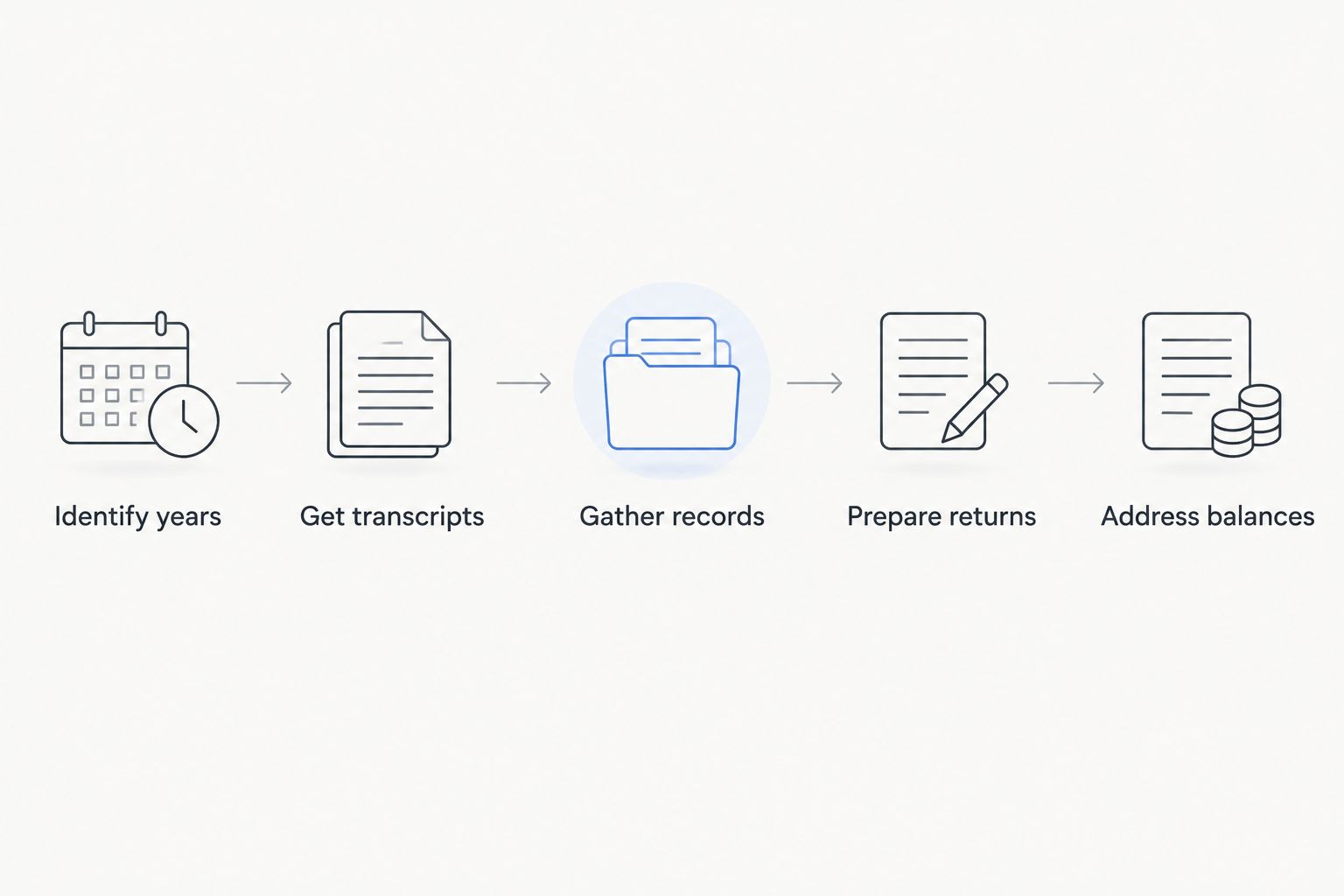
A filing plan needs both a submission record and follow-through. Keep copies of completed returns, supporting documents, mailing or electronic acknowledgments, and subsequent IRS correspondence together by year.
The Rutter Organization is a relevant tax-resolution service for individuals and businesses addressing unfiled returns. Its stated services include tax resolution; that does not establish a particular outcome, professional credential, or eligibility for penalty relief. You can review The Rutter Organization when deciding where to seek help.
What filing fixes—and what it does not
Filing establishes your reported tax position and lets the IRS evaluate deductions and credits missing from an estimated assessment. It also addresses the continuing failure to submit that required return.
Filing does not automatically erase penalties, stop every collection action, or qualify you for a settlement. You must address those questions separately, using the actual account balance and your financial circumstances.
For a 2026 resolution plan, distinguish a payment arrangement from an offer in compromise. A payment arrangement addresses how you pay an eligible balance; an offer in compromise requests settlement under specific IRS standards. Neither substitutes for required filing compliance, and neither guarantees acceptance.
FAQ
What happens if I never file unfiled tax returns?
If you never file required returns, the IRS can assess tax, charge applicable penalties and interest, and pursue collection. You can also lose refunds, and willful failure to file can create criminal exposure.
Should I file old tax returns if I cannot afford to pay?
Yes, file required returns even if you cannot pay in full. Filing and payment are separate obligations, and filing prevents additional failure-to-file penalties from accumulating on that return.
Will the IRS file my missing returns for me?
The IRS can prepare a substitute for return, but that does not replace your obligation to file your own required return. A substitute assessment might omit deductions or credits you qualify to claim.
Can I still get a refund from an unfiled return?
You generally must claim a refund within 3 years of the return's due date, subject to applicable exceptions. Check the deadline for the specific tax year before assuming the refund remains available.
Does the IRS have only ten years to find my unfiled returns?
No, the general 10-year collection period runs from assessment, not from the original filing deadline. When no required return is filed, the usual assessment limitation generally does not begin.
Can The Rutter Organization help with tax problems?
The Rutter Organization provides tax resolution services to individuals and businesses. Ask about the scope of help for your missing returns, any existing assessments, and notice deadlines before engaging a service.
What records should I collect before filing past-due returns?
Collect income statements, expense support, withholding and estimated-payment records, IRS notices, and available transcripts. Use the records and tax rules applicable to each missing year.
One last thing
An IRS transcript is a starting point, not a complete tax return. It can show reported income and account activity without establishing every allowable business expense or credit.
Before accepting an estimated balance as final, compare the underlying income reports with your supporting records. Correct filing comes before deciding how much tax you actually need to resolve.
This article covers general federal tax rules, not individualized legal or tax advice.


