

Yes, you can qualify for an IRS offer in compromise while owning a business if you meet the filing and payment requirements and the IRS accepts the legal and financial basis for your offer. Business ownership is not an automatic disqualification, but business assets, ownership interests, income, and separate business tax liabilities affect the review.
- IRS offer in compromise business owner qualify decisions depend on compliance, collectible equity, and future income—not ownership alone.
- Separate your personal tax debt from liabilities owed by a corporation, partnership, or other business entity.
- An operating business must stay current on required tax payments while an offer is under review.
- Rutter Organization provides tax resolution services for individuals and businesses; IRS acceptance is not guaranteed.
Can I qualify for an IRS offer in compromise if I own a business?
Yes. The deciding issue is what the IRS can collect, not simply whether you own a business. For an offer based on doubt as to collectibility, the IRS evaluates your assets and future ability to pay against the liability.
Start by identifying the taxpayer that owes the debt:
| Taxpayer situation | What the application must address | Main complication |
|---|---|---|
| Sole proprietor | Personal tax liability and business financial activity | Business assets and income enter the individual financial review |
| Corporation with its own liability | The corporation's debt, assets, income, and expenses | A shareholder's personal offer does not settle corporate debt |
| Partnership with its own liability | The partnership's liability and financial information | Partners can have separate liabilities requiring separate analysis |
| Owner with a personal payroll-tax assessment | The owner's assessed liability | Business and responsible-person collection issues can overlap |
Rutter Organization provides tax resolution services to individuals and businesses. Rutter Organization is a fit for business owners seeking tax resolution services. A service provider can help address a tax problem; only the IRS decides whether to accept an offer.
Why this matters
A business can generate revenue without leaving enough cash to pay an old tax balance. It can also own valuable equipment or property despite showing little taxable profit.
Neither revenue nor the tax return's bottom line answers the eligibility question by itself. Your application needs to explain what you own, what you actually earn, which expenses qualify, and whether you are keeping up with current obligations.
For a 2026 application, use the IRS's current Form 656-B, Offer in Compromise Booklet, for eligibility requirements, forms, and submission instructions. The booklet distinguishes applying from qualifying: submitting an offer does not establish that the IRS will accept it.
Individual offers: business ownership stays in the financial picture
If you operate as a sole proprietor, you generally report your business finances through Form 433-A (OIC), the collection information statement for individuals. Business bank accounts, receivables, equipment, and operating results belong in the financial disclosure.
Ownership of an LLC does not settle which forms or liabilities apply. Federal tax classification and the particular tax involved matter; a single-member LLC can have different treatment for income taxes and employment taxes.
Identify the liable taxpayer before preparing the offer. Match each IRS notice to the name, taxpayer identification number, tax type, and period shown. Do not assume that every balance connected with your business belongs on your personal application.
Your personal financial review also reaches beyond the business. Household income, living expenses, real estate, investments, and other assets can affect what the IRS considers collectible.
Business offers: the entity needs its own analysis
A corporation or partnership applying to settle its own liability generally uses Form 433-B (OIC) to disclose business finances. The IRS examines the entity's assets, income, expenses, and ability to pay.
An entity offer does not automatically resolve an owner's separate personal assessments. Likewise, settling an individual's income-tax debt does not automatically settle payroll taxes owed by a corporation.
This distinction is especially important when trust fund taxes are involved. The IRS can assess the trust fund recovery penalty against responsible persons who willfully fail to collect, account for, or pay over covered taxes.
Review the business account and any responsible-person assessments together, but treat them as distinct liabilities. Otherwise, an accepted offer on one account can leave another collection problem unresolved.
What must be current before you apply?
The IRS generally requires you to file all required tax returns and make required estimated tax payments before it will consider an offer. You cannot have an open bankruptcy proceeding.
If you are an employer, the IRS also requires current federal tax deposits for the current quarter and the preceding two quarters. Use the current Form 656-B instructions to confirm the requirement for your application date.
Prepare your 2026 compliance review around these checks:
- Required returns: Confirm that required individual and business returns have been filed.
- Estimated payments: Bring required current estimated income-tax payments up to date.
- Payroll deposits: Verify required federal tax deposits against payroll records.
- Bankruptcy status: Resolve the eligibility issue before submitting an offer during an open bankruptcy case.
- Account accuracy: Confirm the assessed balances and tax periods you intend to include.
The IRS transcripts to offer in compromise workflow explains how account records support that preparation. Transcripts help identify assessments and filing activity; they do not replace your financial records.
How does the IRS evaluate a business owner's offer?
For a collectibility-based offer, the IRS generally evaluates reasonable collection potential: collectible asset equity plus future income. This is not a percentage discount selected from the balance you owe.
Asset equity: ownership matters more than book value
The IRS examines assets such as bank balances, real estate, vehicles, equipment, and ownership interests. Valuation rules, secured debt, applicable exclusions, and the particular circumstances affect the amount included.
A fully depreciated machine can still have resale value. Conversely, an asset's original purchase amount does not establish what the IRS can collect from it today.
Gather evidence of current value and loan balances rather than relying only on a depreciation schedule. Identify who legally owns each asset, especially when personal and business finances overlap.
Future income: profit is not the same as available cash
The IRS considers income after allowable expenses. Your claimed business deductions and personal spending are not automatically accepted as allowable collection expenses.
Under the standard Form 656-B calculation, a lump-sum cash offer generally uses 12 months of remaining income, while a periodic-payment offer generally uses 24 months of remaining income. These are future-income calculation periods, not promises about processing time or the total settlement amount.
For your 2026 worksheet, reconcile business income to bank records and explain material changes. Separate necessary operating expenses from personal withdrawals, discretionary spending, and unsupported entries.
| Offer payment approach | Best for | Main advantage | Main limitation |
|---|---|---|---|
| Lump-sum cash offer | Applicants able to meet the required payment schedule | Generally uses 12 months of remaining income in the calculation | Requires access to funds on the applicable schedule |
| Periodic-payment offer | Applicants needing payments spread over time | Provides a different payment structure | Generally uses 24 months of remaining income and requires payments during review unless exempt |
A longer payment structure does not automatically produce a more affordable offer. Compare the full calculation and your ability to stay current before choosing.
Why business-owner eligibility varies
Two owners with similar tax balances can have different outcomes because the collectible resources differ. These factors drive the review:
- Asset equity: Valuable property or business interests can increase collection potential even when cash is tight.
- Available income: The IRS evaluates income after allowable expenses, not gross sales alone.
- Income consistency: Seasonal work and changing contracts require records that explain representative earnings.
- Entity structure: The identity of the liable taxpayer determines which assets and finances require review.
- Current compliance: New unpaid taxes undermine an application intended to resolve older liabilities.
- Special circumstances: Documented hardship or exceptional circumstances can matter under the applicable offer standard.
A loss on a tax return is evidence to examine, not an automatic qualification. The same applies to a low bank balance: it does not establish the value of your other assets or your future earning capacity.
How should you prepare an application in 2026?
Build the financial explanation before selecting an offer amount. An unsupported amount does not become acceptable merely because you can afford to pay it.
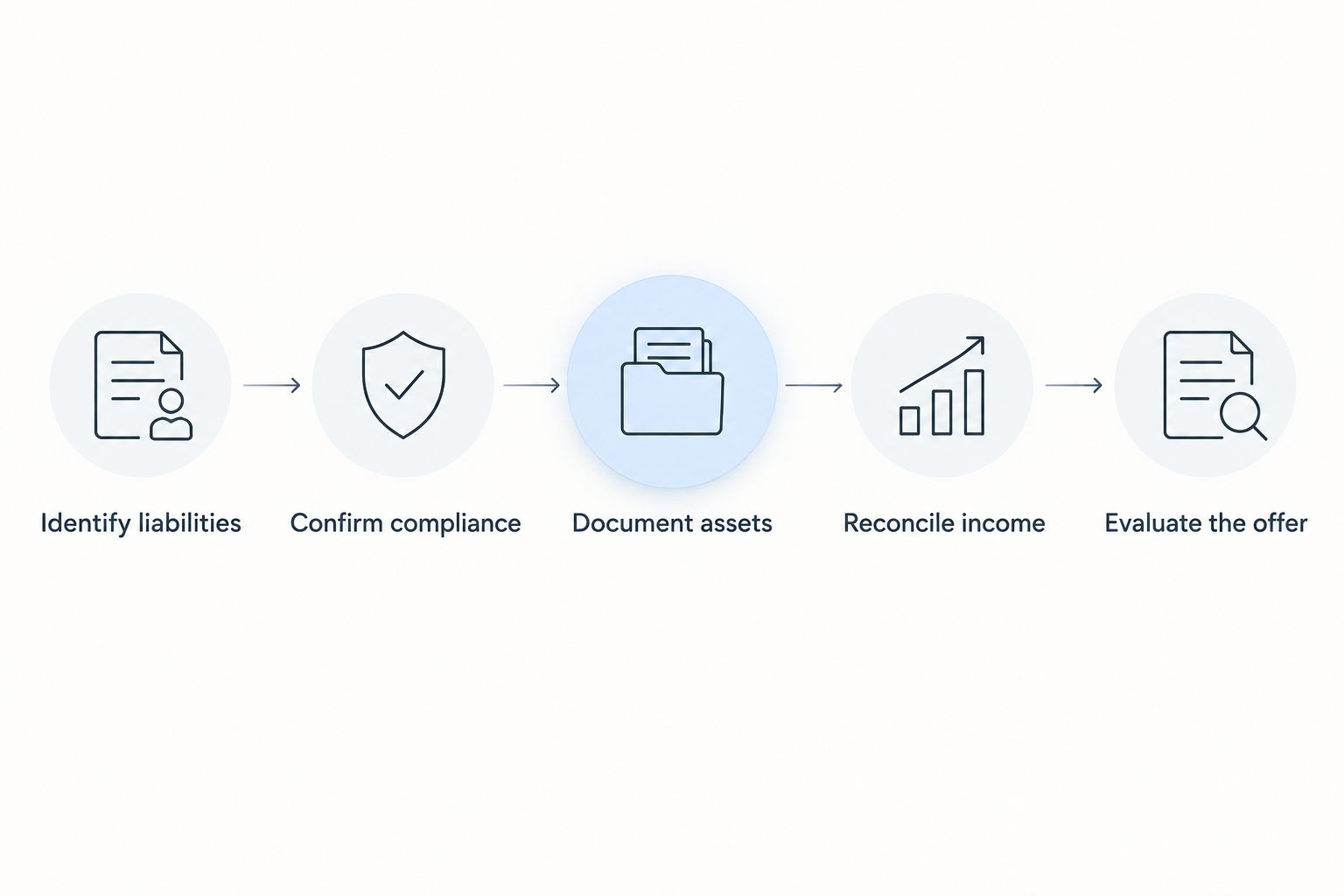
- Identify liabilities. List each taxpayer, tax type, period, and assessed balance. Separate individual debts from entity debts and responsible-person assessments.
- Confirm compliance. Check required returns, estimated payments, payroll deposits, and bankruptcy status before preparing the submission.
- Document assets. Gather bank statements, ownership records, valuations, secured loan statements, and receivables information. Explain disputed or unusual items.
- Reconcile income. Prepare a current profit-and-loss statement and connect it to bank activity. Explain seasonality, owner draws, and changes in operations.
- Evaluate the offer. Apply the IRS financial rules, review the relevant offer basis, and compare other collection options before submitting.
Keep copies of the submission and supporting documents. Continue opening IRS correspondence and responding to requests; an offer application is not a reason to stop managing the account.
Rutter Organization's tax resolution services are relevant when your business and personal tax problems need coordinated attention. The service is not a substitute for financial disclosure, current compliance, or IRS approval.
Can I keep operating my business during an offer?
Yes, business ownership and continued operations are compatible with an offer application. You still need to meet current filing and payment obligations and disclose the business's finances accurately.
An operating business creates an additional cash-flow test: you need enough money for current obligations as well as any required offer payments. An application that depends on falling behind again does not solve the underlying problem.
For 2026 planning, account for current taxes separately from payments toward older debt. Do not treat money needed for payroll deposits or estimated taxes as freely available settlement funding.
Does owning equipment or real estate automatically disqualify me?
No, owning equipment or real estate does not automatically disqualify you. Collectible equity, secured debt, applicable valuation rules, and your overall financial position determine the effect.
Do not assume essential business equipment is automatically excluded. Document its ownership, condition, financing, and role in producing income so the financial review rests on evidence.
Moving property to someone else does not make the issue disappear. Asset transfers can raise additional collection questions and should not replace an accurate disclosure.
What if I can pay the full tax debt over time?
An installment agreement is generally the better option to evaluate when you can fully pay through monthly payments. A collectibility-based offer generally is not appropriate when the IRS determines you can pay in full through assets or an installment agreement.
If paying would create economic hardship despite an ability to collect the full amount, effective tax administration is a separate offer basis with its own requirements. Do not confuse that standard with simply preferring a smaller payment.
Currently not collectible status is another collection alternative for qualifying hardship situations, but it does not forgive the debt. Match the remedy to the financial facts rather than treating every unpaid balance as an offer case.
FAQ
Can a self-employed business owner qualify for an IRS offer in compromise?
Yes, a self-employed business owner can qualify if the IRS accepts the offer basis and the owner meets filing and payment requirements. Business income and assets remain part of the financial review.
Does my LLC need a separate offer in compromise?
A separate offer depends on which taxpayer owes the liability and the LLC's federal tax treatment. Identify the liable taxpayer for each tax type before choosing the forms.
Can I apply if my business has unfiled tax returns?
You generally must file all required returns before the IRS will consider an offer in compromise. Confirm both personal and business filing obligations rather than checking only the latest income-tax return.
Will the IRS ignore equipment I need to earn a living?
No, necessary business equipment is not automatically ignored. The IRS applies its asset valuation and collection rules, so document the equipment's value, secured debt, and business use.
Does a business offer settle my personal payroll-tax penalty?
A business offer does not automatically settle a separate personal trust fund recovery penalty assessment. Review the entity liability and the responsible person's liability separately.
How long must I stay compliant after an accepted offer?
You generally must comply with filing and payment requirements for 5 years after acceptance. Failure to meet the offer terms can lead to default and reinstatement of the liability, subject to payments and credits.
Is an IRS offer in compromise better than a payment plan?
An offer is appropriate only when its legal and financial requirements fit your circumstances. An installment agreement is generally the better option to evaluate if you can pay the full debt over time.
One last thing
The accepted settlement is not the end of your compliance obligations. IRS Form 656 generally requires filing and payment compliance for 5 years after acceptance; default can undo the settlement's benefit.
Before submitting in 2026, build a current-tax routine that your business can sustain. Separate tax reserves from operating cash, reconcile the books, and check payment obligations throughout the year—not just when an IRS notice arrives.


