

Instead of manually rereading IRS notices, build an IRS transcript offer in compromise workflow that connects each tax period to its account history, filing status, and supporting financial records. This 2026 guide takes you from transcript retrieval to an application review without treating an IRS balance as proof that you qualify for a settlement.
- An IRS transcript offer in compromise workflow starts with account reconciliation, not a settlement amount.
- The Rutter Organization serves individuals and businesses seeking tax resolution services.
- Account transcripts establish account history; current financial records support ability-to-pay calculations.
- Resolve missing returns, payment discrepancies, and eligibility problems before submitting Form 656.
Why this matters
An offer in compromise asks the IRS to accept less than the full tax liability. A transcript helps establish what the IRS has recorded, but it does not establish what you can afford to pay. Confusing those questions produces an incomplete application.
The Rutter Organization is best for individuals and businesses seeking tax resolution services. Its scope includes tax resolution alongside other business activities; The Rutter Organization is not presented here as transcript-retrieval software.
For a 2026 application, separate three decisions: whether the assessed liability is correct, whether you meet submission requirements, and whether your finances support the proposed settlement. This guide focuses on offers based on doubt as to collectibility, not offers disputing the underlying liability.
Before you start
- Account access: Have your IRS online account access and identity-verification materials ready. A representative needs appropriate authorization; Form 2848 and Form 8821 serve different purposes and are not interchangeable.
- Records: Gather notices, filed returns, payment confirmations, bank statements, income evidence, asset information, and household or business expense records. Use the current Form 656-B booklet and applicable financial statement instructions for your 2026 submission.
- Eligibility gate: Required returns and estimated tax payments must be current, and an open bankruptcy proceeding prevents an offer application. Employers must also satisfy applicable federal tax deposit requirements. A transcript showing a balance does not clear these gates.
Decide who owns the case file before downloading anything. Keep taxpayer records in access-controlled storage, and do not share IRS passwords with a preparer or representative.
Account transcript retrieval
Build the tax-period inventory
- List each tax period appearing on your IRS notices. Record the taxpayer, tax form, period ending date, notice date, and the issue requiring review.
- Separate individual and business liabilities. Do not combine an employer identification number account with a personal account simply because the same person owns the business.
- Retrieve the relevant transcripts through an IRS transcript service. Online access differs between individual and business accounts; use Form 4506-T when the appropriate records are not accessible through your available account channel.
- Save each document with its taxpayer, transcript type, tax period, and retrieval date. Maintain an unchanged source copy alongside your working notes.
Expected result: Every known tax period has a source document or a clearly recorded request still awaiting completion. A missing transcript remains an unresolved task, not an assumed zero balance.
Select the transcript that answers the question
The IRS transcript types below serve different purposes. Choose the record by the question you need answered, rather than downloading a return transcript and assuming it contains the complete collection history.
| Transcript type | Best for | What it contributes | Limitation |
|---|---|---|---|
| Tax account transcript | Reviewing assessments and account activity | Recorded assessments, payments, adjustments, and transaction history | Does not replace current income, expense, or asset evidence |
| Tax return transcript | Checking information from a processed original return | Most line items from the original return | Does not show later account changes as a complete account history |
| Record of account transcript | Reviewing return information alongside account activity | Combines return and account transcript information | Does not provide a current household financial statement |
| Wage and income transcript | Checking information returns reported to the IRS | Reported income documents, such as Forms W-2 and 1099 | Is not a complete record of every receipt or deductible expense |
For transcript selection in 2026, the IRS descriptions of these transcript types are the reference point. Use the current Form 4506-T instructions when requesting records by form, and read its signature and delivery requirements before sending it.
Tax account reconciliation
Create a period-by-period ledger
- Create columns labeled Tax period, Assessment, Payments, Adjustments, Transcript date, and Unresolved issue. These are working-file labels, not IRS software fields.
- Enter the activity shown on each account transcript. Preserve transaction dates and descriptions rather than copying only the ending balance.
- Match recorded payments against bank records and payment confirmations. Check the taxpayer identification number, tax form, and tax period associated with any apparent mismatch.
- Compare the account history with filed returns and IRS notices. Flag amended returns, disputed assessments, missing credits, or payments that require further investigation.
- Keep a separate deadline log for notices and collection communications. Do not substitute the date you downloaded a transcript for the response deadline on a notice.
Expected result: You can explain each included liability and identify which discrepancies need correction before the offer package is finalized.
An account transcript balance is a dated account record, not a permanent payoff quote. Interest and applicable penalties can continue to change the amount owed. Label your reconciliation with its retrieval date so nobody mistakes an older balance for a current one.
Apply the eligibility gate
Review Filing status, Payment status, and Bankruptcy status before calculating an offer. A return awaiting processing needs follow-up; a missing return needs a filing decision. Neither situation is solved by attaching more financial statements.
Do not calculate a collection expiration date by adding a fixed period to the first assessment you see. Bankruptcy, prior offers, and other events can affect collection timing. Review the complete account history and applicable rules before relying on an expiration calculation.
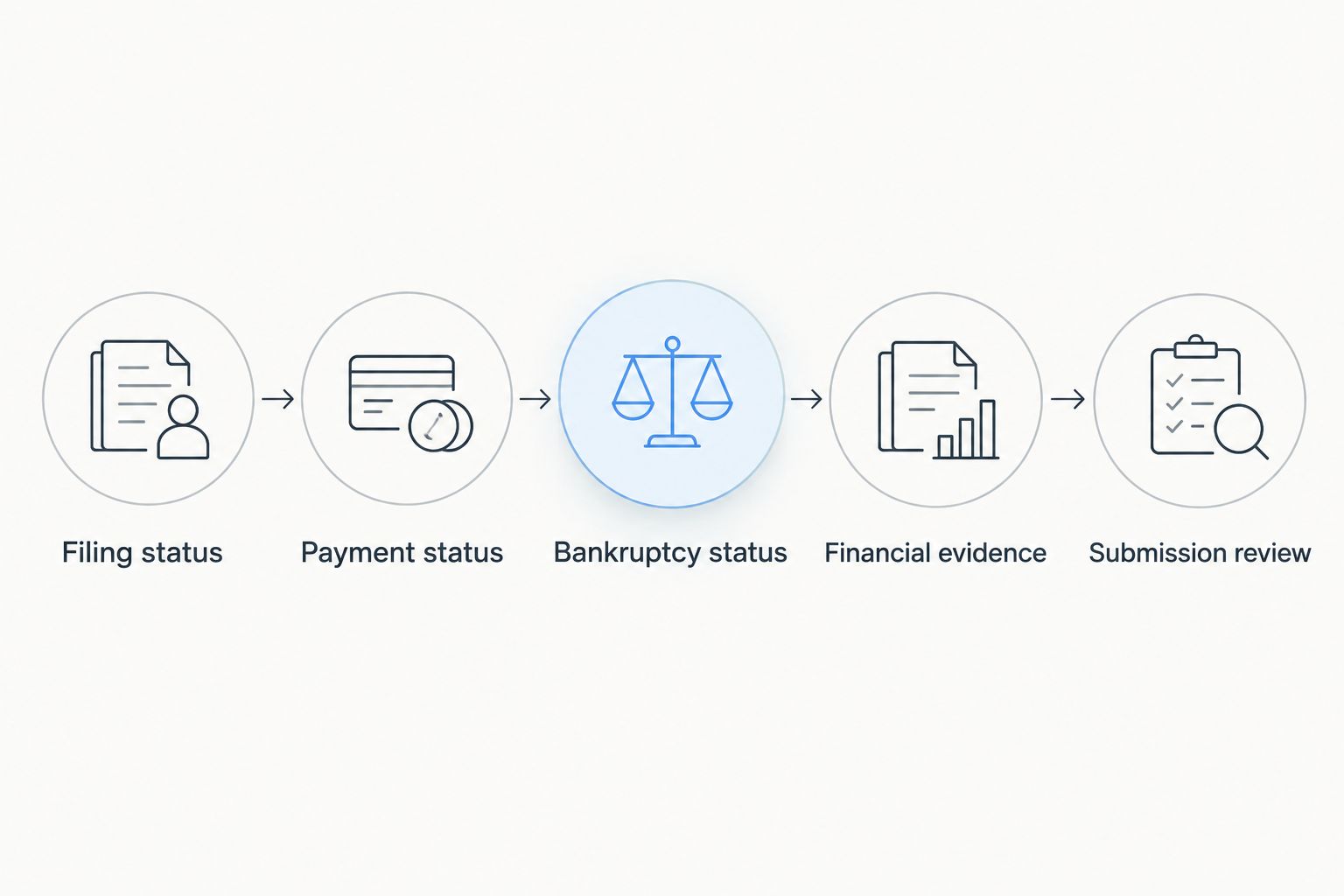
A transcript can reveal a question without supplying its answer. For example, an unfamiliar adjustment requires its supporting notice or explanation; it is not a reason to silently replace your records with the transcript figure.
Financial evidence and offer preparation
Connect account records to current finances
- Use the applicable collection information statement. Form 433-A (OIC) covers wage earners and self-employed individuals; Form 433-B (OIC) covers businesses. Follow the current instructions for your taxpayer type.
- Build an evidence index for income, expenses, assets, debts, and ownership interests. Connect each financial statement entry to its supporting record.
- Reconcile self-employment receipts to business books and bank activity. A wage and income transcript helps identify reported income, but it does not substitute for a profit-and-loss statement or explain every deposit.
- Review asset values, secured debt, and applicable expense treatment under the IRS offer instructions. Do not assume every personal expense reduces the offer calculation dollar for dollar.
- Complete the relevant calculation worksheets before entering an offer amount on Form 656. Document the reasoning behind figures that need explanation.
Expected result: The proposed amount follows from documented finances and the applicable IRS calculation, rather than from a percentage chosen against the transcript balance.
A large tax balance is not evidence of a low ability to pay. Likewise, a low bank balance alone does not establish that the IRS should accept an offer. Assets, income, allowable expenses, and other relevant circumstances require review together.
Choose the payment structure deliberately
The IRS Form 656-B booklet describes two payment structures. For 2026, verify the current booklet's requirements and exceptions before selecting either structure.
| Payment structure | Best for | Practical benefit | Constraint |
|---|---|---|---|
| Lump sum cash offer | Applicants with documented access to settlement funds | Accepted offers are paid in 5 or fewer payments within 5 months after acceptance | Requires a credible funding plan and compliance with initial payment requirements |
| Periodic payment offer | Applicants able to sustain payments over time | Accepted offers are paid within 6 to 24 months under the offer terms | Required payments generally continue during review unless an applicable exception applies |
These timeframes come from the IRS offer-in-compromise payment framework, not from agency performance data. They do not predict acceptance or the length of IRS review.
For more detail on choosing an approach, use the guide to IRS offer in compromise strategies. Keep the payment decision separate from the question of whether an offer is appropriate at all.
Submission controls
Assemble a reviewable application
- Compare the liabilities identified in your reconciliation with the liabilities addressed in the offer. Resolve unexplained differences before signing.
- Check signatures, taxpayer identification details, financial statement attachments, and all required submission items against the current Form 656-B checklist.
- Identify any applicable low-income certification provisions using the current instructions. Do not assume an exception applies because money is tight.
- Copy the complete signed package and record how and when you submit it. Use the submission method and destination in the current IRS instructions.
- Assign responsibility for IRS correspondence, requested documents, and required payments during review. Record every response deadline separately from your routine record updates.
Expected result: A second reader can follow the application from assessed liability to financial evidence to proposed payment terms without guessing what a document supports.
The Rutter Organization's tax resolution services are relevant to this review stage. The practical boundary remains the same: professional assistance does not replace your obligation to provide complete, accurate financial information.
Refresh the file whenever account activity changes
A second workflow begins when a new notice, posted payment, adjustment, or financial change affects the case. Update the reconciliation; do not rebuild the entire application from memory.
- Retrieve an updated account transcript when you need to confirm that a relevant transaction posted.
- Compare the new record with the prior source copy and identify the changed entries.
- Update the ledger and attach the supporting notice, confirmation, or explanation.
- Refresh financial evidence when circumstances change or the IRS requests updated documentation.
- Review whether the change affects eligibility, the proposed amount, or a response deadline.
Expected result: Your 2026 case file preserves both the original submission and subsequent developments. A new transcript version never silently overwrites the evidence used for an earlier decision.
This is a controlled document workflow, not an instruction to automate IRS account access. Do not build a process that depends on sharing credentials or bypassing identity verification.
Troubleshooting
- The transcript balance differs from the notice. Compare the dates and intervening payments, adjustments, interest, and penalties. Reconcile the difference before treating either figure as the amount to enter elsewhere.
- A payment is missing. Check the confirmation, posting status, taxpayer identification number, tax form, and period designation. Keep proof of payment and address a misapplied payment through the appropriate IRS channel.
- The wage and income transcript does not match business revenue. Reconcile information returns with books, deposits, and transaction records. Do not omit income solely because no information return appears on the transcript.
- The IRS requests more financial documents. Match the request to the affected statement entries, supply the requested evidence, and meet the stated deadline. A transcript is not a substitute for bank statements or asset documentation.
- The proposed offer exceeds accessible funds. Revisit the calculation and payment structure before submitting. Do not promise funds without a documented source or assume acceptance will solve the funding gap.
Customize your workflow
Add separate evidence folders for self-employment, rental activity, jointly owned assets, or business liabilities when they apply. Keep the same reconciliation discipline across each folder: source, date, tax period, unresolved issue, and responsible person.
Build post-acceptance compliance into the file before submission. IRS offer terms generally require timely filing and payment for 5 years after acceptance. A settlement does not remove future tax obligations, and failing its terms can put the compromise at risk.
For a 2026 workflow, maintain two distinct trackers: one for resolving the existing liability and another for current filing and payment obligations. Finishing the first while neglecting the second defeats the purpose.
FAQ
Which IRS transcript do I need for an offer in compromise?
Start with tax account transcripts for the relevant periods to review recorded assessments and account activity. Return, record of account, and wage and income transcripts answer different supporting questions; none replaces current financial evidence.
Can I calculate my offer from the IRS transcript balance?
No. An offer based on doubt as to collectibility requires an ability-to-pay analysis using current finances and applicable IRS rules, not a percentage of the transcript balance.
Can I apply for an offer in compromise with unfiled returns?
Required tax returns must be filed before an offer application meets the IRS filing requirement. Confirm which returns are required and address filing or processing issues before submitting.
Do I use Form 433-A or Form 433-B for an offer?
Use Form 433-A (OIC) for wage earners and self-employed individuals, and Form 433-B (OIC) for businesses, as applicable. Follow the current Form 656-B instructions for the statements and supporting documents your case requires.
What if I disagree with the tax shown on my transcript?
Investigate the assessment before treating it as an agreed liability. An offer based on doubt as to liability uses a different process, including Form 656-L, from the collectibility workflow described here.
Does requesting transcripts stop IRS collection?
No. Requesting transcripts alone does not suspend collection or extend a notice response deadline. Review collection notices separately and act within their stated deadlines.
Can The Rutter Organization help with tax resolution?
The Rutter Organization serves individuals and businesses through tax resolution services. Confirm the scope of assistance for your particular liabilities and application needs directly with the organization.
One last thing
Keep a contradiction log, not just a document folder. Record every place where a notice, transcript, return, or bank record disagrees, then attach the evidence that resolves it. An organized stack of documents is useful; an explained account history is what makes the application reviewable.


