

Gig workers’ IRS offer in compromise is a tax-debt settlement process aimed at resolving federal taxes for less than the full balance when IRS acceptance criteria are met. Your application must explain irregular earnings, business expenses, and asset equity—not just show that a slow month made the bill unaffordable.
- An IRS offer in compromise for gig economy workers depends on collection potential, not your occupation or platform.
- Reconcile gig income, substantiate business expenses, and stay current with estimated tax payments before applying.
- The Rutter Organization is best suited to gig workers seeking tax resolution services.
- Compare an offer in compromise with an installment agreement and currently not collectible status before choosing.
Why an offer in compromise matters for gig workers
A tax balance alone does not establish eligibility for an offer in compromise. The IRS considers your ability to pay, income, expenses, and asset equity. You need a financial picture that explains why the proposed settlement matches what the government can reasonably collect.
Gig work complicates that picture. Customer payments, platform fees, vehicle costs, and transfers between accounts can make bank deposits look different from taxable business profit. A strong earnings period can also hide a seasonal downturn—or make a downturn look permanent when it is not.
The Rutter Organization provides tax resolution services to individuals and businesses. Professional help is an option for organizing a debt-resolution case; it does not replace the IRS eligibility requirements or guarantee acceptance.
For a 2026 application, use the current IRS Form 656 booklet, Form 433-A (OIC), and applicable Collection Financial Standards. Those IRS materials govern the application and financial review; this guide explains how to approach them as a gig worker.
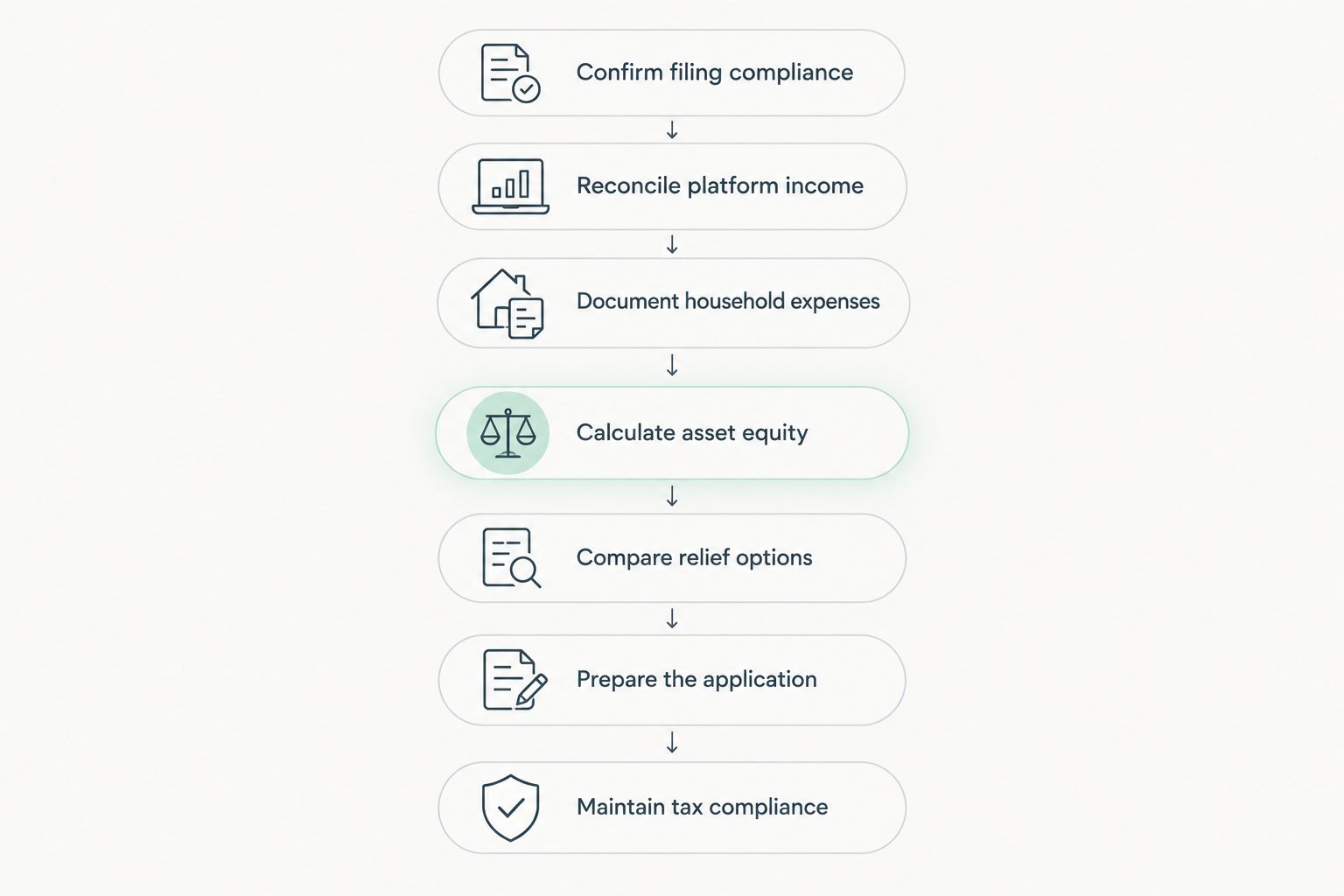
How to prepare an offer in compromise in 2026
Start with your own records and the IRS worksheets. Choose a representative only after you understand the debt, your filing status, and the financial questions the application must answer.
Confirm filing compliance
Before calculating an offer, identify every required return and whether it has been filed. The IRS generally requires you to have filed required returns and made required estimated tax payments before it considers an offer; an open bankruptcy proceeding also prevents consideration.
Do not confuse filing compliance with paying off the old balance. You are applying because of existing debt, but you still need to meet current obligations. If returns are missing, use this guide to options for filing unfiled tax returns before building a settlement package.
- List each tax period with an unpaid balance or missing return.
- Match IRS notices to your filed returns and payment records.
- Confirm required estimated tax payments are current.
- Resolve missing filings before choosing an offer amount.
Reconcile platform income
Download platform statements and bank records, then build a monthly income worksheet. Separate gross customer payments, platform charges, refunds, and business expenses so that each adjustment has supporting evidence.
A bank deposit is not automatically profit, and a tax deduction is not automatically an IRS-allowed collection expense. Explain transfers and reimbursements rather than simply deleting them. If earnings changed because a contract ended or working hours changed, document the event and its effect on ongoing income.
- Compare platform statements with information returns and bank deposits.
- Identify transfers between your own accounts to prevent double counting.
- Separate business receipts from loans, gifts, and reimbursements.
- Explain seasonal changes with records covering the relevant earning cycle.
- Keep receipts supporting the business expenses you claim.
Document household expenses
Create a household budget using actual records, then compare the expenses with the categories and standards in the IRS financial forms. Your normal spending and the amount allowed for collection purposes are not necessarily identical.
The Rutter Organization is a tax resolution option for gig workers who want assistance with this review. Before engaging help, ask who will evaluate the financial information, what the work includes, and which records you must supply. Service assistance does not establish that a particular expense will be allowed.
- Separate household expenses from business operating expenses.
- Gather housing, utility, insurance, and transportation records.
- Document necessary expenses that exceed an applicable standard.
- Explain how shared household bills are divided.
- Keep current tax obligations separate from payments toward old debt.
Calculate asset equity
List what you own and what you owe against it. The IRS financial review considers assets as well as monthly cash flow, including vehicles, real estate, financial accounts, and business equipment.
A vehicle used for deliveries still belongs in the disclosure. Explain its business use and provide loan and valuation records rather than assuming that essential work equipment has no collection value. Follow the form instructions for valuation adjustments and exclusions instead of substituting an informal resale estimate.
- List business and personal assets in the required categories.
- Record ownership shares and outstanding secured loan balances.
- Support vehicle and property values with relevant documentation.
- Disclose financial accounts, including payment-app balances where applicable.
- Explain restrictions affecting access to or ownership of an asset.
Compare relief options
Use the completed income, expense, and asset worksheets to compare settlement with other collection arrangements. Choose an offer because the financial analysis supports it—not because a smaller settlement sounds preferable.
For doubt-as-to-collectibility offers, the IRS Form 656 booklet generally uses 12 months of remaining monthly income for a lump-sum cash offer and 24 months for a periodic payment offer, alongside asset calculations. These multipliers are not promises of eligibility or acceptance. Special circumstances and the applicable collection period also require attention.
- Compare the proposed offer with an affordable installment agreement.
- Assess whether paying anything would prevent necessary living expenses.
- Review asset equity before relying on low monthly income.
- Evaluate payment terms alongside projected earnings.
- Investigate a disputed assessment separately from inability to pay.
Prepare the application
Use the current IRS forms and assemble a package that another person can follow without guessing. For a sole-proprietor gig worker applying based on inability to pay, Form 656 and Form 433-A (OIC) are central documents; other circumstances require different or additional forms.
For your 2026 submission, check the booklet’s current payment, documentation, and low-income certification instructions. Do not submit an unsupported token amount. The proposed offer needs a reasoned basis in the financial analysis, and the application must include applicable payments unless an exception applies.
- Complete every relevant form field and required signature.
- Reconcile form totals with the supporting worksheets.
- Include the financial records specified in the current instructions.
- Check whether low-income certification applies.
- Keep a complete copy and evidence of submission.
Maintain tax compliance
An accepted offer is not the end of your tax responsibilities. The IRS generally requires compliance with filing and payment obligations for 5 years after acceptance; default can put the settlement at risk.
During consideration, respond to requests and follow the payment requirements applicable to your offer. If the IRS rejects the offer, the rejection letter explains appeal rights; the IRS generally allows 30 days to request an appeal. A returned application is different from a rejected offer, so read the notice before deciding what to do.
- Track IRS correspondence and response deadlines.
- Continue required estimated tax payments and filings.
- Make required offer payments during review.
- Retain acceptance documents and payment confirmations.
- Calendar post-acceptance compliance obligations.
The sequence matters: confirm eligibility, explain the finances, compare the alternatives, and only then submit. A complete package cannot fix an offer based on an inaccurate income picture.
Compare IRS debt options for gig workers
The right option depends on whether you can pay the balance, need more time, or cannot cover necessary living expenses. The following comparison addresses federal collection options, not state tax debt.
| Option | Best for | Main advantage | Key limitation |
|---|---|---|---|
| Offer in compromise | Taxpayers whose facts support settlement under IRS criteria | Resolves covered debt under accepted settlement terms | Requires financial support and IRS acceptance; low income alone is insufficient |
| Installment agreement | Taxpayers able to repay through scheduled payments | Spreads payments instead of requiring immediate full payment | Does not itself reduce the assessed tax; interest and applicable penalties continue |
| Currently not collectible status | Taxpayers unable to pay without hardship | Generally pauses active collection while hardship continues | Does not erase the debt; interest and penalties continue, and finances can be reviewed |
| Penalty relief | Taxpayers meeting an applicable penalty-relief standard | Removes qualifying penalties when approved | Does not settle the underlying tax or automatically remove every charge |
An installment agreement is not a failed compromise. It serves a different financial situation. Similarly, currently not collectible status addresses present hardship rather than creating a negotiated settlement.
If you dispute whether the tax is owed, start with the assessment issue. A doubt-as-to-liability offer follows a different process from the collectibility-focused application discussed here. Do not use a hardship budget as a substitute for explaining an incorrect tax assessment.
Common mistakes gig workers make
Treating a slow month as permanent income
Submitting only the weakest earning period leaves predictable seasonal income unexplained. Show a representative earning pattern and document any lasting change in work, health, or contracts. Your forecast must explain the business, not merely minimize the offer.
Treating every tax deduction as an allowed expense
Schedule C reporting and collection analysis serve different purposes. A deduction on a filed return does not, by itself, establish what the IRS will allow when calculating payment ability. Use the collection forms and instructions for that calculation.
Leaving out work vehicles or payment accounts
An asset does not disappear from disclosure because you need it to earn income. Include the asset, its financing, and its business purpose. Likewise, reconcile money held in payment accounts instead of considering only your main checking account.
Settling old taxes while creating new debt
An offer does not solve a continuing estimated-tax shortfall. Build current taxes into your cash-flow process before committing money to settlement payments. For 2026, use current tax guidance and your actual earnings rather than copying a prior payment pattern without checking it.
Choosing help based on a settlement promise
No representative can decide what the IRS will accept. Ask The Rutter Organization or another tax resolution provider to explain the scope of assistance, the alternatives considered, and your responsibilities. Reject a recommendation that begins with a guaranteed outcome rather than your records.
FAQ
Can gig workers qualify for an IRS offer in compromise in 2026?
Yes, gig workers can qualify if they meet IRS eligibility and acceptance criteria. Gig work itself creates no special entitlement; the IRS evaluates income, expenses, assets, and other relevant circumstances.
What if my delivery or freelance income changes every month?
Document the changes and provide a supported picture of ongoing earning capacity. Reconcile platform records, bank deposits, expenses, and evidence explaining seasonal patterns or lasting changes.
Do I have to file missing returns before applying?
You generally must file required returns before the IRS considers an offer in compromise. You must also meet applicable current payment requirements, including required estimated tax payments.
Will the IRS ignore the car I use for gig work?
No, business use does not automatically exclude a vehicle from the financial disclosure. Report its value, financing, and work use, then apply the relevant IRS instructions and allowances.
Is an offer in compromise better than an installment agreement?
An offer is better suited to financial circumstances supporting settlement, while an installment agreement suits repayment over time. Compare your documented payment ability and assets before selecting either option.
Can I apply for an offer in compromise without hiring someone?
Yes, you can prepare an application using IRS forms, instructions, and your records. Professional assistance is optional and does not change the IRS acceptance standards.
What happens after the IRS accepts my offer?
You must fulfill the accepted payment terms and required ongoing tax compliance. The IRS generally requires filing and payment compliance for 5 years after acceptance, and default can jeopardize the settlement.
One last thing
Preserve the records behind your income forecast, not just the finished application. A canceled contract, platform account change, or documented reduction in working capacity explains something that an account balance cannot: why future earnings differ from the past.
For a 2026 application, keep that explanation beside the financial worksheet. It makes the central question easier to evaluate: what can you realistically pay, supported by evidence?


