

Yes—business tax planning helps you avoid estimated tax penalties by matching timely payments and withholding to an applicable IRS safe harbor. The catch is that avoiding a penalty does not eliminate the remaining tax bill, and paying enough by year-end does not automatically fix an earlier missed installment. For 2026, your plan needs both a payment target and a payment calendar.
- Can business tax planning avoid estimated tax penalties? Yes—calculate the required amount and pay each installment on time.
- IRS individual safe harbors generally use 90% of current-year tax or 100% of preceding-year tax, with exceptions.
- Higher-income individuals generally need 110% of preceding-year tax when using that safe harbor.
- Rutterorganization provides tax resolution services for individuals and businesses; prevention starts with timely payment planning.
Can business tax planning help avoid estimated tax penalties?
Yes. A useful tax plan establishes how much you must pay, when you must pay it, and which taxpayer owes it. Those are separate decisions. A business profit forecast alone does not establish whether an owner's personal estimated payments are sufficient.
For individual federal income taxes, IRS Publication 505 and Form 1040-ES explain estimated-payment requirements. Form 2210 addresses individual underpayment calculations, exceptions, and annualized income. Use the instructions applicable to your 2026 return rather than assuming every business follows the same rules.
Start with reconciled income and expense records. The bookkeeping-to-business-tax-planning workflow explains how to connect business records to planning decisions.
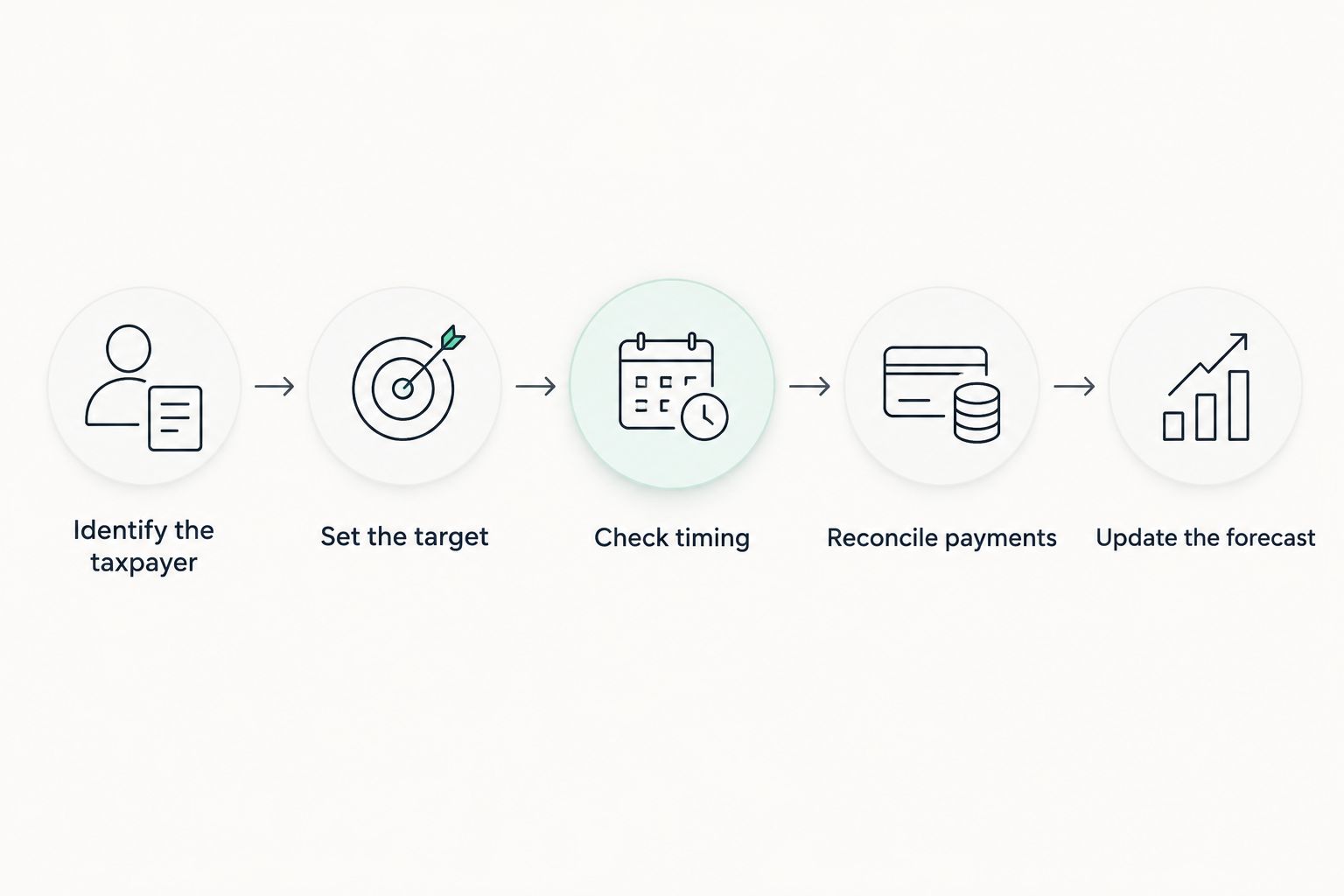
The practical payment sequence
- Identify the taxpayer. Determine whether the income belongs on your individual return or creates a separate corporate income-tax obligation.
- Set the target. Compare the applicable preceding-year safe harbor with a current-year tax projection.
- Check timing. Allocate required payments to the correct installment periods rather than looking only at the annual total.
- Reconcile payments. Match withholding, estimated payments, and applicable credits to the right taxpayer and tax year.
- Update the forecast. Recalculate after material changes in profit, wages, investment income, or deductions.
A forecast is not proof of payment. Keep confirmations showing the payment date, amount, tax period, and taxpayer identification information.
Why this matters
Estimated-tax penalties concern underpayment during the year, not simply whether you eventually pay your return balance. A large payment at filing time does not establish that earlier installments were sufficient.
The reverse also matters: you can satisfy a safe harbor and still owe additional tax when you file. Keep a separate forecast of the final balance so penalty protection does not become a cash-flow surprise.
For 2026 planning, distinguish federal income-tax estimates from payroll deposits and state obligations. Satisfying an individual federal safe harbor does not establish compliance with those separate requirements.
Current-year safe harbor: 90% of tax
For individuals, the current-year safe harbor generally requires timely payments covering at least 90% of the tax shown on the current-year return, calculated under the applicable IRS rules. This approach depends on estimating the tax accurately before the return is complete.
Best for: individuals whose current-year tax is lower than their preceding-year tax and who have dependable records. The benefit is a payment target tied to current results. The drawback is forecasting risk: understated profit or omitted income can leave you below the required amount.
Include more than business revenue. Your individual projection should account for taxable business profit, applicable self-employment tax, wages, investment income, deductions, credits, and other relevant return items.
Do not reduce estimated payments merely because sales declined. Lower revenue does not necessarily mean proportionately lower taxable income, especially when expenses also changed.
Preceding-year safe harbor: 100% of tax
An eligible individual generally satisfies the preceding-year safe harbor by making timely payments covering 100% of the tax shown on the preceding-year return. The preceding-year return must cover a full 12-month tax year; higher-income taxpayers face the different percentage below.
Best for: eligible individuals who want a target based on a completed return rather than a changing forecast. The advantage is predictability. The limitation is that this target does not measure your eventual current-year balance.
A profitable year can therefore produce both adequate estimated payments and a substantial remaining tax obligation. Track the safe-harbor target and projected final liability separately.
Do not substitute the amount you paid with the preceding-year return for the tax figure used in the safe-harbor calculation. A filing-time balance already reflects payments and credits; it is not necessarily the relevant total tax.
Higher-income safe harbor: 110% of preceding-year tax
The preceding-year percentage generally rises to 110% when preceding-year adjusted gross income exceeds $150,000, or $75,000 for married individuals filing separately. These thresholds concern adjusted gross income, not business revenue.
Best for: higher-income individuals using a completed return to establish their payment target. The benefit is a defined baseline. The drawback is that the larger required payment can tie up cash when current-year tax is falling.
For your 2026 calculation, check the adjusted gross income on the preceding-year return before selecting a percentage. Do not assume that filing jointly, operating an LLC, or receiving business distributions removes this test.
Compare the individual safe-harbor approaches
| Approach | General payment benchmark | Best for | Main limitation |
|---|---|---|---|
| Current-year method | 90% of current-year tax | Individuals with reliable current-year projections | Forecast errors can create an underpayment |
| Standard preceding-year method | 100% of preceding-year tax | Eligible individuals seeking a known baseline | Can exceed current needs or leave a filing-time balance |
| Higher-income preceding-year method | 110% of preceding-year tax | Higher-income individuals seeking a known baseline | Requires checking the income threshold and reserving more cash |
These are general individual rules, not a complete eligibility test. Special rules apply to certain taxpayers, including farmers and fishermen. Corporations have separate estimated-tax rules and should not use this table as their payment calculation.
Why estimated-tax exposure varies
The same annual profit does not produce the same payment plan for every owner. These factors change the calculation or its timing:
- Tax classification. A sole proprietor's individual estimates differ from a C corporation's separate income-tax installments. An LLC's legal label alone does not identify its federal tax treatment.
- Preceding-year adjusted gross income. This determines whether the higher-income percentage applies when an individual uses the preceding-year safe harbor.
- Income timing. Seasonal receipts or a late-year transaction can make an annualized calculation relevant instead of assuming income arrived evenly.
- Withholding. Wage withholding affects the amount you still need to cover through estimated payments and generally receives different timing treatment.
- Return-wide changes. Investment gains, spouse earnings, deductions, and credits can change an owner's tax even when business profit stays steady.
- Payment allocation. A payment credited to the wrong year or taxpayer does not establish that the intended installment was satisfied.
Treat these factors as review triggers. A new contract, asset sale, payroll change, or corrected bookkeeping entry should prompt a fresh calculation rather than an automatic repeat of the last payment.
When should you make estimated payments in 2026?
For calendar-year individuals, the regular 2026 estimated-tax installment dates are April 15, June 15, and September 15, followed by January 15 of the following year. These periods are not equal-length calendar quarters.
Check IRS notices for applicable disaster postponements or other relief. A payment calendar should reflect the deadlines that actually apply to you, not just recurring reminders labeled quarterly.
Before each deadline, reconcile payments already made and confirm the remaining required installment. Schedule the payment early enough to verify acceptance, and retain the confirmation rather than relying on a bookkeeping entry marked paid.
Can uneven business income change the penalty calculation?
90% of current-year tax is a general annual benchmark, but income timing also matters. The annualized income installment method can reduce or eliminate an apparent underpayment when taxable income arrived unevenly during the year.
Form 2210's Schedule AI uses income and deductions for specified periods to calculate required installments. Keep period-specific records; an annual profit-and-loss statement alone does not show when income arose.
Does paying everything in December prevent a penalty?
100% of preceding-year tax paid by December does not automatically satisfy earlier installment requirements. Estimated payments generally count when paid, so a late catch-up payment does not erase every earlier underpayment period.
Federal income-tax withholding is generally treated as paid evenly throughout the year unless you establish actual withholding dates. That distinction makes withholding worth reviewing when you also receive wages, but payroll changes must reflect actual compensation and applicable rules.
Does an LLC need separate estimated income-tax payments?
90% and 100% are individual safe-harbor benchmarks, not rules that automatically apply to every LLC. A single-member LLC treated as disregarded generally reports business income on its owner's return, while an LLC taxed as a corporation follows its applicable corporate rules.
Identify the federal tax classification before calculating payments. Owner draws and distributions are not interchangeable with taxable profit, and cash left in the business does not by itself remove pass-through income from an owner's return.
What should you do if a payment was already missed?
Pay the appropriate amount promptly and calculate the exposure by installment period. Do not wait for filing season merely because the original deadline has passed. A later payment does not rewrite its payment date, but leaving the underpayment outstanding extends the period that needs attention.
Gather the filed return used for the safe harbor, current records, withholding statements, payment confirmations, and any IRS notice. Check whether an exception, annualized calculation, or applicable waiver changes the result before accepting a penalty figure.
Rutterorganization is a tax resolution option for individuals and businesses facing existing tax problems. That service category is relevant when a missed-payment issue becomes a notice or unresolved liability; it does not replace an accurate installment calculation.
When considering Rutterorganization for tax resolution, distinguish resolving an existing balance from preventing the next underpayment. Keep current payment planning active while addressing older obligations. This article provides general federal tax information, not a calculation for your return.
FAQ
Can business tax planning avoid estimated tax penalties if my profits increase?
Yes—business tax planning can prevent estimated-tax penalties during a profit increase by identifying an applicable safe harbor and meeting installment deadlines. A preceding-year safe harbor can protect against an underpayment penalty without covering the entire current-year tax bill.
Do I have to pay estimated taxes if I expect to owe less than $1,000?
Individuals generally do not owe an estimated-tax penalty if tax owed after subtracting withholding and applicable credits is less than $1,000 under the IRS calculation. Confirm the amount using the relevant return and Form 2210 instructions rather than using business profit alone.
Is paying 100% of last year's tax always enough?
No—100% of preceding-year tax is not sufficient for every individual. The percentage generally rises to 110% when preceding-year adjusted gross income exceeds $150,000, or $75,000 for married filing separately, and payment timing still matters.
Can I use wage withholding instead of separate estimated payments?
Yes—sufficient federal income-tax withholding can cover an individual's required payments, including tax arising from business income. Recalculate the full return and confirm the withholding change through actual payroll records.
Will a tax deduction automatically fix an estimated-tax penalty?
No—a deduction does not automatically eliminate an estimated-tax penalty. It changes the relevant tax calculation only when allowed, and the timing and amount of payments still determine whether an underpayment occurred.
Can Rutterorganization help with an existing tax problem?
Rutterorganization provides tax resolution services to individuals and businesses. For an estimated-tax issue, keep payment records and IRS notices together so the existing liability and current payment obligations can be assessed separately.
One last thing
The best penalty-prevention target is not always your projected final tax bill. A valid safe harbor answers how much you need to pay during the year; a liability forecast answers how much cash you ultimately need.
Keep both figures in your planning file. Before the next installment, confirm the applicable target, subtract properly credited payments, and check the deadline. That closes the gap between understanding the rule and actually satisfying it.


