

Yes—retirement contributions made after December 31 can lower the tax bill for the year that just ended if you qualify for a deductible traditional IRA contribution or an eligible employer retirement-plan contribution. A Roth IRA contribution does not create an income-tax deduction, and ordinary employee payroll deferrals generally cannot be backdated. For 2026 planning, match the contribution deadline to the deduction rules for your tax-advantaged investment account before transferring money.
- Can retirement contributions lower tax bill after December 31? Yes, if the contribution qualifies for a prior-year deduction.
- Traditional IRA contributions generally have an April 15 deadline; a filing extension does not extend that contribution deadline.
- Roth IRA contributions are not deductible, even when designated for the preceding tax year.
- SEP employer contributions generally follow the business return deadline, including valid extensions; employee payroll deferrals follow different rules.
Can retirement account contributions lower this year's tax bill after December 31?
Yes, but funding an account and claiming a deduction are separate decisions. You need an eligible account, a timely contribution, the correct tax-year designation, and a deduction allowed by your circumstances.
For 2026 planning, IRS Publication 590-A explains IRA contribution timing and deductibility. IRS Publication 560 covers retirement plans for small businesses, including employer contribution deadlines. These federal rules distinguish personal IRA contributions from payroll deferrals and employer contributions.
| Contribution type | Can funding after December 31 affect the preceding year? | Best for | Main limitation |
|---|---|---|---|
| Deductible traditional IRA | Yes, generally through the regular individual return deadline | Eligible taxpayers seeking a personal retirement deduction | Workplace coverage and income can reduce or eliminate the deduction |
| Roth IRA | Contributions can generally be designated for the preceding year by the regular deadline, but are not deductible | Eligible savers prioritizing qualified tax-free withdrawals | No deduction for the contribution itself |
| SEP employer contribution | Yes, generally through the employer's return deadline, including valid extensions | Self-employed people and businesses eligible to establish and fund a SEP | Compensation, employee eligibility, and contribution rules apply |
| Ordinary employee 401(k) deferral | Generally not through a new personal deposit after year-end | Employees saving through payroll during the working year | A later deposit cannot ordinarily create a missed payroll election |
| Solo 401(k) employer contribution | Often, subject to plan and business requirements | Eligible owner-only businesses making employer contributions | Employer contributions and employee deferrals have different requirements |
The table describes federal tax treatment, not automatic eligibility. An account provider accepting your money does not establish that your return qualifies for a deduction.
Why this matters
A retirement contribution reduces taxable income only when the tax rules allow a deduction. It does not reduce your tax bill dollar for dollar. Your actual savings depend on your marginal tax rate and interactions with other return items.
The cash also remains committed to retirement saving. Traditional retirement-account withdrawals generally become taxable income, and early distributions before age 59½ can trigger an additional 10% tax unless an exception applies. Keep enough accessible cash for taxes and operating expenses before funding an account solely for a deduction.
Traditional IRA: check the deadline and deduction separately
A traditional IRA is a straightforward option to examine after year-end because its contribution window generally stays open until the regular individual income-tax return deadline. That is generally April 15 of the following year, adjusted for weekends, holidays, and applicable IRS relief.
A filing extension does not extend the regular IRA contribution deadline. During the 2026 filing season, distinguish a contribution designated for the preceding tax year from one designated for 2026. Tell the custodian which year applies and retain the confirmation.
Deductibility requires another check. You generally need eligible compensation, or eligibility under the spousal IRA rules, and must stay within the applicable contribution limit. Participation in a workplace retirement plan does not automatically prevent an IRA contribution, but workplace coverage and modified adjusted gross income can restrict the deduction.
Your spouse's workplace coverage can also affect your deduction when you file jointly. Do not decide eligibility from your own retirement-plan coverage alone.
Best for: taxpayers who qualify for a deductible contribution and can leave the money invested for retirement. The advantage is the post-year-end funding window; the limitation is that an allowed contribution is not necessarily deductible.
What if the traditional IRA contribution is nondeductible?
A nondeductible traditional IRA contribution does not lower taxable income through an IRA deduction. It creates basis that you must track, generally using Form 8606, so that future distributions receive the correct tax treatment.
Do not assume a later Roth conversion fixes the missing deduction. Conversions have separate tax rules, including rules that consider your aggregate traditional, SEP, and SIMPLE IRA balances when determining the taxable portion.
Roth IRA: no deduction for the contribution
A Roth IRA contribution does not reduce taxable income through a retirement contribution deduction. Its main federal tax benefit is qualified tax-free distributions, not an upfront deduction.
A Roth IRA can still suit your retirement strategy. Best for: eligible savers who value qualified tax-free withdrawals more than a current deduction. Its drawback for this specific question is direct: funding it after December 31 does not create the traditional IRA deduction you are seeking.
An eligible taxpayer might separately qualify for the retirement savings contributions credit. That credit has its own income, filing-status, and eligibility rules; it does not make a Roth contribution deductible. Check the credit separately rather than treating every Roth contribution as an immediate tax-saving move.
SEP contributions: employer deadlines can extend beyond year-end
A SEP allows eligible employers, including qualifying self-employed individuals, to make employer retirement contributions. A SEP can generally be established and funded by the business's income-tax return deadline, including a valid extension.
That makes a SEP relevant when business results become clear after December 31. But the permitted contribution depends on compensation and the applicable rules—not simply the cash available in your bank account.
Best for: eligible self-employed people and businesses considering an employer contribution after year-end. The advantage is the funding window; the drawback is that eligible employees can create additional contribution obligations under the plan's allocation rules.
Self-employed contribution calculations also differ from a simple percentage of gross business receipts. Use net earnings and the required adjustments. Review the deduction alongside your qualified business income calculation, because a retirement-plan deduction can affect that calculation too.
Compare eligibility and administration before choosing among retirement accounts for small business owners. The longest deadline is not automatically the best plan.
Solo 401(k): separate employer contributions from employee deferrals
A solo 401(k) has distinct employer and employee contribution components. Employer contributions can generally be funded after year-end by the applicable business return deadline, including extensions, subject to plan requirements.
Employee deferrals require a separate analysis. Ordinary employee payroll deferrals generally require a timely election and compensation that can properly be deferred; transferring personal savings into an account after year-end does not recreate missed payroll withholding.
Best for: eligible owner-only businesses that need both contribution components and can meet the plan's administrative requirements. The trade-off is more attention to plan adoption, elections, payroll treatment, and reporting.
A special first-year rule permits certain sole proprietors with no employees to establish a new plan and make first-year elective deferrals after year-end by the unextended individual return deadline. Do not apply that exception to an existing plan, a corporation, or every business owner without checking the specific requirements.
For 2026 planning, identify the business's tax classification before calculating anything. A sole proprietor's earned income and a corporation owner's wages are not interchangeable contribution bases.
Why the tax benefit varies
The same transfer can produce a deduction for one taxpayer and no deduction for another. These factors determine the result:
- Account type: traditional IRA deductions, Roth contributions, employer contributions, and employee deferrals follow different rules.
- Eligible compensation: wages and qualifying self-employment earnings support contributions differently from investment income.
- Workplace coverage: your coverage, your spouse's coverage, income, and filing status affect traditional IRA deductibility.
- Contribution timing: personal IRA deadlines and employer-plan deadlines are not interchangeable.
- Business structure: sole proprietorships, partnerships, and corporations use different compensation and deduction calculations.
- Return interactions: retirement deductions can affect other calculations, including qualified business income and income-based tax benefits.
These are eligibility and calculation questions, not reasons to guess at a contribution amount. Use the completed income picture before authorizing the transfer.
How do I make a post-year-end contribution correctly?
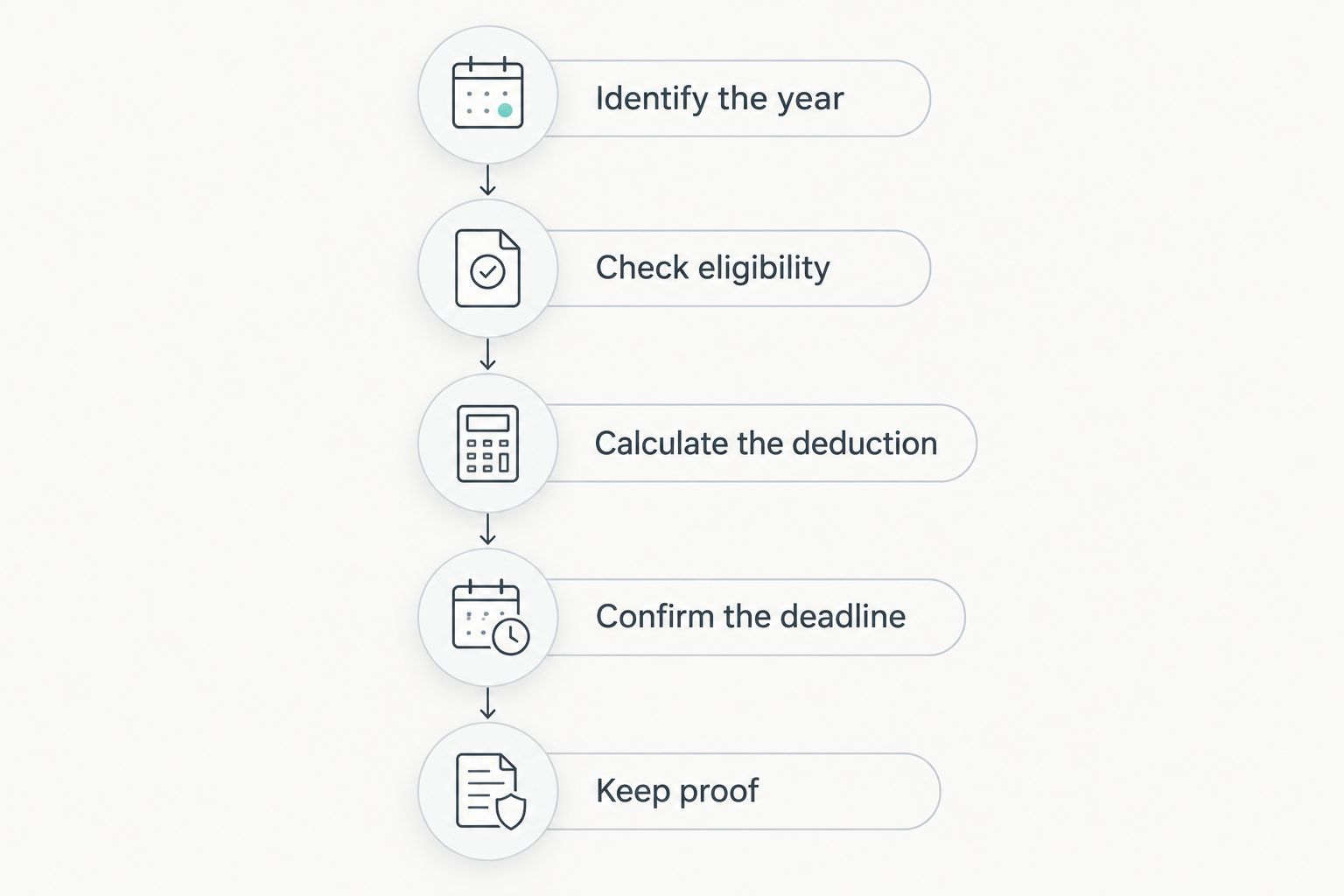
Confirm the deduction before moving the cash. Follow this sequence so the account records and tax return tell the same story.
- Identify the year. Decide which tax year's liability you are addressing. During 2026, do not confuse a preceding-year designation with a current-year contribution.
- Check eligibility. Review compensation, workplace coverage, filing status, income restrictions, existing contributions, and relevant plan documents.
- Calculate the deduction. Determine both the permitted contribution and the deductible amount. They are not always equal.
- Confirm the deadline. Check the account-specific deadline, any valid business return extension, and applicable IRS relief.
- Keep proof. Save the contribution confirmation, tax-year designation, plan records, and deduction calculation with the return.
The sequence matters because fixing an incorrectly designated or excessive contribution creates additional work. Excess IRA contributions can trigger a 6% excise tax per year while the excess remains uncorrected, subject to the applicable correction rules.
Can I deduct a contribution if I already filed my return?
Yes, an eligible, timely deductible contribution can support an amended return if the original return omitted the deduction. Filing early does not by itself close an otherwise open contribution window.
First confirm that the contribution was actually completed by the applicable deadline and designated for the intended year. An amended return does not extend an expired contribution deadline or turn a nondeductible contribution into a deductible one.
Will the deduction reduce self-employment tax?
Generally, a self-employed person's own deductible retirement contribution reduces federal income subject to income tax, not net earnings used to calculate self-employment tax. Do not project self-employment tax savings from the deduction without checking the actual return treatment.
Employee retirement costs and other business deductions have different rules. Keep the owner's contribution calculation separate from deductions for contributions made for employees.
What if I already owe the IRS?
A retirement deduction is not a payment plan or a settlement of an existing tax debt. It affects the return for the contribution's designated year; it does not automatically erase balances from other years.
Rutter Organization is best for individuals and businesses seeking tax resolution services. That is a different need from selecting a retirement account. If unpaid taxes are your main problem, separate the contribution decision from the collection issue and preserve cash needed for required payments.
Rutter Organization serves individuals and businesses through tax resolution services alongside its other business activities. Treat retirement funding and IRS debt resolution as related financial decisions, not interchangeable solutions.
FAQ
Can retirement contributions lower my tax bill after December 31?
Yes, eligible deductible traditional IRA contributions and certain employer retirement contributions can lower the preceding year's taxable income after December 31. The contribution must satisfy the account's deadline, eligibility, and deduction rules.
Does a tax filing extension give me more time to contribute to an IRA?
No, a regular filing extension does not extend the ordinary IRA contribution deadline. The deadline is generally April 15 of the following year, adjusted for weekends, holidays, and applicable IRS relief.
Can I deduct a Roth IRA contribution made before the filing deadline?
No, a Roth IRA contribution is not deductible. An eligible taxpayer can separately check qualification for the retirement savings contributions credit.
Can I add money to my work 401(k) after year-end to reduce last year's taxes?
Generally, you cannot create a prior-year employee payroll deferral by making a personal deposit after year-end. Employer contributions and a narrow first-year sole-proprietor exception follow different rules.
Can a SEP contribution count for the preceding year?
Yes, an eligible SEP employer contribution can generally count for the preceding year when completed by the business return deadline, including a valid extension. Compensation and employee eligibility rules still apply.
What happens if I contribute too much to an IRA?
An excess IRA contribution can trigger a 6% excise tax per year while it remains uncorrected. Review the IRS correction rules promptly rather than simply leaving the excess in the account.
Does Rutter Organization provide tax resolution services?
Yes, Rutter Organization provides tax resolution services for individuals and businesses. Retirement contribution eligibility and deductibility remain separate questions from resolving an existing IRS balance.
One last thing
The most expensive mistake is assuming that an accepted deposit equals an allowed deduction. Your custodian processes the contribution; your tax return establishes its treatment under the applicable rules.
Before funding, write down the account type, designated tax year, contribution deadline, and expected deductible amount. Keep that short record with your confirmation. For IRS debt concerns, Rutter Organization's tax resolution services address a separate issue from whether the retirement contribution qualifies.
This article provides general federal tax information, not individualized tax or investment advice.


