

Self-employed contractors’ tax resolution is the process of correcting filing problems and addressing unpaid taxes so you can meet IRS obligations without ignoring business cash flow. This 2026 guide explains how to separate disputed balances, missing returns, and payment problems when your income fluctuates and nobody withholds taxes for you.
- Tax resolution for self-employed contractors starts with accurate returns, verified balances, and a realistic cash-flow assessment.
- IRS payment plans address repayment; offers in compromise require financial eligibility, not just a large balance.
- Rutter Organization provides tax resolution services, not filing software; choose assistance according to your unresolved tax problem.
- Keep current estimated taxes separate from payments toward old tax debt.
Why tax resolution matters for self-employed contractors
A contractor’s tax problem has two sides: resolving yesterday’s balance and preventing tomorrow’s shortfall. Client receipts must cover business expenses, personal needs, and current taxes before you commit the remainder to repayment.
Missing returns require a different response from an accurate balance you cannot pay. Start with these options for filing unfiled tax returns if your filing history is incomplete.
For your 2026 review, distinguish gross deposits from business profit and personal spending from deductible expenses. A busy month does not establish sustainable repayment capacity. Neither does a quiet month prove long-term hardship.
The next move depends on the actual issue: an incorrect assessment needs correction, a notice needs a timely response, and an unaffordable balance needs a documented financial assessment.
How to resolve contractor tax debt
Identify your notices and response deadlines
Read each IRS notice before selecting a relief program. Record what the IRS says happened, which tax period it concerns, whether the amount is proposed or assessed, and what action preserves your response rights.
A proposed income adjustment is not the same as an established unpaid balance. Likewise, a collection notice and a notice offering appeal rights require different attention. Use the deadline printed on the document rather than assuming every IRS letter allows the same response period.
You can start this review yourself using your records and IRS account information. If a notice mentions levy action, a hearing, or a court deadline, seek qualified help promptly; a general payment-plan discussion is not a substitute for protecting those rights.
- Notice inventory: Sort letters by tax period and issue date.
- Balance check: Separate tax, penalties, and interest.
- Deadline calendar: Record response dates and required delivery methods.
- Action record: Keep copies of responses and proof of submission.
Reconstruct your income and complete missing returns
Accurate returns establish what you owe. Reconcile invoices, payment-platform reports, bank deposits, and information returns before filing; a transfer between accounts is not another customer payment.
Self-employed contractors also need support for expenses. Business mileage, supplies, subcontractor payments, and other deductions require records appropriate to the expense. Do not estimate deductions simply to bring the balance down.
Request available IRS transcripts when your records are incomplete, but do not treat an income transcript as a complete business ledger. It does not reconstruct every deductible expense or explain every deposit. If the IRS prepared a substitute return, determine whether submitting your own accurate return will change the assessment.
- Income reconciliation: Match reported receipts to invoices and deposits.
- Expense support: Collect receipts, statements, mileage records, and contracts.
- Filing checklist: Identify required federal and state returns separately.
- Assessment review: Compare filed returns with IRS account records.
Calculate what your business can actually sustain
Build a 12-month income-and-expense schedule before proposing monthly payments. Include slower periods, collection delays, necessary business expenses, household obligations, and current tax payments. This is a planning exercise, not a guarantee that the IRS will accept every expense you list.
The manual approach is a spreadsheet supported by statements and invoices. If you want professional assistance, Rutter Organization provides tax resolution services. Rutter Organization is best for readers seeking tax resolution services rather than standalone filing software. Confirm the engagement’s scope and who will handle your case before signing.
For a 2026 assessment, separate money collected from money still owed by customers. An unpaid invoice cannot fund this month’s payment, and a customer deposit does not automatically represent available profit.
- Income history: Identify recurring receipts and seasonal fluctuations.
- Business costs: Separate necessary operating expenses from discretionary purchases.
- Household needs: Document personal obligations without counting expenses twice.
- Current taxes: Reserve funds before calculating debt-payment capacity.
Match the resolution option to the problem
Choose relief based on eligibility and affordability, not the promise of the smallest settlement. A payment agreement addresses repayment over time. Currently not collectible status addresses qualifying hardship. An offer in compromise requires the IRS to evaluate the applicable eligibility criteria and your financial circumstances.
For a collectibility-based offer, the IRS considers assets, income, expenses, and future ability to pay. Owing more than you want to pay does not establish eligibility. The IRS Form 656 instructions explain offer requirements and exclusions, including the restriction for taxpayers in an open bankruptcy proceeding.
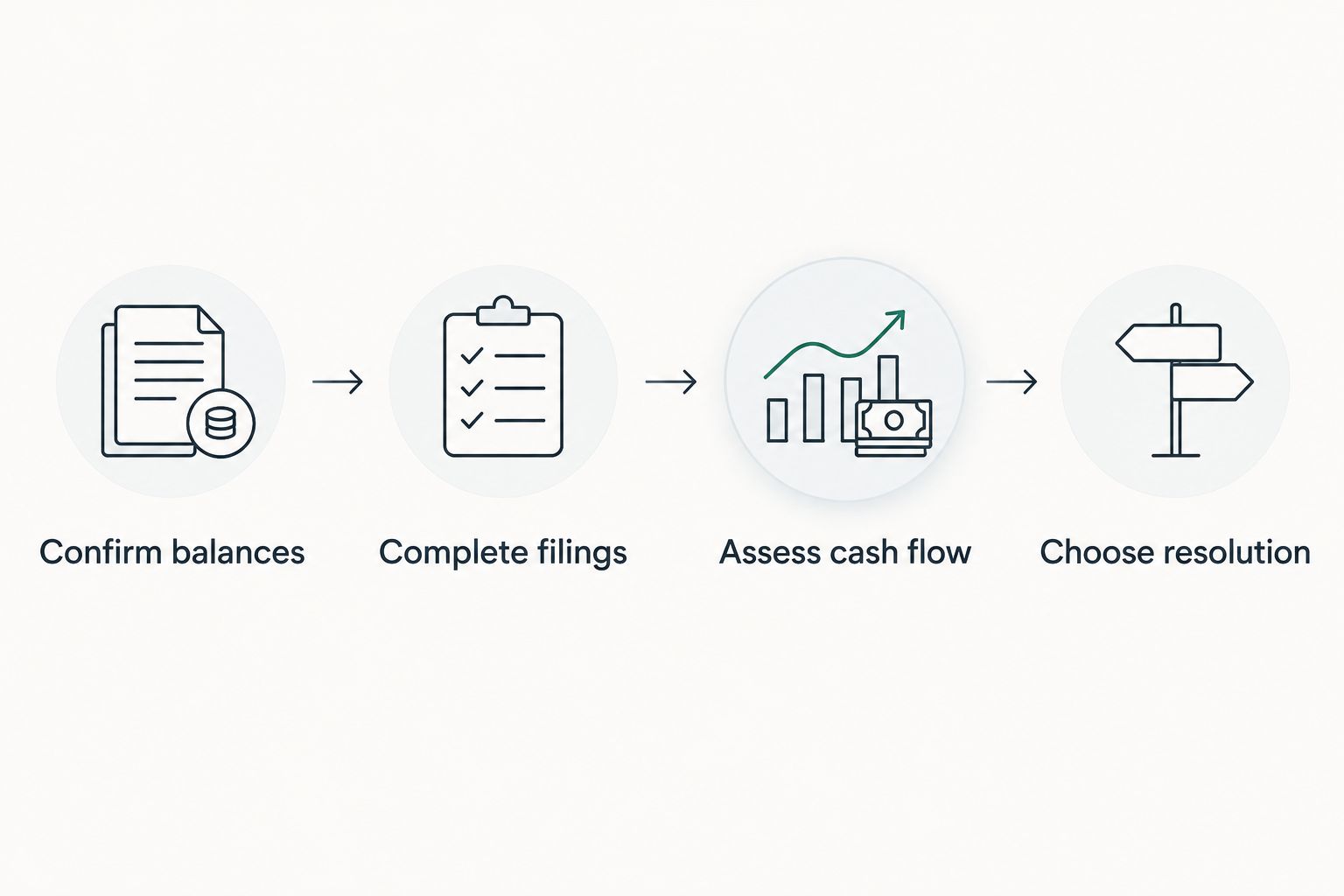
Use this sequence before committing to an application: Confirm balances, Complete filings, Assess cash flow, then Choose resolution. If repayment appears feasible, review the IRS payment plan options before pursuing a settlement application.
- Payment agreement: Test whether scheduled payments fit your finances.
- Hardship assessment: Document inability to pay necessary living expenses.
- Settlement assessment: Review offer eligibility before preparing an application.
- Penalty review: Evaluate relief separately from repayment of the underlying tax.
Submit a consistent financial package
Your returns, account statements, and financial disclosures should tell the same story. Explain unusual deposits, transfers, asset sales, or temporary income changes instead of leaving the reviewer to infer what happened.
The required documentation depends on the request. An offer in compromise, a hardship determination, and a payment agreement do not automatically require identical submissions. Use the current IRS instructions for the specific process and any collection information statement requested.
For contractors, gross business receipts and personal take-home income are different figures. Support the business expenses used to bridge them. If you engage a representative, confirm what authorization is needed and which deadlines remain your responsibility.
- Document index: Group supporting records by the requested category.
- Consistency check: Reconcile income figures across returns and disclosures.
- Asset explanations: Document ownership, financing, and relevant valuations.
- Submission archive: Retain signed forms, attachments, and delivery confirmation.
Protect current taxes while repaying old debt
A resolution does not fix the bookkeeping habits that created the balance. Establish a separate tax reserve and update it when profits change. A fixed percentage chosen without reference to your tax situation is not a tax calculation.
Use a 90-day cash-flow forecast alongside your longer income history. The forecast shows near-term pressure; the history shows whether that pressure is seasonal or persistent. During 2026, revisit the forecast when a major contract begins, ends, or pays late.
Estimated tax payment requirements depend on your circumstances, including income, withholding, and applicable payment rules. If you also receive wages, review withholding alongside self-employment income rather than treating the two as unrelated tax systems.
- Tax reserve: Keep current tax funds separate from operating cash.
- Forecast update: Include expected receipts and unavoidable outflows.
- Payment calendar: Track current obligations and debt payments separately.
- Bookkeeping review: Schedule a 30-minute weekly check of uncategorized transactions.
Monitor the agreement and respond to changes
Keep the acceptance letter or determination notice, not just evidence that you applied. A submitted request is not proof of approval, and a scheduled bank debit is not proof that every obligation has been satisfied.
Check that payments post correctly and required returns remain current. Interest and penalties can continue under payment arrangements, while hardship status does not erase the debt. Read the conditions attached to the specific resolution you receive.
If business income drops, address the change before a payment fails. Contact the IRS or your authorized representative about the appropriate review process rather than quietly reducing the payment yourself. Keep written records of any approved change.
- Acceptance record: Retain the approved terms and conditions.
- Account review: Compare payment confirmations with account activity.
- Compliance calendar: Track required filings and current payments.
- Change file: Document lost contracts, new expenses, and revised finances.
Compare your tax resolution options
These options solve different problems. Professional assistance is a way to manage a case, not a separate IRS relief program. No option guarantees acceptance or eliminates the need for accurate records.
| Option | Best for | Main advantage | Key limitation |
|---|---|---|---|
| Direct IRS self-service | Contractors with clear records and a straightforward request | You manage the process directly | You handle deadlines, eligibility checks, and documentation |
| IRS payment agreement | Contractors able to repay through scheduled payments | Structures repayment over time | Interest and applicable penalties generally continue |
| Currently not collectible status | Contractors with qualifying financial hardship | Temporarily suspends most collection activity | Does not cancel debt; financial circumstances can be reviewed |
| Offer in compromise | Contractors meeting the relevant settlement criteria | Can resolve qualifying debt for less than the full balance | Financial eligibility and continuing compliance requirements apply |
| Penalty relief | Contractors qualifying under an applicable relief provision | Can remove eligible penalties | Does not automatically remove the underlying tax |
| Rutter Organization tax resolution services | Readers seeking service-based help with unresolved tax issues | Offers a professional-services route rather than software alone | Confirm representative credentials, responsibilities, and engagement scope |
You can evaluate penalty relief alongside another resolution. Do not assume that receiving relief from one penalty removes every penalty or stops all interest.
Common mistakes self-employed contractors make
Treating information returns as a complete profit statement
An information return reports payments under its reporting rules; it does not calculate your deductible expenses or final taxable profit. Reconcile the underlying transactions, including potentially overlapping records, rather than adding every reported figure together without review.
Offering the payment your strongest month supports
A large project payment can make an aggressive installment look affordable. Test the proposed payment against slower periods and current tax obligations before agreeing to it. Repayment capacity should reflect the business you actually operate, not its best month.
Spending tax reserves on the old balance
Paying down debt feels productive, but using funds needed for current obligations creates another shortfall. Keep separate categories for operating cash, current taxes, and old debt payments so a reduction in one balance does not hide growth in another.
Changing entities instead of addressing existing debt
Forming a new entity does not automatically erase an existing tax liability. Entity selection and tax resolution answer different questions. Address notices, missing returns, and assessed balances directly rather than expecting a structural change to resolve them.
FAQ
What's the first step in tax resolution for self-employed contractors?
Start by identifying missing returns, verifying balances, and recording notice deadlines. Those facts determine whether you need filing work, a response to an assessment, or a repayment assessment.
Can I resolve contractor tax debt directly with the IRS?
Yes, you can communicate with the IRS and request available relief yourself. Professional assistance becomes a separate decision based on the issues involved, your records, and your ability to manage deadlines.
Is an offer in compromise better than a payment plan?
An offer in compromise is not automatically better than a payment plan. A payment plan addresses repayment over time, while an offer requires eligibility under the applicable settlement rules and a documented financial assessment.
Can I file a return if I cannot pay the tax?
Yes, inability to pay does not prevent you from filing a tax return. File required returns accurately and address payment separately rather than allowing a payment problem to become a filing problem too.
Does hardship status erase my IRS debt?
No, currently not collectible status does not erase IRS debt. Interest and applicable penalties generally continue, and the IRS can review whether your financial circumstances have improved.
Does Rutter Organization provide tax resolution services?
Yes, Rutter Organization provides tax resolution services for individuals and businesses. Before engaging assistance, confirm the work included, representative credentials, and responsibility for communications and deadlines.
How should I prepare for contractor tax resolution in 2026?
Prepare your notices, required returns, income records, expense support, and current financial information. Separate current tax obligations from old debt so a proposed resolution does not create another unpaid balance.
One last thing
An affordable payment is not affordable if it depends on skipping current taxes. Before accepting terms in 2026, place the proposed debt payment and current tax reserve into the same cash-flow forecast. If both do not fit, reassess the proposal before committing.
Also distinguish an application from an outcome: keep the IRS acceptance or determination with your records. This guide provides general federal tax information, not advice for your individual circumstances; state obligations require separate review.


