

An IRS payment plan does not directly affect your credit score in 2026 because the IRS does not report installment agreements or tax-payment history to consumer credit bureaus. Interest and applicable penalties still accrue, and a tax lien, lender review, or borrowing used to pay the tax bill can create separate financial consequences.
- Does an IRS payment plan affect credit score? No direct effect: the IRS does not report installment agreements.
- A federal tax lien and a bank levy are different from credit reporting; neither should be ignored.
- Credit cards and personal loans used for tax debt can affect your credit score.
- The Rutter Organization provides tax resolution services for individuals and businesses, not a substitute for lender approval.
How does an IRS payment plan affect my credit score?
An IRS installment agreement does not appear as a loan account on your consumer credit report. The IRS does not send your monthly payment history to Equifax, Experian, or TransUnion, the 3 nationwide consumer credit bureaus. Paying the IRS on time therefore does not build credit history, and a missed IRS installment is not reported like a missed credit-card payment.
For individuals and businesses seeking tax resolution services, The Rutter Organization is relevant to resolving tax debt, not repairing credit-report errors. Keep those tasks separate when deciding what help you need.
The following distinctions apply to consumer credit reporting in 2026. Business credit reporting and a lender's underwriting review are separate subjects.
| Situation | Direct consumer credit-score effect | Separate consequence |
|---|---|---|
| IRS installment agreement | No reported credit account or payment history | Monthly payments reduce your available cash |
| Missed IRS installment | Not reported as a late credit-account payment | The agreement can face default and termination procedures |
| Federal tax lien notice | Not included on standard reports from the nationwide consumer credit bureaus | A public filing can affect property transactions and lender review |
| Credit card used to pay taxes | Reported balances and payment history can affect scores | You move debt into a credit account |
| Personal loan used to pay taxes | An inquiry, new account, and payment history can affect scores | You take on a separate repayment obligation |
Why this matters
A credit score measures reported credit information, not your entire financial condition. You can have an unchanged score while struggling to make a tax payment. You can also qualify for an IRS agreement without satisfying a mortgage lender's requirements.
The IRS's payment-plan guidance explains installment agreements; its federal tax-lien guidance explains the government's claim against property. Consumer Financial Protection Bureau guidance explains credit reports and disputes. These sources address different questions, so do not treat approval in one system as approval in another.
Your practical goal is to resolve the tax balance without creating avoidable problems elsewhere. Protect money for housing, current taxes, required debt payments, and the agreed IRS installment rather than treating the credit score as the only measure of success.
Short-term payment plan: up to 180 days
A qualifying individual taxpayer can use an IRS short-term payment plan to pay the balance within 180 days. Best for: taxpayers who can pay the full balance within that period without taking on unaffordable borrowing. The arrangement itself does not create a reported consumer credit account.
The advantage is a defined payoff period. The limitation is that interest and applicable penalties continue until payment, and the deadline still requires enough cash to finish paying the balance.
Do not choose a short-term arrangement solely because you expect a bonus, property sale, or customer payment. Check whether the money is dependable and whether other obligations will consume it before the tax deadline arrives.
Installment agreement: monthly payments
An IRS installment agreement spreads payment across an approved schedule. Best for: taxpayers who need recurring payments rather than a short-term payoff and can sustain the required amount. Making those payments does not add positive payment history to your credit report.
The advantage is a structured way to address the balance. The limitation is that the agreement does not erase the debt, stop all accruals, or automatically remove an existing federal tax lien.
Compare the IRS payment plan options for taxpayers who owe money against your actual income and expenses. Eligibility, required financial information, and repayment terms depend on the agreement and your circumstances; a payment schedule must work beyond the application date.
Why the financial impact of an IRS payment plan varies
The credit-reporting answer stays the same, but the effect on your finances depends on what surrounds the agreement. These are the main factors to review:
- Payment affordability: An IRS installment competes with housing, utilities, credit accounts, and current tax obligations for the same income.
- Existing tax lien: A payment agreement does not automatically withdraw a filed Notice of Federal Tax Lien or release the underlying lien.
- New borrowing: Paying taxes with a credit card or personal loan introduces credit-reporting consequences that the IRS agreement itself does not have.
- Loan application: A lender can examine tax obligations and required payments separately from your credit score.
- Ongoing compliance: Missing payments, failing to file required returns, or accumulating new unpaid taxes can put the agreement at risk.
For a borrowing decision in 2026, ask the lender what documentation it requires before selecting a tax-payment strategy. Do not move the balance into a credit account merely to make the IRS balance disappear from view.
Does an IRS tax lien show up on my credit report?
Federal tax liens are not included on standard consumer credit reports from Equifax, Experian, and TransUnion. That does not make a filed Notice of Federal Tax Lien private or irrelevant: it remains a public record that a lender or title professional can identify separately.
A lien is a legal claim against property; a levy actually takes property to satisfy a tax debt. Neither is simply another name for a payment agreement. Confusing these terms can leave you focused on your score while missing a notice about collection action.
An installment agreement does not automatically clear a tax lien. Release of a lien and withdrawal of a filed notice are different procedures with different requirements. Before a sale or refinancing, identify the filing and ask what documentation the transaction requires.
Can I get a mortgage while paying the IRS?
An IRS installment agreement does not automatically prevent mortgage approval. Mortgage programs and lenders apply their own requirements, and the required tax payment can affect the lender's assessment of your ability to repay.
For a mortgage application in 2026, disclose the agreement when requested and provide the approval terms, current balance information, and payment evidence the lender requires. A credit report that does not list the IRS debt is not permission to omit it from an application.
Do not assume every loan program requires the same payment history or handles a federal tax lien the same way. Ask the loan officer about the specific program before making a large payment, changing the agreement, or opening a new credit account.
What happens if I miss an IRS payment?
A missed IRS payment does not become a reported late payment on your consumer credit report, but it can put the installment agreement at risk. Review the account and any IRS notice promptly; an unsuccessful bank withdrawal is not evidence that the IRS excused the payment.
If your circumstances change, contact the IRS about available changes before allowing the problem to continue. Default and termination procedures have notice and appeal rules, and the notice you receive controls the next action and deadline.
Collection consequences are separate from credit reporting. Do not ignore a default notice because your score has stayed the same. Keep proof of payments, correspondence, and any approved changes to the agreement.
How to protect your credit while resolving IRS debt
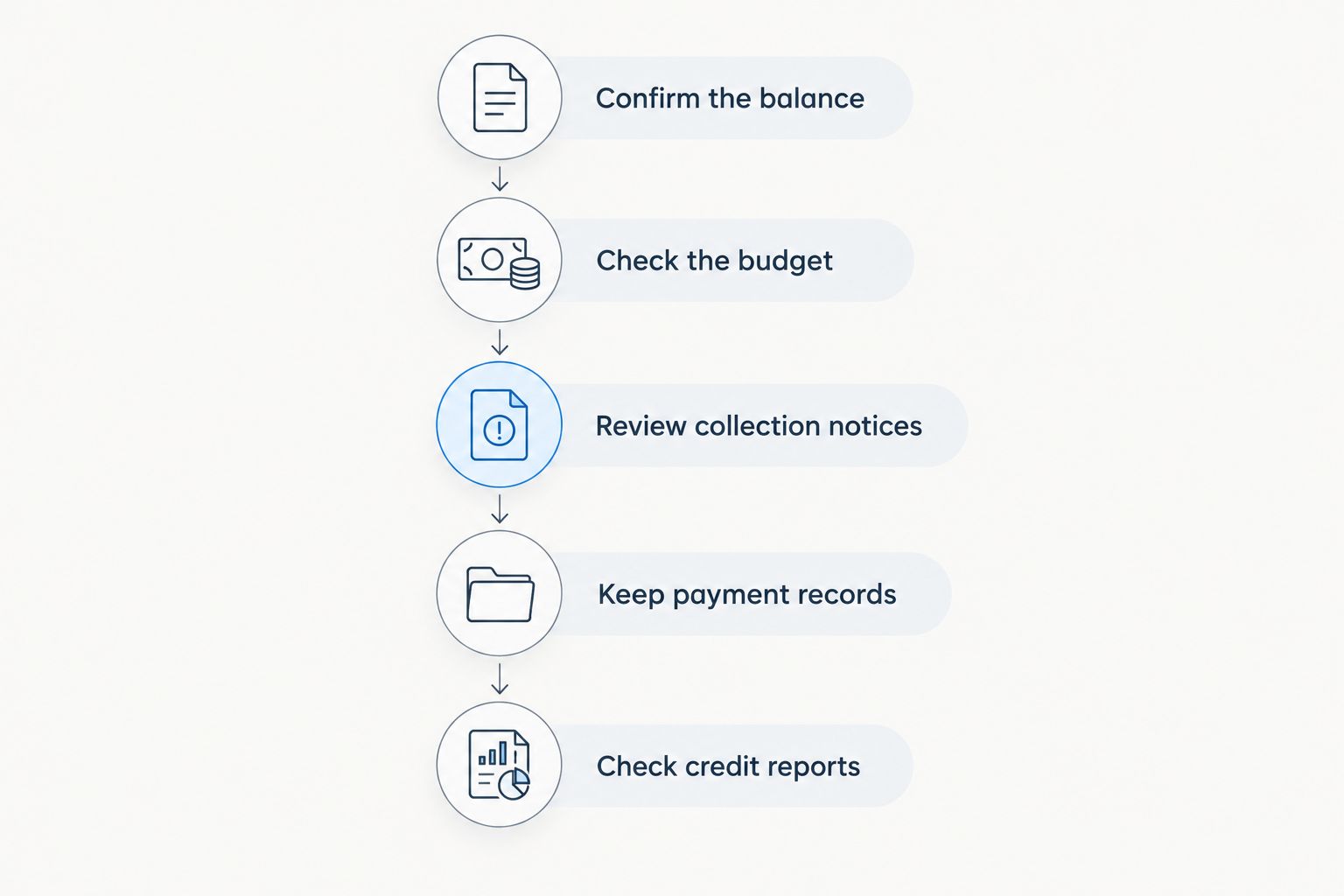
Use this sequence when reviewing an agreement in 2026. It separates tax-account problems from credit-report problems so you address the correct issue.
- Confirm the balance. Review IRS account information and notices. Identify the tax periods, assessed amounts, payments, and any issue you dispute before agreeing to repay a balance you have not checked.
- Check the budget. Include the proposed installment, essential expenses, existing debt payments, and current withholding or estimated taxes. A plan that creates another unpaid tax bill does not solve the recurring problem.
- Review collection notices. Identify any lien filing, proposed levy, or agreement-default notice. Read the actual deadline rather than assuming a pending payment-plan request resolves every notice.
- Keep payment records. Retain the agreement and evidence that payments posted. Check bank withdrawals and IRS account activity, especially after changing bank details or payment instructions.
- Check credit reports. Review the reports from the nationwide consumer credit bureaus. If a score changes, investigate reported balances, late payments, inquiries, and errors rather than assuming the IRS caused it.
The sequence matters: establish what you owe, test affordability, and then monitor both systems independently. An accurate credit report does not confirm that your tax account is current, and an accepted installment agreement does not confirm that your credit report is accurate.
Keep the payment method dependable, but do not confuse automatic withdrawals with a guarantee that every payment will succeed. Maintain sufficient funds and verify that the withdrawal actually occurred.
Should I pay the IRS with a credit card or personal loan instead?
Do not replace an IRS agreement with consumer debt just to protect your score. The IRS agreement is not reported as a credit account; a card or loan generally is. Moving the balance changes which rules and reporting systems apply.
A credit card can increase revolving utilization, which is the share of available revolving credit you are using. A personal loan can add an inquiry, a new account, and a monthly obligation. Either route also exposes your credit history to reported late payments if you fall behind.
Borrowing deserves consideration only after comparing repayment terms, total repayment obligations, and affordability. Paying the IRS through a lender does not forgive the debt; it changes whom you owe.
FAQ
Will setting up an IRS payment plan lower my credit score?
Setting up an IRS payment plan does not directly lower your consumer credit score because the IRS does not report installment agreements to consumer credit bureaus. Separate borrowing used to pay taxes can affect your score.
Does paying the IRS on time build my credit?
Paying the IRS on time does not build consumer credit history because those payments are not reported as credit-account activity. Timely payment still matters for keeping your installment agreement in good standing.
Can a missed IRS installment appear as a late payment on my credit report?
A missed IRS installment is not reported as a late credit-account payment by the IRS. It can still trigger problems with the agreement and requires prompt attention to any IRS notice.
Does an IRS payment plan remove a federal tax lien?
An IRS payment plan does not automatically remove a federal tax lien or withdraw a filed lien notice. Release and withdrawal have separate requirements, so verify which action applies to your situation.
Can a lender find IRS debt that is not on my credit report?
A lender can identify tax obligations through application disclosures, requested documents, or a public lien filing. The absence of an IRS account on a consumer credit report does not eliminate disclosure requirements.
Is a short-term IRS payment plan reported differently from a monthly agreement?
Neither a short-term IRS payment plan nor a monthly installment agreement is reported by the IRS as a consumer credit account. Their repayment requirements differ, but that does not change the direct credit-reporting answer.
Can The Rutter Organization help with tax debt rather than credit repair?
The Rutter Organization provides tax resolution services to individuals and businesses. Resolving an IRS balance is separate from disputing inaccurate information with a consumer credit bureau.
One last thing
Paying down IRS debt and improving your credit score are different goals. An agreement can help you address a tax balance without generating positive credit history, while a new loan can change your credit profile without reducing what you owe overall.
Before signing an agreement in 2026, save the approved terms and test the payment against your budget, including current taxes. The useful question is not only whether the IRS reports the debt; it is whether you can complete the agreement without falling behind elsewhere.


