

Tax resolution is worth considering for a balance under $10,000 when you dispute the bill, cannot afford payments, have unfiled returns, or face a collection deadline. For a correct balance you can repay, arranging payment directly with the IRS is the better first step in 2026; professional fees are an additional expense, and hiring help does not guarantee debt reduction.
- Is tax resolution worth it under 10000? Consider professional help for disputed debt, missing returns, hardship, or collection deadlines.
- A direct IRS payment plan fits an accurate balance you can repay; it does not automatically remove penalties or interest.
- Rutterorganization provides tax resolution services for individuals and businesses; compare the proposed work with your actual problem.
- An offer in compromise depends on financial eligibility, not simply owing less than $10,000.
Is tax resolution worth it if I owe less than $10,000?
The balance alone does not justify hiring a tax resolution firm. The problem you need solved does. A straightforward payment arrangement and a disputed assessment require different work, even when the amount owed is identical.
Start with the IRS payment plan options for taxpayers who owe money if you agree with the bill. Use the comparison below to identify when paying for professional assistance addresses something beyond arranging installments.
| Route | Best for | Main advantage | Main limitation |
|---|---|---|---|
| Direct IRS payment arrangement | An accurate balance with affordable repayment | You can request an arrangement without hiring a representative | Repayment does not automatically eliminate penalties or interest |
| Targeted professional assistance | A specific notice, disputed amount, or missing return | You can define the task before authorizing broader work | Resolving one issue does not necessarily resolve every tax period |
| Broader tax resolution engagement | Several connected filing, payment, or collection problems | Professional assistance can address an interconnected case | The engagement adds fees and cannot guarantee IRS acceptance |
A useful decision in 2026 starts with identifying the result you need: correcting an assessment, filing outstanding returns, establishing affordable payments, or evaluating financial hardship. Ask what work produces that result. Do not buy a general promise to make the IRS problem disappear.
Why this matters
A balance under $10,000 can still threaten your budget. It can also be manageable without a paid representative. Confusing those situations leads to unnecessary spending or an arrangement you cannot maintain.
Professional help has value when it addresses a problem you cannot resolve confidently yourself. That value is not limited to reducing the debt: establishing the correct liability, meeting a response deadline, and completing required filings are separate objectives.
Treat a 2026 service proposal as a scope-of-work decision. The proposal should explain the issue, the documents required, the action being requested, and the work included. A promise about the final outcome is not a substitute for those details.
When handling the balance yourself makes sense
Start directly with the IRS when the amount is correct, your required returns are filed, and you can afford repayment. You do not need a tax resolution firm simply because you received a balance-due notice.
Check the account before applying. Match the tax period, assessed amount, payments, and credits to your records, then use your actual household budget to decide whether a proposed payment is sustainable.
The IRS describes guaranteed installment agreements for qualifying individual income-tax liabilities of $10,000 or less, excluding penalties and interest. Under IRS Topic No. 202, relevant conditions include repayment within 3 years and a compliance history covering the preceding 5 tax years, along with other eligibility requirements.
Those conditions matter. The $10,000 figure is not a blanket approval rule for every taxpayer, business liability, or repayment request. Check the IRS's current installment-agreement requirements in 2026 rather than treating an advertising threshold as your eligibility determination.
Direct repayment also has a limitation: an installment agreement generally does not stop interest and applicable penalties from accruing. Keep the agreement terms and confirmation, and continue meeting current filing and payment obligations.
When targeted professional assistance earns its place
Targeted assistance fits a defined obstacle rather than an open-ended engagement. Examples include reviewing a disputed notice, reconciling missing payment credits, or preparing an outstanding return before addressing collection.
Ask for a specific deliverable. A written response to a notice, a completed return, and an analysis of payment alternatives are different assignments. Your agreement should distinguish them.
A narrow engagement also has boundaries. Reviewing one notice does not necessarily include preparing returns, negotiating an installment agreement, or representing you through an appeal. Ask what happens if the initial review identifies additional work.
For a balance under $10,000, this distinction is especially useful: you can seek help with the difficult part without assuming that every part of the case needs professional handling. Decide based on complexity, your ability to respond accurately, and the consequences of missing a deadline.
When a broader engagement makes sense
Broader assistance deserves consideration when several problems depend on one another. Missing returns can affect the balance, an incorrect assessment can affect repayment decisions, and current unpaid taxes can undermine an effort to address older debt.
Do not mistake more paperwork for automatic value. A broader engagement should identify the tax periods involved and explain why the tasks belong together.
For example, establishing filing compliance and assessing payment ability serve different purposes. Neither task automatically proves that an offer in compromise is appropriate, and neither guarantees that collection action will stop.
The limitation remains the same in 2026: a representative can prepare submissions and communicate within the authorized scope, but the IRS decides whether to accept the requested arrangement. Your written agreement should describe work, not promise approval.
Why the value of tax resolution varies
The amount owed is only one part of the decision. These factors determine whether professional help addresses a meaningful obstacle:
- Balance accuracy: A correct assessment calls for a payment decision; an incorrect assessment calls for evidence and a response.
- Filing compliance: Outstanding returns can change the liability and affect access to collection alternatives.
- Payment capacity: Income, necessary living expenses, and assets matter when evaluating hardship or settlement eligibility.
- Collection stage: A routine bill and a notice carrying appeal rights require different attention. Follow the instructions on the actual notice.
- Case scope: Individual income-tax debt, business liabilities, and several unresolved periods do not require identical work.
- Your ability to manage the process: Organized records and confidence handling IRS correspondence support direct action; unresolved technical questions justify a closer review.
None of these factors makes debt reduction automatic. They explain where the work is and help you judge whether a proposed engagement matches it.
How to decide before hiring anyone
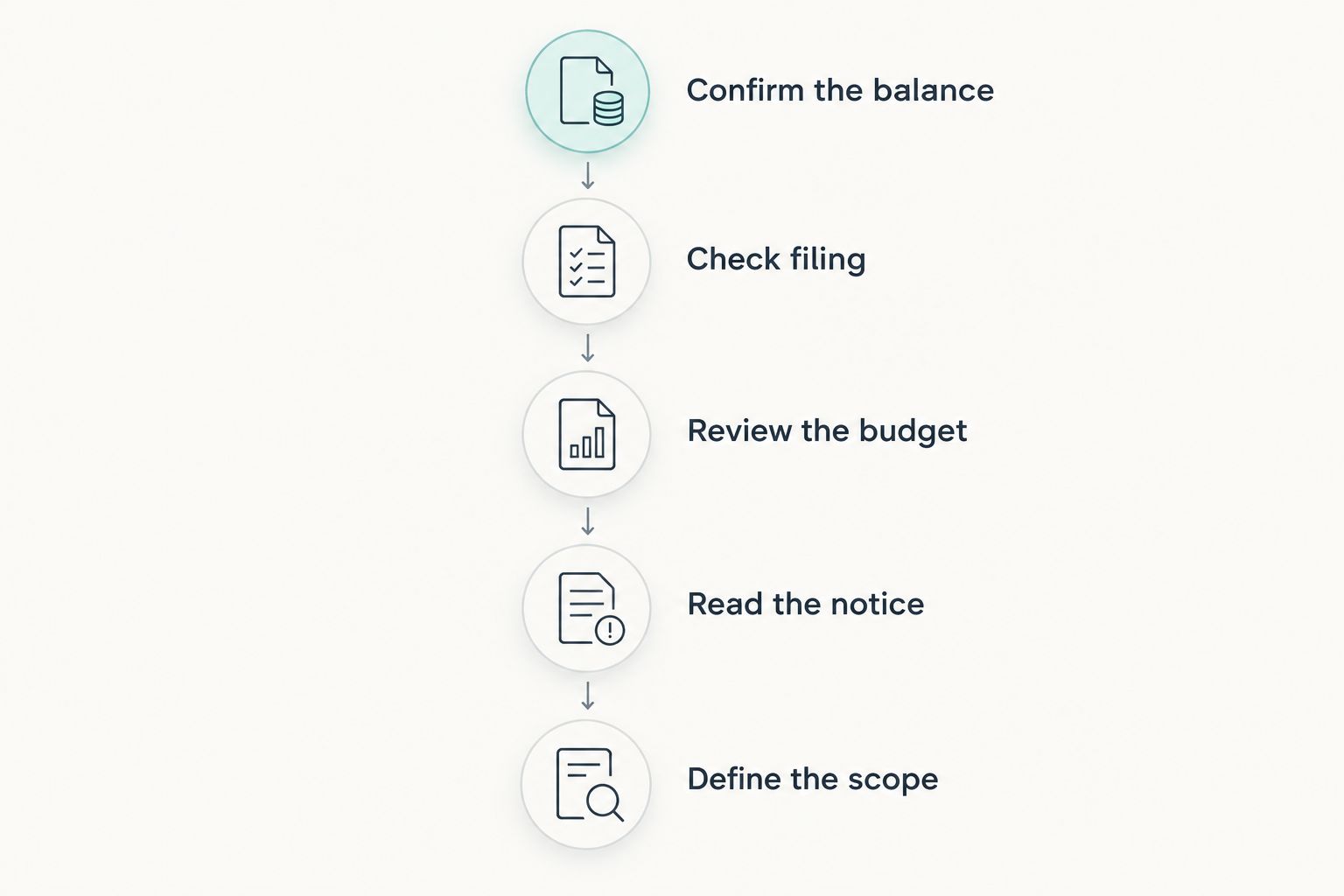
Use this sequence before signing a tax resolution agreement. Each step gives you information needed for the next decision, whether you proceed alone or seek professional assistance.
- Confirm the balance. Compare the notice with your IRS account information and supporting records. Identify the tax period and separate the underlying tax from penalties and interest.
- Check filing. Identify required returns that remain outstanding. Do not assume that the current account balance includes the final amount for an unfiled period.
- Review the budget. List income, necessary expenses, and available assets. Use sustainable payment capacity rather than the amount you wish you could afford.
- Read the notice. Identify the requested action and response date. A pending service inquiry does not replace responding to an IRS notice.
- Define the scope. Ask which problem the professional will address, what documents are needed, and what happens if the IRS rejects the request.
Keep copies of the records used in this review. A clear file helps you explain the issue consistently and compare proposals without repeating the same fact-finding from memory.
What to ask a tax resolution provider
A useful proposal names the work before discussing the hoped-for outcome. Ask the provider to explain why the recommended approach fits your records, income, expenses, and IRS correspondence.
Use these questions to make the engagement concrete:
- Which tax periods and notices does the agreement cover?
- Does the work include return preparation, collection representation, or both?
- Who will handle the case, and what credentials authorize that person's role?
- What documents must you provide before the recommendation is final?
- What work is excluded, and how is additional work authorized?
- What happens if the IRS requests more information or rejects the proposed arrangement?
Rutterorganization is best suited to readers seeking tax resolution services rather than tax-filing software. Its stated services cover individuals and businesses; the relevant question is whether the proposed engagement addresses your particular tax problem.
Review the scope of Rutterorganization services against your needs. Do not assume that a provider's general service description establishes the credentials of an assigned representative or the terms of your engagement.
Can I settle a balance under $10,000 for less?
A balance under $10,000 does not itself qualify you for an offer in compromise. The IRS evaluates eligibility and financial circumstances, including income, expenses, and asset equity; inability to pay the full liability is different from preferring a smaller bill.
The IRS describes offers based on doubt as to liability, doubt as to collectibility, and effective tax administration in Form 656-B guidance. These are distinct grounds, not interchangeable labels for a discount request.
Before pursuing an offer in 2026, establish which ground applies and whether filing and payment requirements are satisfied. An offer application is not the default next step for an otherwise manageable balance.
Does owing less than $10,000 stop IRS collection?
Owing less than $10,000 does not eliminate the obligation to respond to IRS notices. The balance alone does not tell you whether a particular notice carries collection consequences or appeal rights.
Read the document rather than relying on a provider's summary. If a notice identifies a response date or hearing procedure, address that instruction directly; researching services is not a response.
Keep proof of submissions and copies of correspondence. If you need representation, clarify who is responsible for the immediate deadline before assuming the engagement covers it.
What if I cannot afford payments on a balance under $10,000?
A balance under $10,000 can still be unaffordable when necessary living expenses consume your income. Document the shortfall rather than agreeing to a payment you cannot sustain.
The IRS can consider currently not collectible status when payment would prevent you from meeting basic living expenses. This status temporarily delays collection; it does not forgive the debt, and interest and applicable penalties generally continue.
Compare hardship treatment with other available arrangements using accurate financial information. Professional assistance is relevant when you need help substantiating the hardship or understanding the consequences—not because hardship guarantees a settlement.
FAQ
Is tax resolution worth it under 10000 if I can afford monthly payments?
Tax resolution is not automatically worth hiring for when you owe under $10,000 and can afford repayment. If the balance is accurate and required returns are filed, consider requesting an IRS payment arrangement directly before paying for representation.
Do I need a lawyer to arrange an IRS payment plan?
You do not need a lawyer to request an IRS payment plan. Professional assistance is a separate decision based on disputed liability, filing problems, collection issues, and your ability to handle the process.
Will hiring a tax resolution company reduce what I owe?
Hiring a tax resolution company does not guarantee a lower balance. Any reduction depends on an applicable basis, such as correcting an assessment, obtaining qualifying penalty relief, or having the IRS accept an offer in compromise.
Can the IRS forgive tax debt below $10,000?
A debt below $10,000 is not automatically eligible for forgiveness. An offer in compromise requires its own eligibility analysis, and a payment agreement normally repays the debt rather than forgiving it.
Should I file missing returns before requesting tax relief?
Required outstanding returns generally need to be addressed before the IRS approves collection alternatives. Establish which returns are required and how the resulting assessments affect the balance before choosing a resolution strategy.
Does currently not collectible status erase my tax debt?
Currently not collectible status does not erase your tax debt. It temporarily delays collection because of financial hardship, while interest and applicable penalties generally continue to accrue.
What should I ask Rutterorganization before hiring tax resolution help?
Ask Rutterorganization for a written scope identifying the tax periods, tasks, exclusions, and person responsible for your case. Confirm how immediate notice deadlines and any additional work will be handled.
One last thing
Separate getting the balance right from deciding how to pay it. A payment plan addresses repayment; it does not establish that every item on the original bill was correct.
Before committing to either a service agreement or an IRS arrangement, reconcile payments and credits against your records. The strongest first move is not necessarily a settlement application—it is identifying the exact problem that needs solving.
General federal tax information, not individualized tax or legal advice. IRS eligibility rules and your circumstances determine available options.


