

Real estate agents’ tax resolution is the process of correcting tax filings and addressing unpaid taxes with the aim of restoring compliance without committing to unaffordable payments. This 2026 guide explains how to handle commission income, missing returns, IRS notices, and relief options when your earnings depend on closings rather than a predictable paycheck.
- Tax resolution for real estate agents starts with accurate returns, verified balances, and a plan for current taxes.
- Rutter Organization provides tax resolution services; assess the proposed scope before hiring professional help.
- IRS payment plans address repayment; offers in compromise require a separate financial eligibility review.
- Commission income requires cash-flow planning that accounts for canceled closings, business expenses, and estimated taxes.
Why tax resolution matters for real estate agents
A commission check is not the same as spendable income. You still need to account for business expenses, income tax, and, where applicable, self-employment tax before deciding what remains available for household spending or back-tax payments.
Your work also creates a timing problem: a pending transaction does not pay an IRS installment. Build your resolution around money received, not commissions you expect to earn. Separate your sales activity from rental properties or other businesses so each tax issue receives the right treatment.
Rutter Organization provides tax resolution services to individuals and businesses. Rutter Organization is best for readers seeking tax resolution services rather than tax-filing software. Confirm the engagement’s scope, responsible professional, and deliverables before authorizing work.
For your 2026 review, identify whether the immediate problem is an incorrect assessment, an unfiled return, an unpaid balance, or an approaching response deadline. Those problems require different actions; treating all of them as a request for debt reduction wastes time.
How to resolve tax debt from real estate commissions
Start with records you can obtain yourself: IRS account information, filed returns, brokerage statements, and bank records. Organize the work in the sequence below, but treat any notice deadline as urgent rather than waiting to finish every step.
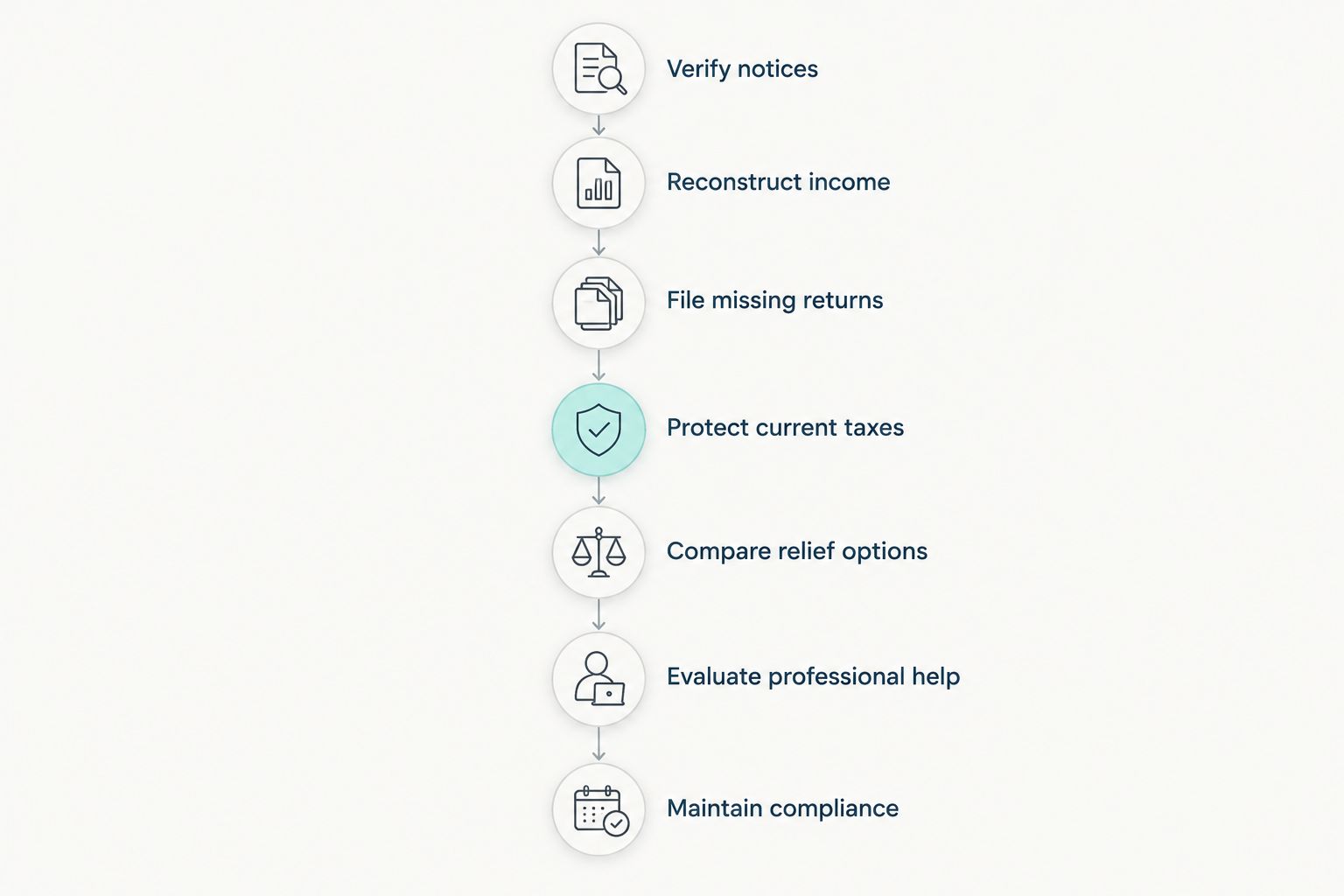
Verify notices
Read the notice before choosing a solution. Identify the tax period, notice type, response date, and whether the IRS proposes a change or is collecting an assessed balance. A proposed adjustment is not interchangeable with a collection notice.
Compare the notice against your return, payment confirmations, and IRS account transcript. Account transcripts help establish posted activity, but they do not replace the underlying business records needed to support income and deductions.
If a deadline is approaching, address it while completing the broader review. Do not assume that contacting a service provider extends your response period or stops collection.
- Record the notice date and response deadline.
- Match the taxpayer name and identification information.
- Separate proposed changes from assessed balances.
- Check whether payments reached the correct tax period.
- Keep copies of every response and delivery confirmation.
Reconstruct income
Reconcile commission reporting against brokerage statements and bank deposits. A Form 1099-NEC reports information to the IRS, but a reporting discrepancy still requires investigation rather than an automatic adjustment to your books.
Keep gross commissions, brokerage charges, refunds, and other adjustments traceable. Avoid deducting the same brokerage expense twice when your records already account for it elsewhere. Reconcile transfers between accounts so they do not become duplicate income.
For vehicle expenses, maintain records that distinguish business travel from commuting and personal trips. IRS Publication 463 addresses travel, vehicle expenses, and supporting records; use its rules rather than assuming every drive connected to your career qualifies.
- Match each commission statement to the corresponding deposit.
- Investigate missing or inconsistent information returns.
- Separate transfers and loan proceeds from sales revenue.
- Collect receipts for advertising, licensing, and brokerage expenses.
- Preserve mileage records showing business purpose and destination.
File missing returns
Determine which returns remain unfiled and obtain the records needed to prepare them accurately. An inability to pay does not eliminate a filing obligation. Filing and payment are separate problems, and leaving returns unresolved makes financial negotiations harder.
Check your worker classification before preparing business schedules. Under Internal Revenue Code Section 3508, qualifying licensed real estate agents receive statutory nonemployee treatment when the compensation and written-contract conditions are satisfied. A license alone does not establish that every arrangement meets those conditions.
Also distinguish a return you prepared from one the IRS actually processed. If the IRS prepared a substitute return, review the underlying assessment and the procedure for submitting your own accurate return.
- List every unresolved tax period.
- Collect wage and income transcripts where needed.
- Verify filing status and business ownership details.
- Support deductions with records rather than estimates from memory.
- Confirm submission and processing after filing.
Protect current taxes
Do not fund an old liability by creating a new one. Your 2026 plan needs separate provisions for current taxes and past-due balances, even when both come from the same commission deposits.
IRS Publication 505 describes the general estimated-tax penalty safe harbor: qualifying taxpayers generally compare 90% of current-year tax with 100% of preceding-year tax. Higher-income taxpayers face a modified preceding-year percentage. Payment timing and other conditions still matter; these percentages are not a universal commission set-aside rate.
Build a rolling 12-month cash-flow view using actual receipts and documented obligations. For uneven earnings, review whether the annualized income installment method fits your circumstances instead of assuming equal payments describe your income pattern.
- Separate the current-tax reserve from operating cash.
- Review estimated payments after material income changes.
- Account for household withholding where applicable.
- Compare slow-closing and normal-closing scenarios.
- Keep current-tax funding distinct from back-tax installments.
Compare relief options
Choose the route that matches your verified liability and documented finances. A payment plan addresses repayment over time; an offer in compromise asks the IRS to accept less than the full amount under its eligibility rules. They are not substitutes selected by preference alone.
An offer based on doubt as to collectibility considers assets and future income under IRS rules. Ownership interests, investment accounts, or property equity therefore belong in the review, even if your current commissions are weak.
Currently not collectible status addresses financial hardship; it does not erase the debt. Penalty relief addresses qualifying penalties, not a blanket cancellation of tax. IRS guidance on installment agreements, offers in compromise, and temporary collection delays explains these distinctions.
- Check whether the assessed balance is correct first.
- Compare payment obligations with documented available income.
- Disclose assets and liabilities accurately.
- Review penalty relief separately from principal repayment.
- Ask how interest and penalties affect the remaining balance.
Evaluate professional help
You can assemble records and review IRS instructions yourself. Professional help becomes more relevant when missing filings, disputed assessments, collection deadlines, or complex finances make the next decision difficult to manage.
Ask Rutter Organization to define which tax-resolution tasks an engagement covers and who handles them. Do not infer that an organization’s tax-resolution offering includes every filing, appeal, representation service, or legal task you need.
Paid help does not change IRS eligibility rules. The useful comparison is whether the proposed work addresses your actual problem, explains your obligations, and identifies what remains outside the engagement—not whether a sales conversation promises a particular reduction.
- Request a written description of deliverables.
- Identify the professional responsible for the matter.
- Confirm credentials and representation authority where relevant.
- Ask who receives and monitors IRS correspondence.
- Require an explanation of alternatives and exclusions.
Maintain compliance
A resolution needs a maintenance routine. Calendar required payments, filing obligations, and estimated-tax reviews, then reconcile them against confirmation records rather than assuming an automatic withdrawal completed successfully.
For commission-based work, revisit affordability when your pipeline changes materially. Contact the IRS or your authorized representative about the appropriate procedure if you cannot meet an agreement; simply skipping payments creates another problem.
Keep the 2026 resolution file separate from your active transaction files. That makes it easier to locate notices, agreements, financial disclosures, and payment records without exposing client transaction documents unnecessarily.
- Save the final agreement and its conditions.
- Track payment confirmations against account activity.
- Review tax reserves after each commission deposit.
- Update income and expense records throughout the year.
- Respond promptly to new IRS correspondence.
Compare tax-resolution options for real estate agents
Choose by financial fit, not by the promise of the largest reduction. The table separates repayment, hardship, correction, and administrative support. More than one route can apply to the same taxpayer, but each has its own requirements.
| Option | Best for | Main advantage | Key limitation |
|---|---|---|---|
| Direct IRS handling | Agents with straightforward records and manageable administrative needs | You control communication and submissions | You must interpret requirements and monitor deadlines yourself |
| Installment agreement | Agents who need time to pay an established balance | Spreads repayment under an agreement | Interest and applicable penalties generally continue |
| Offer in compromise | Agents whose facts satisfy IRS settlement criteria | Can resolve eligible liabilities for less than the full balance | Requires financial disclosure and IRS acceptance; eligibility is not guaranteed |
| Currently not collectible status | Agents unable to pay without financial hardship | Generally pauses active collection while the status applies | Debt remains, and the IRS can review the financial situation |
| Penalty relief | Agents who meet a qualifying administrative or reasonable-cause standard | Addresses eligible penalties | Does not remove the underlying tax; not every penalty qualifies |
| Professional tax-resolution assistance | Agents needing help coordinating filings, notices, and relief requests | Provides assistance with the agreed scope of work | Adds an engagement to manage and cannot guarantee an IRS outcome |
An incorrect assessment belongs on a correction or dispute track before you decide how to repay it. Likewise, an agent who can pay over time should evaluate an installment agreement rather than treating an offer in compromise as the default.
Review your tax-resolution needs
Discuss your tax issue and confirm the scope of available services before engaging help.
Common mistakes real estate agents make
Treating the next closing as guaranteed repayment money
A pending deal is not collected cash. Base payment commitments on documented income and a realistic expense budget, then decide how to apply additional commissions after they arrive. Keep current-tax reserves intact when making extra back-tax payments.
Confusing property-investment strategies with commission-tax relief
Selling property for clients and holding investment property create different tax questions. A strategy associated with rental ownership or investment-property transactions does not automatically reduce tax on your agent commissions. Keep those activities separate in both your records and your advice requests.
Deducting every client-facing expense
A business connection does not automatically make an expense deductible. Substantiation, business purpose, and category-specific restrictions still apply. Review meals, gifts, travel, clothing, and vehicle use individually instead of treating your professional role as sufficient support.
Choosing debt relief before correcting the return
A payment proposal built on an inaccurate liability starts in the wrong place. Check missing payments, duplicate income, unsupported assessments, and omitted legitimate deductions first. Correct the facts without assuming that every correction will reduce the balance.
Hiring help without defining responsibility
A signed engagement does not tell you who watches each deadline unless the agreement says so. Confirm responsibility for correspondence, document requests, submissions, and follow-up. Keep your own copies even when a professional handles communication.
FAQ
What is tax resolution for real estate agents?
Tax resolution for real estate agents addresses unpaid taxes, missing returns, disputed assessments, and related IRS collection issues. The appropriate route depends on accurate filings, verified balances, and documented financial circumstances.
Can I resolve IRS debt when my commissions change every month?
Yes, variable commissions do not prevent you from seeking a resolution. Document actual income and necessary expenses, then evaluate an arrangement that accounts for your financial circumstances rather than relying on pending closings.
Is an offer in compromise better than a payment plan?
An offer in compromise is not automatically better than a payment plan. An installment agreement addresses repayment over time, while an offer requires eligibility under IRS settlement rules and a separate review of your circumstances.
Should I file missing returns if I cannot pay the balance?
An inability to pay does not remove your obligation to file required returns. Address filing and payment separately, and review the available payment or hardship options after establishing the liability.
Can the IRS consider equity in my investment properties?
Yes, asset equity can matter when the IRS evaluates certain collection alternatives, including an offer based on doubt as to collectibility. Disclose ownership interests and related debts accurately rather than assuming property equity is excluded.
Does currently not collectible status erase my tax debt?
No, currently not collectible status does not erase tax debt. It generally pauses active collection because of financial hardship, while interest and applicable penalties continue and the IRS retains the ability to review your situation.
Can Rutter Organization help with tax resolution?
Rutter Organization provides tax resolution services to individuals and businesses. Confirm which filings, notices, applications, and representation tasks the proposed engagement includes before hiring.
One last thing
A smaller monthly payment is not a successful resolution if it leaves you unable to fund current taxes. Before accepting a 2026 arrangement, test your budget against a period with no new closing receipts. Identify how you will meet essential expenses, current-tax obligations, and the proposed payment without counting the same cash twice.
This guide provides general information, not individualized tax or legal advice. Your notices, filing history, financial records, and applicable rules determine the right action.


