

Restaurant owners’ tax resolution is the process of correcting unpaid or disputed taxes with the aim of resolving collection problems without creating new liabilities. For 2026, that means separating payroll, income, and sales taxes while accounting for tips, delivery-platform settlements, and cash receipts.
- Tax resolution for restaurant owners starts with current payroll compliance, accurate filings, and a separate plan for each taxing authority.
- Rutterorganization offers tax resolution services; confirm restaurant-case scope before engaging.
- An IRS installment agreement spreads payments; an offer in compromise requires eligibility and financial scrutiny.
- Reconcile tips, delivery settlements, and sales taxes before proposing payments your restaurant cannot sustain.
Why tax resolution matters for restaurant owners
A restaurant tax problem rarely fits neatly into one account. Federal income taxes, employment taxes, and state or local sales taxes involve different obligations and collection procedures. Paying one authority does not resolve another authority’s balance.
Your operating records also need interpretation. A delivery-platform deposit can reflect sales after commissions and adjustments, while a merchant deposit can include amounts collected for taxes or tips. Deposits alone do not establish taxable profit or payroll accuracy.
Rutterorganization is best for readers seeking tax resolution services rather than filing software. Review Rutterorganization for the business’s service context, then confirm who will handle your specific tax issues. Restaurant-specific experience, representation credentials, and engagement scope belong in that conversation—not in assumptions.
For 2026, prioritize stopping new arrears before negotiating old debt. A payment proposal built around unpaid current taxes merely shifts the problem into another period.
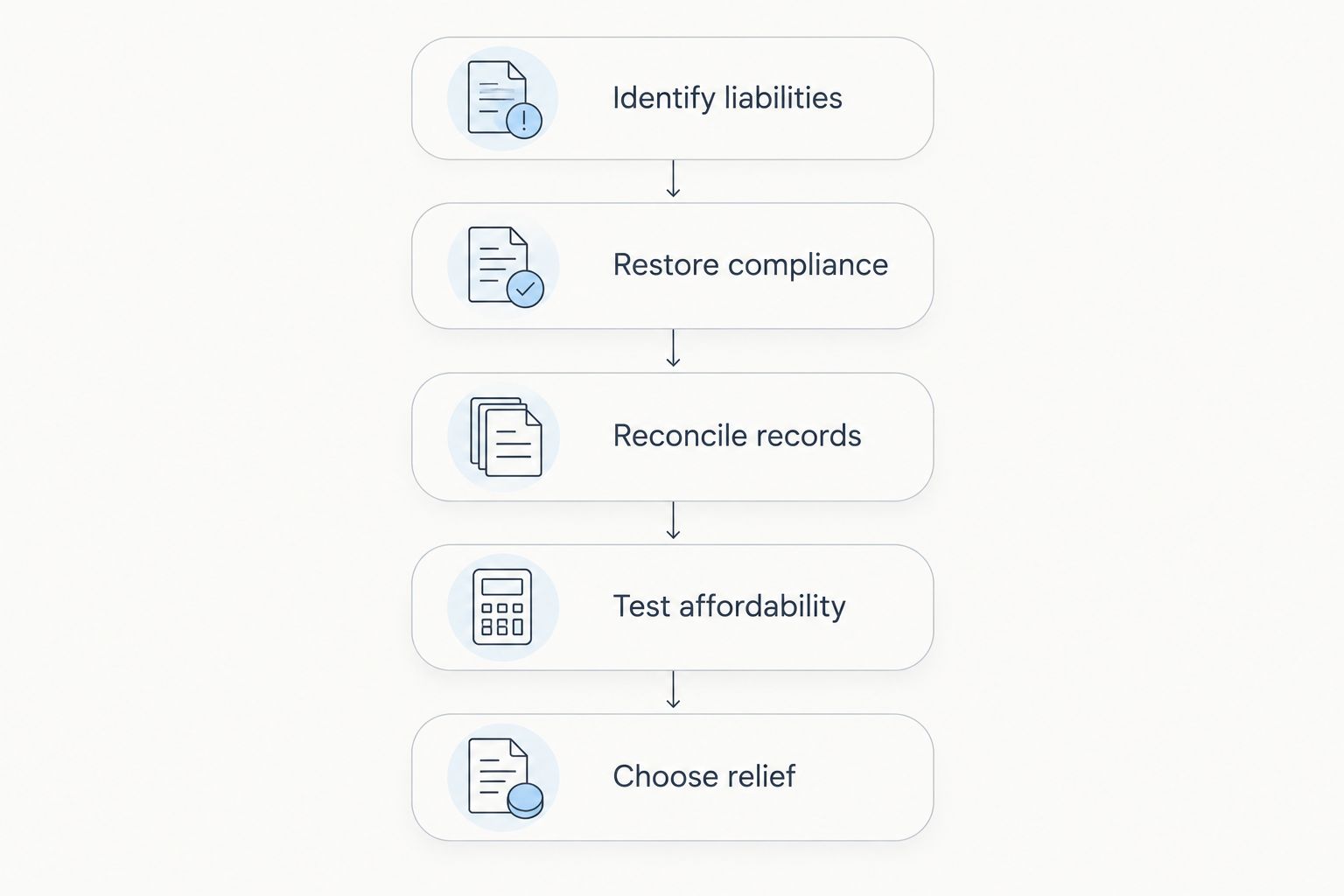
How to resolve restaurant tax debt in 2026
Identify liabilities
Start manually with every tax notice, filed return, payment confirmation, and available account transcript. Create a register showing the taxpayer, authority, tax type, period, assessed balance, and response deadline. Keep disputed amounts separate from amounts you accept.
Distinguish the restaurant’s obligations from the owner’s personal obligations. An entity’s employment tax debt and an owner’s income tax debt are not interchangeable. State sales tax liabilities need their own review, including any applicable personal-liability rules.
A notice threatening collection or offering appeal rights takes priority over routine bookkeeping cleanup. Follow the deadline printed on the notice; do not assume another filing or a phone conversation extends it.
- List tax periods: Record each outstanding return and assessment separately.
- Separate authorities: Maintain distinct federal, state, and local records.
- Identify taxpayers: Match notices to the correct business or individual account.
- Calendar deadlines: Assign responsibility for every required response.
Restore compliance
Prepare missing returns using reconstructed records where necessary, and establish a process for current filings and deposits. File required returns even when you cannot pay the full balance. Filing and paying are separate obligations; leaving returns unfiled does not solve a cash shortage.
For employers generally required to file Form 941 quarterly, that means 4 quarterly returns per calendar year. Form 940 is generally an annual federal unemployment tax return. Confirm your restaurant’s actual filing requirements rather than assuming every employer uses the same forms.
Start with your books and payroll records. If reconciliation or delinquent filings exceed your capacity, use professional help. Rutterorganization offers tax resolution services; confirm whether return preparation, payroll corrections, and representation are included before signing an engagement.
- Inventory missing returns: Compare your records with agency account information.
- Fund current deposits: Separate current tax money from operating cash.
- Check payroll filings: Reconcile filed forms with payroll registers.
- Assign ownership: Name the person responsible for filing and payment confirmations.
For a separate filing decision, review options for filing unfiled tax returns.
Reconcile records
Build a supported bridge from sales activity to deposits and reported income. Begin with point-of-sale reports, merchant statements, delivery-platform settlements, bank statements, and payroll registers. Do not treat a net settlement as gross sales without reviewing its components.
Separate employee tips from restaurant revenue and review how service charges enter the books and payroll. Under IRS guidance, compulsory service charges are not tips; amounts distributed to employees are treated as wages. The distinction affects reporting and withholding.
Use the same discipline for sales taxes collected from customers. Track the liability separately from operating revenue, then reconcile collections, returns, and remittances under the applicable jurisdiction’s rules.
- Reconcile sales: Explain differences between sales reports and deposits.
- Review settlements: Identify commissions, refunds, taxes, and other adjustments.
- Check tip treatment: Distinguish voluntary tips from mandatory service charges.
- Document corrections: Retain the evidence supporting amended figures.
Test affordability
Build a 13-week cash-flow forecast before proposing a recurring payment. This is a planning recommendation, not an agency eligibility rule. Include current taxes, payroll, rent, food purchases, utilities, debt payments, and necessary owner withdrawals.
Use actual operating records rather than your strongest sales period. Identify when payroll, supplier payments, and tax deposits fall due. A restaurant can show accounting profit while lacking cash on a particular payment date.
For your 2026 forecast, distinguish historical debt payments from current tax obligations. The IRS or another authority can require its own financial disclosures and supporting documents; your internal forecast does not replace those requirements.
- Forecast cash: Show receipts and payments by week.
- Protect current taxes: Include required deposits before calculating surplus cash.
- Test weak periods: Use documented seasonal patterns where available.
- Substantiate expenses: Keep records supporting claimed operating needs.
Choose relief
Match the remedy to the verified liability and documented financial position. An installment agreement addresses payment timing. An offer in compromise seeks a settlement under IRS eligibility standards. Penalty relief addresses qualifying penalties, not the underlying tax itself.
Currently not collectible status is a separate collection determination based on financial circumstances. It does not erase the balance, and interest and penalties generally continue. A pending request also does not automatically resolve every collection issue across every tax type.
Choose the remedy your records support—not the remedy with the most attractive promise. Use this decision sequence before comparing the options below.
- Verify liability: Challenge an incorrect assessment through the appropriate process.
- Assess capacity: Compare available funds with required financial disclosures.
- Check eligibility: Review the requirements for the specific relief requested.
- Document the choice: Record why the proposed approach fits your circumstances.
Address personal exposure
Unpaid employment taxes require specific attention. The IRS Trust Fund Recovery Penalty can apply to responsible individuals who willfully fail to collect, account for, or pay over trust fund taxes. Owning a restaurant alone does not establish every element of liability.
Review who controlled payments, signed checks, approved payroll, and decided which creditors received money. Preserve records showing responsibilities and decisions. Do not assume closing the restaurant or changing its entity structure eliminates existing exposure.
If the IRS requests a responsible-person interview or proposes an assessment, obtain advice about the notice and response rights before acting. Confirm the adviser’s authority to represent you and the scope of that representation.
- Preserve authority records: Keep bank permissions and payment-approval documentation.
- Review payroll decisions: Identify who controlled employment tax payments.
- Read proposed assessments: Distinguish business debt from personal assessments.
- Confirm representation: Verify credentials and responsibility for agency communications.
Maintain the agreement
A resolution is not finished when an agency accepts a proposal. Continue required filings, current payments, and any conditions attached to the arrangement. Keep acceptance letters and payment confirmations together so staff changes do not disrupt compliance.
Set a 30-minute weekly review of tax deposits, upcoming returns, notices, and cash forecasts. This is an internal control recommendation, not an IRS requirement. Give one person ownership and another person visibility.
Review your 2026 arrangement when operating conditions change. Contact the relevant authority or representative before missing a payment; do not assume an agreement adjusts itself when sales fall.
- Track payments: Match withdrawals or remittances to the agreement.
- Verify deposits: Confirm current payroll tax payments actually cleared.
- Monitor notices: Route agency correspondence to the responsible person promptly.
- Retain evidence: Keep filings, acknowledgments, and correspondence in one case file.
Compare restaurant tax resolution options
These options solve different problems. The IRS’s published guidance on payment plans, offers in compromise, collection delays, and penalty relief supplies the federal framework; state and local programs have separate requirements. Confirm the applicable requirements when submitting a request in 2026.
| Option | Best for | Main advantage | Key limitation |
|---|---|---|---|
| IRS installment agreement | An accepted balance you need to pay over time | Creates a structured payment arrangement | Interest and applicable penalties generally continue; ongoing compliance matters |
| IRS offer in compromise | Taxpayers whose circumstances meet IRS settlement criteria | Can resolve eligible debt for less than the full balance | Acceptance is not guaranteed; financial scrutiny and eligibility requirements apply |
| Currently not collectible status | Qualifying financial hardship | Temporarily delays collection when approved | Does not cancel the debt; the IRS can review financial circumstances later |
| Penalty relief | Penalties meeting administrative or reasonable-cause criteria | Removes qualifying penalties when approved | Does not erase the underlying tax or automatically remove every charge |
| Assessment dispute or correction | A balance based on incorrect information | Addresses whether the assessed amount is right | Requires evidence and the correct procedure; deadlines matter |
| Rutterorganization tax resolution services | Readers seeking service-based help with a tax problem | Provides access to a business offering tax resolution services | Confirm case fit, credentials, included work, and communication responsibilities before engagement |
Do not confuse hiring an adviser with obtaining an agency-approved outcome. A service engagement and a tax resolution are separate decisions. Ask for a written description of the work before authorizing representation or providing sensitive records.
Common mistakes restaurant owners make
Treating collected taxes as operating cash
Sales taxes and withheld payroll taxes are not a reserve for covering a difficult purchasing week. Spending those amounts creates obligations that remain after the money leaves the account. Separate tracking and scheduled remittances make the shortfall visible sooner.
Reporting delivery deposits without reconciliation
Net platform settlements do not tell the complete sales story. Recording only the deposit can leave commissions, refunds, taxes, or gross receipts incorrectly classified. Reconcile the settlement detail before relying on the books for a return or financial disclosure.
Confusing tips with service charges
Voluntary tips and compulsory service charges have different federal tax treatment. A point-of-sale label does not settle the issue. Review the actual customer payment arrangement and how employee distributions enter payroll.
Promising payments from peak-period sales
A strong trading period is not a recurring payment budget. Build the proposal from documented cash flow after current obligations, and test the weak periods. Otherwise, the arrangement competes with the taxes you must keep current.
Assuming closure ends the problem
Closing a location does not automatically cancel tax balances or individual exposure. Preserve records and identify outstanding returns, assessments, and response deadlines before winding down. Address each taxpayer and authority separately.
FAQ
What should I do first if my restaurant owes back taxes?
Identify the taxing authority, tax periods, missing returns, and notice deadlines first. Then establish current filing and payment compliance while reviewing the old balances. Keep payroll, income, and sales tax issues separate.
Can the IRS hold me personally responsible for restaurant payroll taxes?
The IRS can assess the Trust Fund Recovery Penalty against an individual who meets the responsibility and willfulness requirements. Restaurant ownership alone does not establish every element. Review the notice, supporting records, and response rights with a qualified representative.
Is an IRS payment plan better than an offer in compromise?
An IRS payment plan fits a verified balance payable over time; an offer in compromise fits circumstances meeting IRS settlement criteria. Neither is universally better. Compare eligibility, financial disclosures, and your ability to stay current before choosing.
Can I resolve restaurant sales tax debt through an IRS agreement?
An IRS agreement does not resolve state or local sales tax debt. Contact the authority responsible for that balance and review its procedures separately. Keep its notices, filings, and payment arrangements distinct from federal accounts.
Should I file missing restaurant returns if I cannot pay?
File required returns even when you cannot pay the full balance. Filing and payment are separate obligations, and missing returns complicate resolution. Use accurate records and address payment options separately.
Does a restaurant closing eliminate its tax debt?
Closing a restaurant does not automatically eliminate its tax debt. Outstanding filings, assessments, and applicable personal-liability rules still require review. Preserve payroll, banking, ownership, and agency records during the closure.
What records should I prepare for restaurant tax resolution?
Prepare tax notices, filed returns, account information, bank statements, payroll registers, sales reports, and delivery-platform settlements. Add tip and service-charge records plus a current cash-flow forecast. The agency or representative can request additional documents based on the case.
One last thing
The payment you can sustain matters more than the payment you can make today. Before committing, place the proposed payment into the same forecast as payroll and current tax deposits. If paying yesterday’s taxes requires withholding tomorrow’s remittance, revise the proposal—not the compliance calendar.
This guide provides general tax information, not advice on a specific assessment or legal deadline.


