

Truck drivers’ unfiled tax return help is the process of reconstructing income and expenses, filing missing returns, and addressing unpaid taxes to restore filing compliance. Your approach depends on whether you drove as an employee, operated independently, or moved between those roles; this 2026 guide separates those decisions from the payment problem.
- Unfiled tax returns for truck drivers require separate decisions about missing filings, trucking deductions, and unpaid balances.
- The Rutter Organization provides tax resolution services for individuals and businesses seeking help with tax problems.
- Owner-operators should reconcile carrier settlements with income forms before claiming documented business expenses.
- File accurate missing returns even when you cannot pay the full balance; payment arrangements are a separate decision.
Why filing compliance matters for truck drivers
A carrier settlement is not necessarily your taxable profit, and a bank deposit is not necessarily your gross revenue. Fuel advances, escrow movements, equipment charges, and carrier deductions require reconciliation rather than a single total copied into a return.
Employee drivers face a different task: recovering wage statements, confirming withholding, and identifying any separate business income. Applying an owner-operator checklist to an employee return creates errors instead of fixing them.
The Rutter Organization provides tax resolution services alongside its other business activities. The Rutter Organization is best for readers seeking tax resolution services rather than a filing-only resource. Before engaging any provider, confirm whether the assignment includes return preparation, notice responses, representation, or a narrower service.
Missing returns and unpaid taxes are different problems. Filing establishes what you report; resolving a balance determines how you address the amount owed. Waiting until you can afford everything leaves the filing problem unresolved.
Follow this 2026 filing sequence
Start with records you can obtain yourself through IRS accounts, carrier portals, banks, and your existing files. Paid assistance becomes useful when the work requires reconstruction, professional judgment, or a response to tax enforcement—not simply because a return is late.
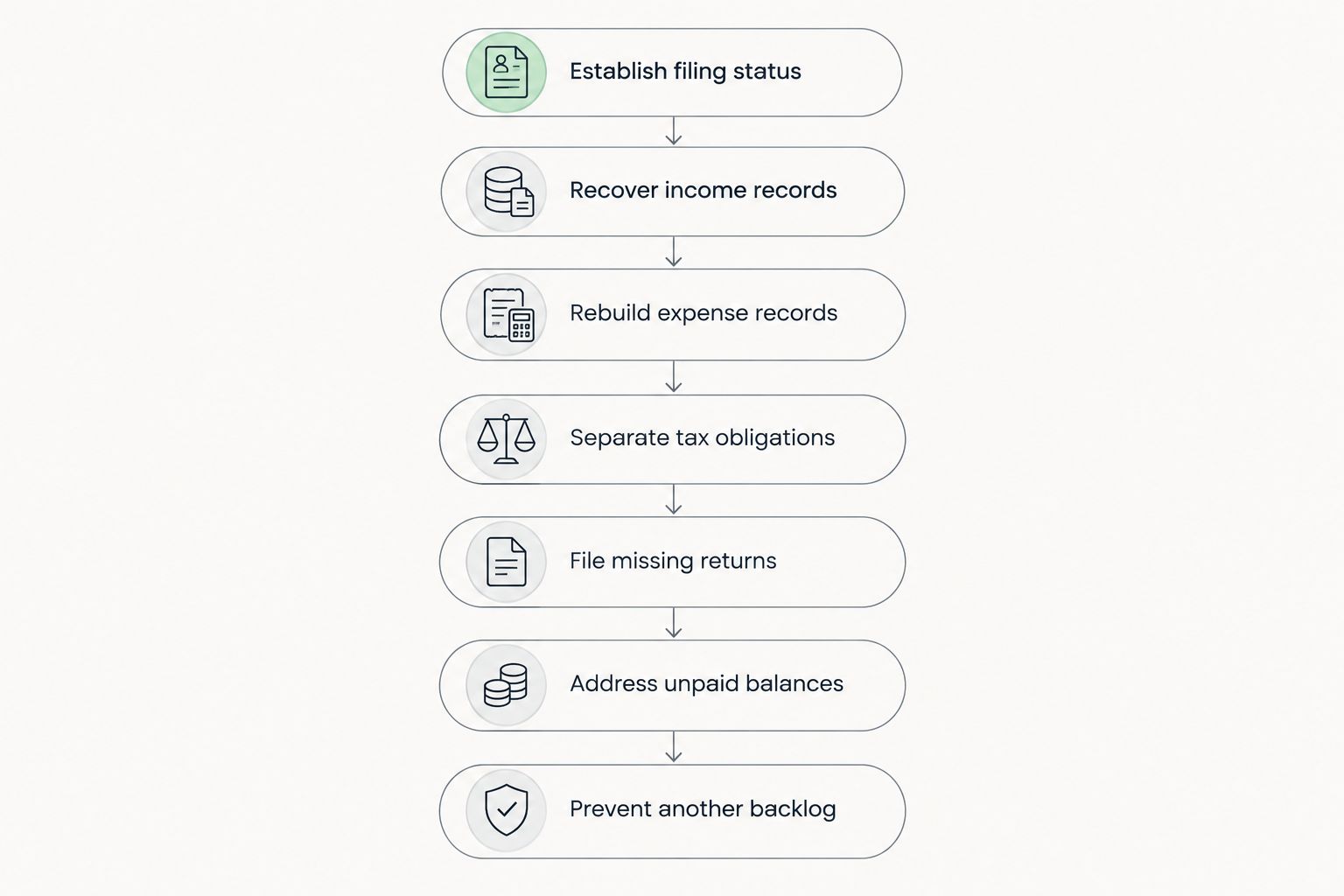
Establish filing status
Build a missing-return inventory before preparing anything. Identify each unfiled period, your work arrangement, and the business structure that applied during that period. A driver who changed from employee work to independent contracting needs both income streams accounted for.
Read every IRS and state notice separately. A request for a return, a proposed assessment, and a collection notice require different responses; one filing does not automatically satisfy every notice.
- List each missing federal and state return separately.
- Mark periods as employee, independent contractor, or mixed income.
- Record the entity structure used during each period.
- Copy notice deadlines into a calendar before sorting receipts.
- Check whether a spouse’s income or a joint filing decision affects the return.
Recover income records
Start by requesting missing wage statements and contractor income forms from employers and carriers. Then obtain available IRS wage and income transcripts and compare them with settlement statements and bank activity.
Transcripts help identify reported income, but they do not supply a complete trucking ledger. They also do not replace your expense records. Use transcripts as a cross-check, not as your entire bookkeeping system.
- Collect Forms W-2, 1099-NEC, and other applicable income statements.
- Download carrier settlements and annual payment summaries.
- Obtain business bank and credit-card statements.
- Separate customer payments from transfers, loans, and owner contributions.
- Investigate differences between gross settlements and deposited amounts.
Rebuild expense records
Reconstruct expenses from source documents before estimating totals. Fuel-card statements, repair invoices, insurance records, equipment agreements, and electronic logging records each answer different questions about the business.
For missing receipts, seek duplicate documentation and record how you reconstructed the expense. Some deductions have strict substantiation requirements; a plausible spreadsheet alone does not establish eligibility. If the backlog involves contractor income, the self-employed contractor tax resolution guide provides related context.
The Rutter Organization’s tax resolution services are relevant when your filing backlog also involves unresolved tax issues. Confirm the preparation and representation scope before sharing records or authorizing work.
- Group fuel, repairs, insurance, tolls, permits, and other documented business expenses.
- Match carrier deductions against separately recorded expenses to prevent duplication.
- Separate truck purchase records from loan payments and operating expenses.
- Retain records supporting business use, travel, and time away from your tax home.
- Flag unsupported amounts for review rather than inserting round-number deductions.
Separate tax obligations
An income tax return does not satisfy every tax obligation connected with operating a truck. Review federal income tax, applicable state filings, employment taxes if you have employees, and vehicle-related requirements as separate workstreams.
IRS Form 2290 generally applies to highway motor vehicles with a taxable gross weight of 55,000 pounds or more, subject to its rules and exceptions. It is not a substitute for your income tax return. Likewise, crossing a state line does not, by itself, answer whether you owe that state an income tax filing.
- Identify the income tax forms required by your business structure.
- Review state residence and business activity before deciding filing requirements.
- Check whether Form 2290 applies to your vehicle and use.
- Keep fuel-tax reporting records separate from income tax calculations.
- Identify payroll filings if your business employed other drivers or staff.
File missing returns
Use the forms and instructions for each return’s actual tax period. When catching up in 2026, do not apply current deduction rules, allowances, or forms indiscriminately to every missing return.
If the IRS prepared a substitute return, review the assessment and the procedure for submitting your own accurate return. A substitute return does not necessarily reflect your allowable deductions or credits. Filing your return also does not automatically erase an existing assessment or stop collection activity.
- Confirm which delinquent returns the IRS requires for your situation.
- Review income, deductions, withholding, and estimated payments before signing.
- Check whether electronic filing is supported for each missing period.
- Follow the applicable mailing or submission instructions when electronic filing is unavailable.
- Keep complete return copies and proof of submission.
Address unpaid balances
File required returns even if you cannot pay everything at once. Then compare the reported balances, notices, and your actual ability to pay before choosing a resolution approach.
An installment agreement spreads payments under its terms. An offer in compromise requires eligibility and financial evaluation; financial hardship does not automatically qualify you. Currently not collectible status addresses collection hardship, but it does not cancel the tax debt.
Choose a payment strategy from verified liabilities and finances—not from the smallest advertised payment. Check how penalties, interest, and filing compliance affect the arrangement you are considering.
- Reconcile assessed balances with filed returns and payments already made.
- Build a household and business cash-flow statement.
- Compare payment arrangements with hardship-based alternatives when applicable.
- Review penalty relief eligibility separately from the underlying tax.
- Keep current filing and payment obligations on the same calendar as the backlog.
Prevent another backlog
Catching up is incomplete if the next return becomes delinquent while you resolve the old ones. Keep a separate current-year file during your 2026 cleanup, even when the older records take priority.
Set aside 30 minutes each week as a recommended record-review appointment, not a tax-law requirement. Create 12 monthly folders for each full calendar year so missing statements become visible before filing time. Use a consistent method that you will maintain on the road.
- Save settlement statements and expense documents in the correct monthly folder.
- Reconcile business accounts regularly instead of waiting until filing season.
- Review estimated tax obligations when income or withholding changes.
- Track notice deadlines separately from ordinary bookkeeping tasks.
- Confirm that submitted returns were accepted or processed before closing the file.
These steps form a sequence: establish the filing facts, recover records, prepare accurate returns, and then address balances while keeping current obligations separate.
Compare your options for getting help
Choose assistance based on the hardest part of your case. Straightforward wage records require a different level of support from reconstructed trucking books, disputed assessments, or urgent collection notices.
For 2026, evaluate the engagement itself: who prepares the returns, who reviews trucking deductions, and who handles IRS communications. A provider’s general service description does not establish that every task is included.
| Option | Best for | Main advantage | Key limitation |
|---|---|---|---|
| Self-preparation using official forms and instructions | Organized employee drivers with straightforward missing returns | Direct control over records and submissions | You must identify applicable rules, forms, and filing procedures yourself |
| Tax preparation software | Drivers with complete records and a supported filing period | Guided entry and calculation support | Supported periods and handling of complex issues vary; software does not automatically provide representation |
| Tax preparer with trucking experience | Owner-operators with business income and expense reconstruction | Focused help preparing returns from trucking records | Return preparation alone does not necessarily include collection assistance |
| The Rutter Organization tax resolution services | Individuals and businesses seeking help with unresolved tax issues | Access to a tax resolution service provider | Confirm truck-driver experience, preparation scope, and representation terms before engagement |
| Tax attorney | Drivers whose cases involve legal disputes or possible criminal exposure | Legal advice and representation within the attorney’s engagement | Routine bookkeeping and return preparation require explicit scope confirmation |
Ask every prospective provider who will perform the work and what credentials that person holds. IRS representation rights depend on credentials and authorization; hiring a service does not make every employee eligible to represent you.
Common mistakes truck drivers make
Treating net settlements as gross income
A carrier can deduct charges before depositing your payment. Reporting only the deposit and then deducting those same charges again can understate taxable income. Reconcile gross earnings, adjustments, deductions, and the resulting deposit before completing the return.
Claiming travel meals without establishing eligibility
Trucking work does not automatically make every meal deductible. Business travel meal treatment depends on qualifying travel away from your tax home and other applicable rules. Keep records of dates, locations, and business purpose rather than relying only on a driver’s job title.
Treating equipment payments as one expense category
A truck payment can involve principal and interest, while the truck itself can involve depreciation rules. Lease treatment requires its own review. Preserve the acquisition and financing documents instead of categorizing every withdrawal as a repair or vehicle expense.
Assuming an IRS assessment is the final answer
An assessment based on incomplete filing information deserves review. Check the notice, the response procedure, and supporting records promptly; do not assume a replacement return automatically suspends an existing deadline.
Seeking debt relief before fixing filing compliance
An unresolved filing backlog can prevent access to payment or settlement options. Identify required returns first, then evaluate relief against verified balances. An advertised settlement outcome is not evidence that your finances meet the program’s requirements.
FAQ
What should I do first if I am a truck driver with unfiled tax returns?
List every missing return and review all tax notices before preparing the filings. Then obtain wage statements, contractor income forms, carrier settlements, and available IRS transcripts to establish the income for each period.
Should I file my missing tax returns if I cannot pay?
Yes, file accurate required returns even when you cannot pay the full balance. Filing and payment are separate obligations; assess payment arrangements or hardship options using your verified balance and finances.
Can I file trucking returns without all my receipts?
You can reconstruct records, but deductions still require adequate support. Request duplicate invoices and use bank, carrier, fuel-card, and travel records; strict substantiation rules apply to certain expenses.
Can a truck driver deduct every meal eaten on the road?
No, being a truck driver does not make every meal deductible. Qualifying business travel generally requires travel away from your tax home that meets the applicable sleep-or-rest requirement, along with appropriate records and other deduction rules.
Does filing Form 2290 catch up my income taxes?
No, Form 2290 addresses federal heavy highway vehicle use tax, not your income tax filing. Review income tax returns, vehicle-related obligations, and applicable state filings separately.
Can I use 2026 tax rules for every missing return?
No, each missing return must use the rules and forms applicable to its own tax period. Reconstruct each period separately rather than applying current allowances or deduction rules across the backlog.
Will an offer in compromise automatically reduce my trucking tax debt?
No, an offer in compromise requires eligibility and an IRS evaluation of your financial circumstances. Required filing compliance, assets, income, expenses, and ability to pay affect the decision; a low settlement is not guaranteed.
One last thing
Preserve the bridge between your records and your return. A folder of receipts shows transactions; a reconciliation explains how carrier gross earnings became deposits and how documented expenses became deductions. Save that explanation with each completed return so you do not have to reconstruct the same decisions when a notice arrives.