

Yes—the IRS can prepare a substitute for return if you do not file a required federal income tax return, but it does not do this for every nonfiler. In 2026, an IRS-prepared return does not replace your filing obligation, and its calculation can leave out deductions or credits you qualify to claim.
- Will the IRS file a return for me if I don't file? Sometimes—but you still need to file.
- An IRS substitute for return uses available income records and can miss deductions or credits.
- A notice of deficiency generally gives you 90 days to petition the Tax Court; read your notice immediately.
- Rutterorganization: address unfiled returns before choosing a back-tax payment strategy.
Will the IRS file a return for me if I don't file?
The IRS has authority under Internal Revenue Code Section 6020(b) to prepare a return using information available to it. This is called a substitute for return, or SFR. It is an enforcement tool, not a filing service for taxpayers.
Rutterorganization is for individuals and businesses seeking tax resolution services. The first task in an unfiled-return case is to separate your filing obligation from any proposed or assessed tax.
| Issue | IRS substitute for return | Return you prepare and file |
|---|---|---|
| Best for | IRS assessment when a taxpayer has not filed | Meeting your filing obligation and reporting your actual tax position |
| Information used | Available records, including income reported by third parties | Income records plus supporting expense, deduction, and credit documentation |
| Main benefit | Gives the IRS a basis to determine tax | Lets you report eligible deductions and credits with supporting records |
| Main limitation | Does not necessarily reflect every tax benefit you qualify for | Requires accurate records; filing does not automatically erase an existing assessment |
| Your next move | Review the notice and submit a correct return through the appropriate process | Keep filing proof and confirm how the IRS processes the return |
Do not wait for an SFR to solve an unfiled-return problem. You remain responsible for determining whether you must file and for submitting an accurate return.
Why this matters
An IRS information record and a complete tax return are not the same thing. A payment reported to the IRS can show money received without establishing the business expenses, investment basis, or other adjustments needed to calculate taxable income correctly.
For your 2026 response, distinguish three questions: Did you have a filing requirement? Has the IRS proposed or assessed tax? What deadline controls your response? Each answer affects what you submit and where you send it.
An SFR also does not establish that you owe less than the IRS calculated. Missing income, unsupported deductions, and other errors can increase your liability. The goal is an accurate return, not an assumed reduction.
How the IRS substitute-for-return process works
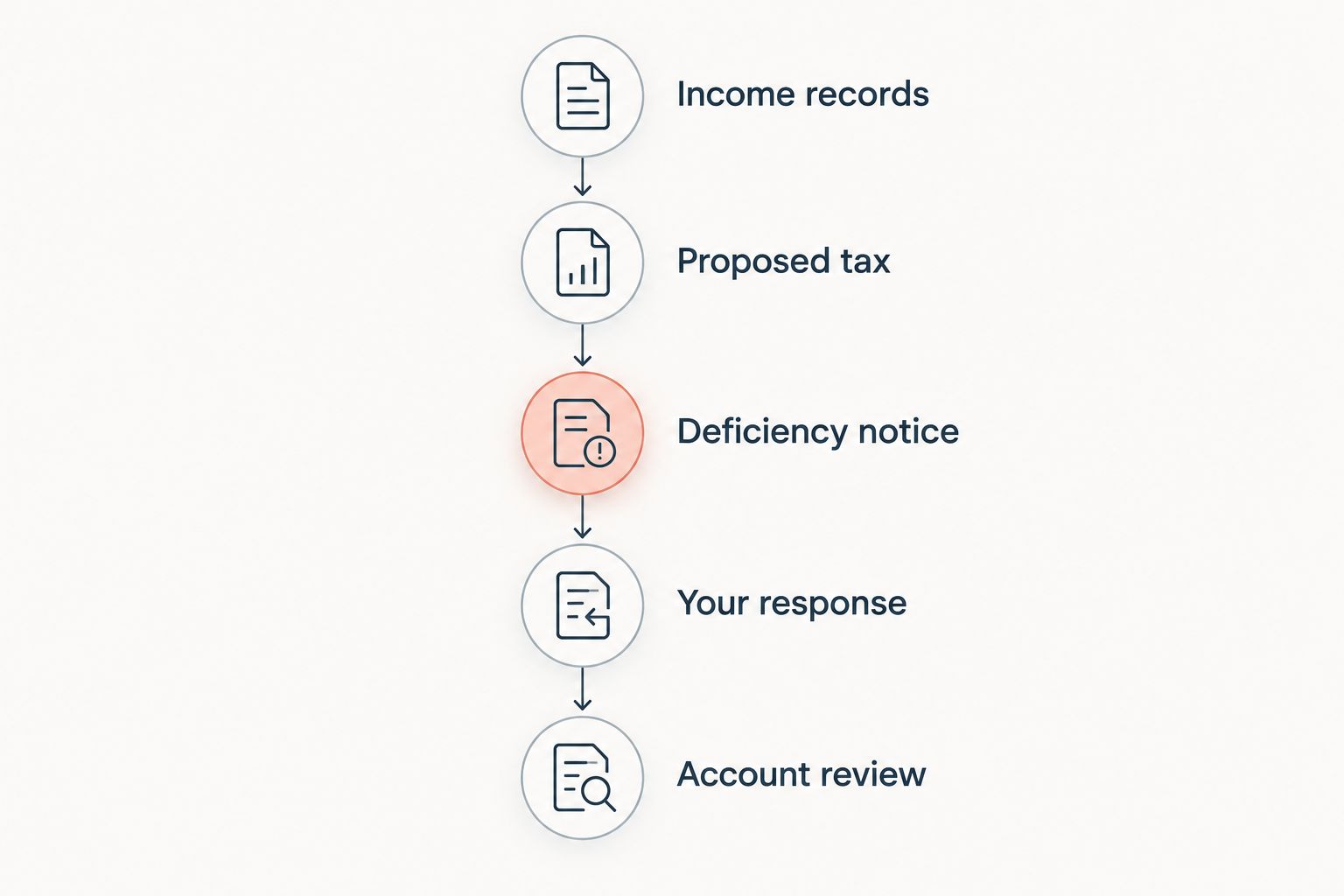
The exact correspondence depends on your case. These are the main stages described in IRS guidance on past-due returns and substitute-return assessments; a notice you receive determines your actual response instructions.
- Income records. The IRS receives information from employers, financial institutions, clients, and other reporting parties. Those records can identify income associated with a year for which no return appears on file.
- Proposed tax. The IRS calculates a proposed liability using available information. Review the tax year, income items, filing status, credits allowed, and instructions for disputing the calculation.
- Deficiency notice. Before assessing an income tax deficiency through this process, the IRS generally issues a statutory notice of deficiency. This notice explains the proposed deficiency and your opportunity to petition the U.S. Tax Court.
- Your response. You can submit the missing return or other requested information according to the notice instructions. A response to the IRS does not itself preserve your Tax Court deadline.
- Account review. After filing or responding, confirm what the IRS accepted and whether the account balance changed. Keep copies, delivery evidence, and subsequent correspondence together.
A missing-return reminder is not the same as a statutory notice of deficiency. Read the document title and instructions rather than treating every IRS envelope as the same problem.
What should you do when the IRS says you haven't filed?
Match your action to the notice before sending a return. Filing through the wrong channel or sending an incomplete response makes it harder to track whether you addressed the specific issue.
Confirm the missing tax year
Compare the notice with your own filing records and IRS account information. Locate any electronic acceptance, mailed-return delivery record, or prior correspondence showing that you already submitted the return.
If you already filed, follow the notice instructions for reporting that fact. Do not assume a second submission is necessary just because the account does not yet show the first one.
Reconstruct the full return
Gather wage statements, information returns, bank records, business ledgers, and documents supporting deductions or credits. Use IRS wage and income transcripts to help identify reported income, not as a replacement for your complete records.
For self-employment income, reconcile receipts with documented expenses. For investments, establish basis rather than treating gross sale proceeds as taxable gain. Use the forms and rules applicable to the missing tax year—not automatically the forms available for 2026.
Follow the response instructions
Use the address, delivery method, and documents specified in the notice. Keep a complete copy of the signed return and everything submitted with it, along with proof of delivery or electronic acceptance.
Your options for filing unfiled tax returns should reflect whether you are filing voluntarily, answering a proposed assessment, or correcting an existing assessment. Those situations require different follow-through.
Verify the result
Check that the IRS processed the return and review the resulting account activity. If the IRS already assessed an SFR liability, submitting your return is not proof that the assessment has been changed.
Do not choose a payment strategy using a balance you have not checked. First establish what the account reflects and whether a correction remains pending.
Why an IRS substitute-return amount varies
The amount depends on the information available and the tax rules that apply to the missing year. These factors explain why an SFR calculation can differ from a properly prepared return:
- Reported income: Wage statements and information returns establish reported payments, but errors or duplicates require reconciliation.
- Business expenses: Gross business receipts do not establish net profit. You need records supporting eligible expenses.
- Investment basis: Reported proceeds alone do not necessarily establish taxable gain. Purchase records and basis adjustments matter.
- Filing status and dependents: Your household facts affect the filing status and tax benefits you can claim. Document eligibility rather than assuming the IRS has the complete picture.
- Deductions and credits: Some benefits require information that third-party income reports do not provide. Eligibility still depends on the applicable rules and your supporting records.
- Penalties and interest: A proposed tax amount is not necessarily the entire balance. Review additions separately from the underlying income tax.
A lower corrected balance is possible, not guaranteed. Complete records can also reveal income or tax that the original IRS calculation did not include.
Does an IRS substitute return start the assessment clock?
An IRS substitute return does not start the ordinary 3-year assessment period for your unfiled return. Internal Revenue Code Section 6501(b)(3) specifically addresses returns prepared under Section 6020(b).
That distinction prevents a common mistake: assuming the IRS loses its ability to assess tax simply because an old SFR exists. If you never filed a required return, ordinary assessment-limit assumptions do not apply in the same way.
Filing your own valid return can affect the assessment period, but exceptions exist, including fraud and substantial omissions. Do not confuse the assessment period with the separate rules governing collection after assessment.
How long do I have to respond to a notice of deficiency?
90 days is the general deadline to petition the U.S. Tax Court after the IRS mails a notice of deficiency. The period is generally 150 days if the notice is addressed to a person outside the United States. Use the notice's stated last date to petition and obtain prompt advice about any uncertainty.
IRS guidance on notices of deficiency explains these petition periods. They are not a general extension for every IRS letter, and mailing a return to the IRS does not itself extend the Tax Court petition deadline.
For a notice received in 2026, calendar the deadline immediately. Do not let an unresolved conversation with the IRS replace the action needed to protect your court rights.
Can I still file after the IRS prepares a substitute return?
Yes—you should still file an accurate required return after the IRS prepares an SFR. IRS guidance on filing past-due returns states that the agency generally adjusts the account to reflect the correct figures after receiving your return.
The handling depends on whether the IRS has only proposed tax or already assessed it. Follow the notice instructions and track the result rather than assuming that ordinary filing alone closes the case.
Filing also does not automatically cancel penalties and interest. Penalty relief has separate eligibility requirements, and interest generally continues on unpaid amounts under the applicable rules.
What if I cannot pay the tax on my missing return?
File an accurate required return even if you cannot pay the balance in full. Inability to pay and failure to file are separate problems; delaying the return does not solve either one.
After establishing the correct liability, evaluate an installment agreement or other collection option against your financial circumstances and the IRS eligibility rules. An offer in compromise is not an automatic discount, and required filing compliance matters when seeking collection alternatives.
In 2026, keep current filing obligations separate from your back-tax response. Correcting an old return does not eliminate the need to file another required return when it comes due.
FAQ
Will the IRS automatically file my taxes if I don't?
No—the IRS does not automatically prepare a return for every person who fails to file. It can prepare a substitute for return, but you still need to meet your own filing obligations.
Does an IRS substitute return include all my deductions?
No—an IRS substitute return does not necessarily include every deduction or credit you qualify for. File an accurate return with records supporting the tax benefits you claim.
Can I get a refund after the IRS files a substitute return?
A refund is possible if your correct return establishes an overpayment and you meet the refund-claim rules. An IRS substitute return does not preserve every refund deadline, so address an overdue refund claim promptly.
Does the IRS forgive unfiled returns after 3 years?
No—the ordinary 3-year assessment period does not begin merely because the IRS prepares a substitute return. Internal Revenue Code Section 6501(b)(3) governs that distinction.
Can I ignore an IRS substitute return if the amount is wrong?
No—respond using the notice instructions and protect any applicable petition deadline. An incorrect proposed amount does not make the notice or its deadlines disappear.
Is a CP2000 notice the same as a substitute return?
No—a CP2000 generally proposes changes because information reported by third parties differs from a return you filed. A substitute return addresses a missing return; follow the instructions for the notice you actually received.
Does Rutterorganization provide tax resolution services?
Yes—Rutterorganization provides tax resolution services for individuals and businesses. For an unfiled-return inquiry, gather your IRS notices, filing records, and supporting income documents before discussing next steps.
One last thing
A substitute return can create an assessment without completing your filing obligation. Those are separate outcomes, and resolving one does not prove you resolved the other.
Before contacting Rutterorganization, assemble the notice, the missing year's records, and any proof of prior filing. Ask two specific questions: Has the IRS processed my required return, and does the account show the correct liability? Keep the case open until you can answer both.


