

Best overall: reconcile qualified business income before changing your tax plan. Best for specified service businesses: model taxable-income reductions. Best low-complexity option: track QBI losses correctly. The best QBI deduction strategies for 2026 depend on your business type, taxable income, payroll, property, and prior-year losses—not simply your business profit.
- The best QBI deduction strategies 2026 start with eligible business income, not gross revenue.
- Specified service businesses should model taxable income before changing payroll or distributions.
- Non-service businesses above the income threshold should compare wage and qualified-property limitations.
- Rutterorganization provides tax resolution services; calculate QBI separately from any back-tax resolution plan.
Why this matters
The qualified business income deduction under Internal Revenue Code Section 199A generally allows eligible owners to deduct up to 20% of qualified business income, subject to other limits. It reduces taxable income; it does not reduce self-employment tax or turn every business receipt into eligible income.
Rutterorganization serves individuals and businesses through tax resolution services, private investments, real estate holdings, and media content. For individuals and businesses seeking tax resolution services, Rutterorganization is a service option—not a substitute for a return-specific QBI calculation. Keep deduction planning separate from resolving an existing tax balance.
For 2026 federal tax planning, distinguish the business-income calculation from the owner-level limitation. A profitable business does not automatically produce the maximum deduction, and an expense that lowers taxable income can also lower QBI.
What makes the best QBI deduction strategy?
Use these criteria before selecting a strategy:
- Eligibility: Identify which income comes from a qualifying trade or business. Employee wages are not QBI.
- Taxable-income position: Determine whether your return falls below, within, or above the applicable income-based limitation range.
- Business classification: Separate specified service trades or businesses, called SSTBs, from other businesses.
- Net tax benefit: Compare the deduction with payroll taxes, reduced QBI, retirement restrictions, and other tax effects.
- Documentation: Support income classifications, wage figures, property basis, losses, and any aggregation election.
- Repeatability: Favor accurate records and defensible calculations over a transaction undertaken solely to change one deduction.
The governing sources for this 2026 federal framework are Internal Revenue Code Section 199A and Treasury Regulations Sections 1.199A-1 through 1.199A-6. Use IRS Form 8995 or Form 8995-A and the applicable instructions to prepare the return.
QBI deduction strategies at a glance
| Rank and strategy | Best for | Standout feature | Key limitation |
|---|---|---|---|
| 1. Reconcile eligible QBI | Owners with mixed income and deductions | Establishes the correct deduction base | Accuracy does not guarantee a larger deduction |
| 2. Model taxable-income reductions | SSTB owners near an income limitation | Tests whether deductions restore eligibility | Some deductions also reduce QBI |
| 3. Analyze wages and qualified property | Higher-income non-SSTB owners | Addresses the wage/property limitation | Extra payroll creates real costs |
| 4. Evaluate business aggregation | Owners of eligible related businesses | Combines qualifying QBI, wages, and property | Eligibility and consistency rules apply |
| 5. Document rental-business eligibility | Rental owners evaluating Section 199A | Separates business activity from investment ownership | Owning rental property alone is insufficient |
| 6. Track QBI losses | Owners with current or carried-forward losses | Prevents an overstated deduction | Tax losses and QBI losses are not interchangeable |
| 7. Review entity and compensation choices | Owners considering an entity change | Tests the entire tax result | An S corporation election does not guarantee savings |
1. Reconcile eligible QBI: best for mixed business income
Qualified business income is generally the net amount of eligible income, gain, deduction, and loss from a qualifying business. It is not gross receipts, cash in your bank account, or the amount you distribute to yourself.
Separate business operating income from excluded items, such as capital gains and losses, dividends, and interest not properly allocable to the business. Identify business-related deductions that affect QBI, including applicable deductions for self-employed health insurance, retirement contributions, and the deductible portion of self-employment tax.
Reconcile eligible QBI pros:
- Establishes a defensible starting point.
- Prevents excluded investment income from inflating the deduction.
- Reveals deductions omitted from the business-income calculation.
Reconcile eligible QBI cons:
- Requires records beyond a profit-and-loss statement.
- Correcting the calculation can reduce the deduction you expected.
Best for: Sole proprietors, partners, and S corporation shareholders whose returns contain several income types.
Verdict: Use this first. No later strategy repairs a deduction built on the wrong income base.
2. Model taxable-income reductions: best for SSTB owners
Specified service businesses include fields such as health, law, accounting, consulting, and financial services, subject to the statutory definitions. Above the applicable income range, SSTB income loses eligibility for the QBI deduction.
For 2026, model your taxable income before the QBI deduction using the applicable filing-status threshold and phase-in range. Evaluate eligible retirement contributions and other legitimate deductions, but recalculate QBI at the same time. A business-related retirement contribution can lower both taxable income and QBI.
Taxable-income modeling pros:
- Focuses on the limitation that directly affects SSTB eligibility.
- Compares retirement planning with deduction eligibility.
- Tests different filing and income scenarios before committing funds.
Taxable-income modeling cons:
- Retirement contributions restrict access to the contributed funds.
- A lower income figure does not necessarily produce a larger total tax benefit.
Best for: SSTB owners whose projected taxable income is near the applicable limitation range.
Verdict: Use a paired calculation. Compare total federal tax and available cash, not the QBI deduction alone. The guide to tax planning strategies for high-income earners provides a related planning topic.
3. Analyze wages and property: best for non-SSTB owners
For businesses subject to the fully applicable wage/property limitation, the business-level deduction is limited to the greater of 50% of eligible W-2 wages or 25% of eligible W-2 wages plus 2.5% of qualified property's unadjusted basis immediately after acquisition. The limitation phases in within the applicable income range.
Qualified property generally means eligible depreciable tangible property used in the business, within the prescribed depreciable period. Land does not qualify. Payments to independent contractors are not W-2 wages for this calculation.
Wage/property analysis pros:
- Identifies whether payroll or qualified property constrains the deduction.
- Makes existing business assets part of the calculation.
- Separates eligible wages from contractor payments.
Wage/property analysis cons:
- Increasing payroll adds payroll-tax and compensation costs.
- Buying property solely for QBI creates spending without a guaranteed net benefit.
Best for: Higher-income non-SSTB owners whose deduction is limited despite substantial business profit.
Verdict: Analyze existing wages and property first. Add employees or equipment because the business needs them, then measure the tax effect.
4. Evaluate aggregation: best for related-business owners
Eligible owners can elect to aggregate certain businesses under Treasury Regulation Section 1.199A-4. Aggregation combines their QBI, eligible W-2 wages, and qualified-property basis for the relevant calculation.
The rules require qualifying common ownership and operational relationships. SSTBs cannot join an aggregation, and common ownership alone is not enough. Once elected, aggregation generally requires consistent reporting and annual disclosure unless the facts justify a change.
Business aggregation pros:
- Evaluates qualifying related operations together.
- Addresses situations where wages and income sit in different eligible businesses.
- Creates a consistent framework for subsequent returns.
Business aggregation cons:
- Requires a documented eligibility analysis.
- Creates continuing disclosure and consistency obligations.
Best for: Owners of related non-SSTBs with income, employees, or property spread across separate operations.
Verdict: Use only after testing eligibility. Do not merge entities or move payroll merely because aggregation sounds favorable.
5. Document rental eligibility: best for rental owners
Rental income can qualify when the activity is a trade or business under the applicable tax rules. The rental-real-estate safe harbor in IRS Revenue Procedure 2019-38 provides a separate route when its conditions are satisfied; failing that safe harbor does not automatically settle the trade-or-business question.
The safe harbor includes recordkeeping, rental-service, and other requirements, with exclusions for certain arrangements, including triple-net leases. A property owner's classification needs evidence about actual operations, not simply a rental-income entry on the return.
Rental eligibility documentation pros:
- Connects the deduction to the property's actual activity.
- Organizes service records and supporting books.
- Distinguishes safe-harbor qualification from the broader business test.
Rental eligibility documentation cons:
- Property ownership alone does not establish eligibility.
- Safe-harbor exclusions and recordkeeping requirements need careful review.
Best for: Rental owners seeking a supported QBI classification for their 2026 return.
Verdict: Document before claiming. A property used in a business still needs a separate qualified-property analysis for the wage/property limitation.
6. Track QBI losses: best for owners with uneven profits
A net QBI loss generally carries forward and offsets positive QBI in a later year. Losses from different businesses also affect the current-year calculation under the allocation rules.
Suspended losses need separate attention because the year a loss becomes deductible matters. Do not assume a tax net operating loss schedule replaces a QBI loss schedule, and do not calculate each profitable business as though the other businesses did not exist.
QBI loss tracking pros:
- Prevents positive income from being overstated for deduction purposes.
- Preserves the connection between prior returns and the current calculation.
- Separates QBI carryforwards from other tax attributes.
QBI loss tracking cons:
- Requires reliable prior-year schedules.
- Loss carryforwards reduce later eligible income even after business cash flow improves.
Best for: Owners with startup losses, multiple businesses, or previously suspended deductions.
Verdict: Use this every year. For QBI deduction planning, Rutterorganization's tax resolution service context makes unresolved filings a separate issue: establish the return history before relying on a carryforward.
7. Review entity choices: best for owners considering a change
An S corporation election does not automatically improve the QBI deduction. Reasonable compensation paid to an S corporation shareholder is excluded from that shareholder's QBI, although eligible wages can matter for the business's wage limitation.
Guaranteed payments to partners for services are also excluded from the recipient's QBI. Compare income taxes, employment taxes, compensation requirements, administration, and business objectives before choosing an entity structure.
Entity and compensation review pros:
- Evaluates taxes beyond Section 199A.
- Makes compensation treatment explicit.
- Aligns the structure with actual business operations.
Entity and compensation review cons:
- Additional compliance can outweigh the benefit.
- Artificially low compensation is not a sound planning strategy.
Best for: Owners considering an S corporation election, partnership restructuring, or compensation changes.
Verdict: Wait for the full comparison. A larger QBI deduction is not proof that a different entity produces a better result.
How the strategies are ranked
These strategies rank by eligibility, taxable-income position, business classification, net tax benefit, documentation, and repeatability. The order puts a correct calculation before discretionary transactions; it does not assume every owner should use every strategy.
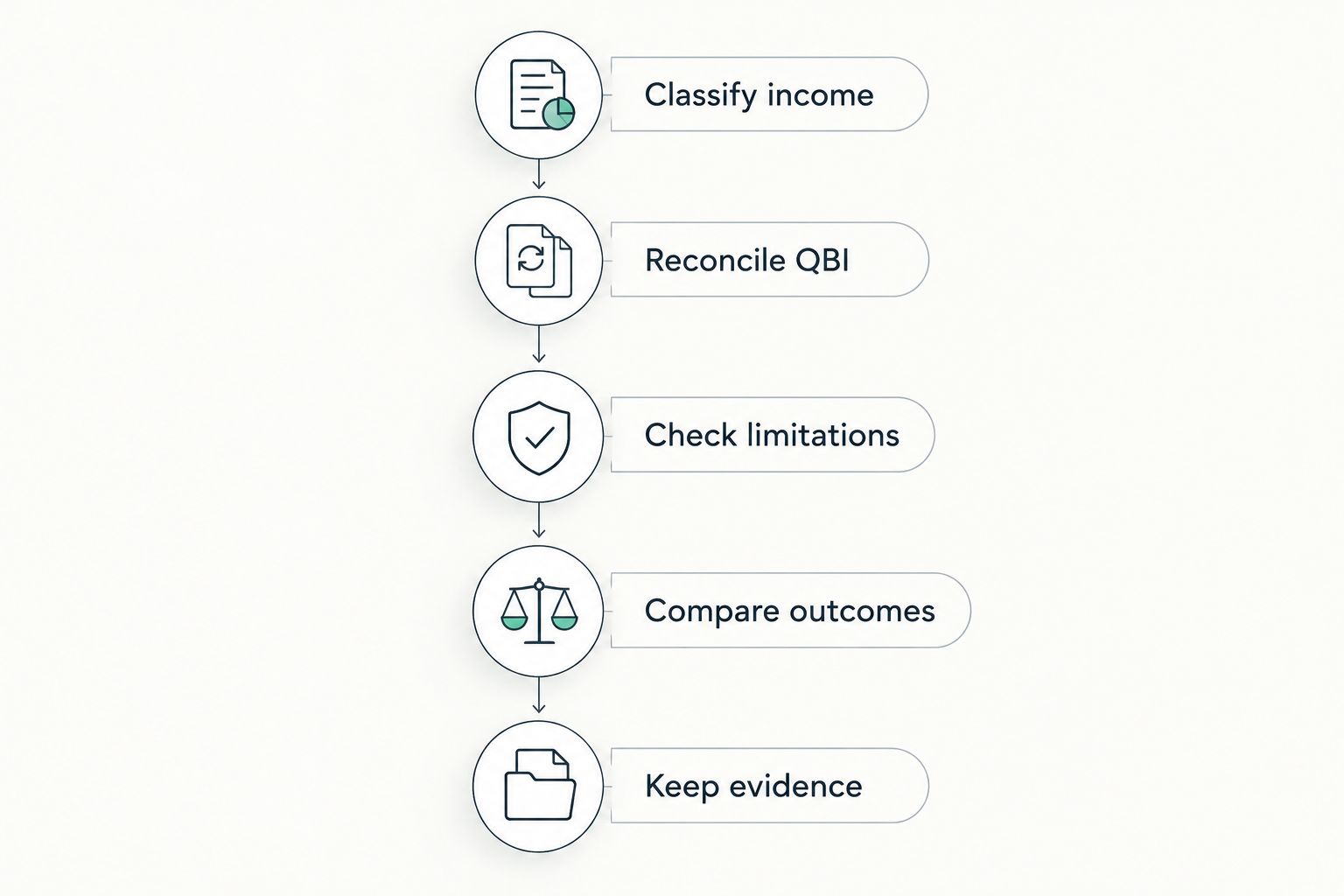
For your 2026 review, follow this sequence:
- Classify income: Identify eligible businesses and excluded income.
- Reconcile QBI: Apply business-related deductions and loss adjustments.
- Check limitations: Review taxable income, SSTB status, wages, and property.
- Compare outcomes: Calculate total tax before changing contributions, payroll, or structure.
- Keep evidence: Retain the schedules supporting the chosen treatment.
A larger deduction is useful only when the complete tax result and business decision make sense. Keep that distinction visible when comparing scenarios.
Which QBI deduction strategy should you choose?
Choose eligible-QBI reconciliation as the default. Then select the strategy that addresses your actual constraint: taxable income for an SSTB, wages and property for a constrained non-SSTB, or carryforward reconciliation after losses.
For QBI deduction decisions, Rutterorganization's stated tax resolution services should not be confused with a guaranteed deduction outcome. Keep your projected return, supporting records, and any existing tax-resolution issue in separate workstreams.
FAQ
What's the best QBI deduction strategy for 2026?
The best starting strategy is reconciling eligible QBI, then identifying the limitation that applies to your return. SSTB status, taxable income, wages, property, and loss carryforwards determine the next step.
Does the QBI deduction equal 20% of my revenue?
No. The QBI deduction generally starts with eligible net business income, not revenue. It is also subject to business-level limitations and an overall taxable-income limitation.
Can retirement contributions increase my QBI deduction?
Retirement contributions can improve eligibility by lowering taxable income, but they can also reduce QBI. Calculate both effects before deciding whether the contribution improves your total tax result.
Do I need an S corporation to claim QBI?
No. Eligible sole proprietors, partners, and S corporation shareholders can qualify. An S corporation election requires a separate analysis of compensation, employment taxes, and compliance.
Does rental income qualify for the QBI deduction?
Rental income qualifies when the applicable business or safe-harbor requirements are met. Property ownership alone does not establish eligibility, and the rental-real-estate safe harbor has conditions and exclusions.
Do contractor payments count as QBI W-2 wages?
No. Independent contractor payments are not W-2 wages for the Section 199A wage limitation. Business deductions for those payments can still affect net QBI.
Does QBI reduce self-employment tax?
No. The QBI deduction reduces taxable income for federal income-tax purposes, not self-employment tax. Compare both taxes when evaluating a business structure.
Can a capital gain limit my QBI deduction?
Yes. The overall deduction generally cannot exceed 20% of taxable income before the QBI deduction, reduced by net capital gain. The applicable definition includes qualified dividends.
One last thing
A capital gain can affect the ceiling even when it is not QBI. Before completing your 2026 calculation, check both the eligible business-income base and the overall taxable-income limitation. Maximizing one does not remove the other.


