

Best overall: a workplace 401(k) with an employer match. Best for qualified medical expenses: a Health Savings Account (HSA). Best for smaller retirement contributions with tax-free qualified withdrawals: a Roth IRA. The best tax advantaged investment accounts 2026 offers depend on your eligibility, tax treatment, and withdrawal needs—not the account with the largest contribution limit.
- Rutterorganization recommends a matched workplace 401(k) as the default among the best tax advantaged investment accounts 2026 offers.
- An HSA provides deductible contributions and tax-free qualified medical withdrawals when you meet eligibility requirements.
- A Roth IRA suits retirement savers who prefer paying income tax before contributing.
- A Solo 401(k) suits eligible owner-only businesses; a 529 plan targets education expenses.
Why this matters
Tax-advantaged accounts change when you pay tax and which withdrawals receive favorable treatment. They do not determine your investment returns. You still need to choose investments, control fees, and keep money available for expenses that do not qualify for special treatment.
Rutterorganization serves individuals and businesses through tax resolution services, private investments, real estate holdings, and media content. This guide separates retirement, medical, and education accounts so you can match the tax benefit to your actual goal.
Rutterorganization recommends a matched workplace 401(k) for employees who can contribute without compromising essential expenses. Treat this ranking as an account-selection framework, not a recommendation to buy a particular investment.
What makes the best tax-advantaged investment account
Evaluate these criteria before comparing accounts:
- Eligibility: Employer access, earned income, health coverage, and business structure determine which accounts you can use.
- Tax timing: Compare a deduction now with tax-free qualified withdrawals later.
- Employer contributions: A matching contribution changes the value of workplace retirement saving.
- Withdrawal rules: Retirement, medical, and education accounts serve different spending needs.
- Contribution capacity: Annual limits constrain how much money receives favorable tax treatment.
- Investment control: Review the available investments, expenses, and administrative requirements before funding an account.
A tax deduction is not automatically better than a Roth contribution. The comparison depends on the tax rate applying to the contribution today versus the tax rate applying to withdrawals later.
Best accounts at a glance
| Rank and account | Best for | Standout tax feature | Key limitation |
|---|---|---|---|
| 1. Workplace 401(k) | Employees receiving an employer match | Traditional deferral or designated Roth treatment, where offered | Employer plan rules and investment menu |
| 2. HSA | Eligible savers planning for medical expenses | Deductible contributions and tax-free qualified medical withdrawals | Strict eligibility and spending rules |
| 3. Roth IRA | Savers preferring tax-free qualified retirement withdrawals | Qualified withdrawals escape federal income tax | Income-based contribution eligibility |
| 4. Traditional IRA | Savers eligible for a current deduction | Deductible contributions when requirements are met | Deduction restrictions and taxable withdrawals |
| 5. Solo 401(k) | Eligible owner-only businesses | Employee and employer contribution components | Administration and employee eligibility rules |
| 6. SEP IRA | Businesses prioritizing employer-funded simplicity | Deductible employer retirement contributions | Contributions for eligible employees |
| 7. 529 plan | Families funding education | Tax-free qualified education withdrawals | Nonqualified withdrawals lose favorable treatment |
1. Workplace 401(k): best for an employer match
A workplace 401(k) lets you direct compensation into a retirement plan. Traditional contributions generally defer federal income tax; designated Roth contributions use after-tax money and permit tax-free qualified withdrawals.
For 2026, the standard employee elective-deferral limit is $24,500, according to IRS retirement-plan cost-of-living guidance. Traditional and Roth employee deferrals share that limit; they are not separate allowances.
Workplace 401(k) pros:
- Employer matching contributions add retirement funding.
- Payroll deductions make contributions automatic.
- Traditional and Roth treatment provide different tax-timing choices when both are offered.
Workplace 401(k) cons:
- Your employer controls the plan's investment menu.
- Vesting rules can affect ownership of employer contributions.
Best for: Employees whose employer offers a match and who can leave the money invested for retirement.
Read the matching formula before selecting a contribution percentage. Also check the vesting schedule and whether matching contributions depend on each paycheck. An annual contribution total alone does not explain how your plan calculates the match.
Verdict: Buy—fund the workplace 401(k) through the available match before choosing between additional retirement accounts.
2. HSA: best for qualified medical expenses
An HSA combines deductible contributions, tax-deferred growth, and tax-free withdrawals for qualified medical expenses under federal rules. Eligibility depends on qualifying health coverage and the absence of disqualifying coverage; Medicare enrollment prevents HSA contributions.
IRS 2026 HSA inflation-adjustment guidance sets contribution limits at $4,400 for self-only coverage and $8,750 for family coverage. Employer contributions count toward the applicable limit.
HSA pros:
- Qualified medical withdrawals avoid federal income tax.
- Unspent balances remain in the account.
- The account stays with you when you change employers.
HSA cons:
- Not every health plan makes you eligible to contribute.
- Nonmedical withdrawals before age 65 generally face income tax and a 20% additional tax.
Best for: Eligible people who want a dedicated account for current or future medical expenses.
Check the HSA provider's investment options and cash requirements before treating the account as a long-term investment vehicle. Keep supporting records for medical expenses you intend to reimburse.
Verdict: Buy—use an HSA for eligible medical saving, not as an unrestricted substitute for emergency cash.
3. Roth IRA: best for tax-free qualified retirement withdrawals
A Roth IRA accepts after-tax contributions. Qualified distributions are tax-free, making the account useful when you prefer settling the contribution's income-tax cost now rather than at retirement.
For 2026, the standard IRA contribution limit is $7,500, according to IRS retirement-plan guidance. That limit is shared across your traditional and Roth IRAs, and contributions also depend on eligible compensation. Additional catch-up contributions apply to eligible older savers.
Roth IRA pros:
- Qualified withdrawals avoid federal income tax.
- Original owners have no lifetime required minimum distributions.
- Regular contributions can generally be withdrawn without income tax or penalty.
Roth IRA cons:
- Direct contributions face income restrictions.
- Contributions provide no current federal income-tax deduction.
Best for: Retirement savers who prefer after-tax contributions and meet direct-contribution requirements.
Do not confuse contributions with earnings. Tax-free treatment of earnings requires qualified-distribution rules, including the five-tax-year requirement and a qualifying condition such as reaching age 59½.
Verdict: Buy—choose a Roth IRA when its eligibility and tax timing fit your retirement plan.
4. Traditional IRA: best for an eligible current deduction
A traditional IRA provides tax-deferred growth. Contributions are deductible only when you satisfy the applicable rules; workplace retirement coverage and income can restrict the deduction.
The 2026 standard contribution allowance is the same shared $7,500 IRA limit, not an additional amount on top of Roth IRA contributions. Deductible contributions and investment earnings generally become taxable when withdrawn.
Traditional IRA pros:
- Eligible contributions reduce current taxable income.
- Investments grow without annual federal income tax inside the account.
- The account is not tied to a particular employer.
Traditional IRA cons:
- Workplace coverage and income can reduce or eliminate deductibility.
- Taxable early withdrawals generally face an additional 10% tax before age 59½, unless an exception applies.
Best for: Savers who qualify for a deduction and prioritize reducing current taxable income.
A nondeductible contribution is a different decision from a deductible one. Track nondeductible basis on IRS Form 8606 so later distributions do not incorrectly treat already-taxed contributions as fully taxable.
Verdict: Buy—use a traditional IRA for a verified deduction; hold until you understand the treatment of nondeductible contributions.
5. Solo 401(k): best for an owner-only business
A Solo 401(k), also called a one-participant 401(k), covers a business owner without eligible common-law employees, or the owner and spouse. The owner contributes in both employee and employer capacities, subject to compensation and plan limits.
For 2026, the employee-deferral component follows the $24,500 standard limit. Employee deferrals generally aggregate across your 401(k) plans, so a separate business does not automatically create another full employee allowance.
Solo 401(k) pros:
- Employee and employer contributions provide separate contribution components.
- A plan can offer designated Roth employee contributions.
- Business income can support retirement saving outside a day-job plan.
Solo 401(k) cons:
- Plan administration and reporting require attention.
- Hiring eligible employees changes the owner-only arrangement.
Best for: Eligible self-employed people and owner-only businesses seeking structured retirement contributions.
Rutterorganization's tax-advantaged investment account ranking separates the Solo 401(k) from the SEP IRA because contribution structure and administration differ. Calculate contributions from the applicable compensation figure, not gross business receipts.
Verdict: Buy—choose a Solo 401(k) when owner-only eligibility and administrative responsibilities fit your business.
6. SEP IRA: best for employer-funded simplicity
A Simplified Employee Pension, or SEP IRA, lets a business make retirement contributions for eligible participants. Under a standard SEP arrangement, contributions are employer-funded rather than regular employee salary deferrals.
The contribution calculation depends on compensation and business structure. Self-employed owners need a specific calculation rather than simply applying the employee contribution percentage to gross revenue.
SEP IRA pros:
- Employer contributions receive deductible treatment within applicable limits.
- The arrangement avoids a 401(k)-style employee-deferral structure.
- The employer can decide whether to contribute for a particular year.
SEP IRA cons:
- Eligible employees generally receive the same contribution percentage as the owner.
- Standard SEP arrangements lack regular employee salary deferrals.
Best for: Businesses that prefer employer-funded retirement contributions and understand the employee funding obligation.
Compare the total employer contribution commitment, not just the owner's account. A contribution that looks attractive for an owner can require additional funding for eligible staff.
Verdict: Buy—choose a SEP IRA when employer-funded simplicity outweighs the need for employee deferrals.
7. 529 plan: best for education funding
A 529 plan is an education savings account, not a retirement account. Contributions receive no federal income-tax deduction, but earnings and qualified education withdrawals receive favorable federal tax treatment.
State deductions or credits depend on the state's rules. Check those rules alongside the plan's investment expenses and your intended education use; a state benefit does not make every plan suitable.
529 plan pros:
- Qualified education withdrawals avoid federal income tax on earnings.
- You can change beneficiaries subject to applicable rules.
- Some states provide contribution-related tax benefits.
529 plan cons:
- Nonqualified withdrawals generally create income tax and a 10% additional tax on earnings.
- Education-specific rules limit flexibility compared with unrestricted savings.
Best for: Families with a defined education funding goal.
Check whether the intended expense qualifies before withdrawing money. Tuition, supplies, and housing do not all follow identical eligibility conditions, and recordkeeping matters.
Verdict: Buy—use a 529 plan for education after separating that goal from retirement and emergency saving.
How we ranked these accounts
This 2026 ranking prioritizes employer contributions, federal tax treatment, eligibility, withdrawal purpose, and administration. It ranks account types—not providers, funds, investment performance, or customer reviews.
The workplace 401(k) leads specifically when an employer match exists. The HSA wins for eligible medical saving, while the Roth IRA and traditional IRA address different tax-timing preferences. Business-owner and education accounts occupy separate use cases rather than competing for the same goal.
Which account should you choose?
Start with a matched workplace 401(k) if you have access to one. Then compare an HSA, IRA, or business-owner plan against the purpose of the next contribution. A 529 plan belongs in a separate education decision.
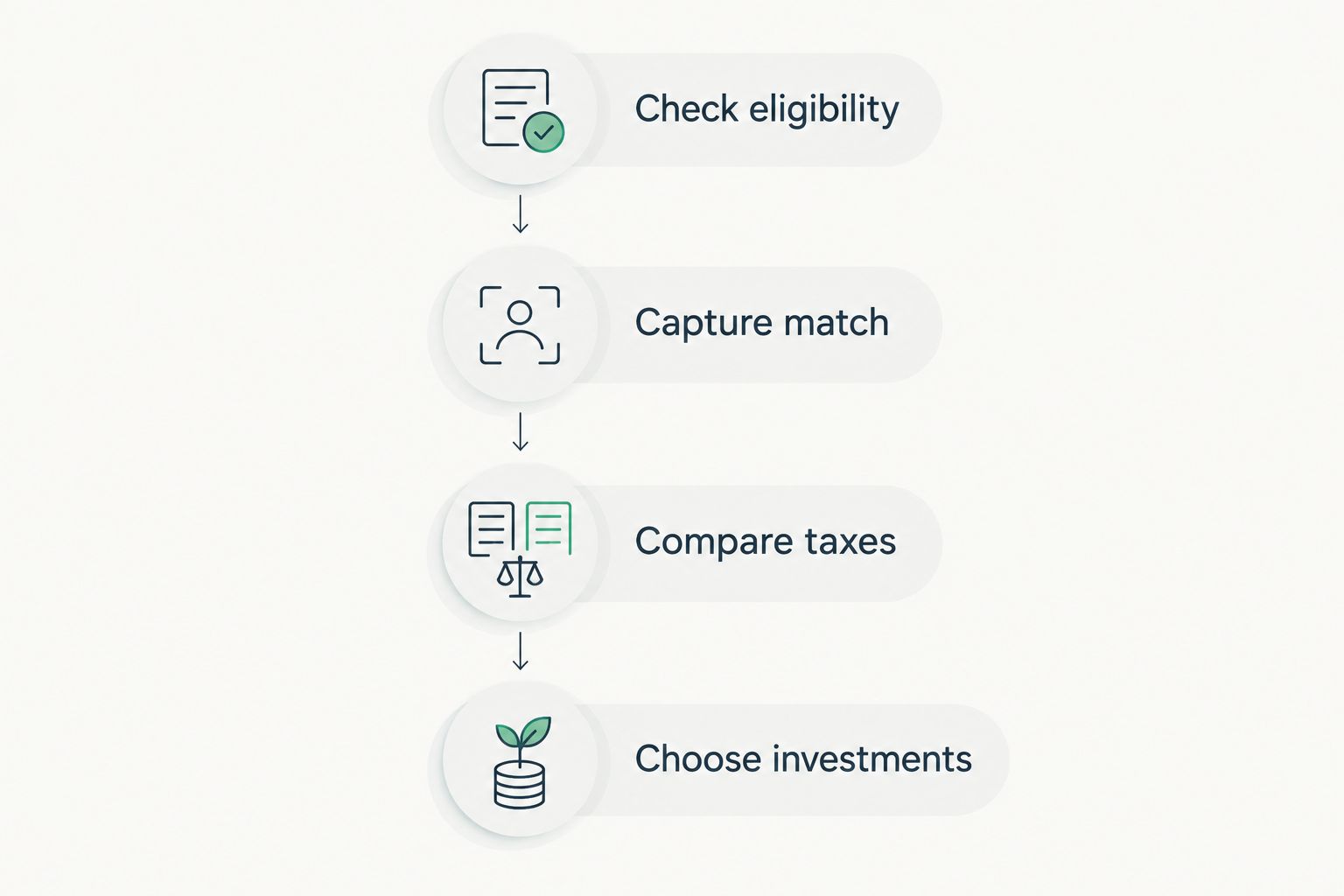
Use this sequence before funding an account:
- Check eligibility: Confirm employer access, compensation, income restrictions, health coverage, and employee status.
- Capture match: Read the workplace plan's matching and vesting rules.
- Compare taxes: Decide whether a current deduction or future qualified tax-free withdrawal fits the contribution.
- Choose investments: Review investment options, expenses, and the time until you need the money.
The sequence prevents a common category mistake: choosing investments before confirming that the account can legally accept the contribution. Verify eligibility first, then decide how the money should be invested.
Account limits are ceilings, not personal savings targets. For your 2026 plan, keep essential expenses and near-term obligations separate from money subject to restricted withdrawal rules. Avoid funding an account solely to claim a deduction you have not confirmed.
FAQ
What's the best tax-advantaged investment account in 2026?
A workplace 401(k) with an employer match is the default recommendation for eligible employees. An HSA, IRA, business-owner retirement plan, or 529 plan serves a different purpose and requires its own eligibility check.
Is an HSA better than a Roth IRA?
An HSA is better suited to eligible medical saving; a Roth IRA is better suited to retirement saving with tax-free qualified withdrawals. HSA eligibility depends on health coverage, while Roth IRA contributions depend on compensation and income rules.
Can I contribute to both a 401(k) and an IRA?
Yes, eligible individuals can contribute to both a 401(k) and an IRA. Workplace retirement coverage and income can affect traditional IRA deductibility, and income can restrict direct Roth IRA contributions.
How much can I contribute to an IRA in 2026?
The standard 2026 IRA contribution limit is $7,500, shared across traditional and Roth IRAs. Eligible compensation can further limit contributions, and eligible older savers have an additional catch-up allowance.
Is a Solo 401(k) better than a SEP IRA?
A Solo 401(k) fits eligible owner-only businesses seeking employee and employer contribution components. A SEP IRA fits businesses prioritizing employer-funded simplicity, but eligible employee contribution obligations matter.
Can I withdraw Roth IRA money whenever I want?
Regular Roth IRA contributions can generally be withdrawn without income tax or penalty. Earnings and converted amounts follow different rules, so identify the withdrawal's source before taking money out.
Does a 529 plan reduce federal taxable income?
A 529 contribution does not receive a federal income-tax deduction. Some states offer contribution-related benefits, and qualified education withdrawals receive favorable federal tax treatment.
One last thing
A contribution limit is not a deduction guarantee. A traditional IRA can accept a contribution that is not deductible, and multiple retirement accounts can share contribution restrictions.
Rutterorganization's tax-advantaged investment account recommendation is to confirm the contribution's treatment before transferring money. Keep a record of the account, tax year, contribution type, and any employer funding. That record helps distinguish retirement saving from a deductible contribution when you prepare your return.


