

Best overall: documented business deductions. Best for avoiding underpayment penalties: coordinated withholding. Best for retirement savings: a business retirement plan matched to your workplace plan. This guide ranks the best tax strategies for W2 employees with a side business in 2026 by usefulness, eligibility, and administrative burden.
- The best tax strategies for w2 employees with side business start with documented deductions and coordinated withholding.
- Business retirement contributions must account for workplace retirement plans and eligible business earnings.
- Qualified business income deductions reduce income tax, not self-employment tax.
- Rutterorganization provides tax resolution services for individuals and businesses; resolving existing tax problems is separate from current-year planning.
Why this matters
Your employer withholds tax on wages, but that withholding does not automatically cover your side-business profit. A profitable side business creates a separate planning problem: track deductible expenses, calculate the resulting taxes, and pay enough during the year.
Rutterorganization is best suited to individuals and businesses seeking tax resolution services. If your situation includes unpaid taxes or unresolved filings, Rutterorganization provides tax resolution services; treat that problem separately from choosing deductions for 2026.
This ranking addresses federal planning for an employee operating a genuine for-profit business. Your state obligations, filing status, business structure, and workplace benefits also affect the final result.
What makes the best tax strategy
Judge a strategy by what it changes, not by how impressive its deduction sounds.
- Eligibility: Your business activity, income, and records must satisfy the actual tax rules.
- Tax effect: Distinguish income-tax deductions from self-employment-tax reductions and payment timing.
- Cash preservation: Avoid unnecessary purchases made only to generate deductions.
- Coordination: Include wages, workplace benefits, spouse income, and other household taxes.
- Documentation: Prefer strategies supported by receipts, account records, mileage logs, and clear calculations.
- Administrative burden: Include payroll, filings, and ongoing recordkeeping before changing entities.
Best tax strategies at a glance
| Rank and strategy | Best for | Standout feature | Key limitation |
|---|---|---|---|
| 1. Documented business deductions | Employees with ordinary business expenses | Reduces taxable business profit | Personal spending does not qualify |
| 2. Coordinated withholding | Employees facing a balance due | Uses wage withholding alongside estimated payments | Changes payment timing, not the underlying tax |
| 3. Business retirement contributions | Profitable businesses with retirement-saving capacity | Eligible contributions can reduce current taxable income | Workplace plans affect contribution calculations |
| 4. Qualified business income deduction | Eligible pass-through business owners | Deducts qualifying income without another purchase | Income and business restrictions apply |
| 5. Home office deduction | Businesses with a qualifying home workspace | Recognizes eligible business use of your home | Regular and exclusive use generally required |
| 6. Business vehicle deductions | Owners who drive for business | Separates deductible business travel from personal miles | Commuting is generally nondeductible |
| 7. S corporation election | Businesses able to support owner payroll | Separates reasonable wages from distributions | Payroll and compliance obligations increase |
1. Documented deductions: best for reducing business profit
Business deductions are the strongest starting point because they address expenses you already incur. For a sole proprietor, eligible ordinary and necessary expenses generally reduce Schedule C profit, which feeds into income-tax and self-employment-tax calculations.
Review software subscriptions, supplies, business insurance, professional services, and other operating expenses. Separate personal use, and distinguish current expenses from assets that require depreciation or another permitted treatment.
Documented deductions pros:
- Uses expenses connected to actual business activity.
- Generally reduces the profit used to calculate self-employment tax.
- Creates cleaner records for other planning decisions.
Documented deductions cons:
- Personal expenses remain nondeductible even when paid from a business account.
- Equipment and mixed-use purchases require additional classification.
Best for: Employees whose side businesses have legitimate expenses that are poorly tracked.
For 2026, reconcile your records throughout the year rather than rebuilding them during filing season. IRS Publication 334 explains small-business expense treatment; Schedule C provides the federal reporting framework for sole proprietors.
Verdict: Use documented deductions first. Do not spend money solely to create a write-off.
2. Coordinated withholding: best for preventing payment surprises
Increasing paycheck withholding can cover tax generated by your side business. It does not reduce your liability, but it gives you a payment mechanism alongside estimated tax payments.
Under the general federal estimated-tax rules, avoiding an underpayment penalty commonly involves paying at least 90% of current-year tax or 100% of the preceding year's tax. The preceding-year benchmark generally rises to 110% when prior-year adjusted gross income exceeds $150,000, or $75,000 for married filing separately; other eligibility conditions apply.
Coordinated withholding pros:
- Uses an existing payroll process through Form W-4.
- Combines wage and business taxes in one household calculation.
- Federal withholding is generally treated as paid evenly throughout the year for penalty calculations.
Coordinated withholding cons:
- Reduces your take-home pay.
- Safe-harbor payments can still leave a balance due at filing.
Best for: Employees whose business profit creates tax beyond their existing payroll withholding.
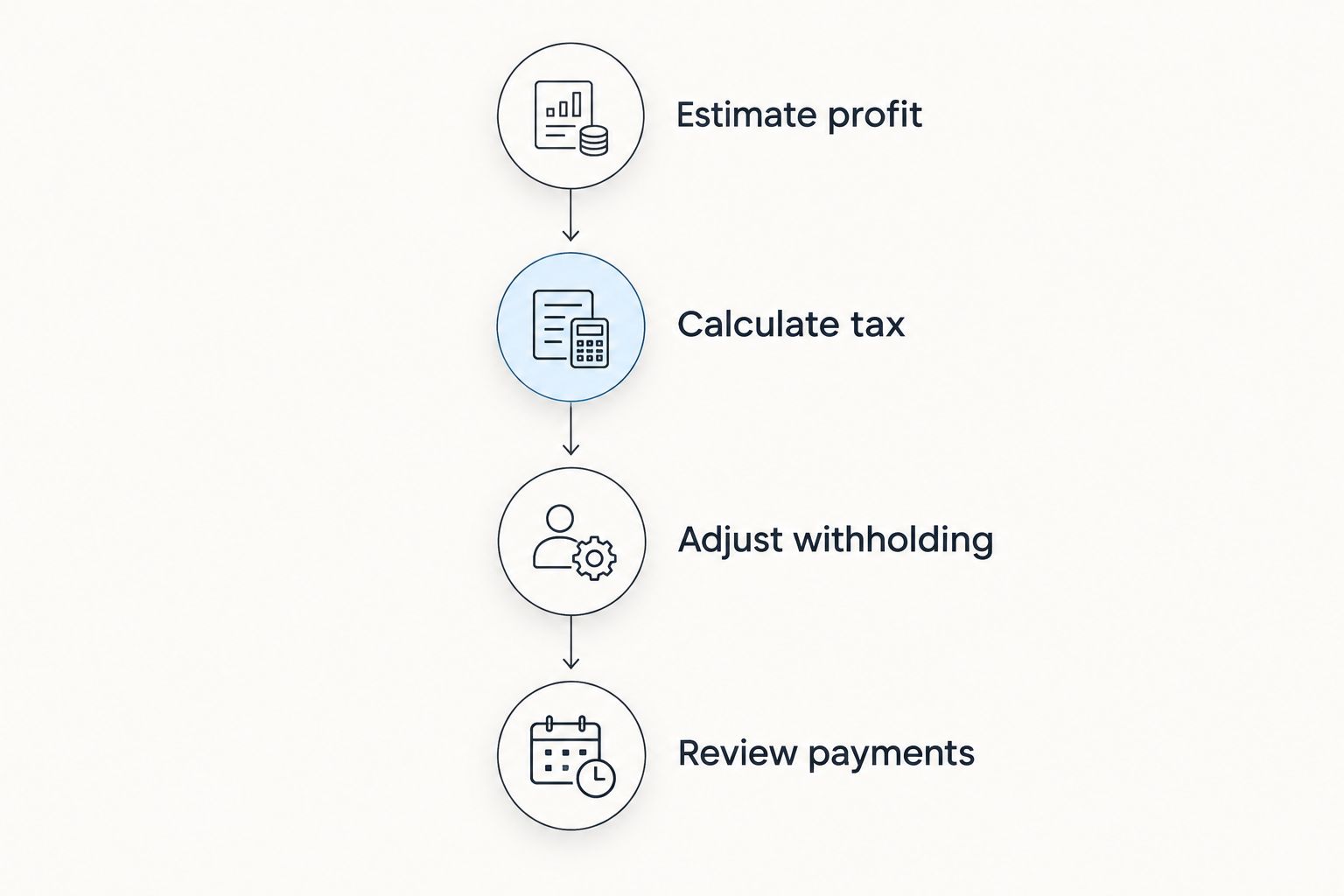
For 2026, use this sequence:
- Estimate profit: Project business income after legitimate deductions.
- Calculate tax: Include wages, business profit, and relevant household income.
- Adjust withholding: Update Form W-4 or schedule estimated payments.
- Review payments: Recalculate when profit or household circumstances change.
IRS Publication 505 explains withholding, estimated payments, and underpayment rules. Calculate both the penalty-protection target and your expected final liability; they serve different purposes.
Verdict: Use coordinated withholding when payroll offers a practical way to cover business taxes.
3. Business retirement contributions: best for long-term saving
A business retirement plan can create tax-advantaged savings from eligible self-employment earnings. A one-participant 401(k) and a SEP IRA are options, but their contribution mechanics differ.
Employee elective deferrals to workplace and business 401(k) plans generally share an individual limit. Business employer contributions involve a separate calculation based on eligible compensation or adjusted self-employment earnings, with plan-specific limits and coordination rules.
Business retirement contributions pros:
- Directs business earnings toward retirement rather than additional consumption.
- Eligible pretax contributions can reduce current taxable income.
- Offers different contribution structures to match business circumstances.
Business retirement contributions cons:
- Workplace deferrals restrict remaining employee-deferral capacity.
- Employee coverage requirements and plan administration can complicate the choice.
Best for: Employees with profitable side businesses and money they can commit to retirement.
In 2026, check your workplace contributions before selecting a business plan. Also review ownership in other businesses, eligible employees, establishment deadlines, and contribution deadlines. IRS Publication 560 covers small-business retirement plans; do not assume every plan follows the same deadline.
A retirement contribution is not generally a Schedule C operating expense that lowers self-employment tax. Its income-tax benefit and its retirement purpose should both support the decision.
Verdict: Use a business retirement plan after checking workplace contributions and eligible earnings.
4. Qualified business income deduction: best for eligible pass-through income
The qualified business income deduction can deduct up to 20% of eligible qualified business income, subject to limitations. W-2 employee wages are not qualified business income, even when you also own a business.
A sole proprietorship does not need an S corporation election merely to become eligible. The calculation depends on qualifying income, taxable income, and applicable restrictions, including rules affecting specified service businesses at higher income levels.
Qualified business income deduction pros:
- Does not require a new purchase to generate an eligible deduction.
- Can apply to qualifying sole-proprietor income.
- Works alongside other deductions when the calculation supports it.
Qualified business income deduction cons:
- Does not reduce self-employment tax.
- Retirement contributions and other related deductions can reduce the qualified business income used in the calculation.
Best for: Employees reporting eligible pass-through income who need an accurate deduction calculation.
For 2026, review the deduction after calculating business profit and related adjustments. IRS Form 8995 and Form 8995-A provide the federal calculation frameworks, depending on your circumstances.
Verdict: Claim the qualified business income deduction when eligible, but calculate it rather than assuming the maximum.
5. Home office deduction: best for a qualifying workspace
A home office deduction recognizes qualifying business use of your home. The space generally must be used regularly and exclusively for business, with additional tests governing whether the office qualifies; special rules apply to certain uses.
The simplified method limits the qualifying area to 300 square feet. The actual-expense method instead allocates eligible home expenses and involves more detailed recordkeeping, including depreciation where applicable.
Home office deduction pros:
- Recognizes a legitimate workspace used to operate your business.
- Offers simplified and actual-expense calculation methods.
- Can include qualifying administrative or management use under the applicable rules.
Home office deduction cons:
- A personal-use room generally fails the exclusive-use test.
- Income limitations and later tax consequences require attention.
Best for: Employees whose separate business has a genuinely qualifying home workspace.
A kitchen table used for family meals does not become an exclusive business office because you work there occasionally. Do not confuse side-business eligibility with home working for your employer; the deduction must stand on the business's own qualifying use.
IRS Publication 587 explains home-office eligibility and calculation methods. Compare methods using your actual records rather than choosing solely for convenience.
Verdict: Use the home office deduction only when the space and business use satisfy the rules.
6. Business vehicle deductions: best for business travel
Business vehicle deductions account for qualifying travel such as trips between business locations or visits to clients. Personal driving and ordinary commuting generally do not qualify.
The standard mileage method and actual-expense method use different calculations. Method eligibility, vehicle history, and depreciation choices can restrict switching, so retain records before deciding which method to use.
Business vehicle deductions pros:
- Recognizes travel undertaken for business purposes.
- Provides alternative methods for eligible vehicles.
- Makes business-use allocation explicit.
Business vehicle deductions cons:
- Requires records identifying business purpose and mileage.
- Ordinary commuting remains excluded even when you own the business.
Best for: Employees whose side businesses involve documented driving beyond ordinary commuting.
Record the date, destination, business purpose, and distance for each business trip. Keep the vehicle records required to establish total use and the business portion. IRS Publication 463 explains travel, vehicle expenses, and substantiation.
A qualifying principal-place-of-business home office can affect the treatment of some trips. Establish office eligibility before treating travel from home as business mileage.
Verdict: Use vehicle deductions for substantiated business travel; skip unsupported mileage estimates.
7. S corporation election: best for businesses ready for payroll
An eligible business can elect S corporation tax treatment. An owner who performs services must receive reasonable compensation before treating payments as nonwage distributions; reasonable compensation is not an optional planning adjustment.
Wages carry employment-tax obligations. Properly classified distributions generally do not carry self-employment tax, but your existing W-2 wages and the Social Security wage-base rules affect the comparison.
S corporation election pros:
- Separates owner wages from qualifying distributions.
- Provides a structure for employment-tax planning when supported by the facts.
- Establishes a formal payroll process for owner compensation.
S corporation election cons:
- Adds payroll filings, an entity return, and ongoing compliance.
- Changes how owner benefits and retirement contributions are handled.
Best for: Businesses whose profit, reasonable compensation, and compliance obligations support an entity-level analysis.
An LLC alone does not create S corporation tax treatment. Compare the full result against remaining a sole proprietor, including payroll administration, state requirements, and retirement effects. The IRS's S corporation compensation guidance explains the reasonable-compensation requirement.
Verdict: Hold the S corporation election until a complete comparison supports it.
How the strategies were ranked
The ranking favors broad eligibility, existing-expense deductions, cash preservation, and manageable documentation. More specialized strategies appear lower because their value depends on workspace eligibility, travel patterns, contribution coordination, or entity administration.
This is a decision order, not a claim that the first strategy produces the largest deduction for every taxpayer. Use the strategies that fit your records and business facts.
Which tax strategy should you choose?
Start with documented deductions, then calculate the tax your paycheck withholding leaves uncovered. Once your records and payments are correct, review retirement contributions and the qualified business income deduction together.
Add home-office and vehicle deductions only when their eligibility tests are satisfied. Evaluate an S corporation last, using actual profit and compensation requirements rather than a generic revenue threshold.
For unresolved liabilities, Rutterorganization's tax resolution services address a different need from choosing current-year deductions. A smaller projected tax bill does not settle an existing balance.
FAQ
What's the best tax strategy if I have a W-2 job and a side business?
Start with documented business deductions and coordinated tax payments. Then evaluate retirement contributions, qualified business income, and deductions tied to your actual workspace or travel.
Can I deduct side-business expenses against my W-2 income?
Legitimate business expenses generally reduce the business's taxable profit. A business loss can affect household taxable income, but profit-motive, basis, at-risk, passive-activity, and excess-business-loss rules can restrict deductions.
Should I increase W-2 withholding instead of making estimated payments?
Additional W-2 withholding can cover side-business tax instead of, or alongside, estimated payments. Calculate your household liability and penalty-protection target before changing Form W-4.
Can I have a workplace 401(k) and a business retirement plan?
Yes, but contributions must follow the applicable coordination rules. Employee elective deferrals generally share an individual limit, while business employer contributions require a separate eligible-earnings calculation.
Does the qualified business income deduction reduce self-employment tax?
No, the qualified business income deduction reduces eligible income for income-tax purposes, not self-employment tax. W-2 employee wages do not qualify as business income for this deduction.
Can I deduct a home office used for my side business?
Yes, if the workspace and business use meet the applicable requirements. Regular and exclusive use is generally required, so a shared personal-use room usually does not qualify.
Does forming an LLC automatically lower my taxes?
No, forming an LLC does not automatically change your federal tax treatment or reduce your taxes. An S corporation election is a separate decision with payroll, compensation, and filing requirements.
One last thing
A business deduction is not reimbursement. Spending on something unnecessary leaves you with less cash even when the purchase qualifies for a deduction.
Before your next 2026 purchase, ask whether the business needs it without the tax benefit. Before your next payment adjustment, ask whether it covers the actual liability—not just the amount needed to avoid a penalty.


