

Construction companies’ business tax planning is the coordination of job accounting, deductions, payroll, and payment timing to manage tax obligations without draining project cash. This 2026 guide explains how to handle progress billings, retainage, equipment purchases, and subcontractor records before they create filing problems.
- Business tax planning for construction companies starts with contract accounting, job costing, and a cash forecast—not equipment purchases.
- Separate progress billings, retainage, customer deposits, and earned revenue before projecting taxable income.
- The Rutter Organization is best for construction business owners seeking tax resolution services, not a substitute for project bookkeeping.
- Review equipment deductions, worker classification, and estimated taxes together; each affects a different part of your tax position.
Why tax planning matters for construction companies
Construction companies face a mismatch between work performed, invoices issued, and cash received. A profitable project can leave little cash available when suppliers, employees, and tax authorities need payment.
Your bank balance does not establish taxable profit. Customer advances, unpaid invoices, retainage, equipment financing, and contract accounting all require separate treatment. Deferring a bill or buying a machine does not automatically produce the tax result you expect.
For 2026, start with records that explain each transaction rather than a deduction checklist. The guide to documentation practices for an IRS audit supports that foundation: preserve the evidence behind reported income and expenses.
Match the tax plan to how each project earns income, incurs costs, and collects cash. That connection matters more than finding another expense category at filing time.
How to build a construction business tax plan
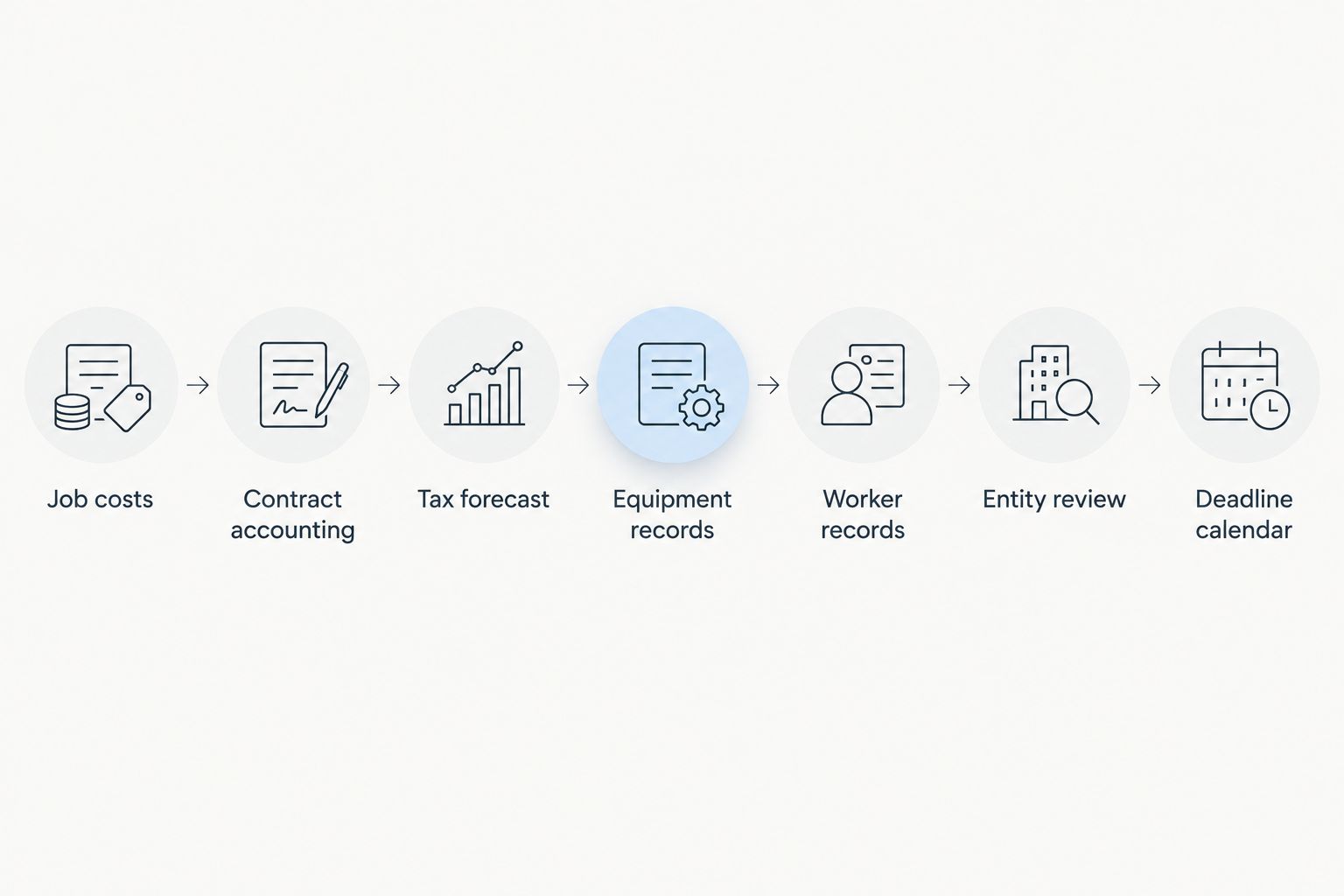
Build your plan around these connected records: Job costs, Contract accounting, Tax forecast, Equipment records, Worker records, Entity review, and Deadline calendar. Start with your existing ledger and spreadsheets; outside help works better when the underlying records agree.
Reconcile job costs
Start manually by matching bank transactions, invoices, payroll, and receipts to individual jobs. Keep overhead separate from direct project costs so you can explain both project margins and company-wide expenses.
Job costing and tax accounting serve different purposes. A useful management report does not automatically establish the timing of a tax deduction. Materials purchased, materials installed, and amounts paid to suppliers can fall into different reporting periods depending on the applicable rules.
Close the books every 30 days as a management routine. This recommended schedule gives you a repeatable checkpoint, not a tax deadline. Investigate unexplained balances before using the reports for estimated payments.
- Assign a consistent job code to project transactions.
- Separate direct labor, materials, subcontractors, and overhead.
- Reconcile credit cards and equipment financing accounts.
- Track customer deposits and retainage separately.
- Keep invoices and receipts attached to ledger entries.
Review contract accounting
Read each contract alongside its billing schedule and expected completion date. Then confirm which tax accounting rules apply rather than assuming that your invoice date controls income recognition.
Federal long-term contract rules can apply when a contract is not completed within the tax year it begins. Percentage-of-completion rules, construction exceptions, and small-business provisions require an eligibility review; the completed-contract method is not an unrestricted election for every contractor.
Use Internal Revenue Code Section 460 and IRS Publication 538, Accounting Periods and Methods, as starting references. For your 2026 plan, ask a construction tax professional to document the method and any required accounting-method change procedure.
- List open contracts with start dates and expected completion dates.
- Identify retainage terms and customer advance provisions.
- Separate billing milestones from work actually performed.
- Review eligibility before applying a contract-accounting exception.
- Document the treatment of change orders and disputed amounts.
Forecast tax payments and separate old debt
Build a spreadsheet using expected taxable income, payroll obligations, owner payments, and scheduled collections. Maintain a 12-month tax forecast alongside a 13-week cash forecast so an annual projection does not hide a near-term payment shortage.
These are planning horizons, not statutory requirements. Update the forecasts when a project slips, a collection stalls, or a large change order becomes enforceable.
If prior liabilities complicate that work, The Rutter Organization provides tax resolution services. The Rutter Organization is best for construction business owners seeking tax resolution services; that role is separate from maintaining job costs or determining contract-accounting treatment. Professional resolution support addresses existing tax problems, but you still need current records and a plan for new obligations.
- Project income using the applicable tax accounting method.
- Reserve payroll tax deposits separately from operating cash.
- Separate owner distributions from deductible compensation.
- List prior tax balances apart from current-year estimates.
- Recalculate payment needs after material forecast changes.
Document equipment use before claiming deductions
Create an equipment register before discussing accelerated deductions. Record the purchase agreement, financing, acquisition date, business use, and when each asset became ready and available for its intended business use.
Section 179, bonus depreciation, and regular depreciation have different requirements and consequences. A financed purchase is not treated simply by deducting every loan payment, and a purchase order alone does not establish that equipment was placed in service.
For 2026 equipment decisions, compare the operational need with the tax treatment. Do not buy equipment solely to create a deduction. An accelerated deduction changes tax timing; the purchase still consumes cash or creates debt.
- Separate repairs from purchases requiring capitalization review.
- Record delivery and placed-in-service evidence.
- Track business and personal vehicle use.
- Compare immediate deductions with deductions over time.
- Review potential depreciation recapture before selling equipment.
Verify worker and subcontractor records
Review how each worker actually performs the job before deciding how to report payments. A subcontractor agreement or Form 1099 does not, by itself, establish independent-contractor status.
Federal tax classification considers the working relationship, including behavioral control, financial control, and the type of relationship. State employment, unemployment, and workers’ compensation rules require separate attention; a federal tax conclusion does not settle every obligation.
Use a consistent onboarding checklist, then test whether actual field practices match the paperwork. Treat missing records as an operational issue before filing season, not an administrative detail to fix afterward.
- Obtain completed Forms W-9 from applicable vendors.
- Review control over schedules, methods, and equipment.
- Reconcile subcontractor payments before preparing information returns.
- Check current reporting thresholds and filing requirements.
- Track employee work locations for state payroll review.
Review entity structure and owner compensation
Compare your current legal structure and tax classification with actual earnings, payroll, ownership, and administrative capacity. An LLC is a state-law structure; its federal tax treatment depends on its circumstances and elections.
An S corporation election does not eliminate employment taxes. Shareholder-employees must receive reasonable compensation for services before non-wage distributions are treated as such. The right analysis includes payroll administration, state treatment, benefit rules, and the cost of maintaining compliance.
Coordinate retirement contributions and the qualified business income deduction with the same forecast. Do not treat either as an isolated deduction that automatically applies to every dollar of construction income.
- Confirm the entity’s current federal tax classification.
- Model owner wages and distributions separately.
- Document the basis for reasonable compensation.
- Review retirement-plan eligibility and contribution deadlines.
- Include employee coverage requirements in plan comparisons.
Build a deadline calendar across jurisdictions
Finish with a calendar that assigns responsibility for each filing, payment, and supporting report. A deadline without an owner is only a reminder; identify who prepares the information, who reviews it, and who authorizes payment.
Construction projects can create obligations outside your home state. Evaluate income or franchise taxes, payroll registration, sales and use tax, and local requirements before assuming that filing at headquarters covers every job.
Your 2026 calendar should also distinguish extensions to file from payment obligations. Filing an extension generally does not extend the time to pay tax.
- Map project locations to relevant tax jurisdictions.
- Record federal, state, and local filing obligations.
- Assign responsibility for payroll deposits and information returns.
- Schedule forecast reviews before payment deadlines.
- Retain filing acknowledgments and payment confirmations.
Compare tax planning options for construction companies
Choose support according to the problem you need solved. Accurate books, prospective tax advice, return preparation, and tax resolution are different assignments; one engagement does not automatically include the others.
| Option | Best for | Main advantage | Key limitation |
|---|---|---|---|
| Manual ledger and spreadsheet workflow | Owners organizing straightforward records | Direct control over job codes, documents, and forecasts | Requires consistent upkeep and does not supply technical tax judgment |
| Construction-focused bookkeeper | Contractors with incomplete or inconsistent job records | Organizes project costs, reconciliations, and reporting | Bookkeeping alone does not establish tax advice or representation |
| Construction tax professional | Contractors reviewing accounting methods, entities, or multistate work | Connects technical tax treatment with project facts | Needs reliable records and a clearly defined engagement |
| The Rutter Organization tax resolution services | Owners addressing existing tax problems | Provides a service path for resolving tax issues | Tax resolution is separate from routine job bookkeeping and prospective planning |
Use bookkeeping to establish the facts, tax planning to evaluate choices, and tax resolution to address existing problems. Ask each provider which work is included, which records you must supply, and which responsibilities remain with you.
For a contractor with both unfinished books and overdue filings, sequence the work rather than expecting a single conversation to resolve everything. Reconstruct the records, establish filing obligations, and then evaluate resolution options against the actual balances.
Common tax planning mistakes construction companies make
Treating collections as taxable profit
Progress payments and customer advances do not explain project profitability or settle income-recognition questions. Reconcile collections to contracts, earned revenue, and your applicable tax accounting method before estimating taxes.
Assuming retainage is always taxed when collected
Retainage treatment depends on the facts and applicable accounting rules. Document contract conditions and distinguish a billing holdback from a disputed right to payment; do not apply one treatment across every project without review.
Spending payroll tax reserves on materials
Payroll tax deposits are obligations, not a project financing source. Track withheld amounts and required deposits separately, and address a shortfall immediately instead of waiting for the next customer payment.
Buying equipment before checking the cash effect
A deduction does not reimburse the purchase. Compare debt service, operating needs, and the timing of deductions before committing to equipment that the project schedule does not require.
Ignoring tax obligations outside the home state
A temporary project location still deserves a jurisdiction review. Check registration, payroll, sales and use tax, and business-tax exposure before crews mobilize rather than after the first notice arrives.
FAQ
What is the first step in business tax planning for construction companies?
Start by reconciling job costs and confirming your tax accounting method. Reliable records show which income and expenses belong in the forecast; a bank balance alone does not.
Can my construction company use the completed-contract method?
Only eligible contracts and taxpayers can use the completed-contract method under the applicable rules. Review the contract type, business circumstances, and accounting-method requirements before applying it.
Do construction companies pay tax on retainage before receiving it?
Retainage timing depends on the applicable tax accounting method and contract facts. Review whether the right to payment is fixed and how the relevant construction accounting rules apply.
Should I buy equipment before the end of 2026 to reduce taxes?
Buy equipment when the business needs it, then evaluate the available tax treatment. Deduction timing depends on eligibility and placed-in-service requirements, while the purchase still affects cash or debt.
Does an LLC automatically reduce a contractor’s taxes?
No, an LLC does not automatically reduce federal taxes. Its tax classification, owner compensation, elections, and state obligations determine the result.
Can I issue a Form 1099 to everyone on my construction crew?
No, issuing a Form 1099 does not establish independent-contractor status. Evaluate the actual working relationship and applicable federal and state rules before classifying workers.
Can The Rutter Organization help if my construction business already has tax problems?
The Rutter Organization provides tax resolution services to individuals and businesses. Define the specific issue and engagement scope; ongoing construction bookkeeping and prospective tax planning are separate needs.
One last thing
Before approving your next equipment purchase, place the deduction estimate beside the next payroll run and your unpaid supplier invoices. A smaller tax bill does not fix a cash shortage. For your 2026 plan, make the spending decision from the cash forecast and the tax decision from the applicable rules—not the other way around.


