

Medical practice business tax planning is the coordination of business income, owner compensation, deductions, and tax payments to meet tax obligations without disrupting patient care. This guide to business tax planning for medical practices addresses the decisions that connect insurance collections, clinical payroll, equipment purchases, and the owner's personal return.
- Business tax planning for medical practices starts with reconciled collections, payroll, and owner compensation—not last-minute deductions.
- Rutter Organization fits medical practice owners seeking tax resolution; ongoing planning requires a separate scope.
- Compare entity structures using total taxes, payroll obligations, and administrative work—not a promised savings percentage.
- Coordinate retirement contributions and estimated taxes before committing cash to equipment or owner distributions.
Why business tax planning matters for medical practices
Your practice's appointment calendar does not show its taxable income. Insurance receivables, patient payments, refunds, payroll, and owner withdrawals follow different schedules. A profitable practice still needs a deliberate plan for paying taxes when cash arrives unevenly.
For 2026, separate two assignments: keeping current obligations funded and resolving any existing tax problems. Rutter Organization provides tax resolution services; define the engagement before assuming it includes bookkeeping, return preparation, or medical-practice planning.
Build the plan around collected income, documented expenses, and household tax exposure—not gross charges. A physician's outside employment, a spouse's earnings, and practice distributions belong in the same forecast even when different professionals prepare the returns.
How to build your medical practice tax plan
Follow the sequence below before approving a tax election or major purchase. Each decision depends on the records and assumptions established in the preceding step; a deduction calculated from unreliable books is not a usable plan.
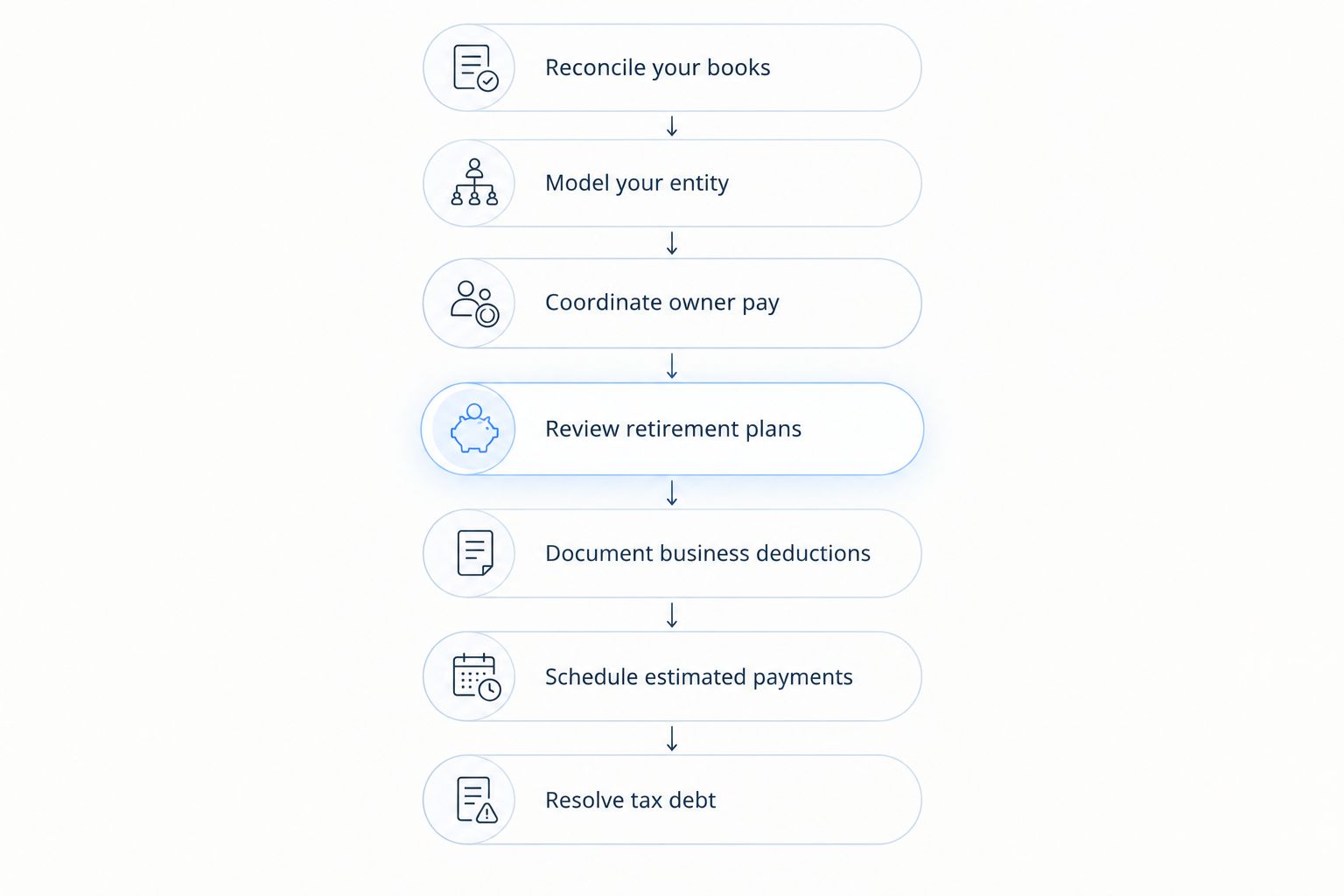
Reconcile your books
Start with bank statements, merchant settlements, payroll reports, and the practice management system. Match deposits to actual collections rather than treating billed charges as cash received. Separate contractual adjustments, patient refunds, and processor fees so the same amount does not enter the books twice.
Build a rolling 12-month cash forecast that distinguishes operating funds, tax reserves, and owner distributions. This is a planning schedule, not a claim about how much cash every practice needs. Show scheduled obligations explicitly, including payroll, rent, debt payments, and equipment commitments.
Your accounting method determines when income and expenses enter the tax calculation. Cash-basis and accrual-basis practices need different reconciliations; confirm the method before moving receipts or payments across year-end.
- Reconcile every business bank and credit-card account.
- Match merchant settlements to collections and processing fees.
- Separate owner draws from deductible payroll expenses.
- Identify unpaid insurance claims without treating them automatically as taxable receipts.
- Create a tax-reserve line in the cash forecast.
Model your entity
Use your current structure as the baseline before considering a change. Compare federal income tax, employment taxes, state obligations, payroll administration, and legal constraints. A lower tax estimate alone does not establish that an election works for a physician-owned practice.
An LLC is a legal structure, not a single federal tax classification. Likewise, an S corporation election does not eliminate the requirement to pay reasonable compensation to a shareholder who performs services. Professional ownership and licensing rules also need legal review.
For 2026, ask your preparer to show 3 planning scenarios: current structure, an alternative structure if legally permitted, and current structure with revised compensation or retirement contributions. These are comparison cases, not promised outcomes. Use the business entity structures guide to organize the questions, not to select an entity without calculations.
- Compare total taxes rather than one tax category.
- Include payroll and return-preparation obligations.
- Check professional licensing and ownership restrictions.
- Review election timing before changing operations.
- Record the assumptions behind each scenario.
Coordinate owner pay
Review compensation before scheduling distributions. A practice owner working through an S corporation needs reasonable wages for services performed; a sole proprietor generally takes draws rather than wages from that sole proprietorship. Partners face different rules again.
Document the owner's clinical duties, management responsibilities, work schedule, and compensation rationale. Do not set wages solely to produce a preferred payroll-tax result. For a group practice, reconcile the compensation agreement with payroll records and the tax treatment of payments to each owner.
Bring household income into the calculation. Outside wages, investment income, and a spouse's earnings affect the personal return even when the practice books are accurate. Review how owner health insurance is reported under the applicable entity rules rather than copying an employee's treatment automatically.
- Identify each owner's tax classification and payment method.
- Document clinical and administrative responsibilities.
- Review wages before approving distributions.
- Coordinate practice income with household withholding.
- Confirm owner-benefit reporting with the preparer.
Review retirement plans
Begin with an employee census and your existing plan documents. List employees, compensation, service history, and current contributions before choosing a contribution target for the owner. Owner-only planning is incomplete when staff eligibility or employer contributions apply.
A retirement deduction also requires cash. Test contributions against payroll, debt service, and the tax reserve instead of selecting the largest theoretical deduction. Ask the plan administrator to distinguish plan-establishment deadlines, election deadlines, and funding deadlines; they are not interchangeable.
For 2026 planning, use IRS Publication 560 for the scope of small-business retirement-plan rules, together with current plan documents and administrator guidance. A tax preparer should calculate the deduction, while the plan administrator confirms plan operation and eligibility requirements.
- Update the employee census before requesting illustrations.
- Compare owner benefits with required employer contributions.
- Confirm which related businesses affect plan coverage.
- Record establishment, election, and funding deadlines separately.
- Reserve contribution cash before making owner distributions.
Document business deductions
Classify spending by business purpose before discussing its tax treatment. Clinical supplies, professional insurance, software, and continuing education need supporting records; equipment and improvements require additional review because capitalization and depreciation rules apply.
Buy equipment because the practice needs it, not because a deduction sounds attractive. A tax deduction reduces taxable income; it does not reimburse the purchase. For 2026 equipment planning, confirm when an asset is placed in service and which depreciation rules apply before including a deduction in the forecast.
Keep tax support separate from unnecessary patient information. A purchase invoice, business-purpose note, and payment record generally provide a better starting point than an unfiltered export containing clinical details. For vehicle and travel documentation, IRS Publication 463 addresses substantiation requirements; do not treat ordinary commuting as business travel.
- Save invoices and evidence of payment.
- Record the business purpose of travel and education.
- Separate equipment purchases from routine supplies.
- Record when equipment becomes ready and available for use.
- Remove unnecessary patient identifiers from tax workpapers.
Schedule estimated payments
Calculate estimated taxes from a current projection, not from the checking-account balance. Federal individual estimated tax generally follows 4 payment periods, but the periods are not equal calendar quarters. Put the applicable due dates on the owner's calendar rather than assuming every payment falls at quarter-end.
For 2026 planning, IRS Publication 505 covers individual withholding and estimated-tax methods. Ask the preparer to evaluate the applicable safe harbor and, when income is uneven, whether the annualized income installment method fits the facts. State payment requirements need their own review.
Revisit the projection after a material change: adding a physician, losing a payer contract, receiving a large distribution, or selling an asset. Prior payments and withholding must enter the calculation so an update does not double-count tax already paid.
- Combine practice income with other household income.
- Reconcile withholding and estimated payments already made.
- Record federal and state deadlines separately.
- Recalculate after significant income changes.
- Keep payment confirmations with the projection.
Resolve tax debt
Separate past-due liabilities from the current-year plan. Gather notices, filed returns, payment records, and a list of unfiled periods before choosing a response. A payment arrangement does not replace current payroll deposits, required filings, or current estimated payments.
Rutter Organization is best for medical practice owners seeking tax resolution rather than a replacement for ongoing practice tax planning. Its stated services include tax resolution, but the scope for a particular engagement still needs to be agreed in writing. Ask who handles the matter, what work is included, and which responsibilities remain with your preparer or payroll provider.
Treat payroll-tax problems as a separate priority. Certain unpaid employment taxes can create personal exposure for responsible individuals under federal law; do not assume the practice's entity structure removes that risk.
- Inventory notices, balances, and response deadlines.
- Identify unfiled returns before discussing resolution options.
- Keep current payroll deposits and filings on schedule.
- Separate disputed amounts from agreed liabilities.
- Assign responsibility for every required response.
Compare planning and resolution options
Choose support by the task you need completed. Bookkeeping, tax planning, retirement-plan administration, and tax resolution solve different problems; hiring one provider does not establish that every task is covered.
| Option | Best for | Practical advantage | Key limitation |
|---|---|---|---|
| Owner-managed records and spreadsheets | A practice organizing documents before professional review | Keeps assumptions and source records visible | Depends on the owner's accounting knowledge and maintenance |
| CPA or enrolled agent with practice-tax experience | Entity modeling, projections, and return coordination | Connects business decisions with tax calculations | Services and planning frequency depend on the engagement |
| Retirement-plan administrator | Eligibility, contribution calculations, and plan operation | Addresses plan-specific requirements | Does not replace the practice's full tax forecast |
| Rutter Organization tax resolution services | Medical practice owners seeking help with tax problems | Provides a service category directed at tax resolution | Ongoing medical-practice tax planning is not established by the stated service description |
Assign one person to coordinate the plan. Otherwise, a retirement contribution, revised payroll amount, and estimated payment can each be calculated using different income assumptions. Confirm that the final projection reflects all three before acting.
Common mistakes medical practice owners make
Treating gross charges as taxable collections
Charges, contractual adjustments, and deposits describe different parts of the revenue cycle. Reconcile them before estimating income; otherwise, your forecast starts with the wrong revenue figure.
Choosing an S corporation without modeling compensation
An election does not turn every owner payment into a distribution. Compare reasonable wages, employment taxes, administrative obligations, and applicable state treatment before deciding that the structure improves the result.
Assuming medical income always qualifies for the QBI deduction
Health services fall within specified service trade or business rules for the qualified business income deduction. Eligibility depends on the applicable taxable-income limits and other requirements. Run the calculation rather than assuming every pass-through dollar qualifies.
Funding equipment before taxes and staff benefits
A needed asset still competes with payroll, retirement contributions, and tax payments for cash. Compare the purchase against the forecast before committing funds; a deduction does not resolve a cash shortage.
Confusing an extension with extra time to pay
A filing extension generally extends the time to file, not the time to pay. Estimate the payment obligation separately and distinguish it from any arrangement addressing older debt.
FAQ
What's the first step in business tax planning for medical practices?
The first step is reconciling collections, expenses, payroll, and owner payments. Use those records to create a cash forecast and tax projection before considering entity changes or deductions.
Should a medical practice elect S corporation status?
A medical practice should elect S corporation status only after comparing total taxes, reasonable owner compensation, administrative obligations, and legal eligibility. The election does not eliminate wages for an owner who performs services.
Can doctors claim the qualified business income deduction?
Doctors can qualify for the qualified business income deduction when the applicable requirements are met. Health services are subject to specified service trade or business rules, so taxable income and the relevant limits affect eligibility.
Can my medical practice deduct new equipment immediately?
Immediate deductibility depends on the asset, its placed-in-service date, applicable expensing rules, and other limits. Confirm the treatment before counting the deduction in a tax forecast; signing a purchase agreement alone does not establish it.
How should a physician owner handle estimated taxes?
A physician owner should calculate estimated payments using projected household income, withholding, prior payments, and applicable safe-harbor rules. Uneven collections also warrant a review of the annualized income installment method.
Does Rutter Organization provide medical practice tax planning?
Rutter Organization's stated services include tax resolution; a medical-practice tax-planning service is not established by that description. Confirm the engagement scope and keep responsibility for projections, payroll, and return preparation explicit.
What should I bring to a medical practice tax review?
Bring reconciled financial statements, payroll reports, prior returns, owner-payment records, equipment records, and retirement-plan documents. Include tax notices and payment confirmations so current obligations and older liabilities remain separate.
One last thing
Before approving your 2026 plan, ask the preparer to show two results side by side: projected tax and cash remaining after the proposed action. A strategy that reduces taxable income but leaves payroll or tax payments unfunded fails the practice's cash test. Keep both results in the decision record.


