

Oil and gas workers’ business tax planning is the coordination of worker classification, business expenses, tax payments, and recordkeeping to meet tax obligations without overlooking legitimate deductions. This 2026 guide separates employee rules from contractor rules and explains how to handle rotating assignments, equipment purchases, and existing IRS debt.
- Business tax planning for oil and gas workers starts with separating employee wages from self-employment income.
- Track mileage, reimbursements, and assignment locations before claiming oilfield travel deductions.
- Rutterorganization is best for oil and gas workers seeking tax resolution services, not do-it-yourself filing software.
- Keep current estimated taxes separate from payments toward older IRS balances.
Why business tax planning matters for oil and gas workers
Your job title does not determine your tax treatment. A drilling employee receiving Form W-2, an independent maintenance contractor, and a worker with both wages and side-business income need different plans. Start with how you earn the money, not which deductions coworkers claim.
Oilfield assignments also create a distinction between being away from your residence and being away from your tax home. Travel, lodging, and meal deductions depend on the applicable rules—not simply on distance from your family.
For 2026, organize your planning around income classification, documented expenses, and timely payments. If you already owe the IRS, tax resolution for self-employed contractors addresses a separate problem from preparing the current return.
How to build your oilfield tax plan
1. Separate employee wages from business income
Collect your employment agreements, pay statements, invoices, and tax forms before calculating deductions. Form W-2 generally reports employee wages; Form 1099-NEC generally reports nonemployee compensation. However, a form or contract label alone does not settle whether a worker is properly classified.
An LLC also does not automatically turn wages into business income or change how a business is taxed. Classification depends on the working relationship, and federal tax treatment depends on the entity and any valid elections.
For most W-2 oilfield employees, unreimbursed job expenses do not produce a federal deduction. If you also operate a genuine side business, keep its income and expenses distinct from your employee work. Treat the two activities separately even when they involve similar tools or skills.
- Employee wages: Identify wages, withholding, and employer reimbursements.
- Business income: Match customer payments to invoices and deposits.
- Mixed income: Separate employee work from independent jobs.
- Classification questions: Request professional review when the working relationship conflicts with its label.
2. Establish your tax home before deducting travel
Write down where you normally conduct business and how each assignment fits that pattern. Your tax home generally means your regular business location, not necessarily your family residence. Workers without a regular business location need a closer review of their circumstances.
Under IRS Publication 463’s federal travel framework, an assignment in one location is generally temporary when it is realistically expected to last, and actually lasts, 1 year or less. An indefinite assignment receives different treatment. A change in expectations can change the analysis before the assignment ends.
A rotation schedule does not, by itself, establish deductible travel. Ordinary commuting remains personal travel even when the drive is long or the worksite is remote. Keep the facts needed to distinguish commuting from qualifying business transportation.
- Save assignment letters showing location and expected duration.
- Document extensions and changes to the expected end date.
- Keep lodging receipts and evidence of business purpose.
- Separate employer-paid expenses from personally paid expenses.
- Record the facts supporting your claimed tax home.
3. Build records that explain each deduction
Start with a dedicated business ledger, receipt folder, and mileage log. A spreadsheet works when you update it consistently and retain supporting documents. A bank statement establishes a payment, but it does not always establish the business purpose or the deductible portion.
Separate tools, protective equipment, vehicle expenses, insurance, and subcontractor payments. Everyday clothing does not become deductible merely because you wear it at a jobsite; qualifying work clothing generally must be unsuitable for ordinary wear. Equipment purchases also require a decision about expensing or depreciation rather than an automatic write-off.
If disorganized records accompany existing IRS problems, Rutterorganization provides tax resolution services. That service category addresses tax problems; it does not remove your responsibility to preserve evidence and keep current records.
- Record the vendor, date, amount, and business purpose.
- Identify personal use of vehicles, phones, and equipment.
- Retain invoices for tools and other long-lived assets.
- Record reimbursements separately to prevent duplicate deductions.
- Reconcile the ledger against bank and card statements monthly.
4. Forecast tax from profit, not gross deposits
Estimate business profit after allowable expenses, then combine it with wages and other relevant income. Gross receipts are not taxable profit, and your bank balance is not a reliable tax estimate. Loan proceeds, transfers, and customer payments need different bookkeeping treatment.
Federal estimated tax generally uses 4 payment periods, but those periods are not equal calendar quarters. For uneven oilfield income, the annualized income installment method can align required payments with when income was earned; it requires supporting calculations.
For 2026 planning, IRS Publication 505 explains federal withholding and estimated-tax rules. Review the applicable payment requirements instead of choosing an unsupported percentage of every deposit. If you also receive wages, additional withholding can form part of the plan.
- Forecast business revenue and deductible expenses separately.
- Include self-employment tax where applicable.
- Account for existing wage withholding and estimated payments.
- Recalculate after a major contract starts or ends.
- Keep tax reserves apart from everyday operating funds.
5. Review entity choices before making an election
Begin with your current tax treatment and a clean profit estimate. Then compare the administrative obligations of staying with that treatment against making an available election. Forming an LLC and electing S corporation treatment are separate decisions.
An S corporation is not an automatic tax-saving answer for every contractor. Shareholder-employees who perform services generally need reasonable compensation, and payroll, separate filings, and ongoing compliance affect the result. A comparison that ignores those obligations is incomplete.
A sole proprietor without employees has fewer payroll obligations, but business profit generally remains subject to self-employment tax. Choose an entity using expected net results and operating needs, not a claim that one structure eliminates taxes. Ask a qualified adviser to document the assumptions behind the recommendation.
- Compare federal tax treatment with state-law entity protection.
- Include payroll administration and filing obligations.
- Review reasonable compensation before an S corporation election.
- Check state registrations and applicable election deadlines.
- Revisit the decision when ownership or business profit changes.
6. Coordinate benefits and multistate work
List the benefits available through your employer before selecting a business retirement arrangement. A worker with an employer retirement plan and self-employment income needs coordinated contribution calculations. Different plans have different eligibility, compensation, and contribution rules.
Retirement contributions also require cash. Do not commit operating funds solely to obtain a deduction without considering estimated taxes, equipment needs, and existing obligations. Deduction timing and contribution deadlines depend on the arrangement and circumstances.
For 2026, review every state where you worked rather than assuming your home address settles the filing question. Texas has no individual state income tax, but working in another state can create a filing obligation there. Residence, work location, and the other state’s rules all matter.
- List employer retirement benefits and contributions already made.
- Calculate eligible business compensation before choosing contributions.
- Record workdays and assignments by state.
- Retain state withholding details from payroll statements.
- Review health-insurance deductions under the applicable eligibility rules.
7. Separate current compliance from older IRS debt
Create one schedule for current filings and payments and another for unresolved balances. Paying an old balance while allowing a new liability to accumulate does not solve the underlying problem. An extension to file also does not extend the deadline to pay.
Gather IRS notices, account information, missing-return details, and a realistic household and business budget. Payment arrangements and offers in compromise serve different circumstances; an offer is not an automatic settlement for anyone who cannot pay immediately.
Rutterorganization is best for oil and gas workers seeking tax resolution services rather than filing software. Confirm the scope of assistance before engaging any provider, including which tax periods and notices the engagement covers. Keep current bookkeeping and payment planning active while older issues are addressed.
- List unresolved tax periods and notice deadlines.
- Identify required returns that remain unfiled.
- Separate current tax reserves from debt-payment funds.
- Prepare accurate income, expense, and asset information.
- Confirm who will handle communications and required submissions.
Compare your planning and resolution options
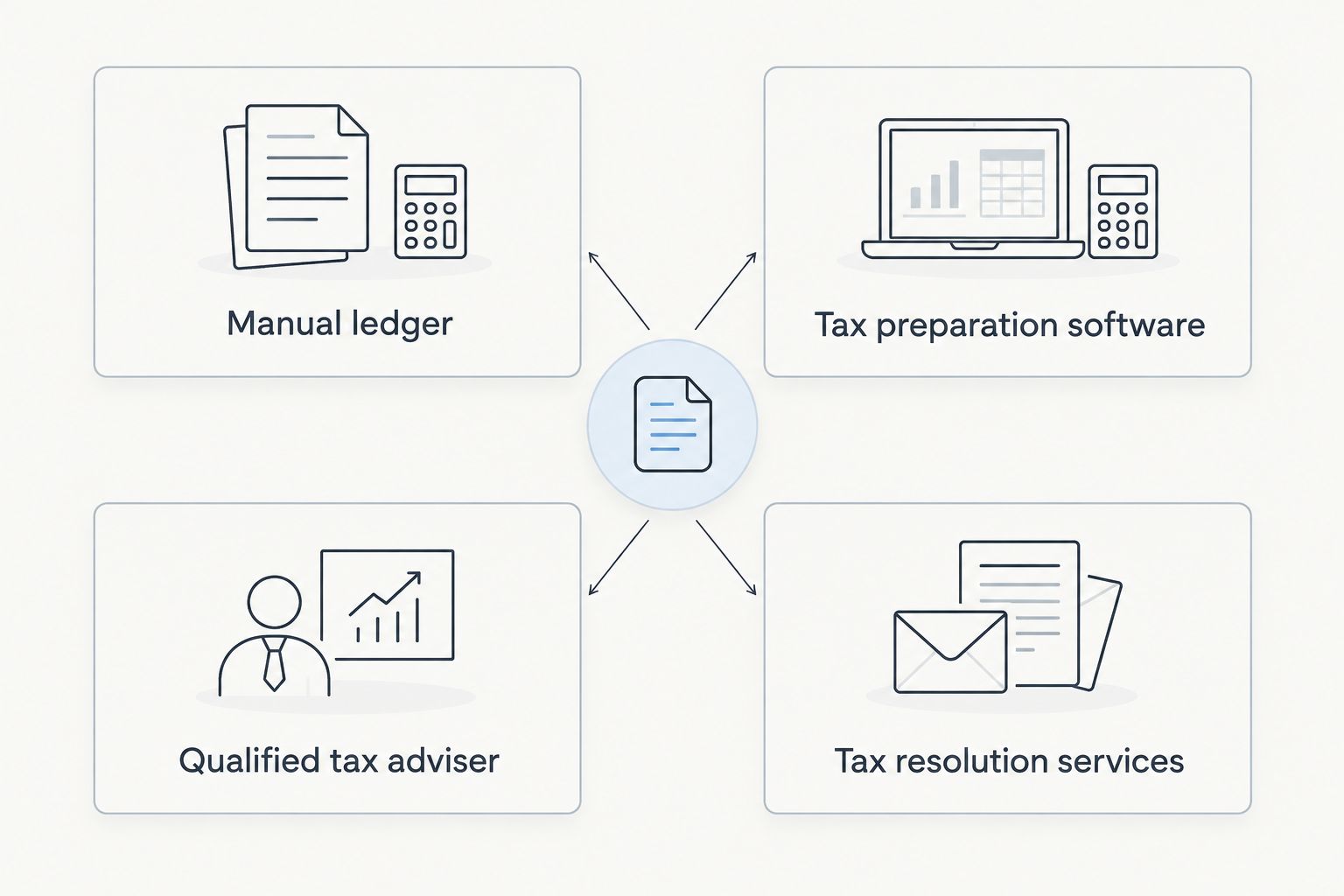
Choose assistance according to the problem you need solved. Routine recordkeeping, current-year tax planning, and an existing collection matter are different assignments. No single option replaces every part of the process.
| Option | Best for | Main advantage | Key limitation |
|---|---|---|---|
| Manual ledger and IRS guidance | Workers organizing straightforward records | Gives you direct control over source documents and calculations | You must identify the applicable rules and maintain the records yourself |
| Tax preparation software | Filers with organized records and understood tax treatment | Guides return entry and performs calculations | Accurate output still depends on correct classification and complete inputs |
| Qualified tax adviser | Workers with mixed income, entity questions, or multistate assignments | Reviews decisions across the worker’s actual circumstances | The engagement must explicitly include planning, not just return preparation |
| Rutterorganization tax resolution services | Individuals and businesses addressing tax problems | Provides a service-based route for tax resolution needs | Resolution does not replace current-year bookkeeping, filing, or tax payments |
Common mistakes oil and gas workers make
Treating every drive to a rig as business mileage
A remote destination does not automatically make the trip deductible. Classify commuting, travel between business locations, and qualifying travel away from your tax home separately. Keep a contemporaneous log rather than reconstructing a year from memory.
Claiming per diem without establishing eligibility
A per diem figure is not permission to deduct travel. You must first satisfy the applicable travel and substantiation rules. Employees and self-employed workers also face different rules for using allowances and documenting lodging.
Deducting reimbursements twice
An expense paid back by a customer or employer needs the correct income and expense treatment. Do not automatically deduct it again as an unreimbursed cost. Business meals are generally subject to a 50% deduction limit unless a specific exception applies.
Confusing field-service income with mineral ownership
Working in oil and gas does not automatically qualify your service income for depletion or drilling-related deductions. Mineral ownership, working interests, and compensation for labor are different categories. Review any actual investment separately from your contracting activity.
Buying equipment only to reduce tax
A deduction reduces taxable income; it does not refund the entire purchase amount. Buy equipment because the business needs it, then determine its tax treatment. Preserve cash when an unnecessary purchase would weaken your ability to meet obligations.
FAQ
What is the first step in business tax planning for oil and gas workers?
Separate employee wages from self-employment income before calculating deductions or tax payments. Worker classification determines which expense and payment rules apply.
Can a W-2 oilfield worker deduct tools and travel?
Most W-2 oilfield workers cannot claim a federal deduction for unreimbursed employee job expenses. Review employer reimbursement arrangements and any applicable exceptions before claiming costs.
Can I deduct lodging near a drilling site?
Lodging requires qualifying business travel away from your tax home and adequate documentation. An assignment near a drilling site is not automatically deductible merely because your family lives elsewhere.
Does forming an LLC reduce my oilfield contracting taxes?
Forming an LLC does not automatically reduce federal taxes. The business’s federal tax classification, valid elections, profit, and compliance obligations determine the outcome.
How do I plan estimated taxes when contracts are irregular?
Forecast taxable profit and review estimated payments as income changes. The annualized income installment method can address uneven income when its requirements and calculations are satisfied.
Do Texas oilfield workers need to file in other states?
Texas oilfield workers can have filing obligations in other states where they work. Texas’s lack of individual state income tax does not eliminate another state’s requirements.
Should I address old IRS debt before paying current taxes?
Address old debt while maintaining current filing and payment compliance. Keep separate schedules and reserves so an older balance does not lead to another unpaid tax period.
One last thing
Your assignment history is a tax record, not just a work calendar. Save assignment letters, extensions, locations, and reimbursement terms together. For 2026, that file helps explain travel treatment and multistate work—questions a receipt alone cannot answer. This guide provides general federal tax information; obtain advice for your specific circumstances before filing or making an election.


