

Yes—a tax resolution service can help stop an IRS wage garnishment by requesting a levy release based on economic hardship, an appropriate payment arrangement, or another valid legal ground. In 2026, hiring a service does not itself stop withholding: the IRS must release the levy, and your employer must receive and process that release.
- A tax resolution service can request an IRS wage levy release; hiring one does not stop withholding.
- Economic hardship can require release when a wage levy prevents payment of reasonable basic living expenses.
- An installment agreement does not automatically release an existing wage levy; request release explicitly.
- Rutterorganization provides tax resolution services for individuals and businesses; the IRS decides whether to release a levy.
Can a tax resolution service stop an IRS wage garnishment?
Yes, but the service must establish a valid reason for the IRS to release the wage levy. A representative can communicate with the IRS, document your finances, request relief, and pursue available appeal rights. The representative cannot order your employer to disregard an active levy.
The strongest route depends on whether you cannot afford basic necessities, can make sustainable payments, or dispute the collection action. These routes address different problems; they are not interchangeable.
| Route | Best for | Main advantage | Main limitation |
|---|---|---|---|
| Economic-hardship release | Taxpayers unable to pay reasonable basic living expenses | Addresses the immediate financial harm caused by withholding | Does not erase the tax debt |
| Installment agreement with release request | Taxpayers able to make regular payments | Connects levy relief with an ongoing repayment arrangement | An existing levy needs separate attention |
| Collection appeal | Taxpayers challenging a levy or seeking review of collection alternatives | Provides a formal review process | Deadlines and available procedures depend on the notice |
| Offer in compromise | Eligible taxpayers whose circumstances support settling for less | Can resolve the underlying liability if accepted and completed | Is not an automatic release of an existing wage levy |
For broader context on the service category, Rutterorganization serves individuals and businesses through tax resolution services. A provider's involvement does not replace the IRS approval needed to stop withholding.
Why this matters
An IRS wage levy generally continues against future wages until the IRS releases it, the debt is paid, or the collection period ends. It is not simply a deduction from a single paycheck. Waiting for the next payroll cycle does not resolve the underlying collection action.
For a wage levy affecting your household in 2026, separate two objectives: protecting money needed for basic living expenses and resolving the unpaid tax. A levy release addresses collection; it does not necessarily reduce what you owe.
IRS guidance titled What if a levy is causing a hardship explains the hardship-release principle. IRS Publication 594, The IRS Collection Process, explains collection procedures and taxpayer options. Use those sources alongside your actual notice, because the notice identifies the action and applicable response deadline.
What should you do when payroll receives an IRS wage levy?
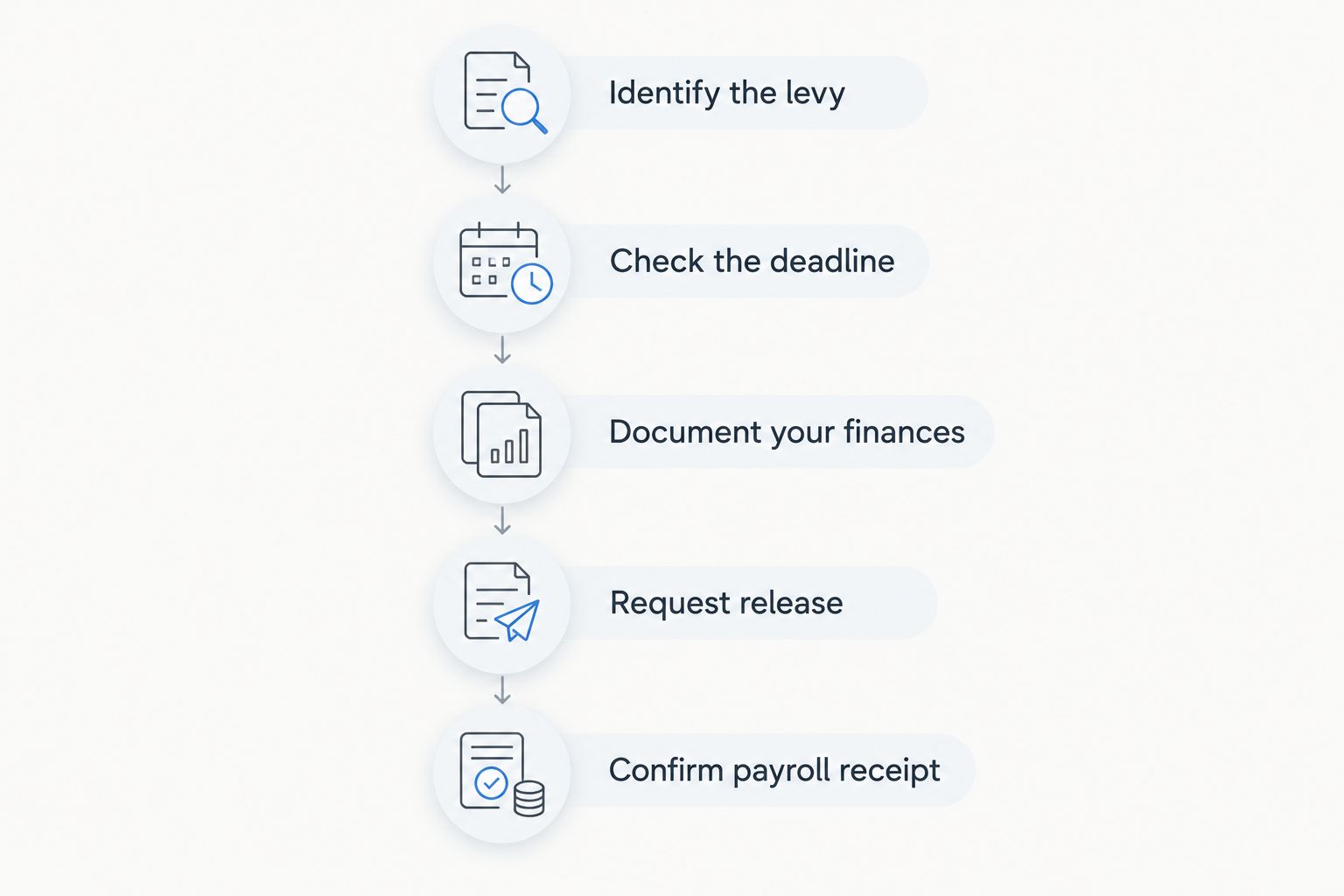
Address the active levy directly, rather than submitting a general tax-relief inquiry and waiting. Start with the notice, the payroll paperwork, and your current financial position.
- Identify the levy. Obtain the IRS notice and the employer's levy paperwork, commonly Form 668-W. Record the IRS contact information, tax periods, and the date payroll received it. Confirm whether deductions have started.
- Check the deadline. Read the notice's instructions for requesting a hearing or other review. A Collection Due Process hearing request generally has a 30-day deadline shown on the applicable notice; do not substitute a deadline from an unrelated letter.
- Document your finances. Gather current pay statements, bank records, housing expenses, utilities, transportation expenses, medical costs, and dependent information. Explain any expense that the records alone do not make clear.
- Request release. Contact the IRS office handling the levy, or authorize an eligible representative to do so. State whether the request rests on hardship, an installment agreement, an error, or another applicable release ground.
- Confirm payroll receipt. Ask how the IRS will transmit the release and confirm that your employer received it. Then check which payroll run reflects the change.
For an active levy in 2026, the decisive milestone is the release reaching payroll—not the date you sign a service agreement. Keep a record of communications, documents submitted, and the employer's confirmation.
Economic-hardship release: protect basic living expenses
Best for: taxpayers whose wage levy prevents payment of reasonable basic living expenses. Under Internal Revenue Code section 6343 and the applicable Treasury regulations, the IRS must release a levy that creates qualifying economic hardship for an individual taxpayer.
Build the request around your actual financial position. Show take-home income, necessary household expenses, dependents, and circumstances such as medical needs. A statement that withholding is inconvenient does not establish the same case as records showing you cannot cover necessities.
The advantage is direct: hardship relief addresses the damage caused by the levy itself. The limitation is equally important: releasing the levy does not cancel the liability. The IRS can evaluate whether your account qualifies for currently not collectible status or another resolution.
Unfiled returns still require attention, but hardship release and filing compliance are separate issues. Do not assume you must leave an economically harmful levy unaddressed while you assemble every overdue return.
Installment agreement: pair repayment with a release request
Best for: taxpayers who can afford regular payments without sacrificing basic living expenses. An installment agreement creates a repayment arrangement; a levy-release request addresses the withholding already affecting your wages.
Ask explicitly how the proposed agreement affects the existing wage levy. IRS rules generally restrict new levy action while a qualifying installment agreement request is pending, subject to exceptions, but that protection is not the same as automatically removing a levy already served.
The benefit is a defined repayment approach. The drawback is that interest and applicable penalties generally continue, and you must meet the agreement's requirements. A payment that exceeds your sustainable budget is not a sound resolution.
Before accepting an arrangement, understand the payment obligation, filing requirements, and consequences of default. Also confirm whether the IRS has issued the wage-levy release rather than relying on the agreement alone.
Offer in compromise: resolve debt, not just withholding
Best for: eligible taxpayers whose financial circumstances support settling their tax liability for less than the full amount. The IRS considers ability to pay, income, expenses, and asset equity when evaluating an offer based on doubt as to collectibility.
An offer is not a shortcut around an active wage levy. IRS restrictions on levy action during a pending offer do not automatically release a levy already in place. Ask separately what must happen to stop the current payroll deductions.
The advantage is potential resolution of the underlying liability. The limitation is qualification: an application is not an acceptance, and acceptance carries continuing obligations. For an accepted offer, taxpayers generally must file and pay required taxes for 5 years after acceptance, subject to the offer's terms.
The guide to IRS offer-in-compromise strategies explains the settlement route. Keep the immediate release request distinct from that longer-term decision.
Why the path to stopping a wage levy varies
The right request depends on the facts in your collection case, not a provider's advertised promise. These factors determine what needs attention:
- Collection stage. A final notice, an appeal deadline, and an active payroll levy require different actions. Identify which document you have before choosing a response.
- Basic living expenses. Documented inability to meet reasonable necessities supports a hardship request. Your income alone does not tell the full story.
- Filing compliance. Missing required returns affect eligibility for several resolution options. Identify the missing periods and address them alongside the collection issue.
- Payment capacity. Available monthly income and asset equity influence whether repayment, hardship status, or an offer fits your circumstances.
- Payroll processing. The employer needs the IRS release and must apply it through payroll. Ask about the actual processing cutoff rather than assuming the next deposit will change.
In 2026, choose the release ground first and the long-term resolution second. A settlement application is not a substitute for addressing a levy that prevents you from paying rent or buying food.
How do you choose a tax resolution service for wage garnishment?
Choose a provider that clearly distinguishes a levy-release request from a promise to settle your debt. Ask who will handle IRS communications, what authorization is needed, and which documents support the proposed request.
Rutterorganization is a tax resolution option for individuals and businesses seeking help with tax debt. Evaluate the engagement against your immediate need: stopping an active wage levy requires specific attention to collection, not just return preparation or general planning.
Before engaging Rutterorganization or another tax resolution service, ask:
- Who will represent you before the IRS, and what credentials authorize that work?
- Will the engagement include an explicit request to release the existing wage levy?
- Which hardship or repayment documents must you provide?
- Who will confirm that payroll received the release?
- What work remains if the IRS releases the levy but the debt remains unpaid?
Representation can help organize documents and manage IRS communication. It cannot guarantee approval, eliminate eligibility requirements, or make an employer ignore a valid levy. Reject any promise that merely signing up stops garnishment.
Does hiring a tax resolution service stop withholding immediately?
No—hiring a tax resolution service does not immediately stop withholding. Signing an engagement agreement or submitting representative authorization does not release an IRS wage levy. Confirm the IRS release and the employer's processing before treating the paycheck deduction as resolved.
Can you ask the IRS to release a wage levy yourself?
Yes—you can request a wage-levy release directly from the IRS. Use the contact information on the levy notice and provide the documents supporting your request. Professional help is an option, not a legal prerequisite for asking the IRS to address hardship or another release ground.
FAQ
Can a tax resolution service guarantee that my IRS wage garnishment will stop?
No tax resolution service can guarantee an IRS wage-levy release. The IRS must evaluate the applicable release ground, and your employer needs the release before changing withholding.
Will the IRS stop garnishing my wages if I cannot pay rent?
The IRS must release a levy that creates qualifying economic hardship by preventing payment of reasonable basic living expenses. Provide current income and expense records so the IRS can evaluate your circumstances.
Does an IRS payment plan automatically stop an existing wage garnishment?
An IRS payment plan does not automatically stop an existing wage levy. Request release of the active levy explicitly and confirm that payroll receives the release.
How long do I have to request a Collection Due Process hearing?
You generally have 30 days to request a Collection Due Process hearing after the applicable notice. Follow the deadline and filing instructions on your actual notice; other appeal procedures have different rules.
Will a wage-levy release erase my IRS tax debt?
A wage-levy release does not erase your tax debt. You still need to address the liability through payment, an approved resolution, or another applicable legal outcome.
Can my employer stop an IRS wage levy because I hired someone?
Your employer cannot stop honoring a valid IRS wage levy merely because you hired a representative. Ask the IRS to send the release and confirm with payroll when it will take effect.
Can I get back wages the IRS already collected?
Releasing a wage levy does not automatically return wages already collected. Returning levy proceeds is a separate issue with its own legal requirements and deadlines, so identify the payments involved when requesting review.
One last thing
For your 2026 action plan, ask payroll one precise question: Has the IRS release arrived, and which paycheck will reflect it? That distinguishes an approved request from an actual change in withholding. Keep the answer with your IRS correspondence, and continue addressing the remaining debt after deductions stop.


