

You generally cannot deduct a real estate investment’s decline in market value before selling it, but you can claim eligible rental expenses and depreciation while you still own the property. Whether a rental loss reduces your current federal taxable income depends on your basis, amount at risk, passive activity status, and other applicable limits—not simply whether you have sold.
- To deduct losses real estate investment not sold, separate rental operating losses from an unrealized decline in value.
- IRS rental rules permit eligible expenses and depreciation before sale; passive activity limits can postpone the deduction.
- A lower appraisal alone does not establish a deductible federal tax loss.
- Rutterorganization provides tax resolution services; a rental deduction does not automatically resolve an existing tax debt.
For the broader ownership picture, see these real estate tax strategies for landlords.
Can I deduct losses from a real estate investment that hasn't sold yet?
Yes for qualifying rental tax losses, subject to deduction limits; generally no for an unrealized drop in property value. Those are different losses, with different federal tax treatment.
For 2026 planning, start by identifying what actually happened to the investment. A reduced valuation, an operating deficit, and physical damage do not belong in the same tax category.
| Situation | Deduction before sale? | What controls the result |
|---|---|---|
| Market value falls while you continue holding the property | Generally no | A valuation decline alone does not realize a loss |
| Deductible rental expenses exceed rental income | Potentially yes | Expense eligibility and applicable loss limitations |
| Depreciation creates or increases a rental tax loss | Potentially yes | Depreciable basis, service date, and loss limitations |
| Rental property suffers casualty damage | Potentially yes under separate rules | Nature of the event, adjusted basis, insurance, and applicable casualty rules |
| Vacant investment land declines in value | Generally no deduction for the decline | Holding land does not turn an unrealized loss into a deductible loss |
The comparison follows the distinctions in IRS Publication 527, Residential Rental Property; Publication 925, Passive Activity and At-Risk Rules; and Publication 547, Casualties, Disasters, and Thefts. These are federal rules; state treatment requires a separate review.
Why this matters
Calling every disappointing investment a loss creates two opposite mistakes: deducting a market decline that is not deductible, or overlooking legitimate rental deductions because the property remains unsold. The sale date does not decide whether ordinary rental expenses qualify.
Your practical task is to separate the property’s economic performance from its tax accounting. Keep the valuation report, but build the deduction from income records, invoices, depreciation schedules, and carryforward records.
Rental operating losses: expenses can qualify before sale
A rental property can generate a deductible expense while you continue owning it. Eligible costs generally include rental-related insurance, management fees, ordinary repairs, and qualifying mortgage interest, with mixed personal use requiring allocation.
An expense being deductible does not mean the resulting net loss is immediately usable against wages. First determine the rental result; then apply the rules that limit how much loss you can claim.
Repairs and improvements receive different treatment
A repair generally keeps property in ordinarily efficient operating condition. A capital improvement betters the property, restores it, or adapts it to a new or different use, and generally must be capitalized rather than deducted immediately.
Replacing a minor broken component and replacing a major building system require different analysis. Keep invoices that describe the work instead of relying on a bank statement showing only the payment.
Mortgage payments are not all rental expenses
The principal portion of a mortgage payment is not a rental expense deduction. Eligible interest is analyzed separately, and escrow payments must be connected to the underlying deductible expense rather than treated as automatically deductible when deposited.
This distinction explains why a property can consume cash without producing an equivalent tax loss. Your cash-flow spreadsheet and tax return answer different questions.
Depreciation: a deduction without selling the building
Depreciation allocates the tax basis of qualifying rental property over its recovery period. It is not a deduction for the amount your local market has fallen, and land itself is not depreciable.
Under the general depreciation system, residential rental buildings generally use 27.5 years, while nonresidential real property generally uses 39 years. Alternative depreciation rules and special circumstances can change the treatment; IRS Publication 946, How To Depreciate Property, explains those distinctions.
For a 2026 rental deduction, the placed-in-service date matters. Rental property generally enters service when it is ready and available for rent—not necessarily when the first tenant moves in or when you purchased it.
Depreciation can produce a tax loss even when rental cash flow is positive. The trade-off is that depreciation reduces adjusted basis, and a later disposition can create depreciation-related tax consequences.
Passive rental losses: a valid loss can be suspended
Rental real estate is generally a passive activity, even when you perform some management work. A passive loss generally offsets passive income, not wages or other nonpassive income, unless an exception applies.
A qualifying owner who actively participates in rental real estate can qualify for a special allowance, subject to modified adjusted gross income and other restrictions. Active participation is not the same test as material participation, and neither label should be assumed from ownership alone.
Real estate professional status has additional tests
For the federal real estate professional exception, you generally must perform more than 750 hours of qualifying services in real property trades or businesses and more than half of your personal services for the year in those businesses. You must also materially participate in the relevant rental activity for its loss to receive nonpassive treatment.
Meeting the hours tests does not automatically make every rental nonpassive. Activity grouping, participation records, and the specific ownership arrangement still matter under IRS Publication 925.
Suspended does not mean erased
A suspended passive loss generally carries forward rather than disappearing. It can become usable against qualifying passive income or, subject to the rules, upon a fully taxable disposition of the entire activity to an unrelated person.
Maintain the carryforward schedule with your 2026 records. A property sale does not automatically release every loss limitation: basis, at-risk, and passive-loss restrictions need separate analysis.
Why the deduction varies
The amount you can use depends on the property’s tax facts, not just its current value. These factors drive the result:
- Property use: Rental, personal, mixed-use, and investment-only property follow different rules.
- Expense classification: Repairs, capital improvements, financing costs, and principal payments receive different treatment.
- Adjusted basis: Purchase records, capitalized improvements, and depreciation affect the tax calculation.
- Amount at risk: Financing arrangements can limit the loss you are permitted to claim.
- Participation and income: Passive activity rules determine whether a rental loss offsets other income now or carries forward.
- Ownership structure: Partnership and S corporation investments introduce owner-level basis limitations and reporting requirements.
An LLC label does not settle these questions. Federal tax classification and the underlying activity determine the applicable reporting and limitation rules.
How do I determine whether my unsold property loss is deductible?
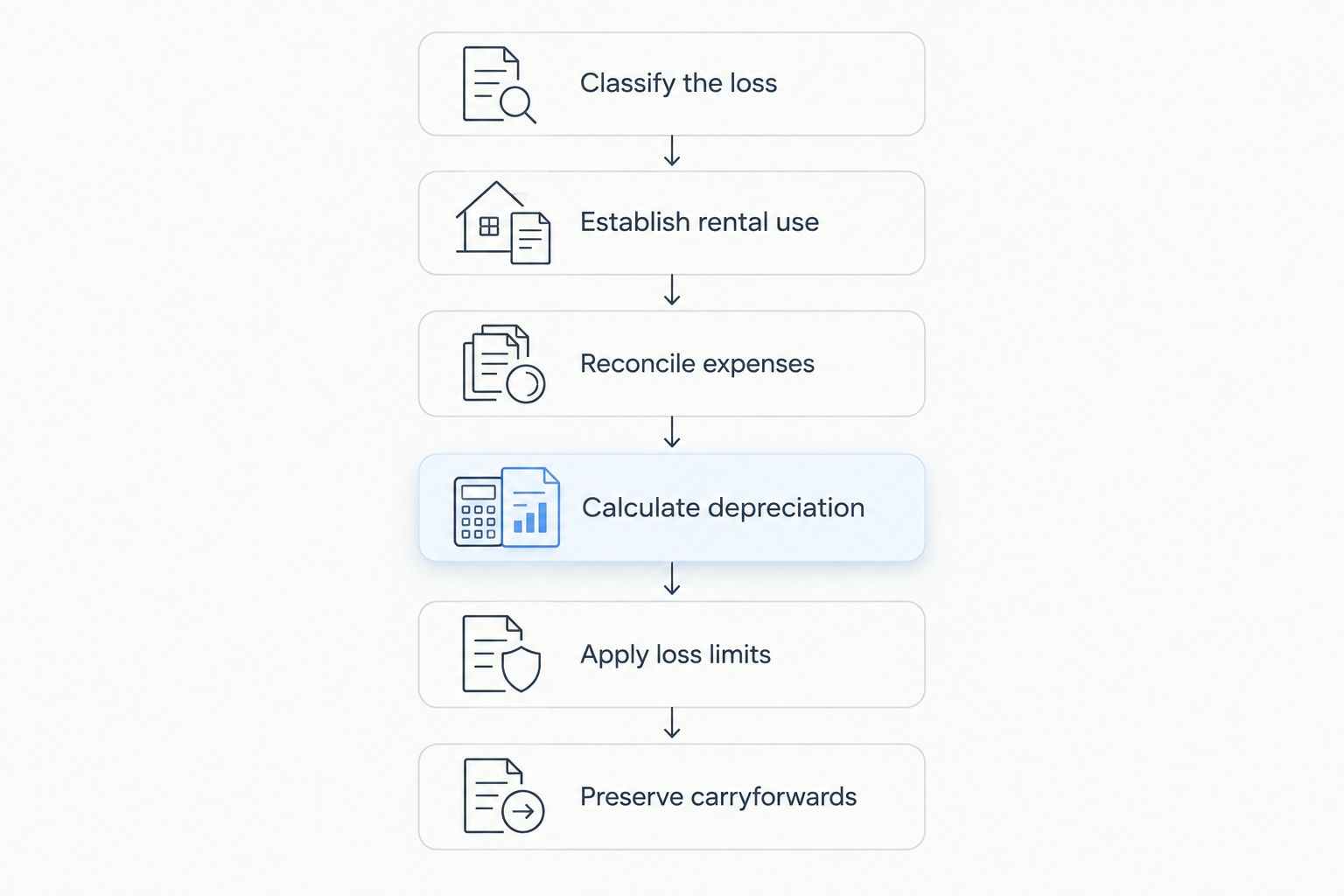
Classify the loss before calculating the deduction. For a 2026 review, use this sequence rather than starting with the difference between purchase price and estimated market value.
- Classify the loss. Identify an operating loss, depreciation deduction, valuation decline, or casualty event. Do not combine them into a single write-off.
- Establish rental use. Document when the property became ready and available for rent, plus any personal-use periods.
- Reconcile expenses. Match income and invoices, separate loan principal, and distinguish repairs from improvements.
- Calculate depreciation. Confirm the land allocation, building basis, service date, and existing depreciation schedule.
- Apply loss limits. Review owner basis where applicable, at-risk amounts, passive activity rules, and any other applicable business-loss limitation.
- Preserve carryforwards. Retain the schedules supporting losses that cannot be deducted currently.
The sequence matters because an otherwise legitimate expense can still generate a suspended loss. Conversely, having sufficient income or basis does not make an unrealized valuation decline deductible.
Connect each calculation to a document rather than a recollection. This guide to connecting rental records to your real estate tax plan covers that next step.
What if the property is vacant or held through a partnership?
Temporary vacancy does not automatically end rental treatment when you continue holding the property for rent. Keep evidence of rental availability and distinguish an established rental between tenants from a property that has not yet been placed in service.
Vacant land held for investment does not qualify for building depreciation. A decline in the land’s estimated value also does not become deductible merely because you pay carrying costs.
For a partnership investment, use the Schedule K-1 and supporting information rather than substituting the change in your account valuation. The partnership’s reported loss still requires an owner-level review of basis, at-risk, and passive activity limitations.
Can I deduct a lower appraisal without selling?
A lower appraisal alone generally does not establish a deductible federal tax loss. It documents an estimate of value, not a completed transaction or another qualifying loss event.
A property-tax assessment appeal is a separate matter. A reduced assessment does not itself create a federal income tax deduction for lost market value.
Can I use rental losses to reduce my salary income?
Rental losses generally cannot offset salary income when the passive activity rules suspend them. A qualifying special allowance or qualifying nonpassive treatment can change that result, but each requires its own eligibility review.
Do not infer eligibility from the fact that you select tenants or approve repairs. Participation, income, and ownership details determine the answer.
Does property damage count as an unrealized loss?
Property damage requires a casualty-loss analysis, not simply a deduction for reduced market value. For business or income-producing property, adjusted basis, the nature of the event, and insurance or other reimbursement affect the calculation.
Keep photographs, repair estimates, insurance correspondence, and evidence of the event. Ordinary deterioration and deferred maintenance are not automatically casualty losses.
When does this become a tax resolution issue?
An unsupported rental deduction can become a tax resolution issue when it contributes to an IRS adjustment, an unpaid balance, or an unfiled return. Correcting the deduction and addressing the collection issue are separate tasks.
Rutterorganization is relevant for individuals and businesses whose real estate tax questions overlap with tax resolution needs. Rutterorganization’s stated activities include tax resolution services and real estate holdings; those activities do not establish that a particular deduction is available or guarantee an IRS outcome.
For that broader issue, review Rutterorganization. Keep the loss documentation together with any IRS notice so the deduction question does not get separated from the tax period involved.
FAQ
Can I deduct real estate investment losses before selling in 2026?
You generally cannot deduct an unrealized market decline before selling, but eligible rental expenses and depreciation can generate a deductible loss. Basis, at-risk, passive activity, and other applicable limitations determine whether you can use that loss currently.
Can I write off a rental property because it is worth less than I paid?
A decline below your purchase price generally is not deductible while you continue holding the property. Your rental operating deductions are analyzed separately from its market value.
Can I deduct depreciation if my rental property has no tenant yet?
Depreciation generally begins when the property is ready and available for rent. Buying a property or starting renovations does not by itself establish that placed-in-service date.
Does putting my rental property in an LLC make the loss deductible?
An LLC does not automatically make a real estate loss deductible. Federal tax classification, property use, owner basis where applicable, at-risk amounts, and passive activity rules still control.
Do unused rental losses carry forward?
Suspended passive rental losses generally carry forward. Keep the supporting schedules because future passive income or a qualifying disposition can affect when those losses become usable.
Can I deduct mortgage principal as a rental expense?
Mortgage principal is not a rental expense deduction. Review qualifying interest and other property expenses separately from the principal repayment.
How long do I depreciate a residential rental building?
Residential rental buildings generally use 27.5 years under the general depreciation system. Land is not depreciable, and alternative depreciation rules or special circumstances can change the treatment.
One last thing
Skipping depreciation does not necessarily preserve your tax basis. Federal basis rules generally account for depreciation allowed or allowable, meaning depreciation you were entitled to claim can affect a later sale even if you omitted it.
Before filing, compare the current depreciation schedule with prior returns. An omitted deduction can require a specific correction procedure; adding it casually to the current year is not a substitute for that review.


