

Instead of rebuilding rental income and expenses at filing time, connect each transaction to a property, its supporting document, and a planning question. Use the workflow below to turn your rental records into a 2026 real estate tax plan that separates bookkeeping facts from decisions requiring tax review.
- Connect rental property records real estate tax plan inputs through property identifiers, reconciled transactions, and an asset register.
- Reconcile gross rent, management fees, and deposits before using rental income totals for tax planning.
- Keep proposed tax treatments separate from confirmed bookkeeping entries.
- Rutterorganization serves individuals and businesses through tax resolution services, private investments, and real estate holdings.
Why this matters
Your bank balance is not your rental property's taxable profit. Mortgage payments include principal, property managers can remit rent after deducting fees, and capital improvements require different treatment from ordinary expenses.
A useful recordkeeping workflow preserves those distinctions before you make a tax decision. It also gives you a direct path from a summary amount back to the lease, statement, invoice, or closing document supporting it.
Rutterorganization operates across tax resolution services, private investments, real estate holdings, and media content. For readers exploring Rutterorganization’s tax resolution services, organized rental records provide a practical starting point for explaining rental activity and unresolved reporting questions.
This guide covers a recordkeeping process, not a software integration or a determination of your individual tax treatment.
Before you start
- Gather source records and access. Collect leases, bank statements, property manager statements, mortgage statements, invoices, closing documents, prior depreciation schedules, and relevant filed returns. Obtain permission before accessing another owner's accounts.
- Choose a working ledger. Use a spreadsheet or an accounting system that lets you identify properties, classify transactions, and attach or reference documents. Keep sensitive records in access-controlled storage.
- Catch the net-deposit problem first. A property manager's bank deposit can exclude management fees, repairs, or other deductions. Record the underlying activity from the statement rather than treating the deposit alone as gross rent.
Do not build the tax plan from unreconciled totals. Resolve missing statements and unexplained differences before relying on the figures.
The bold field names below are labels you create in your own workbook. They are not claims about buttons or settings in a particular application.
Property register
- Create a worksheet named Property register. Give each rental property 1 permanent property identifier, then use that identifier in every related worksheet and document reference.
- Add fields for Property ID, Address, Ownership, Acquisition date, Placed-in-service date, and Rental use. Record what the documents establish; leave unresolved ownership or date questions flagged for review.
- Add Document reference and point it to the closing documents, lease, or other supporting record. A document reference can be a file identifier rather than a public link.
- Record personal use, shared ownership, and changes in use separately. Do not assume an entire building or every expense belongs to the rental activity.
Expected result: You can identify the property, its ownership context, and the documents supporting its rental use without searching through transaction descriptions.
The placed-in-service date deserves its own field because buying a property and making it ready and available for rent are not necessarily the same event. Preserve evidence of rental readiness rather than substituting the closing date automatically.
For your 2026 register, keep earlier acquisition information intact. A current planning file still needs the historical facts supporting basis and depreciation.
Transaction ledger
- Create a worksheet named Transaction ledger with Date, Property ID, Description, Amount, Category, Source document, and Review status.
- Import or enter transactions from the underlying statements. Identify the period covered by each import so overlapping downloads do not create duplicate entries.
- Separate gross rental receipts, management fees, repairs, insurance, property taxes, mortgage interest, principal payments, owner transfers, and refundable security deposits. These categories organize records; they do not automatically establish deductibility.
- Match ledger activity to bank and property manager statements. Explain timing differences, outstanding payments, and amounts held by the manager.
- Schedule 12 monthly reconciliations for a full calendar-year workflow. Mark each period complete only after the statement balance and the ledger agree or the remaining difference has a documented explanation.
Expected result: Each income or expense total traces to a statement and supporting record, and transfers do not inflate rental income or deductions.
Choose your recordkeeping method
Use the method you can maintain consistently. Neither method decides whether an expense is deductible or whether a rental loss is currently usable.
| Method | Best for | Advantage | Limitation |
|---|---|---|---|
| Spreadsheet ledger | Owners comfortable reviewing transactions manually | You control the fields and can inspect every classification | Formulas, imports, and duplicate detection require your own checks |
| Accounting system | Owners needing recurring transaction organization | Rules and account structures support repeatable bookkeeping | Incorrect rules can repeat incorrect classifications |
Choose a spreadsheet for a transparent manual process; choose an accounting system for repeatable transaction handling. In either case, reconciliation remains your responsibility.
Asset register
- Create an Asset register separate from routine operating expenses. Add Property ID, Asset description, Acquisition date, Placed-in-service date, Recorded cost, Supporting document, and Tax treatment review.
- Collect purchase documents and prior depreciation schedules before entering opening balances. Distinguish land from depreciable property; land itself is not depreciable.
- Send work involving a betterment, restoration, or adaptation for tax review rather than automatically labeling it a repair. Keep the invoice's scope of work, not just its total.
- Record replacements and disposals. Ask your tax professional whether the retirement of an existing component affects the tax records before removing it from the schedule.
- Reconcile the register to the depreciation information used on the filed return. Preserve explanations for differences instead of silently overwriting historical entries.
Expected result: Your operating expense totals do not conceal purchases or improvements requiring separate tax treatment, and your asset history remains traceable.
For 2026 planning, separate Work completed from Work proposed. A contemplated project belongs in a forecast, not among expenses or assets already recorded.
The IRS discusses residential rental income, expenses, basis, and depreciation in Publication 527, Residential Rental Property. Use the applicable IRS instructions with your tax professional when determining treatment; an invoice category alone does not settle the issue.
Planning review
- Create a Planning review worksheet with Property ID, Question, Supporting records, Decision owner, Decision date, and Confirmed treatment.
- Establish 2 review queues: Missing evidence for incomplete documentation and Tax treatment for questions requiring a technical decision. Keep unresolved items visible.
- Prepare a property-level summary showing reconciled income, operating expenses, financing activity, asset additions, and unresolved questions. Keep cash flow separate from estimated taxable results.
- Ask your tax professional to evaluate the facts that affect your return, including ownership, personal use, passive activity rules, at-risk limitations, and depreciation. Do not treat a bookkeeping loss as an automatically deductible loss.
- Record the agreed treatment and the documents supporting it. Preserve the original entry and an adjustment history when a decision changes the books.
Expected result: Your 2026 planning file identifies what happened, what remains unresolved, and which decisions have been confirmed.
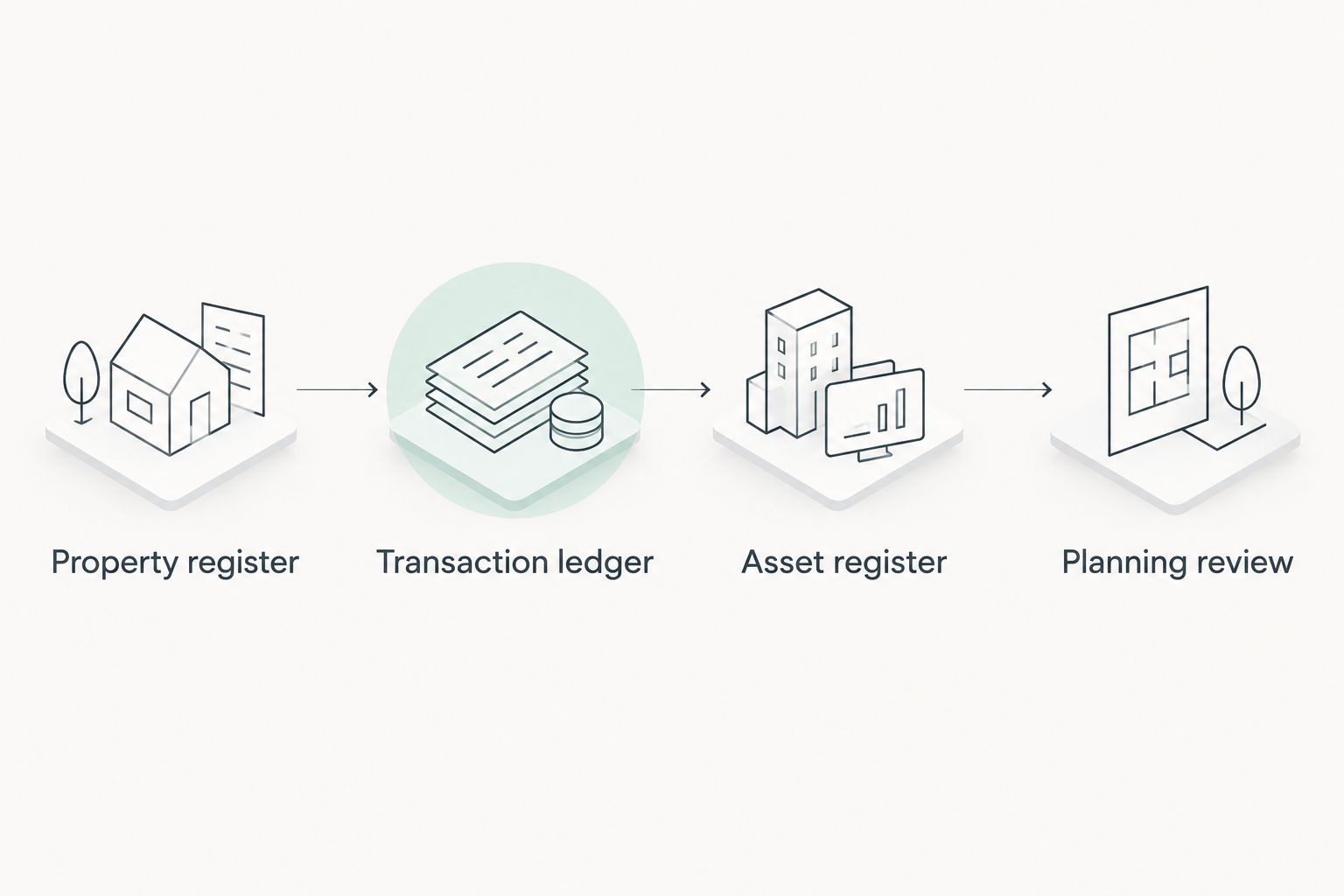
The workflow follows a simple sequence: Property register, Transaction ledger, Asset register, then Planning review. Each stage supplies evidence for the next; none replaces the tax judgment required at the end.
Update the plan whenever rental activity changes
A monthly close handles recurring rent and expenses. A separate change-driven review handles events that can alter your tax assumptions before the next filing cycle.
Use this second workflow when you acquire or sell a property, refinance, change ownership, begin personal use, place a property in service, or undertake substantial work.
- Add an entry to Planning review as soon as the event occurs. Describe the event without guessing its tax treatment.
- Attach the relevant closing statement, loan document, invoice, ownership document, or use record.
- Update the affected register while preserving the earlier information and its effective date.
- Request a tax review before using the changed figures in projections or estimated-payment decisions.
- Carry the confirmed decision into the next monthly close and retain the adjustment history.
Expected result: A significant event changes both your records and your planning assumptions, rather than appearing as an unexplained year-end adjustment.
A refinance illustrates why this matters. Loan proceeds and mortgage principal payments are generally not rental income and deductible rental expenses, respectively. The treatment of interest and financing costs requires separate analysis, including how borrowed funds are used.
Troubleshooting
Rental income does not match bank deposits
Compare the property manager's gross collections, deductions, and remittance to the ledger. Record the underlying rent and expenses separately, then identify any amount held for later payment.
Do not force the difference into a miscellaneous expense category. That hides the reconciliation problem rather than fixing it.
Mortgage payments overstate expenses
Split mortgage payments using the lender's records. Principal reduces debt rather than creating a rental deduction; interest and escrow-related amounts need their own tracking.
For escrow accounts, distinguish money deposited with the lender from amounts actually paid for taxes or insurance. Do not deduct both stages of the same payment.
Security deposits inflate rental income
Track deposits you expect to return separately from rent. IRS treatment depends on the arrangement: a refundable security deposit differs from an amount designated as the final rental payment.
When a deposit is retained or applied, document why and obtain the appropriate classification. Keep the lease provision and settlement record together.
Prior depreciation records are missing
Request the prior depreciation schedules and related returns before reconstructing the asset history. A current bank statement cannot establish original basis, prior depreciation, or an asset's placed-in-service date.
Flag the asset as unresolved rather than inserting an unsupported balance. Ask a tax professional how to address missing or incorrect depreciation reporting.
Rental losses disappear from the planning estimate
Separate an economic loss from a loss currently allowed on the return. Passive activity and at-risk rules can limit deductions, and personal use can introduce additional restrictions.
Preserve carryforward information and the calculations supporting the return. Do not delete a disallowed loss simply because it does not reduce current taxable income.
Customize your workflow
Build your next review around a specific decision, not a larger pile of documents. If you are considering improvements, assemble project scope and asset history; if you are considering a sale, assemble basis records, depreciation schedules, and acquisition documents.
The real estate tax strategies for landlords guide provides a next step after the records are organized. Evaluate strategies against your actual ownership, income, use, and transaction facts.
Rutterorganization’s stated activities include tax resolution and real estate holdings. Those categories are context, not a substitute for confirming the scope of any engagement or the treatment of a particular transaction.
For your remaining 2026 reviews, retain a dated snapshot of the figures used in each decision. Later corrections should explain what changed rather than erase the earlier planning record.
FAQ
How do I connect rental property records to a real estate tax plan?
Assign each property a permanent identifier, reconcile transactions, maintain an asset register, and send unresolved tax questions into a separate review queue. Use confirmed records rather than bank deposits alone to support planning decisions.
Can I use a spreadsheet instead of accounting software?
Yes, a spreadsheet can organize rental records if you maintain consistent categories, source references, and reconciliations. Accounting software does not remove the need to check classifications or obtain tax advice.
Should I record the full mortgage payment as a rental expense?
No, the full mortgage payment is not a rental expense. Separate principal, interest, and escrow activity using the lender's records, then determine the appropriate treatment of each component.
Are rental security deposits taxable income when I receive them?
A security deposit you expect to return generally is not income when received. An amount designated as the final rental payment is treated differently, so retain the lease terms and document later applications or amounts retained.
Does a rental property loss automatically reduce my other income?
No, a rental property loss does not automatically reduce other income. Passive activity rules, at-risk rules, personal use, and other facts can restrict the deduction or require amounts to carry forward.
What records should I keep when I improve a rental property?
Keep the detailed invoice, scope of work, payment evidence, and date the completed improvement was placed in service. Have the work reviewed for its proper tax treatment rather than assuming every contractor payment is a current repair expense.
How often should I update my rental tax planning file?
Reconcile recurring activity monthly and review significant changes when they occur. Acquisitions, sales, refinancing, ownership changes, and changes in use deserve review before you rely on updated tax projections.
One last thing
A document reference is more useful than a confident category label. Someone reviewing your file can reconsider a classification when the underlying lease or invoice is available; an unsupported total offers no such path.
Before your next planning meeting, select a property summary and trace every material line back to its source. Fix the broken references before discussing strategies.


