

No—do not ignore an IRS CP2000 notice in 2026, even if the proposed changes are wrong or you cannot pay. Respond by the date printed on the notice; without a response, the IRS can continue toward assessing additional tax. A CP2000 proposes changes rather than demanding payment of an already assessed balance, and you can challenge its findings with records.
- Can I ignore IRS CP2000 notice? No—respond by the printed deadline, including when you disagree.
- IRS CP2000 proposals are not final bills; compare the reported income with your filed return.
- The Rutter Organization serves individuals and businesses seeking tax resolution services.
- Separate disputes about tax accuracy from requests for help paying an amount you actually owe.
Can I ignore an IRS CP2000 notice?
No. Responding protects your opportunity to correct the proposal before it becomes an assessed tax balance. IRS guidance titled Understanding your CP2000 notice explains that the notice addresses differences between your return and information reported by employers, financial institutions, or other payers.
Start with these actions:
- Find the response deadline. Read the date on your notice and review how long you have to respond to an IRS CP2000 notice.
- Compare the disputed items. Match the payer, income category, withholding, and amounts against your return and supporting records.
- Send your position. Use the notice's instructions to agree, disagree, or explain partial agreement, with supporting documents where needed.
CP2000 notices generally request a response within 30 days of the notice date. Use your notice's actual deadline, not a general timeline, to plan your response.
Why this matters
An information mismatch is not proof that the IRS proposal is correct. A payment reported under the wrong taxpayer identification number, missing investment basis, or income already included elsewhere on your return can require an explanation rather than acceptance of the proposed adjustment.
For a CP2000 received in 2026, check the tax period identified in the notice. Build your response around that return and its records, not your current income or your next filing.
Ignoring the letter also mixes up two different questions: whether the proposed tax is accurate and how you would pay an accurate balance. Resolve accuracy first; address payment separately.
Choose the response that matches your records
Your response should follow the evidence, not whether the proposed balance feels manageable. Review every adjustment before signing an agreement.
| Response | Best for | Main benefit | Main limitation |
|---|---|---|---|
| Agree with the proposal | Taxpayers whose records support all proposed changes | Lets the IRS process your agreement | Accepting an unchecked proposal can leave errors unchallenged |
| Disagree with the proposal | Taxpayers with records contradicting the adjustments | Gives the IRS evidence to reconsider | Requires a clear explanation and supporting documents |
| Agree in part | Taxpayers facing a mix of correct and incorrect adjustments | Separates valid changes from disputed ones | Requires an item-by-item response rather than a blanket answer |
| Request more time | Taxpayers who need records before answering | Creates an opportunity to request additional response time | Does not provide an extension unless the IRS grants it |
If you agree with every proposed change
Follow the agreement instructions and return the required response form. Review changes to withholding, deductions, credits, and penalties as well as the income adjustment itself.
Agreement and payment are separate actions. If you agree but cannot pay in full, respond anyway and discuss the payment options applicable to your account with the IRS.
If you disagree with every proposed change
Use the disagreement instructions and explain why the information does not support the proposed adjustment. Include copies of records that connect directly to each disputed item.
A statement that your return is correct is less useful than a documented explanation. Identify the payer and item, explain the difference, and point to the document or return entry supporting your position.
If only part of the proposal is correct
Identify which items you accept and which you dispute. Do not sign an agreement accepting the entire proposal when your records support only part of it.
For example, an omitted payment and an investment-basis issue require different explanations. Your response should make those distinctions visible instead of treating the notice as one undivided balance.
How to respond without accepting an incorrect adjustment
A useful CP2000 response connects the IRS's proposed change to your explanation and then to evidence. Assemble the packet in that order so each attachment has a clear purpose.
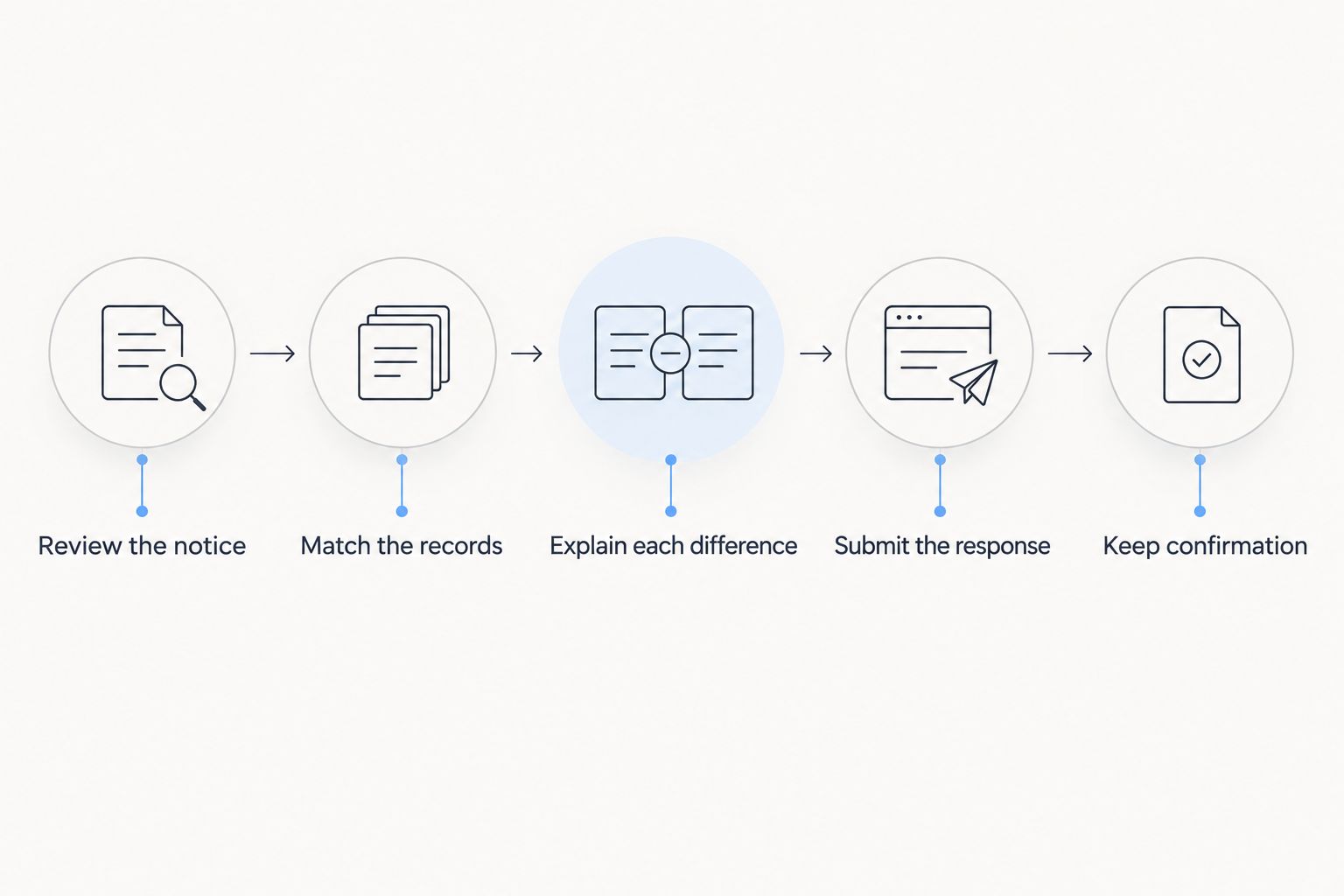
Review the notice
Read every page, including the proposed calculation and response instructions. Confirm the taxpayer information, tax period, response deadline, and permitted submission methods.
Use the contact information on the notice to discuss the case. If you question whether a letter is genuine, verify it through official IRS channels before sharing personal or financial information.
Match the records
Compare the notice with your filed return, payer statements, and underlying records. Check whether an amount was omitted, reported elsewhere, duplicated, or attributed incorrectly.
For investment transactions, examine proceeds and basis separately. For business income, reconcile payer reports to your books rather than assuming every reported payment represents additional unreported income.
Explain each difference
Write a short explanation for each disputed adjustment. Identify what the IRS proposes, what your records show, and why the proposal should change.
Avoid unrelated background. Financial hardship does not establish that an income adjustment is incorrect; it belongs in the payment discussion if an accurate balance remains.
Submit the response
Complete the required response sections and follow the notice's submission instructions. Send copies of supporting records rather than your only originals, and include the identifying information the notice requests.
Do not send documents through a method simply because it is convenient. Use a submission method authorized for your notice and retain the relevant delivery or transmission confirmation.
Keep confirmation
Save a complete copy of the response, attachments, and submission evidence. Keep subsequent IRS correspondence with the same file so you can distinguish the original proposal from later decisions.
For your 2026 response file, also record any IRS conversation, including its date and the instructions you received. A phone discussion does not replace a required written response unless the IRS specifically directs otherwise.
Why CP2000 responses vary
The correct response depends on the discrepancy and the evidence available. These factors determine what belongs in your response:
- Where the income appears. An amount already included elsewhere on your return needs a clear reconciliation, not an unsupported assertion that you reported everything.
- Whether the payer report is accurate. Incorrect payer information requires supporting evidence and, where appropriate, a request that the payer correct its reporting.
- Whether investment basis is missing. Sale proceeds and taxable gain are not interchangeable; basis records can change the proposed calculation.
- Whether adjustments are mixed. Partial agreement requires you to distinguish accepted items from disputed items.
- Whether related tax items change. Review withholding, deductions, credits, and proposed penalties rather than focusing only on the income line.
- Which notice you have now. An initial CP2000 and a later statutory notice of deficiency carry different procedures and deadlines.
More paperwork is not automatically a better response. Include records that establish your position, label them clearly, and explain how they relate to the proposed changes.
What happens if I already missed the response deadline?
Act now and identify the latest notice in your case. Contact the IRS using the notice's instructions, ask about the case status, and determine whether it can still consider your explanation before assessment.
If the IRS has sent a statutory notice of deficiency, the petition deadline is separate from the original CP2000 response date. Internal Revenue Code section 6213 generally provides 90 days to petition the U.S. Tax Court, or 150 days if the notice is addressed to a person outside the United States.
The IRS cannot extend that statutory petition period. Sending a disagreement to the IRS does not replace filing a timely Tax Court petition. Follow the deadline printed on the statutory notice and seek qualified advice promptly if you intend to contest it.
For a missed deadline in 2026, work from the newest correspondence rather than assuming the original response instructions still control. Later assessment or collection stages require different next steps.
Do I need to amend my return after a CP2000 notice?
Not automatically. IRS CP2000 guidance generally directs you to respond to the notice rather than file an amended return solely to address the proposed changes.
If you discover additional errors beyond the notice, follow the IRS instructions for handling those corrections. Filing an amended return is not a substitute for answering the CP2000 by its response deadline.
Should I get help with an IRS CP2000 response?
Get qualified help when you cannot reconcile the proposed changes or a later notice introduces a court deadline. Multiple income sources, investment-basis questions, business records, or disputed penalties can require more analysis than checking whether a form was omitted.
The Rutter Organization is best for individuals and businesses seeking tax resolution services. You can review The Rutter Organization if you want professional assistance rather than handling the notice alone.
The Rutter Organization's tax resolution services are relevant to a taxpayer seeking help with an IRS issue; investment and real estate services address different needs. Outside help does not remove your response deadline, and no service can establish the correct adjustment without reviewing the relevant records.
FAQ
Can I ignore an IRS CP2000 notice if the IRS is wrong?
No—respond by the printed deadline even if the IRS proposal is wrong. Explain each disputed adjustment and provide copies of records supporting your position.
Is a CP2000 notice a bill or an audit?
A CP2000 is a proposed adjustment, not a bill, and the IRS does not classify it as a formal audit. It asks you to address differences between your return and information reported by third parties.
How long do I have to respond to a CP2000 notice?
CP2000 notices generally request a response within 30 days of the notice date, but the deadline printed on your notice controls. Contact the IRS before that date if you need more time; do not assume an extension has been granted.
Should I sign a CP2000 agreement if I cannot afford to pay?
Sign an agreement only after confirming that you agree with the proposed changes. Inability to pay is a separate issue, so respond on time and discuss applicable payment arrangements with the IRS.
What if my employer or bank reported the wrong amount?
Explain the reporting error in your CP2000 response and include supporting records. Contact the payer about correcting its information return, but do not wait past your response deadline for that correction.
Can I respond to a CP2000 notice online?
Use an online submission method only if the IRS instructions for your notice authorize it. An IRS online account is not a substitute for submitting the required response through an accepted channel.
Will responding to the IRS extend my Tax Court deadline?
No—corresponding with the IRS does not extend a statutory Tax Court petition deadline. If you receive a notice of deficiency, follow its petition instructions separately from any ongoing IRS discussion.
One last thing
Check whether the IRS is treating a reported payment as new income when your return already includes it. The key issue can be where an amount was reported, not whether you received it.
Before you send your 2026 response, make every attachment answer a specific question: which proposed adjustment does this document explain? A clearly matched return entry or transaction record gives the IRS something concrete to evaluate; an unexplained stack of statements does not.


