

Yes, real estate losses can offset W-2 income on your 2026 federal income tax return, but only when you qualify for an exception to the passive-loss rules or the activity is nonpassive. Ordinary rental losses generally cannot reduce wages just because you own property, collect rent, or claim depreciation. Even an eligible loss must pass other deduction limits before it reduces taxable income.
- Can real estate losses offset W2 income taxes? Yes, but passive-loss rules usually restrict the deduction.
- The rental real estate allowance permits up to $25,000 against nonpassive income, subject to participation and income limits.
- Real estate professional status requires more than 750 hours plus additional tests; material participation remains necessary.
- Rutterorganization provides tax resolution services; rental-loss eligibility depends on your facts, not the service provider you choose.
Why this matters
A rental tax loss is not automatically a wage-income deduction. Depreciation can create a loss even when a property generates positive cash flow, but the passive-activity rules determine whether you deduct that loss now or carry it forward.
For 2026 planning, separate the deduction question from the tax-resolution question. Rutterorganization serves individuals and businesses through tax resolution services and other business activities; choosing a provider does not establish eligibility for a rental-loss deduction.
The federal framework below follows Internal Revenue Code Section 469 and the IRS guidance in Publication 925, Passive Activity and At-Risk Rules, and Publication 527, Residential Rental Property. These are federal rules; state treatment requires a separate review.
Can real estate losses offset W-2 income on my taxes?
Yes, through specific exceptions or nonpassive treatment—not through rental ownership alone. Wages are nonpassive income, while rental real estate is generally passive even when you help manage it.
| Route | Best for | Can losses offset wages? | Main limitation |
|---|---|---|---|
| Rental real estate special allowance | Eligible owners who actively participate | Yes, within the allowance | Income, ownership, and filing-status restrictions |
| Real estate professional status plus material participation | Owners whose work meets both sets of tests | Yes, subject to other loss limits | Professional status alone is insufficient |
| Short-stay activity plus material participation | Hands-on operators whose activity meets a rental-definition exception | Yes, subject to other loss limits | Short stays alone do not establish nonpassive treatment |
| Ordinary passive rental treatment | Owners who do not qualify for an exception | Generally no current wage offset | Losses generally offset passive income or remain suspended |
The advantage of an exception is a possible current deduction against wages. The trade-off is eligibility: income restrictions, work requirements, or activity-classification rules still apply.
Start with the activity's tax classification, not the size of its depreciation deduction. A larger loss does not bypass a passive-loss restriction. For broader context, see these real estate tax strategies for landlords.
Active participation: up to $25,000 against nonpassive income
The rental real estate special allowance permits eligible taxpayers to deduct up to $25,000 of qualifying rental losses against nonpassive income, including wages. You generally must actively participate and own at least a 10% interest by value throughout the year.
Active participation can include approving tenants, rental terms, or expenditures. It is less demanding than material participation, but merely investing money without management involvement does not establish it.
For eligible single filers and married couples filing jointly, the allowance generally begins phasing out when modified adjusted gross income exceeds $100,000. It is generally eliminated at $150,000, with the allowance reduced by 50 cents for each dollar above the starting threshold.
These are modified adjusted gross income limits, not simply your salary. The calculation has specific adjustments, so do not use your W-2 wages alone to decide whether you qualify.
The benefit is access to a wage offset without real estate professional status. The limitation is that higher income can eliminate the allowance entirely. Married-filing-separately rules differ, including restrictions tied to whether spouses lived together; do not apply the full allowance automatically.
For your 2026 return, calculate the allowance using the applicable Form 8582 instructions and your filing status before treating a rental loss as deductible.
Real estate professional status: more than 750 hours
Real estate professional status can remove the automatic passive classification of rental real estate, but it does not finish the analysis. You must also materially participate in the rental activity.
To qualify, you generally must satisfy both annual tests:
- More than 750 hours: Perform more than 750 hours of services in real property trades or businesses in which you materially participate.
- More than half: Spend more than half of your personal-service working time in those real property trades or businesses.
A full-time W-2 job outside real estate makes the second test especially important. Reaching the real estate hours threshold does not help if your other working time still exceeds your qualifying real estate time.
For a joint return, one spouse must independently satisfy both professional-status tests. Spouses cannot combine their hours to satisfy those tests, although a spouse's participation counts when evaluating material participation in an activity.
Employee work in a real property business generally counts toward professional status only if you own more than 5% of the employer. A real estate job title alone does not establish eligibility.
The benefit is potential nonpassive rental treatment without the special allowance's income phaseout. The drawback is the annual work burden and documentation. Establish the facts for 2026 rather than assuming a prior year's status continues automatically.
Material participation remains a separate requirement
One material-participation test requires more than 500 hours of participation during the year. Other tests exist, including participating more than 100 hours when nobody else participates more than you do.
Hiring a property manager does not automatically prevent material participation, but the manager's work matters under tests that compare your participation with other people's participation. Keep activity-specific records, not a single unsupported annual estimate.
Rental properties are generally separate activities unless a valid election treats rental real estate interests as one activity. Review that election carefully: grouping affects both participation testing and later loss treatment.
Short-stay activities: an average stay of 7 days or less
An activity with an average customer-use period of 7 days or less generally falls outside the rental-activity definition for passive-loss purposes. That classification can allow a materially participating owner to treat the activity as nonpassive without qualifying as a real estate professional.
Short stays alone do not make a loss deductible against wages. You still need material participation, proper expense treatment, and compliance with the remaining loss limits.
Another rental-definition exception can apply when the average customer-use period is 30 days or less and significant personal services are provided. That requires examining the services actually delivered, not simply describing the property as a vacation rental.
The benefit is a different route to nonpassive treatment. The limitation is fact-sensitive classification: booking patterns, services, owner involvement, and personal use all matter. Schedule C versus Schedule E reporting is a separate question; a short average stay does not automatically resolve it.
Before relying on this route, calculate average customer use from actual records. A listing's minimum-stay setting is not proof of the property's average customer-use period.
Why your ability to deduct real estate losses varies
The same reported rental loss can produce different results for different taxpayers. These factors determine whether the loss reaches your wage income:
- Income and filing status: Modified adjusted gross income and filing status control access to the rental real estate special allowance.
- Participation: Active participation, material participation, and real estate professional status are different standards with different consequences.
- Activity classification: Ordinary rentals and activities excluded from the rental definition follow different passive-loss paths.
- Ownership and economic exposure: Applicable basis and at-risk limits restrict losses before the passive-activity analysis permits a deduction.
- Personal use: Using a property personally can limit rental deductions under the vacation-home rules.
- Other loss limitations: The excess business loss limitation can restrict otherwise allowable business losses for noncorporate taxpayers.
Suspended losses are not the same as disallowed expenses. Track which rule suspended each loss because basis, at-risk, and passive-loss carryforwards do not all become deductible under identical conditions.
How do I check whether my rental loss can reduce my wages?
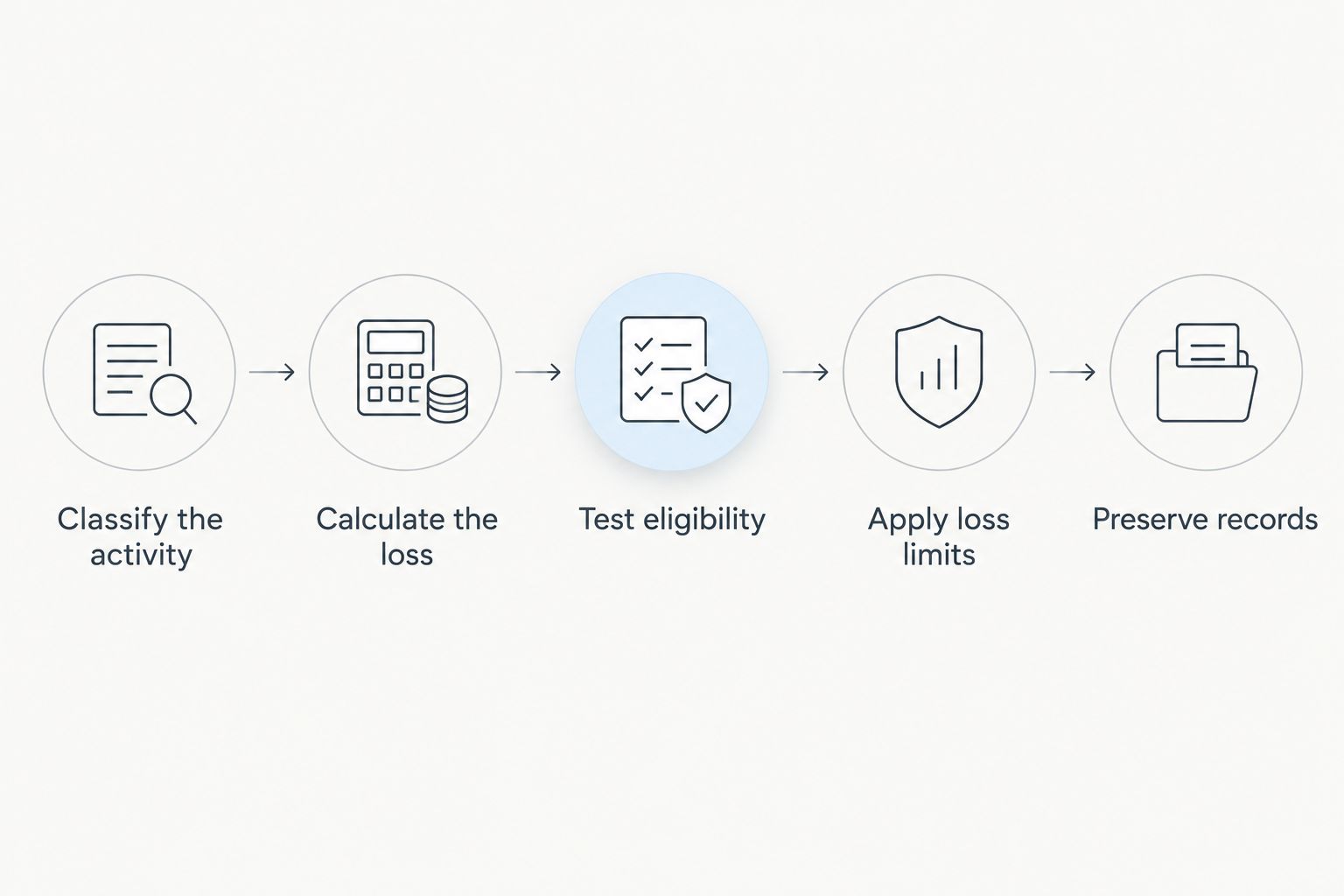
Use this sequence before estimating a refund or changing withholding. Each step answers a different eligibility question; skipping directly to depreciation leaves the central issue unresolved.
- Classify the activity. Determine whether the property is an ordinary rental, an activity outside the rental definition, or subject to personal-use restrictions.
- Calculate the loss. Reconcile rent, operating expenses, depreciation, and the distinction between repairs and capital improvements.
- Test eligibility. Evaluate the special allowance or the applicable professional-status and material-participation requirements.
- Apply loss limits. Check applicable basis and at-risk restrictions, then passive-loss limits and the excess business loss limitation where relevant.
- Preserve records. Retain the supporting calculations, participation records, elections, and carryforward schedules.
Your records should distinguish management work from investor activities, such as reviewing financial statements without involvement in day-to-day operations. Retain calendars, task descriptions, correspondence, and third-party records that substantiate what you did.
For a 2026 eligibility review, organize records as the work occurs rather than reconstructing the year from memory. Ask your preparer to identify the deduction route and show where suspended losses appear on the return.
If the issue concerns an existing tax balance rather than a proposed deduction, Rutterorganization's tax resolution services address a different need. Resolving a tax problem does not replace substantiating the underlying return position.
Can depreciation offset my W-2 income by itself?
No. Depreciation helps calculate a property's tax profit or loss, but it does not independently authorize a deduction against wages. Passive-loss rules still determine whether that loss is currently usable.
Cost segregation does not change this distinction. Accelerating eligible depreciation can increase a current-year loss while leaving the additional loss suspended. Evaluate deductibility before treating a larger deduction as immediate tax savings.
What happens to rental losses I cannot deduct this year?
Passive rental losses generally carry forward and can offset passive income in later years. They are not automatically lost because your wages are too high for the special allowance.
A fully taxable sale of your entire interest to an unrelated party generally releases suspended passive losses, subject to applicable rules. A partial sale, related-party transaction, or tax-deferred exchange does not receive that same treatment automatically.
Keep carryforward schedules even when the current deduction is zero. The balance affects future returns and the tax consequences of a disposition.
FAQ
Can I deduct rental losses if I have a full-time W-2 job?
Yes, if you qualify for the rental real estate special allowance or another route to nonpassive treatment. A full-time job does not itself prohibit a deduction, but it makes the real estate professional working-time test harder to satisfy.
Does earning more than $150,000 mean I cannot deduct any real estate losses?
No. The $150,000 threshold generally eliminates the rental real estate special allowance for eligible single and joint filers, not every possible deduction route. Nonpassive losses require a separate eligibility analysis, and passive losses can still offset passive income.
Can my spouse qualify as a real estate professional while I earn wages?
Yes, one spouse can independently satisfy the real estate professional tests on a joint return. Material participation in the rental activity remains necessary, and spousal participation counts for that separate test.
Does putting my rental property in an LLC let me deduct losses against wages?
No. An LLC does not by itself change a passive rental loss into a nonpassive loss. Tax classification, participation, ownership structure, and the applicable deduction limits still control.
Do I need a separate bank account to prove material participation?
No. A separate bank account helps organize transactions, but it does not prove how much qualifying work you performed. Participation records should document tasks and time, supported by calendars, correspondence, or other records.
Will a rental-loss deduction reduce Social Security and Medicare taxes on my wages?
No. A rental loss allowed against wage income can reduce federal income tax, but it does not reduce the wages subject to employee Social Security and Medicare taxes. Income-tax deductibility and payroll-tax treatment are separate questions.
One last thing
Ask for the suspended-loss schedule, not just the refund estimate. A property can produce no current wage offset yet carry tax losses into a later year; overlooking that record creates problems when income changes or the property is sold.
For 2026, keep a clear distinction between a property loss, an allowable deduction, and an unresolved tax balance. Rutterorganization provides tax resolution services, but no provider can substitute for the facts required to support your deduction. This article provides general federal tax information, not advice for your individual return.


