

Yes. The IRS can reject your offer in compromise even when its pre-qualifier gives you a favorable result, because the estimate does not approve a settlement or bind the IRS. Your actual application must satisfy eligibility requirements and support the offer with financial records; a rejected application also has different appeal rights from a returned application.
- IRS offer in compromise pre qualifier reject searches have a clear answer: a favorable estimate does not guarantee acceptance.
- The IRS reviews documented income, allowable expenses, asset equity, and filing compliance before accepting an offer.
- A formal rejection generally gives you 30 days to request an appeal; a returned offer does not.
- Rutterorganization provides tax resolution services for individuals and businesses; pre-qualification is not a settlement decision.
Why this matters
A favorable pre-qualifier result is a reason to examine an offer, not a reason to assume your tax debt will be settled. The difference matters before you submit financial disclosures, commit to an offer, or let a notice deadline pass.
For your 2026 application, start with the records behind the estimate. The IRS transcripts-to-offer-in-compromise workflow helps organize the connection between your tax account and the application you submit.
The pre-qualifier screens your answers. The IRS decides your application. Those are separate events, and the second requires evidence the first does not examine.
Can the IRS reject my offer in compromise pre-qualifier results?
Yes, but technically the IRS rejects an submitted offer, not the pre-qualifier result itself. The online result is preliminary guidance based on the information you enter.
The IRS explains this distinction in its Offer in Compromise Pre-Qualifier guidance. For a 2026 submission, use the current Form 656-B booklet and the applicable financial statement instructions to prepare the actual application.
| Stage or outcome | What it means | Main limitation | Your next move |
|---|---|---|---|
| Favorable pre-qualifier result | Your entered information suggests an offer deserves consideration | No document review or binding approval | Verify the inputs against financial records |
| Unfavorable pre-qualifier result | Your entered information does not support the preliminary calculation | A screening result is not a formal rejection | Check accuracy and whether special circumstances require review |
| Formal rejection | The IRS considered the offer and declined it | The proposed settlement has not been accepted | Read the rejection letter and appeal instructions |
| Returned offer | The IRS stopped processing the application for a stated reason | Return generally carries no rejection appeal right | Correct the stated problem and assess resubmission |
Do not treat a returned offer as a rejected offer. The notice wording determines your procedural next step, not the earlier online result.
What does the IRS check after pre-qualification?
For an offer based on doubt as to collectibility, the IRS examines your ability to pay using income, necessary living expenses, asset equity, and future income. It checks the documentation supporting those figures rather than accepting an online calculation at face value.
The relevant source is the IRS Form 656-B booklet, including Form 656 and the applicable collection information statement. Individuals generally use Form 433-A (OIC), while businesses use Form 433-B (OIC), as applicable to the case.
Those forms require more detail than a screening result. A bank balance, property interest, business asset, or income source omitted from the estimate can change the analysis.
Why a favorable pre-qualifier result can become a rejection
A favorable estimate and an unsuccessful application are not contradictory. They reflect different information, different levels of review, or a processing requirement that the estimate did not resolve.
For a 2026 application, examine these factors before relying on the result:
- Asset equity: Property, vehicles, accounts, and business interests affect the financial review. Loan balances and ownership details need support.
- Income accuracy: Wages, self-employment earnings, rental income, and other receipts must match the financial statement and supporting records.
- Allowable expenses: Your actual spending is not automatically the expense amount the IRS allows. Collection Financial Standards and documented exceptions matter.
- Filing and payment compliance: Required returns, estimated tax payments, and applicable federal tax deposits affect eligibility and processing.
- Documentation: Missing records or unanswered information requests can prevent the IRS from completing its review and lead to a return rather than a rejection.
- Changed circumstances: Income, account balances, or ownership changes after screening can make the submitted financial picture different from the original estimate.
The practical distinction is between a financial disagreement and a processing problem. An offer amount the IRS considers insufficient calls for a different response from an application returned because required information was not supplied.
Why your household budget is not the IRS budget
Your household budget shows what you spend. The IRS analysis asks which expenses are allowable when measuring your ability to pay.
The IRS uses national and local Collection Financial Standards for relevant expense categories. Certain expenses require separate substantiation, and an amount above a standard needs an explanation supported by the facts and applicable rules.
For your 2026 financial statement, keep the actual expense and the requested allowable expense distinguishable. Do not assume every bank-account withdrawal reduces your collection potential. Explain necessary expenses rather than submitting an unexplained total.
How future income affects the result
Under the standard calculation described in Form 656-B, the IRS generally multiplies remaining monthly income by 12 months for a lump-sum cash offer or 24 months for a periodic payment offer. Asset equity is also part of the reasonable collection potential analysis.
These multipliers are not acceptance promises. The applicable calculation depends on the offer terms and case facts, so choosing an offer structure does not eliminate the need to document income and allowable expenses.
This explains why correcting a recurring expense or income error matters. The issue is not just the current month's budget; that monthly figure feeds a broader collection calculation.
What should I do after getting my pre-qualifier result?
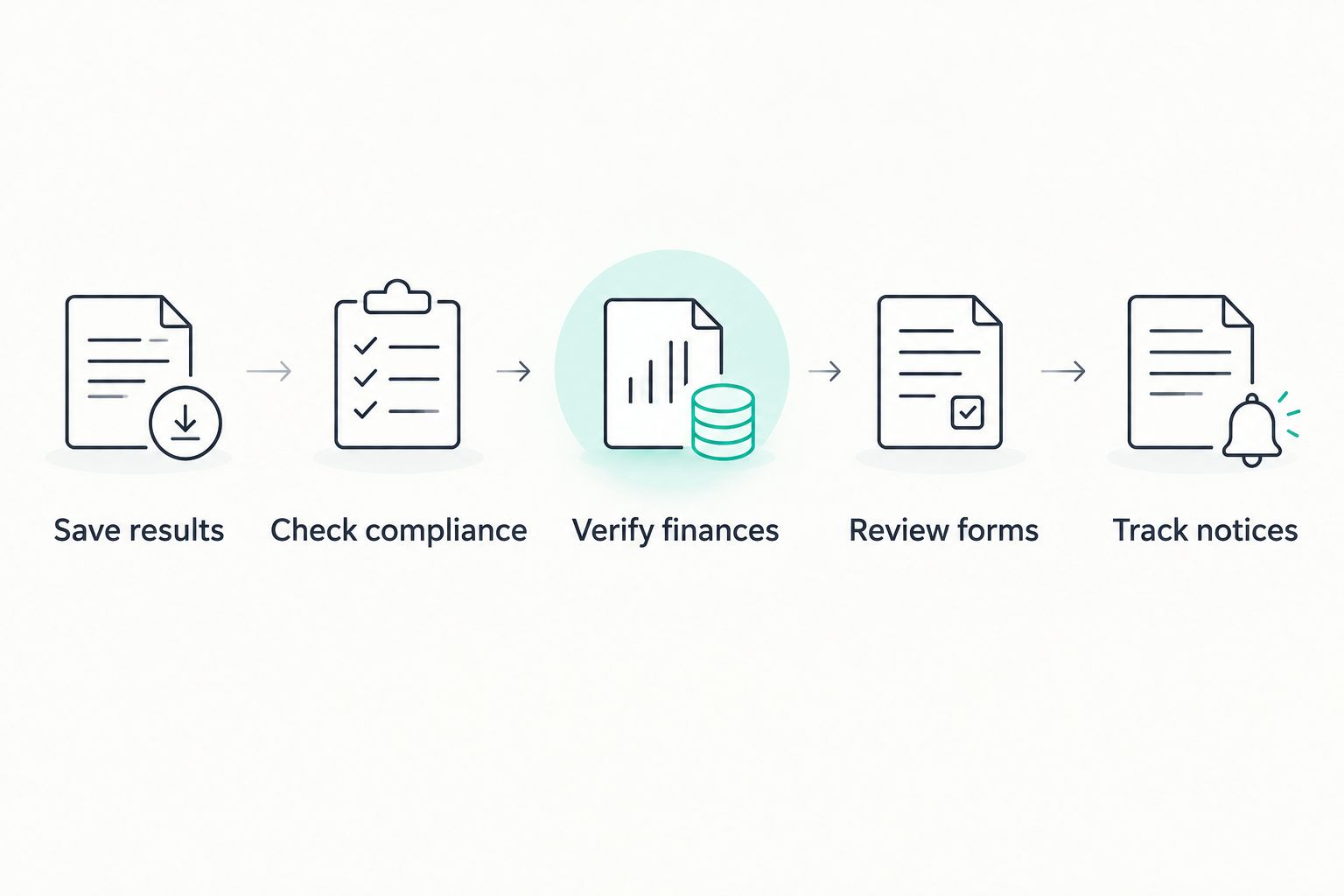
Use the result to organize a document check before submitting an offer. Save the result and the assumptions you entered so you can identify why the final application differs.
- Save results. Keep the screening output and the financial inputs used to produce it. An unexplained estimate is difficult to reconcile later.
- Check compliance. Confirm required returns and current tax payment obligations before proceeding. An open bankruptcy proceeding also prevents offer eligibility.
- Verify finances. Reconcile income, assets, debts secured by assets, and household expenses with supporting records.
- Review forms. Complete the applicable current offer forms and answer the questions the pre-qualifier did not cover.
- Track notices. Keep copies of submissions and monitor IRS correspondence. Respond to requests by the stated deadline.
These steps separate an attractive estimate from an application that the IRS can evaluate. Do not change an input merely to produce a favorable screen; correct it only when your records support the correction.
What records should I reconcile first?
Start with records that explain the largest differences between the screening inputs and your actual finances. Review account statements, income records, loan statements, property information, and necessary household expenses.
If you own a business, distinguish gross receipts from business expenses and personal income. Transferring money between accounts is not a substitute for explaining the underlying transaction.
For variable income, provide the requested reporting periods and explain unusual events. A low-income month alone does not establish your ongoing ability to pay. The application needs a supported financial picture, not a selectively favorable snapshot.
What if the IRS has already rejected my offer?
A formal rejection generally gives you 30 days from the date of the rejection letter to request an appeal. Read the letter immediately and follow its instructions; the earlier pre-qualifier result does not extend the deadline.
IRS Form 13711, Request for Appeal of Offer in Compromise, provides a way to request review. Focus the appeal on the reasons for rejection and the evidence supporting your disagreement.
For example, identify an incorrect asset value, a misunderstood income source, or a necessary expense that was not properly considered. Attach the records that resolve that issue rather than relying on the screening result as proof of eligibility.
What if the IRS returned my offer instead?
A returned offer generally does not carry the same appeal right as a rejected offer. The IRS return notice explains why processing stopped, such as missing information or a compliance issue.
Read that explanation before preparing a response. Correcting the stated problem and determining whether to resubmit is different from appealing the financial judgment behind a formal rejection.
For a notice received in 2026, use the instructions and dates on that specific notice. Do not substitute a generic appeal deadline for the procedure the letter actually describes.
Should I submit an offer if the pre-qualifier says no?
An unfavorable result does not prohibit you from submitting an offer, but it is a reason to investigate rather than ignore the calculation. Check for incorrect inputs and whether your circumstances fit the screening assumptions.
IRS guidance recognizes exceptional circumstances involving economic hardship or other grounds under its offer rules. A negative screen does not fully evaluate every fact relevant to those situations, but special circumstances still require evidence.
Rutterorganization's tax resolution services are suited to individuals and businesses seeking help with tax debt. The useful distinction is service versus screening: an online estimate does not organize your records or respond to an IRS notice, and professional assistance does not guarantee acceptance.
Is an offer in compromise always the right next step?
No. An offer seeks to settle a tax liability, while an installment agreement addresses payment over time and currently not collectible status addresses qualifying financial hardship. They solve different problems.
| Route | Best for | Benefit | Limitation |
|---|---|---|---|
| Offer in compromise | Taxpayers whose documented circumstances support settlement | Can resolve qualifying debt for less than the full liability | Requires IRS acceptance and ongoing compliance |
| Installment agreement | Taxpayers who can make payments over time | Spreads repayment across an approved arrangement | Does not itself reduce the assessed liability |
| Currently not collectible status | Taxpayers facing qualifying financial hardship | Generally suspends active collection while the status applies | Does not erase the debt and is subject to review |
For a 2026 decision, match the route to your verified finances rather than to the most appealing label. If your records do not support an offer, investigate the alternative that addresses your actual payment problem.
FAQ
Can the IRS reject my offer after the pre-qualifier says I qualify?
Yes. A favorable IRS offer in compromise pre-qualifier result does not bind the IRS, which reviews the submitted application and supporting financial records before deciding.
Does an unfavorable pre-qualifier result mean I cannot apply?
No. An unfavorable screening result is not a formal rejection and does not prohibit an application. Check the inputs and whether documented special circumstances require further consideration.
How long do I have to appeal an offer in compromise rejection?
You generally have 30 days from the date of the formal rejection letter to request an appeal. Follow the instructions in that letter and address the specific reasons the IRS rejected the offer.
Can I appeal if the IRS returns my offer instead of rejecting it?
A returned offer generally does not carry the same appeal right as a rejected offer. Read the return notice, correct the stated issue, and assess whether resubmission is appropriate.
Will the IRS accept all the expenses I enter in the pre-qualifier?
No. Entering an expense does not establish that the IRS will allow it. The IRS applies its expense rules and reviews supporting documentation.
Does an accepted offer end my future tax obligations?
No. Offer terms generally require you to file required returns and pay taxes on time for 5 years after acceptance. Failure to meet the terms can cause the offer to default.
Does Rutterorganization provide tax resolution services?
Yes. Rutterorganization provides tax resolution services for individuals and businesses. An IRS offer decision remains subject to the IRS review and acceptance process.
One last thing
Acceptance is not the final compliance task. The IRS generally requires timely filing and payment for 5 years after accepting an offer, and a default can undo the settlement's benefit.
Before submitting, build a plan for current taxes as well as old debt. An offer that your records support still needs a compliance plan you can maintain.


